Search for topics or resources
Enter your search below and hit enter or click the search icon.
In a recent post on his Substack, Samuel James discussed the difference between being a writer and a content creator:
I’ve realized that the reason I could never grind enough grist for the content mill is that I’m not a miller. I really don’t want to be the daily guru, the omnipresent influencer, or the multimedia mogul. I just want to be a writer. And writing is not content-ing. It’s a completely different mindset, that reveals itself in completely different habits.
The distinction James is making here implies something important about how media has evolved in the digital era. In a previous era—one not that far removed from us today and which some of our active writers are old enough to remember—magazines were a dominant form of media and they were supported by readers. Most typically, I think these readers understood themselves as participating in a certain kind of common civic project, and reading the magazines was part of that project. Magazines named common goods we enjoyed together, they reflected on the common world we encountered together, and they remarked on the events of the day that concerned our common life.
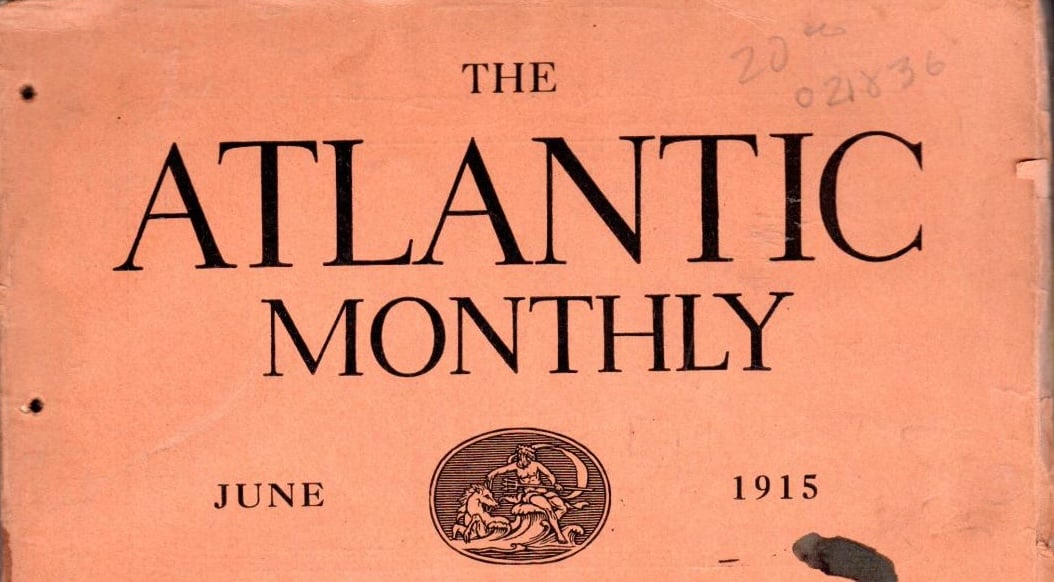
Recently I was browsing the stacks at our research library at the University of Nebraska-Lincoln and I thumbed through old back issues of The Atlantic. In the opening editorial for the January 1902 edition, the author wrote,
It is little more than a year since one of the most genial of Atlantic essayists was lamenting the disappearance of the Gentle Reader. Can it be possible that the Cheerful Reader is disappearing, too? One is loath to believe it; for if the Gentle Reader and the Cheerful Reader are both to vanish, and magazines are to be edited — as Dr. Crothers hinted — for the benefit of the Intelligent Reading Public merely, the world of periodical literature will be a dismal world indeed.
Yet if one were to judge from those Letters to the Editor, which the London Times, for instance, prints, and the Atlantic, for another instance, does not print, the quality of cheerfulness is nowadays sadly strained. What streams of sorrowful correspondence are directed to 4 Park Street after each issue of this magazine! And so few of them seem to flow from the pen of the Cheerful Reader! Perhaps the Cheerful Reader is busy earning his living, — too busy to write. It may be that it is only the Cheerless Persons who have leisure to take their pens in hand and “ write to the editor.” To all such unoccupied and melancholy souls the Atlantic hereby offers a Happy New Year — and a few remarks appropriate to the season.
One could remark on the tone and timbre of the language here, of course, as well as the apparently evergreen anxiety amongst writers about a certain sort of desirable reader passing away. Yet what most stands out to me is the clarity with which The Atlantic can name distinct types of readers and their relationship to their editorial work as a magazine.
In this sort of media economy, writers served readers, and all parties regarded themselves as belonging to a common societal endeavor. Recall, for example, that the First Amendment dedicates special attention to securing the freedom of the press—it would seem that our founders also recognized the unique role that writers and journalists play within our particular democratic liberal political project.
What we have today, by contrast, is a media economy in which media producers engage fans with content. And it seems to me that these changes are almost entirely bad. If you take the account of The Atlantic as one model, then the content producer model seems, by contrast, to presuppose that it is aimed at isolated, atomized fans, rather than readers. And fans are not part of a common civic project, but are simply engaged in personalized projects of identity creation, which they accomplish through activity on the same tech platforms that are used to distribute the content produced my media creators.
On the one hand, these are predictable changes, I think: Algorithmic based methods of distributing media will lend themselves to fandom models, I suspect, rather than what we might call "democratic civilian reader" models. Additionally, as context collapse sets in and we increasingly live within thin brittle social contexts that place a high degree of weight and pressure on individuals to self-create it is natural that people would turn to media not to engage them as democratic citizens but, if you'll forgive a somewhat vulgar image, to titillate them as fans. In other words, these changes all make sense given our current technological and social context.
And yet I do not find it easy to look at this and simply say, "well, democracy is over; enter monarchy!" as someone like Mary Harrington seems to do. That way seems the path to technological fatalism, I think, and it is a path we ought not take.
Rather, we can consider our moment soberly and conclude that both of these things are true.
First, we live in an enormously diverse society in which pluralism is inextricable and unavoidable. Given that, we will do best under a civic and social model that allows that pluralistic citizenry to feel as if they have a relative measure of agency and control over their lives and their experience of society. Therefore, models of top-down control, as are explicitly fantasized about by figures like Curtis Yarvin and Peter Thiel and are gestured at by Harrington, are a dead end. Indeed, I would argue that we already have a model that is too monarchical, in fact, given the combination of a more powerful presidency and an absentee legislative branch. Our politics already are far too tied to fandom, I think, and our presidents already govern largely to give gratification to their fans. Proposals to become more monarchical seem to me like a person with lung cancer deciding to start smoking three cigars a day alongside their pack a day cigarette habit.
Second, the very factors that make a democratic society desirable and conducive to health are also the same factors which make it so terribly difficult to realize. I am under no illusions about the relative challenges to democratic life in our context; I am simply unwilling to give up on the project.
And so, to circle back to the preliminary point: Like James, I am a writer and not a content producer. But in saying that I am a writer, I am not simply saying something about my own sense of calling; I am saying something about the kind of society I would like to participate in and work to build and to preserve. I am holding out hope that even now, nearly 125 years since The Atlantic lamented their demise, there might still be enough cheerful readers out there to join us at Mere Orthodoxy in that venture as we seek to contend for such a civic endeavor.
But if we are to do that, it seems to me we need to have media that still seeks to favor the old model of magazines and readers and civic society rather than the media of producers and algorithms and fandom.
It is possible, of course, that the pull to fandom is too strong and citizenship will be misplaced and forgotten as a result. Yet that need not happen if enough of us choose to resist it.
Mere Orthodoxy publishes serious Christian intellectual thinking. Subscribe and get our best writing in your inbox every week.
I’m very grateful for the work of MO and have really appreciated the things I’ve learned and the companion that it has been for me on my spiritual journey.
Mere Orthodoxy reader
Thank you for offering thoughtful, reasonable and decent commentary. It is a boon to my sanity at this stage of my life in this cultural moment.
Mere Orthodoxy reader
Mere Orthodoxy is (for me) a counterpoint to social media, a place of depth and critical thought.
Mere Orthodoxy reader
You're in. Check your inbox.
Something went wrong. Try again.
Jake Meador is the editor-in-chief of Mere Orthodoxy. His writing has appeared in The Atlantic, Commonweal, First Things, Books & Culture, National Review, Comment, Books & Culture, and Christianity Today. He is a contributing editor with Plough and a contributing writer at the Dispatch. He lives in his hometown of Lincoln, NE with his wife and four children.
Topics: