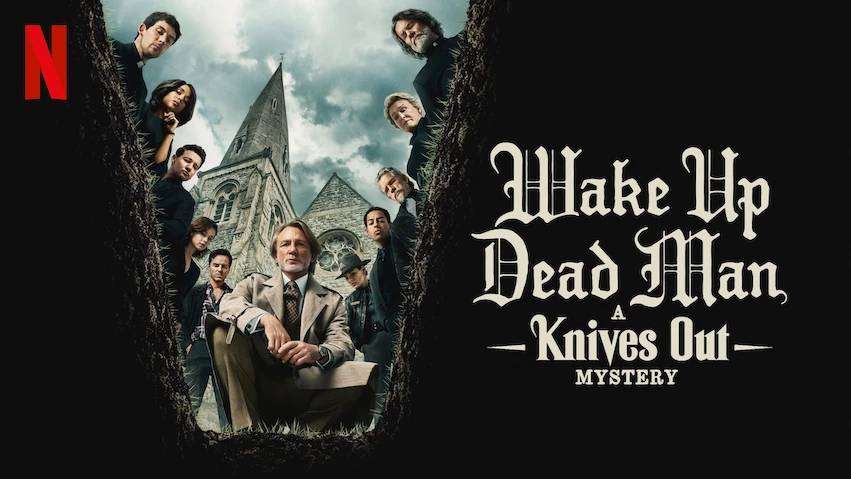
At the premiere of the new Knives Out thriller Wake Up Dead Man [Spoilers ahead], Director Rian Johnson introduced the viewing by saying, “We’re going back to church.”
Anytime Hollywood goes to church, it makes churchgoers nervous. A common Hollywood trope is the outspoken Christian—portrayed as judgmental, hypocritical, duplicitous, downright wicked, or some combination of these. Of course, we churchgoers recognize these villains, too, but nonetheless often feel cartoonishly misrepresented in major productions. As columnist Ross Douthat points out, art can be “coded” by who you choose as your hero or villain. And when Hollywood goes to church, it’s usually not difficult to crack the code of an anti-Christian bias.
Wake Up Dead Man dabbles in such tropes. The church-lady-turned-murderer-mastermind Martha (Glenn Close) and the victim Monseigneur Wicks (Josh Brolin) are stock examples of the silly, sanctimonious believer who manipulates and exploits for personal gain. Yet, Wake Up Dead Man is different because such caricatures are intentionally cartoonish and contrasted with the protagonist Father Jud (Josh O’Connor). Father Jud displays the qualities most of us look for in a pastor. He is fiercely committed to the gospel of Jesus Christ in a way that does not water down the message, but he is a shepherd of souls, a pastor is with people in their brokenness and shows them the light and grace of Christ.
As a movie, Wake Up Dead Man showcases the excellence from the other Knives Out films. It’s a mind-wracking whodunnit that is both funny and touching, led by the magnetic Benoit Blanc (Daniel Craig), who has earned his place among fiction’s greatest detectives. But Wake Up Dead Man is more interesting (and, I think, better) than the previous installments because it tackles life’s greatest questions about meaning, faith, doubt, and belief. Despite his resolute commitment to “reason,” the pinnacle of the movie is not, as we expect and as Blanc foretells, “the moment of checkmate, when I take the stage and unravel my opponent’s web.” Rather, it is a stunning act of mercy, when Blanc himself — despite his nonbelief — has a “Damascus” moment: he relinquishes the grand stage of unfurling the crime and recedes into the background as an act of grace to the guilty. It is an extraordinarily powerful and perfectly understated piece of storytelling. Moments such as these propel Wake Up Dead Man beyond an entertaining mystery and into a wonderful piece of art.
But whatever other important questions it raises, one of the most culturally pressing is Christianity’s place in the public sphere. In Monseigneur Wicks and Father Jud, the film upholds two visions for how the church might think about her role in the world: as a warrior fighting back against a wicked culture or as a welcoming, open-armed hospital. Almost explicitly, the film raises a question essential for the contemporary church to answer: what does it mean to fight for the church? For Christ?
—
The church cannot allow contemporary cinema to set the agenda nor give the final answer to this question. But it’s a question that’s been raised since the inception of the faith. We find it prominently displayed, for instance, in the often neglected, final book of the Christian Scriptures: the book of Revelation.
Revelation strikes fear into the hearts of its readers not only for its fantastic, sometimes bloody, imagery, but also for its opacity. We avoid what we don’t understand. Whatever else Revelation might say about the mysteries of eschatology, one unmistakable theme central to the book is what it means to conquer. The word for conquer (in Greek, “nikao”) appears 17 times in Revelation, more than the rest of the New Testament combined. Careful readers, however, will notice an intentionally inconsistent use.
Revelation 11 tells of the “two witnesses” — in Greek the “martusin,” the word from which we derive “martyr.” When the witnesses finish their “testimony” (“marturia,” from which we derive “martyrdom”), we read: “the beast that comes up from the bottomless pit will make war on them and conquer them” (11:7, NRSV). This harkens back to Revelation 6, when “the souls of those who had been slaughtered for the word of God and for the testimony [marturian] they had given” cry out to God: “how long will it be before you judge and avenge our blood” (6:10)? Plainly, the blasphemous beast is “allowed to make war on the saints and to conquer them” (13:7). Initially, we find “to conquer” implies the straightforward sense of overwhelming force to dominate. The beast conquers the faithful through raw power; the faithful are the conquered.
Yet, John’s revelation also inverts the meaning of conquer. Though themselves conquered, those who follow Christ, portrayed in Revelation as the slain Lamb, “have conquered [the dragon] by the blood of the Lamb and by the word of their testimony[marturias], for they did not cling to life even in the face of death” (12:11). For though the dragon and beast make war on the Lamb, ultimately “the Lamb will conquer them, for he is Lord of lords and King of kings” (17:14). The Lamb is the slaughtered one (5:6), before whom the faithful sing, “worthy is the Lamb that was slaughtered” (5:12). Yet, John’s vision sets before our eyes a Lamb who is slaughtered and yet conquers. So, too, the faithful who follow him: only those who “conquer” with the conquered Lamb — themselves “witnesses” (literally, martyrs) to the Lamb — will inherit God’s promises (21:7).
This bifurcated use of “conquer” presents the reader of Revelation two distinct ways to conquer: the way of the beast and the way of the Lamb. It is not a question of whether we will conquer, but how we shall do so. Revelation’s “beast” might have multiple referents, but several symbols — such as the “seven hills” which indicate the famed seven hills upon which Rome is built or the number “666” which, according to many Biblical scholars, symbolically indicates Nero —
such as the heads on “seven hills” and 666 likely referring, by way of gematria, to “Nero” — suggest the Roman Empire, and its many blasphemous rulers, is in view. The beast is not, or at least not merely, a supernatural force, but the seductive, standard form of empire and worldly power or force. Revelation commentator Richard Bauckham insists “it is a serious mistake to suppose that Revelation opposes the Roman Empire solely because of its persecution of Christians. Rather Revelation advances a thorough-going prophetic critique of the system of Roman power…From John’s prophetic perspective Rome’s evil lay primarily in absolutizing her own power and prosperity.” Revelation’s criticism of Rome, or “the beast,” is not only that it is anti-Christ, but it is a criticism of that kind of power as such and, in particular, in the methods the empire uses to conquer its victims. Revelation, therefore, is manifestly not against conquering — John invites all 7 churches to conquer with the Lamb — but a way of conquering that prioritizes its own interests and bowls over all who get in the way.
The irony, as Bauckham points out, is that the criticism Revelation levies at Rome or worldly force in general could be levied at the church herself at points in her own checkered past. Individual Christians or whole Christians institutions can succumb to the temptation to conquer like the beast. When the ends are Christian morality or even salvation, any means necessary may be justified. Revelation itself, after all, depicts Christ as a warrior. But the warrior imagery is refracted through the much more dominant imagery of the slain Lamb.
The warrior image is aligned with “strongly militaristic and nationalistic” Messianic expectations, but those expectations are subverted by the warrior who fights through willingly submitting to death. Paradoxically, the conquered Lamb conquers precisely because it was conquered. And those who wish to follow Christ must follow the way of the Lamb.
—
What Revelation does with fantastic imagery, Wake Up Dead Man does with the earthy characters Monseigneur Wicks and Father Jud. It presents two paths forward for the church: the way of Wicks or the way of Jud.
It’s an especially timely portrait, too, since Christians are actively wrestling with how to navigate what Aaron Renn calls a “negative world.” Succinctly, a negative world in which our culture takes a predominantly negative view of Christianity, as opposed to a positive or neutral view. Both Monseigneur Wicks and Father Jud gesture to the surrounding culture’s shifting perspective toward the church. It is debatable how “negative” the world is toward Christians, but it’s undeniable that the Western world is becoming less Christian. In measures like church attendance or Biblical literacy or Christian morality, Westerners today are somewhere on the spectrum between “less influenced by” and “more hostile toward” Christianity than they were 10, 25, and 50 years ago. Christians today are still discerning how to operate in a culture that is increasingly called “post-Christian.” This, I think, is what Monseigneur Wicks means by “modernity.”
Wicks’ response is, in Revelation’s parlance, the way of the beast: it opts for force; not necessarily weaponry or even physical might (though, as Wicks shows, that’s not necessarily out of the question), but it is confrontational and projects strength. The physical posture is “dukes up”: if the world insults and reviles, the church should give it back. She must defend herself, whatever it takes. The aim is to win.
Transposed to Revelation, the way of Jud is the way of the Lamb: it repudiates the force utilized by Wicks and, instead, accepts the insults and allows itself to be reviled. It displays strength through vulnerability and boasts in its weakness. It admits its faults. The Wicks-Jud spectrum runs not only through these two different characters, however, but through Father Jud himself. His violent, boxing past haunts him, and he often feels the impulse to punch back — sometimes, literally. But he recognizes his pastoral call is to heal a broken world, not hit it harder.
In one of the funniest scenes of Wake Up Dead Man, Lee Ross (Andrew Scott) strongly voices his support of Monseigneur Wicks by saying: “The church doesn’t need some pussy who’s going to lie down and take it. We need a warrior. We need a warrior.” What makes the moment so funny, and laced with irony, is the painting of Jesus on the cross prominently displayed in the background. The cross is the central, shocking image of Christianity: in the human Christ, God suffered and died. Our savior did “lie down and take it” — and instructs us to do the same. We follow a slaughtered Lamb and we will only conquer if we share in his death.
For all Wake Up Dead Man poignantly captures about the Christian response to the world, there is one subliminal message the church should resist. In one of the most moving scenes of the movie, Father Jud and Blanc are interrupted by Louise (Bridget Everett) emotionally telling Father Jud about personal hardships. Father Jud’s switch to give her his attention is the most convicting and loving act in the film. It is, as he narrates later, his Damascus road moment: instead of solving crimes, he should be tending his flock. The film rightly identifies the Priest’s vocation as a Pastoral one. But there are dangers in any extreme, and the church should be careful not to reduce her mission to a therapeutic mission centered only on soul care and counseling.
In Wicks and Jud, we glimpse the common dichotomy between “grace” and “truth” personified. But that common dichotomy is, of course, a false one. Sometimes we accept false dichotomies because they communicate something otherwise difficult to express. But in this case, the distinction obscures more than clarifies. The message of grace is true, and telling someone the truth is grace. At best, the two are sides of a coin. But they do aim at a real, challenging dynamic the church faces: between her prophetic mode and merciful mode. In the prophetic mode — exemplified in the Old Testament prophets, no less than by John in his apocalypse — the church calls the wicked to repentance; she unrelentingly identifies sin as the destructive force that it is. But she simultaneously (and therein lies the challenge) inhabits a merciful mode — exemplified in the prodigal’s welcoming father — in which she recognizes she cannot cast the first, or any, stone, and so she welcomes all, even the worst of sinners, with open arms, like Christ himself does on the hard wood of the cross. That Monseigneur Wicks is a repulsive character who only inhabits the prophetic mode should not give us license to abandon such a mode altogether. The church must, because she loves the world, uphold a public, prophetic voice for truth, goodness, and beauty. Grace demands it.
The prophetic and merciful modes, together, shape a distinctly Christian vision of “conquering.” Christian conquest is not mere passivity — to lie down and take whatever happens — but a righteous and impassioned concern to reflect Christ’s own concerns. In both means and ends, Monseigneur Wicks exemplifies how the church adopts the way of the Beast: he seeks to conquer for the sake of the church’s earthly power and authority, even when that means trampling over his own parishioners or the broken who attend his church in seek of God’s love. Wicks’ conquest is absorbed with, as Bauckham put it, a thirst to “absolutize [the church’s] own power and prosperity.” Father Jud, by contrast, owns the church’s mistakes and resists her entanglement with earthly power and authority. He is far from passive; indeed, he is often aggressive and, if necessary, combative. We should, to clear up one possible misconception, resist the view that Christianity necessitates pacifism. To defend the defenseless is to oppose the way of the Beast. But we should allow Revelation’s Lamb, in contrast to the Beast, to indelibly shape our imagination for what Christian conquest looks like. There is no clear principle in Revelation, or anywhere in Scripture for that matter, that tells us when force or resistance is appropriate in every case and I do not attempt such a principle here. But we must, nonetheless, allow the Scriptural image of the submission and subjection of Christ — found in Saint Paul no less than Revelation — to transform our hearts and minds, especially in a cultural moment in which the church finds herself against the ropes.
Christ himself, of course, is the perfect embodiment of the way of the Lamb. He shows us how to unite the twin modes of the church. But we do not imitate by merely following his example; rather, we imitate Christ by being caught up in the divine life and transformed by the Spirit. The way of the Lamb is accessible only in a life transformed by God and, therefore, not out of one’s own strength. Exemplified in Father Jud, this is none other than the Christian virtue of humility: the recognition of our own sinfulness, need of a savior, and the true source of all virtue and righteousness. The strength to follow the way of the Lamb comes from the one who wakes up dead men, and him alone. The movie rightly preaches, I think, that insofar as the church positions herself as a “cultural warrior,” the only truly Christian way is the way of the Lamb. If Christians are cultural warriors in the mold of all the others, we’ve fallen into Wicks’ trap. It’s a trap that’s difficult to resist, which is why Wake Up Dead Man is a welcome reminder. At least in this case, we should be grateful that Hollywood went to church.
The Weekly Digest
Premier Thought Every Thursday.
All of our recent essays and podcasts, delivered to you. Free.
Free. Delivered Thursday mornings.