Paul Elie. The Last Supper: Art, Faith, Sex, and Controversy in the 1980s. Farrar, Straus and Giroux, 2025. $33.00. 496 pp.
Mircea Eliade imagined a world that was split down the middle. On the one side was the sacred—a world of gods and demons, of angels ascending and descending on ladders that just barely touched the earth. On the other side was the profane—the world of bodies forgetful of the origin of their desire, ruminating over causes and cures.
Secular man, regardless of his intent, has not been abandoned by religion. Into the secular frame come hierophanies, those disorienting occasions when the profane—a tree, a rock, a man—become sacred. Israel encounters these, when water comes from a rock or when a donkey speaks God’s words to a man. The sacred is apart from the secular, but the door is locked from the inside. God can still enter in, and man can build sacred spaces within the profane, all to be able to access and pay deference to the holy.
Eliade’s observation of these two modalities of existence does not mean that the religious is merely a premodern delusion. The opposite, in fact, is true. If religion is dead, to misquote Julian Barnes, we certainly miss it. Our nostalgia for the God we don’t believe in is evident, I suspect, in the ways secular humans seek out transcendence in everything other than God. Sex becomes a medium for engaging the holy, as does childbirth and maternity. Music might be a pathway, as is art, or you could skip the difficulty of artistic production and go right to LSD.
Eliade’s interest is in the way man builds monuments to the sacred within the world of the profane. These “sacred spaces” are habitations, places for man to experience the numinous reality of a largely forgotten God.
But besides architecture, there are other places where man might encounter the sacred in a world largely void of it. In his book The Last Supper: Art, Faith, Sex, and Controversy in the 1980s, Paul Elie traces the way religious instincts, reminiscences, and longings appeared in the art and music of an era that was rife with such memory. Elie is also the author of The Life You Save May Be Your Own, an award-winning narrative account of Dorothy Day, Thomas Merton, Walker Percy, and Flannery O’Connor. Thus he is no stranger to Catholic thinkers. He is a careful narrator and a compelling writer. His new book is a matchless effort to ask a question that many thinkers are asking in a less interesting and more plodding way: How did America get so secular?
How America got secular is not Elie’s question exactly. Rather, Elie wants to query the in-between time, when the sacred still provoked the imaginations of America’s best artists and musicians. Perched on the backend of a religious century but on the brink of an irreligious one, the 1980s was a decade rife with religious referent. The artists Elie writes about are too numerous to list here. They include Andy Warhol, Toni Morrison, Bruce Springsteen and Patti Smith; U2, the Neville Brothers, and Sinead O’Connor; Martin Scorsese, Salman Rushdie, Robert Mapplethorpe, and Madonna, Leonard Cohen and Bob Dylan.
In Elie’s hands, the 1980s become a decade throbbing with the awareness of the sacred. He opens with a story of Sinead O’Connor on Saturday Night Live in 1992. When she tore a photo of John Paul II and scattered it on the stage, she made herself “a heretic, a public enemy, and unladylike, besides.”
O’Connor in Elie’s hands, however, is no heretic. She is not even formerly religious. In a term once deployed by Czeslaw Milosz, Elie sees her as crypto-religious. Elie believes this describes all of the artists he surveys in the book.
“What’s striking in retrospect,” he writes,
“Isn’t just that artists are marking reference to religion in their work. It is that they take the religious point of view seriously and personally. They aren’t set against religious authority, at least not at first. They aren’t anti-religious or irreligious. They’re crypto-religious. For them prayer, scripture, image and ritual are material they claim as their own via the imagination and seek to complicate and deepen not to do away with. They forthrightly cite their religious roots; they count themselves as believers and regard their work as the expression of convictions formed through intense self-scrutiny. Seen as faithless or profane, they see themselves and their approach to religion as more faithful to the core truths of faith than the clerics and televangelists, and they hope the public will agree…
For the crypto-religious, religion isn’t a structure of historic oppression or a bad influence to be opposed on principle. It is inheritance and legacy, underworld and promised land. It’s a fact on the ground and a stumbling block. It is what it has been for a broad range of believers all along: a means of making sense of the world and our place in it.
Why, then, not just be religious?
Elie describes the early 1980s as “both an end and a beginning.” It was the end of the “long sixties,” a term coined by Fredric Jameson in 1984 to describe the end of the era where religion was largely cooperative to public life. Religion was a “moderate center.” But in the 1980s, though the “post secular” age had not quite reached the fullness it knows today, religion’s decline had begun. The 1980s was the beginning of a questioning that still had belief at its root.
Elie has a delicate hand with the crypto-religious artists of the 1980s. When he writes of Andy Warhol, who opened a monumental Last Supper exhibit in Milan, Elie describes the recounting as a portrait of “a group of men [who have] come together and have a meal in the knowledge that one of them is going to die soon.” The relation between the Last Supper and the death of scores of gay men in Warhol’s orbit can’t be missed. In Warhol’s hand, the work “became a work of social commentary.” Meanwhile, Warhol writes in his journal that he still went to church, still prayed, still found God to be a figure in the world. Religion looms, inspires, and dominates Warhol’s artistic imagination.
In Leonard Cohen’s work, Elie sees a crypto-religious crypto-monk “in sync with the convergence of art, belief, and desire that is taking place in the city.” A descendant of rabbis, Cohen lived as an “unchaste monk”. He excelled at unearthing the deep connections between sex and religion, between devotion of the soul and the body’s longings. With songs like “If It Be Your Will.” “Anthem,” and especially “Hallelujah,” Cohen “joins religious desire and sexual desire as few songs have done before or since.” In the process, “Cohen goes to the outer rim of transcendence where devotion and desire meet and consort together.” He is a genius of crypto-religious art.
Elie writes no less compellingly of U2, Prince, Madonna, Aaron Neville; Martin Scorcese, Robert Mapplethorpe, Czeslaw Milosz. In all their art, the world of gods and demons is nigh—the angels ascending and descending close by, just out of sight.
But if religion is so inspiring—if it is indeed the real frame of reference, the truest story about the world—then why are these artists running from, and not toward it?
Two crises befell American religion in the 1980s. Both occurred within Roman Catholicism, which is the context of Elie’s religious observations. Both crises in his mind seem to underwrite the widespread flight from religion.
The first was the HIV/AIDS epidemic.
Initially mistaken for a “gay cancer,” the earliest evidence of this disease appeared in 1980s New York. Its tell-tale symptoms—“blotchy skin, severe weight loss, difficulty breathing”—led inevitably to death. Without consistent treatment or a standard of care, patients, the vast majority of whom were gay men, suffered the physical aspects of the disease as well as the mental and psychological effects of being untreatable: “Gay men showed symptoms, became ill, went to the hospital, died.”
Adding to the drama of this terrible illness was the Catholic imagery that loomed over many of the hospitals that treated the sickest men. The Catholic Church was providing care for AIDS patients; St. Vincent’s and St. Clare’s each had a hospice for people with AIDS. But at the same time John O’Connor, then archbishop of New York, said he would “shut down [the church’s] several hundred schools and hospitals if required to employ openly gay people in them.” Elie sees this macabre irony visually depicted at St. Vincent’s: “There through the window of the emergency room was AIDS in Catholic terms—the gaunt men in the waiting area overseen by the gaunt man who hung on a cross mounted on the wall.” The crucifix came to life in ways horrific, terrible, and desperately, undeniably real. Both gaunt men died, and both become for Elie a specter, an image of the Church’s lack of mercy.
The second crisis was only whispered of at the time. It was the sexual abuse crisis whose extent would not come to light for years. But already with the trial of Gilbert Gauthe in 1984, the Catholic Church was aware of the pattern of molestation and sexual abuse by priests that occurred within its parishes. Elie suggests that the Church’s unwillingness to address the extent of the problem was directly related to the hardening of the church’s view on sexuality and contraception.
“At a moment when the bishops had unprecedented power and influence in American public life,” he writes:
“their wish to suppress, deny, explain away, and justify widespread criminal sexual misconduct in their ranks put them on the defensive. It prompted them to turn their energies away from matters of war and peace, of justice and inequality, and onto matters of sexual morality. And it led them to try to manage complex questions of human sexuality rather than ponder them. In effect, the bishops sought to defer and evade the inevitable controversy over sexual misconduct by priests, and the challenge to clerical authority it would bring, by shifting attention onto the sexual conduct of everybody else. And they transferred the fear and anger the controversy aroused in them onto a different controversy- the one involving the Church and people with AIDS.”
In what Elie suggests was an intentional sleight of hand, the church focused on legislative documents that outlawed contraception in order to avoid the closer scrutiny that the allegations of sexual abuse in its ranks would have brought. The church’s “creeping obsession with sex” led them to reactive stances about sexuality in general instead of addressing the problem in their own hierarchy.
Artists struggle with prohibitions on sex. Sex is, after all, among the most supple subjects for the production of art. Whatever else it is, sex seems to be an invitation to transcendence—or at least an invitation to whatever is beyond the self. The collision of sex and God is evident throughout Christian history. The early ascetics emphasized denial to avoid temptations. The later mystics mixed thinking of sex and God, emerging with a sort of amalgam of desire and religiosity. Moderns, for the most part, preferred not to speak of sex, or to dismiss its pleasure, delegating it all to the private realm. By the time the “long sixties” had receded with its sexual excesses, what was left was mostly a question mark about the relation between sex and God.
Visual artists like Andy Warhol and Keith Haring emphasized the question of sex and God. Sex was either transgressive or religious; or perhaps seeing sex as religious was the desired transgression. Either way, with blood spattered crucifixes at rock concerts and profane Madonnas; it is easy to assume that art of the 1980s was “anti-religious.” This was certainly how the conservative evangelicals of the Moral Majority would prefer Christians think about such spectacles.
But Elie is not so sure. To him, spectacles like blood-soaked crucifixes, sexual entanglements, and couplings were spectacular because they pointed to images that were still heavy with meaning. The blood-spattered Christ spoke to a gory salvation, the heavy breasts of the Madonna were (purportedly) filled with milk to feed God himself. The religion that such artists were nostalgic for might have been lost to them, but the gaps left behind remained. Like empty wounds, the holes that religion had left in secular culture cried out to be filled—and these holes in the secular were filled with art that beckoned to a higher meaning.
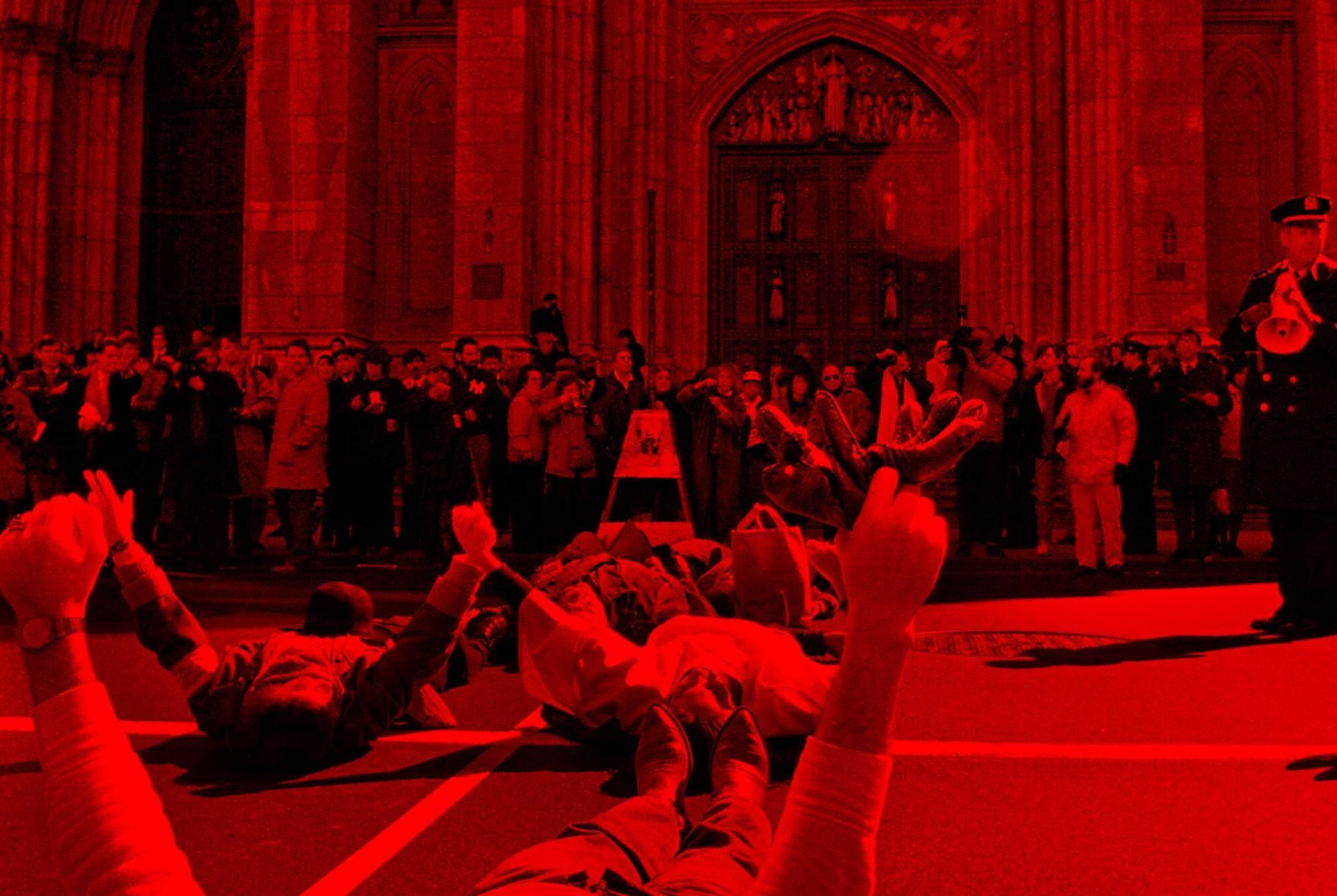
For a time, the artists of the 1980s made such art. By Elie’s account, this was because religion still existed as a site of transgression. You could still transgress the sacred, because “the sacred” was still very much intact. So when the heights of the AIDS crisis seemed to demand direct action, and the activists of ACT UP chose St. Patrick’s Cathedral for the site, the shock that was felt was intended. The Cathedral was still holy enough to the everyman to be transgressed.
The goal of the ACT UP protest, which serves as the cover art for Elie’s book, was to force the government to commit to greater AIDS research, as well as to get the Church hierarchy’s attention. The U.S. Bishops of the Catholic church had issued a recent letter condemning condom use and emphasized the appropriateness of sex only within the context of marriage and conception. But the letter seemed to ignore the public health crisis of HIV. The Church’s insistence that it was the “expert on humanity,” while seemingly ignoring the very human crisis happening under its watch, made the choice of a church for a direct action protest seem the most fitting place for the desired confrontation. When an activist took the Eucharist, broke it, and scattered it all over the cathedral floor, the images shocked the country. By violating the sacred space of a cathedral, the activists had ignored the line between religious observance and secular protest.
There is a way to read this activism as a shattering, as the crossing of a Rubicon. The intent of the protest was to resist the Church’s stated hegemony on matters of humanity and human sexuality, and to force the government’s hand to come to the aid of those suffering the effects of HIV/AIDs.
But certainly, an unintended effect was to desecrate the last place where the sacred had the upper hand. When they lay down and played dead in the cathedral, the activists made a religious shelter a place of political theatre. They contested the Church’s claims to bearing the ultimate truth about the world. Their site of resistance, the collapse of the Church’s authority, became the reality of the world that was yet to come.
If there is a hero of Elie’s book, we only meet him halfway through. He is the Franciscan friar Mychal Judge—a gay man, a recovering alcoholic, and a Franciscan. He placed ads in the gay newspapers of New York, advertising himself “In the spirit of Francis of Assisi… serving our brothers and sisters with AIDS.” The church where he lived, the Church of St. Francis of Assisi, was “an outpost for gay Catholics,” with Judge running a ministry for people with AIDS.
He visited people in their apartments and in hospitals, “four people in a typical day.” He would massage their feet or hear their confessions. He prayed with them and anointed them with oil. “He organized their wakes, celebrated their funeral Masses, saw to the final disposition of their bodies.” Elie writes of Judge: “He was not openly gay, and not an unstinting advocate for the rights of gay people in the Church.” He was himself a contradiction. But he knew that the Church was a place of mercy.
As the HIV/AIDs crisis overlapped with the sexual abuse crisis, the decisions of activists to desecrate places of worship hardened the division between church and world. When the Catholic Church chose to speak to ideal human norms instead of lived human suffering, the overlapping realities of humanity, both sides hardened. We live now in the aftermath of this hardening.
But what Judge reveals—the Franciscan man, poor in spirit in more ways than one—is that the church’s face is, and has always been, mercy. To cradle the feet of dying men was a mercy. And to remain with the Catholic Church, even as a contradiction, Judge chose mercy.
The 1980s were rife with the dissolution of the sacred. Boundary-transgressing artists were ready to spill blood, to sing of prolific sex and to push the boundaries of sexual norms. Placed against the images of the AIDs crisis, the “gay plague,” it seemed the world might implode. It would be easy to assume that this was the crisis, the battle between sacred and secular, between holy and profane, between life and death.
But meanwhile, quietly and close at hand, were Judge and others like him, quietly anointing foreheads with oil, tenderly massaging feet. Mychal Judge did all of this until his own final moment. When the Twin Towers fell on September 11, 2001, he rushed to the site. He entered the North Tower, where he offered prayers and aid for the rescuers and the dead. He was killed when the South Tower collapsed.
Religion walks the borderline like this, between life and death, marking in its presence the space between holy and profane. To map it is to be open to surprise, to see where you’ve been wrong, to touch and be touched with oil, with water, with the relief that comes from being received. Religion itself reveals the crisis, as it makes demands on our allegiances. God stands in the just-beyond.
The artists that Elie writes of longed for the God they didn’t believe in. Each in different ways, they referenced the God of the Catholicism they had left behind, longing for its order, structure. They longed most of all for the mystery that referred beyond themselves, beyond the violence of death and suffering—and most of all for the mystery beyond. They wanted to know that the cathedrals of the city were still there, offering a window to this beyond, even if they were empty and even if they themselves never went.
If the world is indeed split down the middle with angels and demons on one side and the profane on the other, there are yet cracks. There are small openings, tributaries that run from one side to the other. The bridge between the two worlds, the cracks in the fissure, the tributary that carries one from religion to the beyond—it is mercy.
The artists Elie writes of didn’t believe in God, but they sure as hell missed him. I do believe in God, but when I am in church, I sometimes miss him too. I search as they did, in art, in music, in the desire of the body, in the faces of the suffering. When I miss God, it is mercy that I miss the most.
Kirsten Sanders (PhD, Emory University) is a writer and theologian. She lives with her family in Massachusetts.
Topics: