
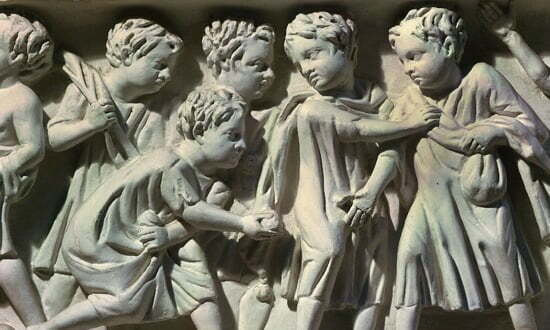
In 1 BC, a man named Hilarion wrote a letter to his pregnant wife, Alis, while he was away on business in Alexandria. The letter survives on papyrus, preserved by two thousand years of dry Egyptian air. He asks about her health. He tells her to take care of herself. And then, almost in the same breath:
If you bear a child, if it is a boy, let it live. If it is a girl, expose it.
One sentence without anguish or apology. Just instruction.
What Hilarion wrote was not considered monstrous in his world, his legal system, or to his gods. Roman law gave the paterfamilias, the father and head of household, the power to accept or reject a newborn. Acceptance meant lifting the child from the floor where it had been placed after birth. Rejection meant leaving it there, to be carried outside the city and abandoned to the elements, to wild animals, or to whoever might find it first.
The practice had a name. It was called exposure. It was legal, widespread, and morally accepted.
What we would call murder, the ancient world called a household decision.
This is not an obscure corner of ancient history. It’s the mainstream. Aristotle, one of the most respected philosophers of the ancient world, argued in his Politics that exposure should be legally required for deformed children, and recommended as population policy for everyone else. Plato, in the Republic, proposed that children born to inferior unions should not be raised. Seneca, whose diagnosis of wasted time was otherwise so penetrating, wrote without particular emotion in De Ira: "We drown children who at birth are weakly and abnormal." He was not describing a tragedy. He was describing a reasonable practice.
Girls and the weak and the inconvenient were abandoned in large numbers, most died. Some were found by slave traders and raised for labor or prostitution. A father had no particular moral obligation to the child his wife was carrying. The child's right to exist was entirely contingent on his decision.
And then there was the matter of what the Greeks called paiderastia.
The word means, literally, love of boys. It described the formalized sexual relationship between an adult male and an adolescent, typically between twelve and seventeen years old. It was not hidden. It was not shameful. It was celebrated in poetry, codified in philosophical writing, and treated across significant parts of Greek culture as a form of mentorship and education. Plato wrote about it approvingly. The gymnasiums where boys trained were, in part, sites of adult male pursuit.
The ancient world did not have a word for child abuse. It had a word for a relationship.
The first Christians stepped into this world and named what they saw differently.
The Didache, one of the earliest Christian documents outside the New Testament, written sometime in the first or early second century, is essentially a manual for community life. One of its instructions condemns murder, adultery, theft, and then, in the same breath, as a matter in the same moral category: "you shall not be a paidophthoros."
The word is not paiderastes. Not a lover of boys. Not a mentor or admirer.
Paidophthoros means destroyer of children. Corruptor of children. The one who ruins what is young.
The vocabulary shift is not incidental. It is a complete moral reclassification. What Greek culture had named as love, the Didache names as destruction. The adult in the relationship is not an admirer or a teacher. He is someone who destroys. The child is not a junior partner in an educational arrangement. He is a victim.
This is not a minor theological shift. It is a revolution in moral language. And moral language shapes moral vision.
The early Christians did not simply write differently about children. They acted differently.
Justin Martyr, writing around AD 155, described the problem with exposure: abandoned children, he mentioned, were frequently found and raised as prostitutes. Christians could not participate in a practice that handed children to such a fate. The logic was not sentimental. It was theological. Their lives were not the fathers to dispose of.
Aristides, a second-century Christian apologist writing to the Emperor Hadrian, described Christian practice: "They do not expose their children." In the context of his time, that sentence was provocative. It marked Christians as different in a way that was socially costly and economically irrational. Families were pressured to limit the number of mouths they fed. Girls were a financial liability. Christians kept them anyway.
It went further. There is substantial historical evidence that early Christians actively rescued exposed infants, taking in children left to die and raising them as their own. The New Testament scholar Larry Hurtado, in his historical study of early Christian distinctiveness, documents the rejection of infanticide and exposure as one of the clearest markers by which the Roman world recognized Christians as genuinely, stubbornly different from everyone around them. This was not a peripheral practice. It was, Hurtado argues, a defining feature of what it meant to be a Christian community in the Roman world, noticed and remarked upon by pagan observers precisely because it made no sense by their moral framework.
By the fourth century, the first institutions specifically for abandoned children, called brephotrophia, were being built and maintained by the church. The emperor Valentinian I, a Christian, outlawed infanticide entirely in AD 374. What had been a household decision became a crime. The moral vocabulary of the Didache had, over three centuries, reshaped the legal vocabulary of the empire.
None of this was accidental. It happened because the early Christians had a theological account of why children mattered that the ancient world simply did not possess.
The scriptures of Israel planted a radical idea that eventually stripped the Roman father’s power over life and death. While Roman tradition viewed a newborn as a mere object awaiting a paterfamilias’s verdict, Jewish and Christian theology saw a sacred life created by God, born with a royal vocation and divine purpose that no earthly authority could revoke. Armed with this conviction found in the scriptures, first-century Jewish and Christian writers like Philo of Alexandria, Flavius Josephus, and Aristides boldly condemned child exposure as outright murder and a violation of nature.
And then there was the specific belief of the incarnation.
The God whom Christians worshiped had entered the world as an infant. He had been placed in a feeding trough. He had been carried as a refugee into Egypt. He had grown slowly, as children do, learning to walk and speak in a particular language in a particular house. He had been, for years, entirely dependent on the care of human parents.
The gods of the ancient world did not become children. They appeared in power and glory. The God of the Christians chose to begin where every human being begins. And in doing so, he made it permanently impossible to treat the vulnerability of childhood as a defect to be eliminated.
Jesus made this explicit. When the disciples tried to turn children away from him as a distraction, he stopped them. "Let the little children come to me," he said. "Do not hinder them, for to such belongs the kingdom of God." And then he said something with no real parallel in ancient moral philosophy: anyone who causes one of these children to stumble would be better off drowned in the depths of the sea. The ancient world assumed children were managed by adults for adult purposes. Jesus made the child's welfare the measure of adult moral standing.
The historian O.M. Bakke, in a carefully researched secular study of childhood in early Christianity, concluded that the church introduced something genuinely new into the ancient world: a framework in which children were not property, not burdens, not tools, but persons with full dignity before God, deserving protection and love for their own sake.
This is now, in much of the world, simply assumed. We call it civilization. We enforce it with law. We feel an outrage at its violation so deep and instinctive that we rarely stop to ask where that outrage came from.
It came from somewhere specific.
It came from a document written in the first century that gave child abuse a different name: not love, but destruction. It came from communities that kept their daughters and pulled abandoned infants from the refuse heaps at the edge of Roman cities. It came from a theology that said every child matters, including the weak and the unwanted, and that their dignity is not ours to grant or revoke.
It came from a God who, when he chose to enter the world, chose to enter it as a child: held in the arms of a young mother, in the middle of the night, in a place no one with power would have chosen.
The world he was born into left children at the city's edge to die.
He came to that world anyway. And he has been gathering the ones it discards ever since.
The Weekly Digest
Premier Thought Every Thursday.
All of our recent essays and podcasts, delivered to you. Free.
Free. Delivered Thursday mornings.

