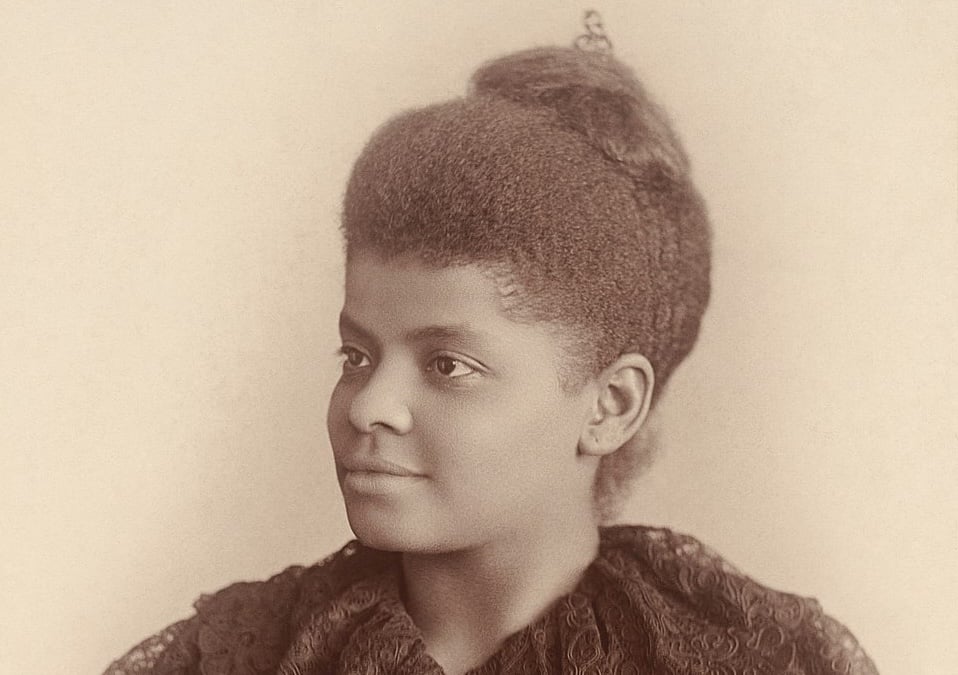
There are moments when you realize the tradition you love is larger than the version you inherited. Ida B. Wells, a Presbyterian, has recently done that for me, and her faithful witness deepens how I live faith in the public square.
I remembered her name only dimly from high school history class. Wells was a crusader against lynching through her journalism, and later a key figure in the suffragist movement and the NAACP. Over the past year, I have felt a conviction to study her life, notably her courage, gumption, and refusal to stay silent.
As a young journalist, Wells reported on lynching with a specificity no one else dared, and her work brought its scourge into the consciousness of both Black and white Americans. Eventually, she would own her own newspaper in Memphis, only to have a white mob destroy the printing office and threaten her life, forcing her into literal exile. Wells went on to play a significant leadership role within the American suffrage movement, working alongside figures such as Susan B. Anthony, Jane Addams, and Elizabeth Cady Stanton, until she broke with them when they asked Black women to wait their turn on questions of race.
What surprised me most was learning that Wells spent roughly thirty-five years in a Presbyterian church. Ida B. Wells did not write on or about Presbyterian theology as a system, but she reasoned, protested, and hoped as someone formed by it. Her faith does not show up in doctrinal exposition, but in her confidence that God judges nations, that institutions can sin, and that truth spoken publicly is an act of obedience to God. We rightly celebrate the sermons of Knox, the persistence of Wilberforce, and the political leadership of Kuyper, her contemporary, no less. Ida B. Wells belongs in their company.
Faith in Life
Wells’ talent was instantly recognized by church leadership. In her autobiography, Crusade for Justice, she writes of joining Grace Presbyterian Church in Chicago:
They did accept me and I and my two daughters united with the church. Shortly after I was asked to accept the position of teacher of the men's Bible class by the members themselves. I thus began that which to me was one of the most delightful periods of my life in Chicago.
Her teaching at Grace (today Sixth Grace Presbyterian Church) did not remain inside the classroom. The Sunday after the 1908 Springfield race riots, Wells confronted the moral paralysis she saw among the young Black men in her class. Many of them, facing urban dislocation, unemployment, and systemic injustice, heard from her that a response to racial violence cannot remain rhetorical, but must become organizational.
What she did next with that moment is worth hearing in her own words:
I do not remember what the lesson was about that Sunday, but when I came to myself I found I had given vent to a passionate denunciation of the apathy of our people over this terrible thing. I told those young men that we should be stirring ourselves to see what could be done. When one of them asked, ‘What can we do about it?’ I replied that they could at least get together and ask themselves that question. The fact that nobody seemed worried was as terrible a thing as the riot itself.
Out of that Bible class emerged the Negro Fellowship League, a ministry designed to do something Presbyterians have long believed matters: form people over time for their flourishing and that of others. The League provided housing, employment assistance, education, and moral formation for Black men navigating a hostile city. This was discipleship embedded in social reality, a deeply Reformed move.
Wells went on to help found organizations that carried her vision beyond her own lifetime: women's clubs, civil rights associations, suffrage groups, kindergartens, and settlement houses. Some of these institutions still exist today, including the NAACP and the National Association of Colored Women. Wells built hopeful alternatives where the kingdom of God broke through. Wells did not see the church as a refuge from the world, but a place of courage and discipleship; a place of moral clarity where God calls and sends every day people for his mission.
Presbyterians have always believed that ideas need structures to survive. My friend Professor Mike Glodo at Reformed Theological Seminary, Orlando, often shares with students that the book of Acts presents institution-building as a church-planting methodology, one we should not neglect in our desire for simple, digestible Christianity delivered over a latte and a text. Wells shows that cultural renewal must be institutional if it is to outlast personalities, trends, and annual budgets. A moral vision, even the gospel itself, untethered from durable forms eventually dissipates. Wells held this instinctively. Her life pairs truth-telling with institution-building, critique with construction, and courage with patience.
A Public Gospel
In my own work, I have been wrestling with what I call "gospel walking." By this I mean the conviction that the gospel is not only something we believe or proclaim, but also something we carry through our bodies into neighborhoods, workplaces, and institutions. Faith that remains abstract eventually loses its hold on people. Wells understood this.
The same scriptures she taught in a men’s Bible class shaped how she read lynching testimonies, court transcripts, and newspaper editorials. Wells did not separate her journalism from her faith, or her organizing from her discipleship. The same moral seriousness that led her to church membership led her to risk her life for the truth,
Ida, my new friend, walked the gospel into places where it was unwelcome. She stood up to the Memphis elite, Black and white. She stood up to northern reformers, content with gradualism. She stood up to church leaders who preferred quiet respectability to costly faithfulness.
Ida B. Wells exercised Presbyterian instincts naturally: moral realism about sin, confidence in God’s sovereignty, patience for long-term formation, and the belief that scripture and institutions matter. Her life suggests that, at its best, Presbyterianism has always been more than polite theology and cautious leadership. It shapes people capable of public courage, institutional imagination, and sustained resistance to evil. As a pastor, I want to do the same. I suspect many of my colleagues do, too.
The Reformation Chapel at First Presbyterian Church of Orlando, where I have served for twenty-one years, bears the names of ten reformers carved into the molding that crowns the room. At the risk of appearing woke, I can’t help noticing that the names are all dead white guys. Could Ida’s name ever be up there? Maybe, but more importantly, I want her story in my heart and to be known by others. The more I attend to her story, the more I suspect that the future health of our churches depends less on innovation and more on recovering the breadth of the house we already inhabit. There are rooms we never entered. She lived in them. And the gospel walked there long before I arrived.
.png?width=5000&height=2188&name=Mere%20Orthodoxy%20-%20Banner.png%20(1).png)