.png?width=5000&height=2188&name=Mere%20Orthodoxy%20-%20Banner.png%20(1).png)
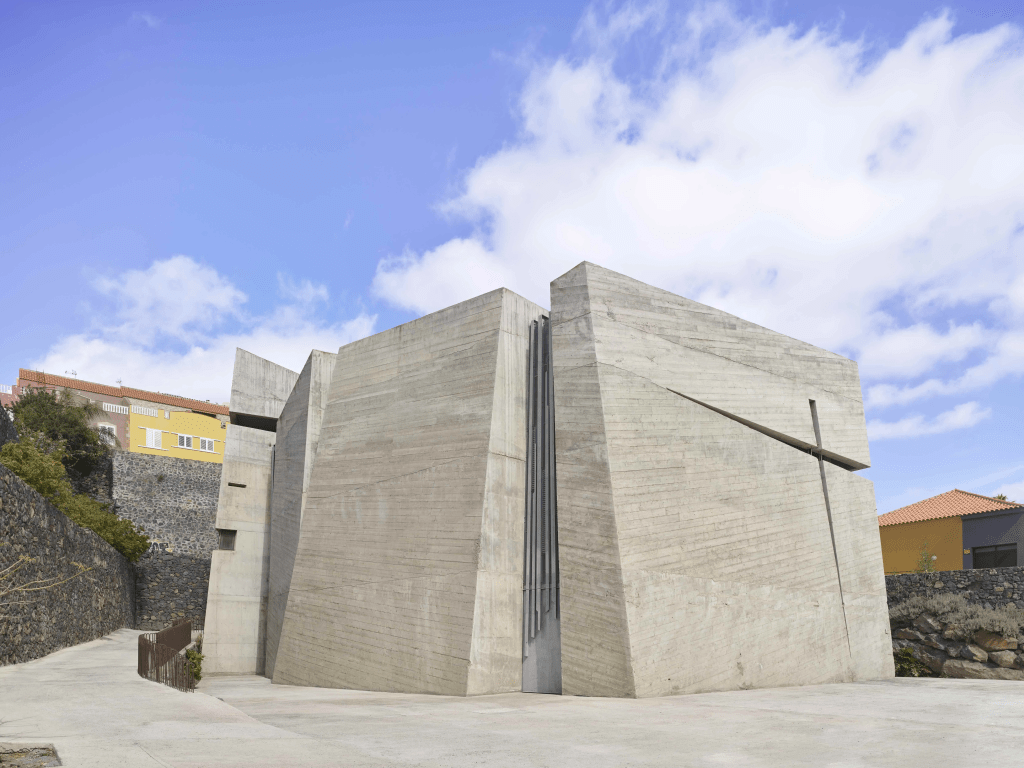
At the recent World Architecture Festival—an annual international gathering of leading figures where prestigious prizes are awarded—the biggest prize of all was awarded to a church. As the news article on Archinect.com put it, “World Building of the Year 2025 awarded to minimalist concrete church by Fernando Menis." We learn the basic facts from the opening paragraph:
The Holy Redeemer Church and Community Center of Las Chumberas [Spain], designed by Spanish architect Fernando Menis, has been named as the World Building of the Year at the 2025 World Architecture Festival.
Thus far the only hint that something is amiss comes from the two descriptive words tucked into the headline, "minimalist concrete." But a picture, as they say, is worth a thousand words. Here are three:
 Image: © Roland Halbe
  Image: © Hisao Suzuki
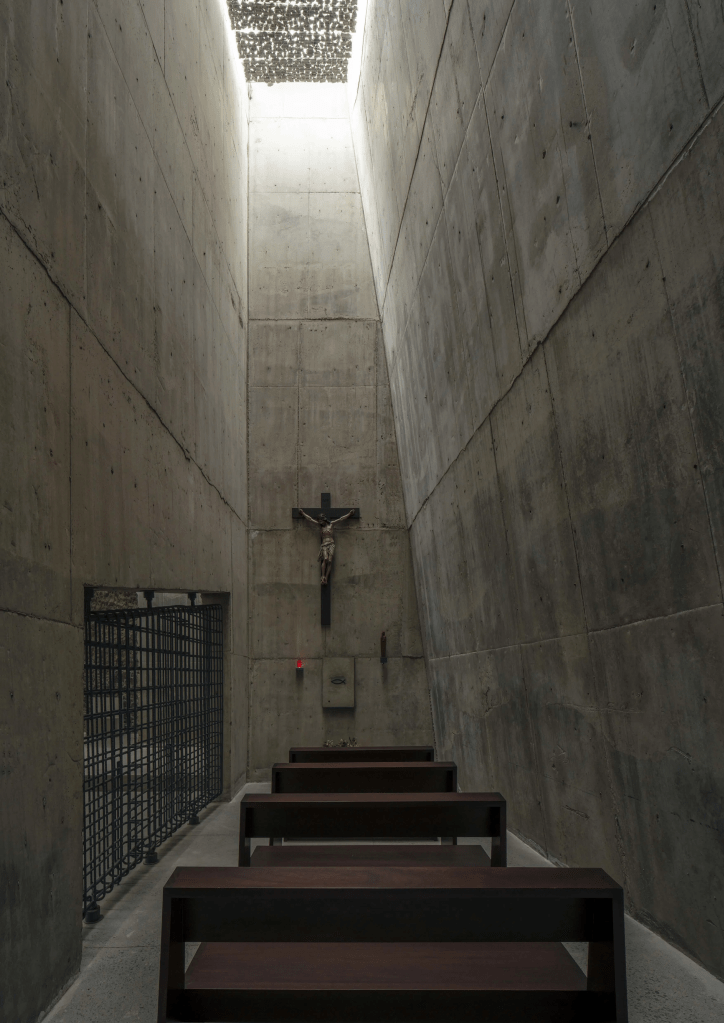
Image: © Hisao Suzuki
It goes without saying that this church is exquisitely ugly, bleak, and depressing. I do not say this to be insulting to the designer, for I am quite certain this was precisely his goal. As such, it is undoubtedly an accomplishment and a demonstration of impressive skill. But rather than putting that skill to use in service of beauty, the design revels in its dark, disjointed, inhuman shape.
It looks like a prison chapel designed by Screwtape to cause all who enter in to abandon hope. I do believe it would make Soviet atheist architects proud. Most of all, here is what a church should look like if Christ never rose from the dead.
It is also everything that is wrong with modern architecture (in both its modernist and postmodernist varieties). Rather than filling the interior space with light, it only lets a few shafts seep in through strange cuts and metallic openings. Rather than tall vertical lines that draw the eyes and spirit upwards, the building's walls lean over towards the inside, giving the space a closing-in, cramped feeling. Rather than materials like hewn stone and carved wood which derive from nature, it features shapeless materials like concrete and metal, lifeless and cold. Rather than curves and dimensional proportions that are pleasing to the eye and communicate a sense of life and wholeness, it resembles nothing so much as ‘the Objective Room’ from C.S. Lewis’s prescient book, That Hideous Strength: intentionally ill-proportioned in order to frustrate and stamp out one’s natural inclination for beauty.
Why do I care? And why should you care? In short: because buildings preach. They proclaim a message to the world about what is true, what is good, and what is beautiful. This is especially true of our most public buildings: our town halls, legislatures, courthouses, and churches. These buildings reveal what the culture which came together to raise them was like. And once they are raised, these buildings shape future generations in subtle but powerful ways. As Churchill said, "We shape our buildings; thereafter they shape us." Dostoevsky put the same truth in his characteristically stark and slightly bleak way: "Low ceilings and tiny rooms cramp the soul and the mind."
I do believe there is a renaissance of beautiful architecture brewing as part of a greater reckoning against the ills and distortions of modernism, but clearly it has yet to reach the World Architecture Festival.
This award-winning church preaches something untrue by being so intentionally at odds with how human beings have thought of beauty. Like so much creative cultural output in the modern age, this building's design is an exercise in subversion. It is fundamentally derivative in the worst sense; instead of building upon the great tradition of sacred architecture bequeathed to it, it only "creates" by perverting what has come before, like a parasitic cancer. The best term for this kind of misbegotten creation, coined by sociologist Philip Rieff, is deathwork. It is what a culture produces when it has rejected the sacred order which gave rise to it in the first place.
That this is a Christian church is a most fitting and bitter irony, for the Christian story is central to the sacred order which built Western civilization—with all its sins and shortcomings. I'm reminded of a line from Oliver O'Donovan, that “we live not at the seed time but at the harvest of the modern age.” This concrete minimalist church feels like a taste of that bitter harvest.
But the idea of sowing seeds brings another truth into focus, one which promises to be more encouraging: great changes start out very small. Not many of us have the opportunity or the means to build beautiful churches or other public buildings, but I am certain that each one of us has influence over some space which we could make more beautiful. Perhaps it’s just a bedroom, an office, a front porch, or a partial church renovation, but somehow or other each of us can make the space around us a little bit more beautiful.
It may seem like so very little to sow small seeds of beauty, but it is work which promises a rich harvest. For example, take my humble little Baptist Church in Quebec, meeting in a converted equestrian riding barn, and blocked thus far by local zoning laws and bureaucracy from making any substantive changes to our building. Our pastor and elders have nevertheless tried to sow small seeds of aesthetic beauty by hanging up nicely framed Reformation-era works of art depicting the life and passion of Christ in the common areas of our church.
It’s easy—too easy—to criticize things that are ugly. We must move beyond criticism to construction. What are you going to build this year? What space will you make more beautiful? Have you thought about what makes some buildings feel right, while others feel wrong? If your church is going to be building or renovating soon, consider carefully what message it will preach. Let us sow seeds of beauty as God gives us opportunity, trusting him to take care of the growth and harvest.
Topics:
