Some Things Shouldn't Be Made Into a Joke

April 23rd, 2026 | 13 min read

By Jake Meador

Eventually we are going to get to Defense Secretary Pete Hegseth's third commandment violation from a 'prayer' he delivered at a worship service in the Pentagon last week.

But to get there, we need to talk about irony and sincerity first with the aid of a short YouTube video about how irony functions in certain digital environments.

It is important for Christian leaders and all people of good will invested in our common life to understand how certain forms of online speech operate. We now live in a media world in which media producers have gotten very good at rhetorical sleights of hand that allow them to simultaneously promote evil ideas or behave in evil ways while retaining enough deniability to give them some cover if challenged for their words or behavior. If you do not understand how these rhetorical tricks work, you will be unable to respond adequately if or when you encounter these tricks within your church, organization, or simply within relationships.

To start, watch the video below. Be warned in advance that the speaker is quite profane and uses obscene and scatological language frequently as he explains the "circle of irony." His language is not safe for work, as they say, but the concept he's explaining is quite important:

To summarize the video, there are basically four forms of communication as they relate to irony:

circle of irony

First, there is sincerity. This is the default way most people communicate. With sincerity, the things we say are simply taken at face-value and understood in their most plain and obvious sense.

Second, there is irony. With irony, the speaker says something that is the opposite of what they truly mean or intend. In its most basic form, it collapses down to sarcasm.

Third, there is post-irony. Here is how the speaker explains it: "After irony we have post-irony. This is where you say something that makes it sound like you don't mean it when you actually do mean it. You're using irony to make a joke about how you're joking."

At this point it is sometimes difficult to discern what a person actually means or believes. That said, generally you can determine the real meaning of the communication provided you understand what the speaker in that YouTube video is laying out: Post-irony is stating something you sincerely believe in a way that makes it seem as if you are joking.

Now we come to the final stage: meta-irony. Here is how the speaker explains it: "This is when you're saying something sincere, but the context could imply that you're saying it ironically, yet the thing that you're saying is actually a sincere thought. This is meant to confuse you." He continues, "meta-irony is used effectively by people whose intention is to blur the line between sincerity and jokes."

In other words, it takes the confusion already present in 'post-ironic' communication and deliberately pushes it toward its breaking point in order to simultaneously allow for a speaker to say extreme or crazy things while preserving significant deniability.

This form of irony has a very obvious application in our political context, which is a time of increasing radicalization in reaction against old taboos and social norms that prohibited many forms of radicalism. Essentially, meta-irony allows extremists to speak quite plainly about what they believe, but because they do so with just the slightest bit of ironic posturing, they can wave it off as a joke if pressed: 

"To say 'I was just joking,' is a legitimate way to exonerate yourself in moments of actual miscommunication. But it's also a perfect fallback option for when you receive criticism for a point that you were genuinely trying to make."

The video then concludes with a profane but important model of exactly how this works in practice:

Speaker 1: I think eating s*** is awesome.
Speaker 2: What? You like eating s***?
Speaker 1: I was just joking. Are you stupid or something?
Speaker 2: Well now I feel bad for being unaware of any irony going on. So in the future I will not criticize you for anything you say.
Speaker 1: (looks at the camera and smiles) I am now invulnerable to criticism.

A Personal Example of Meta-Irony in Political Speech

To take a small-scale example of this: Several years ago I documented the commercial ties that Nate Fischer, a wealthy right-wing activist and founder of the journal American Reformer, has to a pseudonymous online personality named Raw Egg Nationalist (REN). (In the time since my thread, writers in the UK have established that REN is a British academic named Charles Cornish-Dale.)

Amongst other things, Cornish-Dale publishes a magazine called Man's World, which is a particularly vile publication that has, in the past, published pornographic content as well as a variety of obscene essays and stories and has featured prominent advertisements for far-right publishing houses, including Antelope Hill, which publishes most of Hitler's works. (All of this is extensively documented in my thread, linked above.)

By highlighting Cornish-Dale's behavior and noting that he and Fischer had started a business together, I put Fischer in a challenging spot: On the one hand, he couldn't deny that they had a close commercial relationship since he himself had announced it. That said, given the nature of the content published by his business partner, Fischer also couldn't straightforwardly endorse Cornish-Dale since doing so would plainly undermine his ability to present himself as a Christian philanthropist and leading figure in the movement for Christian renewal in America, which is very much how he wants to be seen.

His goal seemingly was to present as a Christian influencer and profit off a commercial relationship with a far right figure like Cornish-Dale. If no one noticed, that would be easy enough. But I noticed. So at that point he needed a way to simultaneously distance himself from Cornish-Dale in the eyes of Christian onlookers while not actually distancing himself from Cornish-Dale in reality if he was going to continue presenting as a Christian leader and profiting off Cornish-Dale's audience.

So how did Fischer attempt to diffuse the situation? He argued that I was a malicious and humorless scold who simply didn't appreciate Cornish-Dale's humor. The problem, in other words, was not with the fact that Cornish-Dale published pro-Hitler memes, pornographic content, and short stories about murdering one's girlfriend—all of which he did, in fact, do. The problem was that I was too simple and dumb to appreciate Cornish-Dale's obvious humor. Those memes and short stories and all the rest were just ironic trolling, you see, as anyone familiar with internet language would have known. It was just ironical. None of these things were sincere expressions of Cornish-Dale's beliefs, Fischer said. So his goal was to shift the conversation: He did not want to talk about why he went into business with a Nazi pornographer. Instead, he wanted to talk about how I was a malicious actor who didn't understand internet humor.

This is a classic example of using meta-irony to dismiss critics and evade giving a plain account of one's actual beliefs and actions. Saying 'I was just joking' is, as the YouTuber observed, a perfectly legitimate thing to say in certain situations. And yet it is also a very good way to state your support for evil, extremist ideologies while retaining just enough deniability for yourself to discredit anyone who attacks you for supporting evil, extremist ideologies. (Vice President Vance offered a not dissimilar defense of President Trump's social media post in which he depicted himself as Jesus.)

The problem isn't that evil things are being done and people need to repent; the problem, they said, was that I was lame and didn't get the joke.

There is a final point we should make here before moving on: For sake of argument, let's suppose that the meta-ironic communication is actually a joke and not sincere. This simply raises a further question: Are there things we shouldn't joke about? Are there domains of life or topics of conversation that should be closed to irony?

The decision to use meta-irony as a rhetorical strategy to mainstream extremist ideology is inherently to claim that nothing is sufficiently grave or sacred that it should simply not be made the subject of a joke. To adopt the posture of meta-irony is inextricably to say that anything can be a joke or a troll if it advances some greater political objective. That's the implicit claim of Cornish-Dale's supporters.

I would suggest, however, that even if Cornish-Dale's decision to publish a story about murdering someone was a joke, it is still grossly inappropriate, as is the decision to publish a variety of pro-Hitler memes and to promote pro-Hitler publishing houses, all of which Cornish-Dale has done.

So even if we grant the claim that these are jokes... well, they are things one should not joke about! And supposedly Christian leaders, of all people, should understand this. The pastoral epistles are abundantly clear, for example, about the character qualifications anyone aspiring to leadership amongst God's people. Paul takes it for granted that anyone aspiring to lead should be defined by a certain sobriety or gravity and should not be prone to irreverent joking or defined by a contentious spirit. It is wrong to make jokes about the mass murder of millions of people. It is wrong to make jokes about God or about prayer. There are things that simply shouldn't be laughed at or treated as a joke.

J. D. Flynn made the point well in his response to Vance's defense of Trump:

Suppose it was a joke.

What Vance didn’t make was any assessment of whether that joke was appropriate, in good taste, or — possibly — an offense against almighty God. Sure, it was a joke, but Vance didn’t say whether presidential jokesters should depict themselves with the trappings of the true Christus Medicus, Jesus Christ.

Even if the person deploying post-irony or meta-irony is actually joking, their speech is still bad because it is marked by an irreverence about grave subject matter and inevitably produces contention within the church and the culture. 

And this now brings us back to Secretary Hegseth's remarks last week during the monthly worship service he leads at the Pentagon.

Meta-Irony in the Pentagon

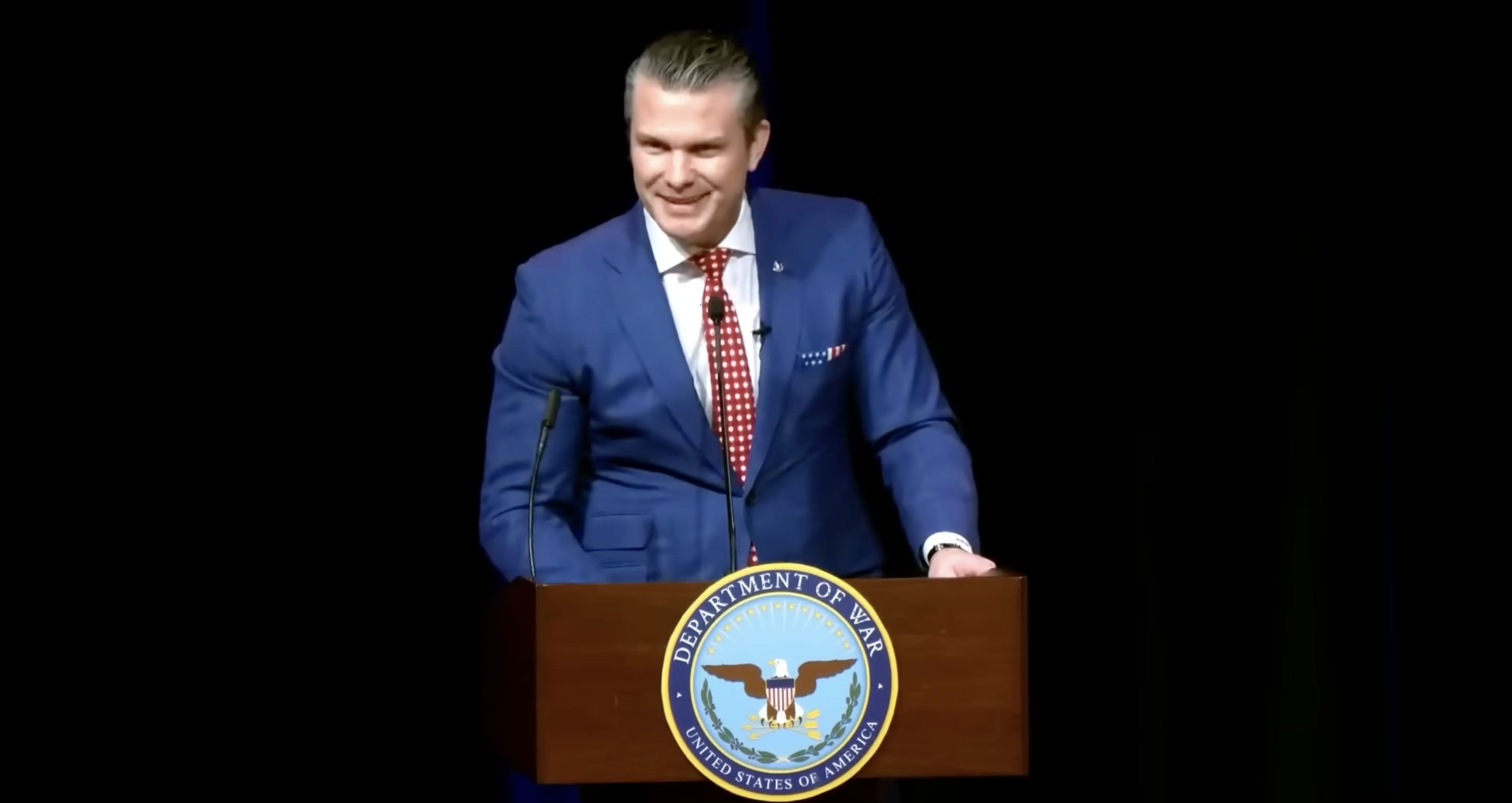
To review the situation for those who didn't follow the story, Secretary of Defense Pete Hegseth last week incorporated a 'prayer' that he said he was given by service members called CSAR 25:17, which he said is a reference to Ezekiel 25:17.

He then quoted the 'prayer' as he said it was given to him, which turned out to be a very slightly edited adaptation of a speech given by Samuel L. Jackson in the Quentin Tarantino film Pulp Fiction as Jackson, who plays a hit man in the film, is about to kill someone.

Here is the transcript of the relevant section:

Which leads me finally to a prayer that I'll read, which was also handed to me a couple of days ago. [It was] delivered from the lead mission planner of Sandy One. Sandy One were the A-10s that were a part of the daylight rescue mission of 44 Alpha -- Dude 44 Alpha -- out of Iran. And if you know anything about Sandies, their job is to bring those A-10s and put them in between the enemy and that downed pilot. And so their job is to literally sacrifice themselves for someone else. And in Iran -- in contested territory -- that's exactly what they did.

So it's this prayer [that] was recited by Sandy One, which is one of the Sandies -- [a prayer] to all Sandies, all those A-10 crews prior to all CSAR [Combat Search and Rescue] missions, but especially this CSAR mission that happened in real time. They they call [the prayer] CSAR 25:17, which I think is meant to reflect Ezekiel 25:17.

So the prayer is CSAR 25:17 and it reads -- and pray with me, please:

The path of the downed aviator is beset on all sides by the iniquities of the selfish and the tyranny of evil men. Blessed is he who in the name of camaraderie and duty shepherd the lost through the valley of darkness. For he is truly his brother's keeper and the finder of lost children. And I will strike down upon thee with great vengeance and furious anger those who attempt to capture and destroy my brother. And you will know my call sign is Sandy One when I lay my vengeance upon thee. And amen.

Steven Wedgeworth's response to this is worth quoting in full:

“And you will know my call sign is Sandy One.” ~US Secretary of War, Pete Hegseth ...

When I first heard this one, I didn’t fully take it in. It’s just young guys having a laugh in a high-pressure situation. Not the best taste, but boys will be boys. I didn’t reflect on it enough. I was more focused on the whole Pulp Fiction part.

But what’s actually going on here? The real Bible verse says, “They shall know that I am the Lord.” In Ezekiel, God is the speaker. That’s also still true in the Pulp Fiction version, even though it’s obviously being perverted. But in Hegseth’s CSAR prayer, there has been a textual edit. In his version, the rescue unit is the speaker. They have identified themselves with God and His eschatological wrath. Sandy One is the Lord.

We already are dealing with a third commandment violation, in other words.

But, Wedgeworth continues,

Put yourself in that room. It’s a sort of parachurch time for prayer and even spiritual worship. The whole point is that you are bringing God back to the military. And then you hear that “prayer.” How do you feel?

Even more than being outraged at the trivialization of an ordinary means of grace, I hope someone asked this question— Who exactly are we praying to here?

Are we bowing our head to CSAR?

Seriously dudes. What are we even doing anymore? ...

Worship shouldn’t be a joke. Accidental sacrilege is not a great strategy in wartime. I don’t want the Lord to strike down upon us in furious anger.

And I gotta say bro, right now, we are doing the sort of things that have historically gotten that reaction out of Him.

In the most plain sense of the event, the above is what happened: The Secretary of Defense, performing an act that was intended as public worship in a recognizably Christian service, violated the third commandment and equated God with our armed services. And he did so while trivializing the worship service itself by quoting from a Quentin Tarantino movie in what certainly seems to have been a meta-ironical way. (If you watch the video, there are several little knowing smirks or looks you can see in both Hegseth and his audience which suggest that he and they know exactly where this 'prayer' originated from.)

So all of this is bad enough.

But I now want to highlight the reaction when people condemned Hegseth's behavior, because it is, once again, a textbook example of using meta-irony as a way to excuse and mask reprehensible behavior.

Here is Daniel Strand, an instructor at the Air War College attempting to justify Hegseth's actions:

strand on hegseth

"Dark humor mixed with real spirituality." Hello, meta-irony.

Or, perhaps we should go straight to the wisdom of Scripture:

Like a madman who throws firebrands, arrows, and death,  Is the man who deceives his neighbor, And says, “I was only joking!”

Not to be outdone by Strand, Erick Erickson made much the same argument:

erickson on hegseth

"They took him out of context!"

Apparently there are contexts in which third commandment violations are acceptable?

At the time of the Reformation certain Christians dissented from the state church on grounds that any civic organization requiring vow-taking as a condition for membership was a violation of Christ's plain words in the Sermon on the Mount to "let your yes be yes and your no be no." I do not think those Radical brothers were correct in their application of Christ's words—if they were then there are examples from the lives of the apostles that we would have to regard as sinful even though we have no textual merit in Scripture for doing so.

And yet I cannot help respecting the sobriety and seriousness with which those radical Christians read the Scriptures. There is a gravity about their faith and a sobriety that is moving and powerful and admirable—and that sobriety drove them toward a conspicuous sort of generosity and love of neighbor that still inspires many 500 years later. That is a million miles from the glib and blasphemous place in which a non-trivial portion of the American church now finds itself, when politics have caused them to become blind to the significance of prayer, of gathered worship, and the terrifying danger of blaspheming a holy God through irreverent mockery. 

Ross Douthat said it best recently when he wrote the following after President Trump's recent posting of an AI image depicting himself as Jesus,

But the core issue from a religious perspective isn’t whether Muslims or Catholics or evangelicals should be personally offended by the specifics of any given presidential foray. It’s that there’s a consistent thread linking profane Easter Sunday threats, a rant against the world’s most famous Christian leader and the depiction of yourself as the Second Person of the Trinity. The compounding offense isn’t against religious identity or papal dignity. It’s a violation of the first and second commandments, where the offended party is Almighty God.

If you are a secular observer who assumes that blasphemy is a sin without a real object, that escalation matters mostly as a window into the president’s second-term state of mind.

If you’re a believer, though, then Mr. Trump’s entire political career — his catalyzing role in liberalism’s crisis, his movement from power to exile to power once again — exists under providential power. In which case a turn to presidential blasphemy is a warning for his religious supporters about potential conclusions to the story, and the spiritual peril of simply sticking with him till the end.

The things which both President Trump and Secretary Hegseth have done in recent weeks are things that send a person to Hell. They are things that, when done by men in the Bible, sometimes led to their instant death at the hand of a righteous and wrathful God who will not see his name mocked. If you doubt me, you can take it up with Uzzah and with King Herod.

We should see these things clearly for what they are, not only so that we can warn others in our attempt to care for the souls of our brothers and sisters, but so that we too can keep watch over our own souls. For what is happening now is not dark humor or out of context speech or ironic joking. What is happening now is the normalization amongst conservative Christians of grave offenses against almighty God.

true true

Did you find this helpful?

Mere Orthodoxy publishes serious Christian intellectual thinking. Subscribe and get our best writing in your inbox every week.

Free.

Jake Meador

Jake Meador is the editor-in-chief of Mere Orthodoxy. His writing has appeared in The Atlantic, Commonweal, First Things, Books & Culture, National Review, Comment, Books & Culture, and Christianity Today. He is a contributing editor with Plough and a contributing writer at the Dispatch. He lives in his hometown of Lincoln, NE with his wife and four children.