


The year is 1943, and change is in the air. After years of enduring a seemingly unstoppable Blitzkrieg, the message of British leaders was beginning to take a different tune. Victory–total, inevitable, unmistakable victory against Germany and the Axis powers–was right around the corner. The war was still raging at full force, with the battles of Normandy, the Bulge, and Berlin yet on the horizon, but an Allied victory over Germany was now a question of when, not if, and the tone and tenor of British leadership and civic life began to adjust accordingly. Life beyond the war was no longer something to wistfully long for in a bomb shelter; it was something already, but not yet fully, here.
The year is 2025, and towards the end of the year, change entered the air. After three years of breathless proclamations by AI advocates about how AI will radically reshape the world, something seems to have given way. What exactly that something is, whether it is one something or many, or even if there is something there at all, is hotly debated–but the tone and tenor has adjusted, just as in 1943, as has the scope of the proclamations and expectations. Whatever this something is, it is not just concerned with AI, but with the Internet as a whole. A tipping point has been reached, and the fallout is only a matter of time.
But unlike 1943, the fallout of 2025 remains uncertain. The Allies saw their expectations for victory realized on May 8, 1945 with the unconditional surrender of the German army. The expectations for 2025 and beyond remain nebulous. The radical claims of AI advocates remain yet to be seen, but a more modest claim–that the Internet is undergoing a substantial transformation because of AI–is harder to refute. And if this claim is true, it inevitably means aftershocks of change will follow from the epicenter. The Internet as we have taken for granted for the past thirty years is fading away, and it is a question of when, not if, this becomes undeniable.
The challenge before us is not unlike what Alan Jacobs describes in his introduction to The Year of Our Lord 1943. Following the defeat of Germany and the Axis powers:
There would be much remaking and reshaping to do: who would do it, and what principles would govern them? Such thoughts were on the minds of many, and some of the more ambitious and provocative ideas emerged from a small group of Christian intellectuals. This was a time—it seems so long ago now, a very different age, and one that is unlikely to return—when prominent Christian thinkers in the West believed that they had a responsibility to set a direction not just for churches but for the whole of society. And, stranger still, in that time, many of their fellow citizens were willing to grant them that authority—or at least to listen when they asserted it. (pg. xi)
Indeed, that time is not returning any time soon. Neither the technology nor the cultural milieu afford us the conditions C. S. Lewis, T. S. Elliot, Simone Weil, and the other thinkers Jacobs surveys were working under. And yet the need for Christian thinkers to speak to the remaking and reshaping yet to be seen, to those most likely to do it and the principles that govern them, is just as urgent. A window of change affords Christian thinkers to be proactive, rather than reactive, in setting direction for Christians on how to make sense of the changes yet to come, even if their final shape remains to be seen.
To do this, we need categories to help us make sense of the past state of the Internet that can help us anticipate the future state of the Internet to come. These categories need to be simple enough to clearly organize and summarize a tremendous amount of information, and durable enough that they can be used for years to come to track these changes over time.
For this inaugural State of the Internet report for Mere Orthodoxy, I am going to introduce the categories of Event, Empire, and Epoch as I've developed them over the past several years in my own Digital Babylon framework.
In order to not overcomplicate a report that is already long and dense, I will save the background of my framework–which I've described as "the climax of the Old Testament meets Neil Postman's Technopoly”–for elsewhere, borrowing only what is necessary for making this report possible (see my original outline and hermeneutic sketch of the framework for more).
However, my hope with this report is to engender a similar response that I hope with my framework. “For whatever was written in former days was written for our instruction,” the Apostle Paul writes in Romans, “that through endurance and through the encouragement of the Scriptures we might have hope.” And for whatever changes a changing Internet brings to a society intimately dependent on the Internet and all it makes possible, the hope of Christians–in the face of how a changing Internet changes ministry, family life, civic life, and more–is one thing that ought never change.
Event: 2025 Was a Turning Point for the Internet
Digital Babylon refers to two things:
- First, the rapid and meteoric rise of immensely powerful tech, media, and telecommunications companies
- Second, the moment society reached the point of no return relative to the world that existed previously
Like the Babylon of the 6th century BC, Digital Babylon emerged over time, transforming the world gradually yet radically. One can think of the release of the iPhone in 2007, the launch of the first true Facebook smartphone app in 2012 (replacing the slower, clunkier HTML version that released in 2008), the debut of TikTok in 2019, and most recently, the release of ChatGPT in 2022.
While it was not immediately obvious at the time, these events fundamentally changed the world in ways we are still trying to come to terms with. As with the destruction of the walls of Jerusalem at the hands of Babylon in 587 BC, we cannot rewind the world back to a pre-smartphone, pre-social media, pre-LLM state.
When I speak of events within this framework, then, I am speaking of those specific moments in the story where some decisive next step was taken in the entrenchment of Digital Babylon.
2025 we saw the latest such event as the infrastructure of the Internet began to shift in unprecedented ways. By "infrastructure", I am referring to both the physical and technical components that make the Internet work as well as the services running atop all those servers, fiber optic cables, and routers that we more colloquially refer to as "the Internet", which used to go by the name "World Wide Web."
While I acknowledge some overlap, I will distinguish "infrastructure" from "content." The latter refers to the propositional information communicated via the Internet in text, images, video, audio, and peer-to-peer media; this is what "media literacy" most often refers to. The former refers to the necessary scaffolding that makes the hosting, accessing, creating, and sharing that information possible; this is what "media ecology" addresses. Said another way, the infrastructure of the Internet is the house, the content of the Internet is what makes the Internet a home. And after years of an unfathomable amount of people moving in and out of the home, the house itself is being gutted and rebuilt.
This distinction is vital because the way society has grown accustomed to talking about "the Internet" is unsuitable for comprehending what is now taking place. Just as "the Internet" eventually came to mean "World Wide Web" in popular use (even though the two are substantially different things), so certain aspects of "the Internet"–social media, streaming, Internet culture, gaming, pornography, among others–have come to function as practical synonyms for "the Internet."
In other words: the majority of our conversations around the Internet concern the content of the Internet. This is perfectly understandable, given that the biggest story of the Internet since the dawn of the smartphone-empowered social media era has been the unfathomable increase in content created in ways that were previously unimaginable. But those categories I mentioned are now, for the most part, largely "solved."
As product categories, nearly every option and combination of options that could exist now does. The supply and demand for new social media content, more bingeable Netflix shows, new games to play and porn to watch and everything else that we think of as "Internet content" may ebb and flow, but the total volume of content flowing will be far more than any one person can possibly keep up with.
What is not solved as a product category, however, is AI. This report is not about AI, but it is impossible to discuss the changes to the infrastructure of the Internet without talking about it. The two primary culprits–LLMs and agentic AI–are each reshaping the structure of the Internet in mutually reinforcing ways. “The internet” as we usually think of it was once a set of commonly accessible websites that users could all access in equivalent ways and where they would have roughly equivalent experiences.
However, in recent years as the web has become customized and personalized that has begun to shift, such that each user of the internet comes to possess their own personalized internet, customized to their desires, needs, and actions. LLMs are now accelerating that trend at an unimaginable rate. They are taking the content of the Internet and re-arranging it in a new layer atop the World Wide Web, one that is atomized and personalized to the individual user.
Meanwhile, according to MIT's 2025 AI Agent Index, there were at least 30 prominent AI agents for chat, web browser, and enterprise use by the end of the 2025. (Agents are specific individualized AI-powered actors that can do something very like decision making, which makes them a kind of tailored personal assistant to the owner of the agent. If LLMs are a kind of super-powered search engine, AI agents are something more like Tony Stark’s J.A.R.V.I.S. from the Iron Man movies.) Open Claw, which took the Internet by storm in January 2026 with its AI-agent social network "Moltbook", didn't even make the list– although given that OpenAI hired Open Claw creator Peter Steinberger shortly thereafter Open Claw went viral, it's only a matter of time before the widely-praised accessibility of Open Claw appears in OpenAI's array of AI offerings. While LLMs and other AI chatbots may simply continue to iterate and improve over time, MIT’s report is clear that the development of agentic AI that began in 2025 shows no sign of slowing down:
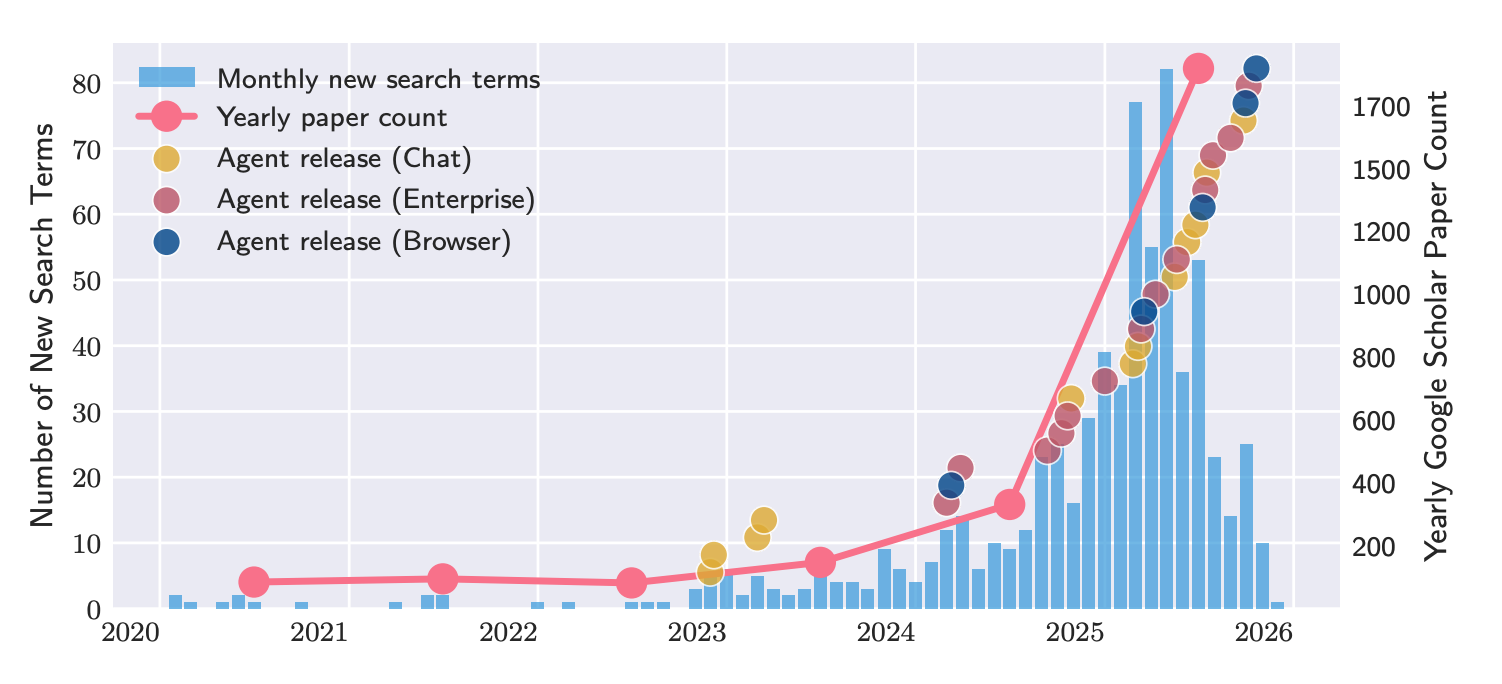
Whatever your opinions may be of the promise or pitfalls of AI, all of this development is having a measurable impact on the Internet. Cloudflare’s 2025 Year in Review reported that global internet traffic grew a whopping 19% in 2025, and that most of this growth can be traced to AI crawlers and agents. Over 30% of global web traffic is now bot traffic, with GPTBot and ClaudeBot in an arms race to take second place to Google’s dominance.
AI also empowers bad actors to assault others on the Internet through cyberattacks so severe that ”it can disrupt or degrade Internet service for adjacent (non-botted) customers of the ISPs.” In other words, if your next door-neighbor gets a strong enough direct-denial-of-service attack, you’ll lose your Internet access too. All of this amounts to “[a] busier, more brittle, more hostile network”; as Cloudflare CEO Matthew Prince remarked, "The internet isn't just changing, it's being fundamentally rewired. From AI to more creative and sophisticated threat actors, every day is different."
“So what?”, you may think. “I’m not an Internet technician. I’m not a fan of AI. I’m not planning to change how I use the Internet. Why does any of this matter to me?”
One of the most striking quotes of Neil Postman’s Amusing Ourselves to Death is not from Postman himself, but from Annenberg School of Communications Dean George Gerbner:
“Liberation cannot be accomplished by turning [television] off. Television is for most people the most attractive thing going any time of the day or night. We live in a world in which the vast majority will not turn off. If we don’t get the message from the tube, we get it through other people.”
If there is anything the major “events” of the past near-two decades have in common, it is that the Internet has been “for most people the most attractive thing going on any time of the day or night.” But unlike television, the Internet is more than just entertainment. The Internet may preserve the “old paths” of use, but it is the infrastructure of the Internet and how we use the Internet that shapes what influence the Internet has on our social, political, and economic imaginations. And unlike new content to consume, a change in the infrastructure of the Internet threatens aspects of the Internet that we have long taken for granted, such as the Internet’s role in banking, housing, employment, medical care, education, criminal justice, transportation and other vital industries and institutions already feeling unprecedented challenges by industry-specific AI in ways that rarely make the headlines.
What LLMs have already done to the content of the Internet, agentic AI has yet to do to the infrastructure of the Internet. With the launch of ChatGPT and the rapid development of generative AI, it was not long before you began to wonder if the article, social media post, school essay, or email was made by AI. With the explosive growth of agentic AI in 2025, it will not be long before the question shifts from “was this made by AI?” to “was this action taken by a human?”
How long will it be before “sorry, my AI agent went haywire” becomes the first line of defense for actions and behavior that could’ve only previously been done by a human actor–and says something that cannot be unsaid through a social media account, breaks something that cannot easily be repaired that countless people rely on to work or travel, or upends the careers and callings of people you know and love because the Internet laptop-class jobs that let them spend more time at home with their kids or move back home to be close to their parents just aren’t needed anymore?
To put it bluntly: you are naive if you think these disruptions won’t directly affect you, or indirectly affect you through the effect they will have on others. If the iPhone, social media, and AI have taught us anything, it is that you are impacted by these events regardless of whether you participate in them or not. A changing Internet will change you. It will change you in ways you can see and in ways you can’t. It will change those you live with, work with, play with, build with, and fight with. It will change what is possible, probable, permissible, and prohibited in your life, your vocation, your church, your neighborhood, and any other physical space the Internet touches.
The glue that holds together all our computers, smartphones, servers, algorithms, routers, streams, databases, digital wallets, cloud backups, and countless other points of contact in between cannot give way without causing all that the glue holds together to move with it. At some point or another, you will feel it move, whether you want it to or not.
But this is where this State of the Internet project comes in. We must train ourselves to see a longer time horizon in a season of nonstop back-to-back breakthroughs and developments.
Real-time updates are important, but Christians cannot solely depend on them if we want to live well in this moment.
The number of small-scale “events” that will happen in 2026 will be far more than anyone can keep up with. The only way to meaningfully understand the Internet will be to begin tracking big-picture changes of the Internet, namely as infrastructure, over a longer period of time. The category of “event” helps us classify which developments are worth remembering because of their consequence for years to come, and which ones ought to be forgotten in the dustbins of hype and hubris.
Empire: From FAANG to the Magnificent Seven and Beyond
The “empire” of Digital Babylon refers to the key companies, industries, and innovators that exert economical, cultural, political, and spiritual pressure on us individually and collectively with their products, tools, and services.
Of the three categories of this report, “Empire” is the most straightforward: firms and technologists like Amazon, Meta, Sam Altman, Elon Musk, and many others are household names alongside any celebrity or public official. These individuals and organizations wield an unfathomable amount of power over nearly every sphere of life and society, rivaling the power of the governments of the nations they are based in. As with a typological understanding of Babylon in Scripture, the empires of Digital Babylon refer both to individual entities (the historic Babylonian empire) and a collection of entity-types, which conglomerate into the real-time economic form of Babylon the Great.
2025 was the year that any remaining vestiges of FAANG were finally swept away for good. FAANG, an acronym referring to Facebook, Amazon, Apple, Netflix, and Google, arose around 2013 to label the five key economic juggernauts of the new era. The acronym would remain a reliable rubric for the “gold standard” of modern tech companies until 2023, when it became clear that OpenAI’s groundbreaking innovation would inevitably lead to a shakeup. By 2025, the “Magnificent Seven” was widely adopted as an updated label for a new group of companies: Apple, Microsoft, Alphabet, Amazon, Meta, Nvidia, and Tesla. But unlike FAANG, the “Magnificent Seven” is a more flexible moniker. Though the stocks of these companies constituted a whopping 1/3rd of the S&P 500 in 2024, the term is flexible enough to adjust the companies included in this designation–an eventual possibility given the relative underperformance of some of the companies in this grouping.
The changes from FAANG to the Magnificent Seven are instructive for the future of the Internet. In FAANG, the emphasis is content: Facebook, Netflix, and Google (YouTube) make up the majority, while Apple focused mostly on infrastructure and Amazon was saddled somewhere in between (Amazon Instant Video first launched in 2011 and was later rebranded “Prime Video” in 2018). With the Magnificent Seven, the emphasis has shifted to infrastructure: Apple, Microsoft, Nvidia, and Tesla make up the majority, and even Alphabet, Amazon, and Meta have made significant inroads with hardware and software developments of their own.
Future contenders for the Magnificent Seven or a subsequent group are all companies that build infrastructure for interfacing with and extending the Internet: Taiwan Semiconductor Manufacturing Company (chipsets/processors), Micron (memory), Visa/Mastercard (finance), Symbiotic (robotics), Intuitive Surgical and Tempus AI (med-tech). Both OpenAI and Anthropic may reach this threshold after they go public later this year if their IPOs perform as well as expected.
If the 2010s were dominated by the content of FAANG in the glory days of a cheap Netflix subscription and Facebook back when it was cool, the late 2020s-early 2030s are shaping up to be dominated by the unprecedented expansion of the Internet thanks to new infrastructure provided by the Magnificent Seven - to say nothing of your regional ISP and companies like Cloudflare that keep the Internet humming along as best they can.
New to the picture are the physical colonies of Digital Babylon in the form of AI data centers. By the end of 2024, there were 1240 known data centers in construction; by the end of 2025, that number had soared to an estimated 3000 planned or in construction. Though the grassroots resistance to these data centers has been significant at the local, state, and national level, that hasn’t stopped data centers from surpassing the number of Home Depot, Costco, and Target stores in the USA in a matter of years.
But the truth is much bleaker: getting a precise count of just how many AI data centers there are in operation or under construction is almost impossible because AI data centers, strictly speaking, are not a singular “thing.” Rather, it is a popular term that refers to a facility that is likely multi-purpose, being used for AI and non-AI related data work. Once a data center is built and operational, it will not just support the company who owns it, but numerous other companies, products, and services that rent out functionality of that data center for their own use–all of which, of course, requires a strong and stable connection to the Internet to make use of.
This leads to a very important point about the “AI Bubble”: even if this gold rush of data center construction is being spurned on by advances in AI, their integration into the infrastructure of the Internet will ensure that even if the AI bubble pops, the Internet’s expansive reach will not recede to previous levels. A certain level of gains have already been locked in, and even if AI’s gains plateaued in 2025, it would still be more than enough to ensure that AI remains a part of the Internet, a part of any aspect of life that relies on the Internet, and for the physical landscape of America to be permanently reshaped by new egresses of the Internet into the physical world. Whether those data centers are being used for AI or non-AI related work, they will be in use for something. And as long as this infrastructure exists, the Internet will continue to gain new territory. A market correction may happen, but just as the dot.com bubble of the 90s taught us, a burst bubble does not mean the end of the story.
All this, of course, is just for America and the West. The impact of these Empires are not equally distributed: if you cannot access the Internet, these companies, products, and services are less influential. Starlink, the satellite Internet service from SpaceX, doubled its traffic in 2025 and brought the Internet to 20 countries for the first time. Even in countries and regions where Starlink was already operating, adoption skyrocketed: 51x growth in Benin, 19x in Timor-Leste, and 16x in Botswana. Where the Internet is a reality we take for granted in the West, more than a quarter of the global population lacks Internet access, especially those in least-developed and landlocked-developing countries (LDCs and LLDCs, respectively), which tend to be rural and lacking in infrastructure stability for basic needs such as food and water.
There remains territory yet to conquer, and the number of satellite Internet options is increasing–including services from Amazon and China. The Empires that rely on the Internet to exist have every incentive to throw as much money as they can towards expanding their presence where their names aren’t preached. What happened with Myanmar in 2016 when then-Facebook bankrolled the country’s ISP development and saw Facebook become the country’s de-facto Internet may happen yet again, as will the expansion of crypto-scamming operations that function as a growing form of modern day, Internet-enabled slavery in places like the Golden Triangle (Myanmar, Cambodia, Laos).
The point is this: if we still cannot fully comprehend the depth to which the economic titans have used the Internet to fundamentally reshape modern life, we are even less prepared to comprehend an Internet that is both changing and expanding throughout the world. And to refer back to the infrastructure vs content distinction: it is the infrastructure of the Internet that allows for the Empires that rely on the Internet to reshape the world far beyond the content of the Internet itself.
Just this week (as I write), the Attorney General of California filed a preliminary injunction against Amazon to halt a price-fixing scheme so pervasive it has likely increased prices–at the rate of twice the rate of inflation–for the entire American economy. If traditional price-fixing schemes, such as the recent Pepsi-Walmart scheme, can have a measurable impact on the quality of life of millions of individuals, how much more so one for an Internet company used by people in places that do not even have a Walmart? The questions that could be raised for Amazon and the things we know about them can be multiplied for each of the companies of the Magnificent Seven and for numerous other companies that are still tremendously influential even if they’re not as lucrative. Our worldviews may be deeply influenced by the content of the Internet, but it is the infrastructure of the Internet that governs the social imaginary of where we will shop, where we can get jobs, where we can socialize, who we will get medical care from, and increasingly what cars we can drive or what AI and (eventual) robotic agents we can deploy for our vocations and convenience. And as the Internet changes, that social imaginary will change once again.
Where the State of the Internet Project comes in is to give increased attention to the Empires that shape the infrastructure of the Internet. The content of the Internet will always be important, but in a moment where the countless Internet writers and social media content creators are settling into a fixed playing state, understanding the infrastructures of the Internet as developed and used by economic juggernauts of unfathomable size and power will be more important than ever.
To give language to this change, we must take the best of Christian thinking regarding the social and political imaginary and apply it to the economic imaginary of life under the glowing shores of Digital Babylon, and that kind of work cannot be done with quick hot takes. It will take slow, deep, and thoughtful meditation to apply the riches of Christian thought to making sense of the companies that got us here and where they are taking us.
Epoch: The Need for the One Body with Many Parts to Form a Shared Reality of the Internet
The “Epoch” of Digital Babylon is a period where individuals, families, churches, and communities must pursue faithfulness to the Lord relative to their placements and callings throughout Digital Babylon as they endure God-ordained technological opposition and oppression.
Where “Event” seeks to make sense of “what has happened?” and “Empire” seeks to make sense of “who is responsible?”, “Epoch” seeks to make sense of “how then shall we live?” And before we can answer that question relative to the State of the Internet, I need to import some additional background context from my Digital Babylon framework first.
The Babylonian exile, much like the coming kingdom of God, started off as an already-but-not-yet-fully-realized epoch of time. By the time Jerusalem was destroyed in 587 BC, there had already been two prior deportations of Judeans to Babylon, the first in 605 BC and the second in 597 BC. While the exile technically began in 605 BC, including for key biblical figures such as the prophet Daniel, the exile would not become a uniform reality for another 18 years.
But even after the final deportation, it was already established that the question of “how then shall we live?” would not be uniform for every person. The earliest seeds of Paul’s teaching of “one body with many members” from 1 Corinthians 12 are found in the distribution map of the exiles in response to Babylon as event and empire. One exile led to many destinations, each with their own set of unique answers to the same question. For Daniel and his three friends, the answers to the question “how then shall we live?” would look radically different from how Ezekiel, living in the squalor of mud huts with the exilic community by the Chebar Canal after the second deportation, would answer the same question. The same is true of Jeremiah (both before the third deportation and after), and then later for Ezra, Nehemiah, and Esther.
Of course, all of them would have shared the same beliefs about YHWH, the one true God, and his Law and promises to his covenant people. But once the promised land of Abraham and temple of Solomon were completely taken away for all, it was no longer possible for the people of God to answer the question “how then shall we live?” in a uniform way because there was no longer a shared reference point making it possible for the people of God to live out those answers in the same way. An organic unity amid diversity would emerge, one that would continue into the New Testament church and down into the present.
Understanding the Babylonian exile requires understanding the totality of the exile as experienced from the numerous vantage points given us in Scripture. No one individual’s experiences or circumstances are considered the one “true” standard by which the others are evaluated. This, too, carries over into Paul’s teaching of the body of Christ. Just as “the eye cannot say to the hand, ‘I have no need of you’, nor again the head to the feet, ‘I have no need of you’” (1 Cor 12:21), so it would’ve been unfathomable if Daniel had said to Ezekiel “Because you are not up here with me in the upper echelons of the Babylonian and Persian governments, I have no need of of you,” or Ezekiel to tell Jeremiah “Because you are not here with us on the shores of Babylon, I have no need of you.” Long before Paul wrote,
“If the whole body were an eye, where would be the sense of hearing? If the whole body were an ear, where would be the sense of smell? But as it is, God arranged the members in the body, each of them, as he chose. If all were a single member, where would the body be?” (15:17-19)
God had already provided the types and shadows to illustrate his point. As Douglas F. Kelly once remarked, “every truly Christian doctrine is found in the Old Testament”, and for Paul’s teaching about the organization of the body of Christ, it is found in the saints who endured the same event, brought about by the same empire, and lived through the same epoch in different ways.
This leads to the foundational starting point for this section of this report: if there is not one “single member” of the body of Christ, there cannot be one single answer to the question “how then shall we live with respect to the Internet?” Rather, we need all members of the body of Christ–the eyes, the ears, noses, mouths, arms, hands, feet–to answer this question both with respect to their individual members (“how do the eyes live as eyes?”) and to their individual members relative to the one body (“how do the eyes serve the body?”).
This is not a licence for relativism. No part of the body of Christ may sin in order that grace may increase, or find its nourishment apart from Christ as the one head. Rather, this is both a Scriptural reality, and a reality born as a result of the accelerated fragmentation of the Internet itself.
It is no secret that the very technology that promised to unite the world and usher in a new era of human learning and knowledge has not lived up to its promises. Instead of unity, we live in the collapse of a shared reality. Instead of the democratization of resources and knowledge, we live under new forms of tyranny. The early days of social media promised the ability to gain a level of omniscience over what was happening in the world, but even before personalized algorithms came into view, this was always an illusion.
At no point has it ever been possible for one person to truly comprehend the Internet in its fullness; while I try to be a person mindful of his blind spots, there are undoubtedly things that I don’t know I don’t know. But as the Internet continues to atomize in ways that further erode what little of a shared reality we have left, the Church has an opportunity to resist this atomization by bringing together Christians from all walks of life–the “pastors, professors, and product managers” as we use for a tagline for the What Would Jesus Tech? podcast–to form a colony of a shared reality regarding the Internet and the multitude of ways to “let each person lead the life that the Lord has assigned to him, and to which God has called him” (1 Cor 7:17).
The world, including the best of secular media ecologists, humanists, and journalists, cannot create this. Only Christ can create this through those “holding fast to the Head, from whom the whole body, nourished and knit together through its joints and ligaments [and growing] with a growth that is from God” (Col 2:19). And while our present circumstances may not have complete overlap with those of Christians in 1943, the opportunity for the Church to bear a unified-yet-diverse witness to the dawn of a new world remains the same.
While the long-term need for this epoch is for Christians to work together in the manner I’ve described above, there are some urgent short-term needs that Christians must aim to address in 2026. Using the four spheres I identified in my definition for Epoch–individuals, families, churches, and communities–I want to pose a series of questions to help you think through “how shall we live?” in some more concrete ways.
To be candid: a good number of these questions are autobiographical. As I’ve found them helpful, I include them here in the hopes you might find them helpful too. These questions aren’t exhaustive, applicable to everyone in the same way, or even unique to our situation in 2026. But rather than making predictions or prescribing certain courses of action, we should each take a moment to get our bearings on the role of the Internet of our lives now to have as a baseline for whenever these changes to the Internet wash upon our shores.
Individual
- Who am I with the Internet? Who am I without the Internet? Are my answers to those two questions answers that let me say “my only comfort in life and death is that I am not my own, but belong…to Jesus Christ?” (Heidelberg Catechism 1)
- Where are the boundaries of the Internet in my life? Which of those boundaries are necessary, and which of those boundaries are voluntary? Are those boundaries helps or hindrances to my life as a Christian and to the callings and vocations the Lord has given me?
- For as long as I’ve used the Internet, what has proven beneficial to my life as a Christian? What has proven detrimental? How would an Internet reshaped by AI amplify those dangers?
- What role does the Internet play in my rest and recreation? What are the skills and hobbies the Internet helps me in? What are the skills and hobbies that would survive without the Internet? What skills or hobbies would I like to develop that the Internet interferes with?
- How do I extend the Internet’s presence into the lives of others? Where would I draw the line on physical hardware (security cameras, AirTags, smartglasses) that extend the physicality of the Internet into my life and family? At what point would I say “enough is enough” to physical devices that require the Internet to function?
- What role does the Internet play in the life of my spouse, friends, and family members? If one of them told me they felt like their personal AI assistant or an AI chatbot understood them better than their spouse, their friends, or God, would I know what to say or how to respond?
- Am I the kind of person that would warmly welcome someone looking to escape their reliance on the Internet, or someone that would passively reinforce or require it to be in community with? Do I know how to enjoy a conversation over a cup of coffee, or a meal around the table, or drink at the local brewery, or a board game over several hours without using the Internet?
- Do I believe that my Internet usage is something that falls under the purview of God’s sanctification in my life? What would need to change to where I saw the Internet and its role in my life as a matter of growth in Christlikeness?
Family
- What does the Internet make possible for my family? How much of our lives–including our house, vehicles, education, and standard of living–is dependent on the Internet being a stable and reliable presence in our lives?
- How much of mine or my spouse’s job is dependent on the Internet? If one or both of us lost our jobs due to changes in the Internet or an AI-driven layoff, what would be our Plan B? Do we have enough money in savings to weather a season of unstable employment?
- What role does the Internet play in my marriage? Where has the Internet been a help to my marriage? Where has it been a hindrance? Do I know how to talk with my spouse about our Internet usage and habits? Can I imagine enjoying our marriage if the Internet played a less/different role in our lives?
- Where does the Internet help me manage my household? How much of our finances, education, healthcare, and other information is only accessible or knowable through an Internet connection? What role does the Internet, and specifically AI (either LLM or agentic), provide guidance and assistance for managing my family’s needs?
- If my children were to retain mine and my spouse's Internet habits, what would those habits be? How do we use the Internet to build, create, and grow? How do we use the Internet to distract, numb, and isolate? Are those habits we want them to have?
- How does the Internet help me disciple my family? How does the Internet get in the way of discipling my family? Is the Internet such a strong presence in our home that it precludes catechesis and prayer? Does the way we use the Internet lead us to trust in the providence and power of God, or in our own strength, wisdom, and willpower to provide our own daily bread?
- What role does the Internet play in creating a shared culture in our home? How much of our shared stories, hobbies, and traditions are dependent on the Internet? What role does physical media, and the technology to make physical media use possible, play in creating shared reference points for my spouse and children? How can we build a “digital hearth” that brings our family together rather than isolates us to our individual devices?
Church
- What role does the Internet play in my church? What is the minimal amount of Internet-enabling technology one needs to have to participate in church life? What aspects of our church would we lose if the Internet no longer supported it? Where am I willing to draw the line on Internet-dependent technologies being allowed in my church?
- If I am a pastor: do I comprehend how much I utilize the Internet for my work? How confident am I in my ability to do my job without the Internet? If I am a layperson: do I know how my pastor(s) utilize the Internet for their work? Do I trust that my pastor could care well for my soul if all he had was a physical Bible and other physical ministry resources?
- If I am a pastor: have I established clear guidelines and boundaries for when and where AI use is permissible among my church staff? If AI use results in time saved, have I instructed how that time saved is to be spent? If I am a layperson: do I know how my church staff uses AI in their work? Are these uses for AI that afford them more time in the Word, prayer, and service to the people in the church, or shortchange those efforts?
- If I am a pastor: do I know how many people in my church rely on the Internet for their job? If those people were to lose their jobs due to AI-induced layoffs or some other change in how the Internet functions in their industry, how would those people respond? How much of our tithe income is dependent on jobs empowered by the Internet? How many of our leaders would we lose if upheavals to industries dependent on the Internet had to move away to find new work?
- If I am a pastor: is discipleship regarding Internet use and Internet culture a part of my discipleship programming? If I consider this as important an issue as discipleship on finances, marriage, and parenting, what are my options for consistently addressing it? If I am a layperson: would I support my pastor(s) if they wanted to begin discipleship with respect to the Internet, or would I resist it?
- If I’m a pastor: how will I teach my denomination or tradition’s doctrinal and ecclesiological standards when LLMs train its users to think “non-denominationally” about theology, the Bible, and the church? If I am a layperson: do I know my denomination or tradition’s doctrinal and ecclesiological standards well enough to recognize when my Internet habits and usage conflict with those standards? How important is it to me that I walk in unity with my church’s beliefs and leadership?
- If I am a pastor: would I know what to do if someone in my church was acting out of an AI-induced psychosis from over-reliance on an AI chatbot? Would those around me or under me know what to do? If I am a layperson: if someone in my life was pursuing a romantic, violent, or spiritual relationship with an AI chatbot, do I know what I would do? Do I know who I would ask for help? Would my pastor(s) be among those people I’d reach out to?
Community
- What role does the Internet play in my community? How much of my knowledge and experience of my community is mediated by the Internet? What are the things I know about my community by my physical presence and activity, and what are the things I know from reading about it through social media or local news?
- How does the Internet facilitate participation in local political life? What are the necessary devices, social media platforms, or other products/services one needs to use to get reliable up-to-date information about local elections, meetings, events, and community services? What are the avenues for finding out this information outside of the Internet?
- How much does the Internet determine the social life of my community? How easy is it to meet and socialize with new people outside my immediate circles without using a smartphone or app? Do I know how to strike up a congenial conversation with someone at the coffee shop or park even if that person is on their phone?
- How does the Internet shape the local economy? What industries does the Internet make possible for my region? What gaps does my region have that the Internet helps close? What would be lost in my region if the Internet underwent a major change or disruption? How many jobs would be lost if a major industry dependent on the Internet experienced a downturn, and could those jobs be filled locally elsewhere?
- What areas of my community would be threatened by the increased role AI plays in the Internet? How are my local school districts addressing both LLMs and agentic AI use in classrooms? What impact is AI having on my regional medical care and law enforcement? What aspects of my community would be disrupted if AI agents became more widespread and tolerated?
- What local resources are available for helping parents and children when it comes to using the Internet well? What resources are available for intervention and counseling that specialize in problems created by unfettered access to the Internet? How can local Christians meet any of these needs in and through local churches?
Again: the point of these questions is not to determine the one singular right answer for all Christians in all times and places. How I would answer these questions living in rural West Texas may be different from how you would answer them based on where you live. But it is only in the body of Christ that a wide range of answers to these questions can exist without threatening a shared culture, lifestyle, or religious system.
It is only within the body of Christ that AI developers and AI skeptics, white collar remote workers and blue-collar tradesmen, online college students and Montessori instructors, farmers and social media managers, and countless other individuals living and working in polar opposites can be united together in one body. And in this one body, no one voice or vantage point has the true authoritative say on “how then shall we live?”, but all parts of the body have gifts, wisdom, and insight to share with one another for our mutual uplifting and worship of Christ. We must ask ourselves these questions (and others undoubtedly not included here) of ourselves, and of one another, and in humility be willing to learn from one another, encourage one another, and confront one another, not to make other parts of the body into our preferred parts, but to turn our eyes to Christ and live for his glory.
The State of the Internet, A Mere Orthodoxy Project
The State of the Internet is a new project by Mere Orthodoxy. It is an annual column that will trace the changes in the Internet, the key players of the Internet, and the enduring questions Christians must be summoned to both think about and provide solutions for. An annual column sounds far too slow given the rapid uncertainty of this moment, but we see this as a feature, not a bug.
The speed of the Internet’s growth and change is now reaching a point where the only way to truly understand what is going on is to slow down. We have to understand where we are, and be patient enough to watch these changes play out in real time, in order to offer more than reactionary hot takes. This is not necessarily a data collecting, graph producing, bullet-point-takeaway project (though it may include those!). It is primarily a wisdom seeking, patience driven, and discipleship oriented project. We want readers to be informed without requiring staying atop every single piece of breaking news. We want readers to be advised without inducing panic. We want readers to both think and live with confidence in the sovereign power of God and courage to pursue creative and imaginative ways to love God and neighbor in a new season of turmoil and chaos-and to make those ways as widely accessible as possible for others to put into practice in their own lives.
Your financial support of Mere Orthodoxy is necessary to make this work sustainable. By supporting Mere Orthodoxy, you not only support content projects like this alongside website articles, a print journal, and podcasts, but infrastructure for building shared reality in Digital Babylon through our member-only Discord server. You are supporting a growing organization that is positioned to take the treasures of the past and explore them in new ways and strategies, such as a successful zero-click Substack content strategy that has resulted in both a new native audience and website growth.
For whatever comes next in how the Internet reshapes our lives, the Internet will not follow us into eternity. It is the users of the Internet, the flesh-and-blood image bearers of God, who will outlive the temporal creations of man into eternity. For wherever the Lord has placed us, and in whatever role the Internet plays in our lives, may we be a people that aspires to hear their Lord and Master say, “Well done, good and faithful servant. You have been faithful over a little; I will set you over much. Enter into the joy of your master” (Matt 25:21).
The Weekly Digest
Premier Thought Every Thursday.
All of our recent essays and podcasts, delivered to you. Free.
Free. Delivered Thursday mornings.