“Possibly it had occurred to him that the colossal significance of that light had now vanished forever… Now it was again a green light on a dock. His count of enchanted objects had diminished by one.” ~The Great Gatsby
I used to perform an odd, private ritual before a movie started. Right as the lights dimmed and the crowd grew quiet, I would suddenly remember that this is all very frivolous, and that one day I would die. This thought wouldn’t hit with despair, but a kind of resigned sadness. After a moment’s reflection, I would say a quick prayer of gratitude for being alive, and then fully turn my attention to the movie: I really hope this is good.
Somewhere in the last few years, I quit doing this. I don’t fully know why. But I suspect it is because the church of film has died. The cathedrals still sit downtown, albeit with fewer screens and more anniversary showings. But the corporate power of the experience is gone. I miss it. And I don’t think it is coming back.
–
For the last few generations, film felt like the easy way to read culture. This was never entirely true, but it always felt true. If a movie came out and made millions of dollars, it proved what culture was like and what people liked. Engage with movies, and you engaged with the culture. It sure made sermons easier.
There was also some truth to it. Given how much the modern person moved throughout their lifetime, what shared experiences could you really have with your neighbor? Neither of you remembered the great snowstorm of ‘94 or knew the names of local trees, but you both remembered seeing Titanic in theaters.
For several generations, going to the movies was not just escapism; it was like watching a new Western canon being composed in real time. Maybe we once quoted Shakespeare, but when I was in highschool we were saying “I see dead people” at the right moment and making everyone laugh. In that same classroom, when a teacher brought in Franco Zefferelli’s Hamlet starring Mel Gibson, we weren’t just getting out of some seatwork but also being invited further into the world of film.
If you were an evangelical Christian growing up in the ‘90s, there was an added layer of meaning to movie-watching. Everyone else got to simply go to the movies, but, for the Christian community, cinema’s symbolic weight as culture-bearer was tremendous. In a way, Christians got to postmodernism before the rest of the culture did. They were the biggest group of people trying to say “these stories and the way we tell them shape us in major ways”. This was often superficially done, but it was done nonetheless. There is a whole generation of Christians whose weekend viewing depended on PluggedIn and whatever James Dobson said on the radio.
But what this meant is that when films passed the (often inconsistent) gatekeepers, they could be enjoyed with a complete joy verging on religious transcendence. The Lord of the Rings movies weren’t just great movies, they were literally gifts from God. My dad and I have both been known to publicly say that Peter Jackson’s Lord of the Rings trilogy is a sign of God’s common grace. Movies, for the Christian, weren’t just entertainment: they could tap into the truth of the eternal order. They could point towards the Divine.
When I was in seminary, I got a chance to start writing film reviews. I don’t know how this happened, but I was suddenly writing film commentary and reviews for places like Relevant Magazine’s website (all my reviews have since been scrubbed), The Gospel Coalition, and Christianity Today. I once wrote an article on how bad Christian films were and suddenly became the Protestant Roger Ebert for a month or so. Dozens of Christian filmmakers sent me their stuff to say “Yes, you are right, but we will be different” while at the same time David French was critiquing my argument. I was given screeners and gave some script-writers real feedback.
I wasn’t sure if the eternal stakes of Christianity would allow me to spend my life writing film reviews, but, at that time, I agreed with Eric Liddell in Chariots of Fire: “When I run, I feel His pleasure.”
–
I spent close to a decade teaching English Literature, and so people have been throwing the inevitable death of reading in my face for as long as I can remember. But even as airplanes have shifted from flying reading parlors into just another screen-invaded prison, the culture shift hasn’t affected the experience of reading itself. If I sit down with a new book, I can still access the same experience I would have had twenty years ago.
Film is different. It turns out that being popular and seen was part of enjoying it. When the 2013 Oscars were coming, my wife and I tried to see as many Best Picture nominations as we could. And every time we went, the theaters were packed with people doing the same thing. Maybe you weren’t a part of that crowd, but you knew what people were talking about. Not going to see The Matrix wasn’t something that just happened, it was a choice.
Lately, the only time I’ve been in a full theater was when I took my son to a 25th(!) anniversary screening for The Fellowship of the Ring. I saw the new Superman with five other people in the room. Deadline tells me it made over 600 million dollars. I never heard anyone speak about it unless I googled it first.
After Avengers: Endgame came out, I never again heard my students quote a new movie in class. The canon has closed. Nowadays, when I say “I hear [a new movie] is good”, I mean “someone online wrote this was good.” People don’t actually talk about movies anymore.
To add salt to the wound, the lovers of mainstream film who invited you to watch Casablanca and Singing in the Rain have been replaced by people who are arguing about the in-world consistency of the 9th Star Wars/Halloween/Aliens movie. Debates about the filmic canon have given way to debates about specific mythologies created so that studios can keep making movies with the same main characters.
The deep analysis of “the death of film” has been done much better than I could ever do, so I will just say that film seems truly dead in a way the naysayers have always predicted. Film is just another important part of the world that has been shunted up the attic. I’ll probably go up there and rifle around every now and then. But I’m done pretending that these things are still sitting on the mantle.
Turns out that movies don’t matter when they don’t matter. Maybe this is what it means to grow up as a modern person: accepting that the home you thought you were inheriting turned out to be yet another liminal space.
_
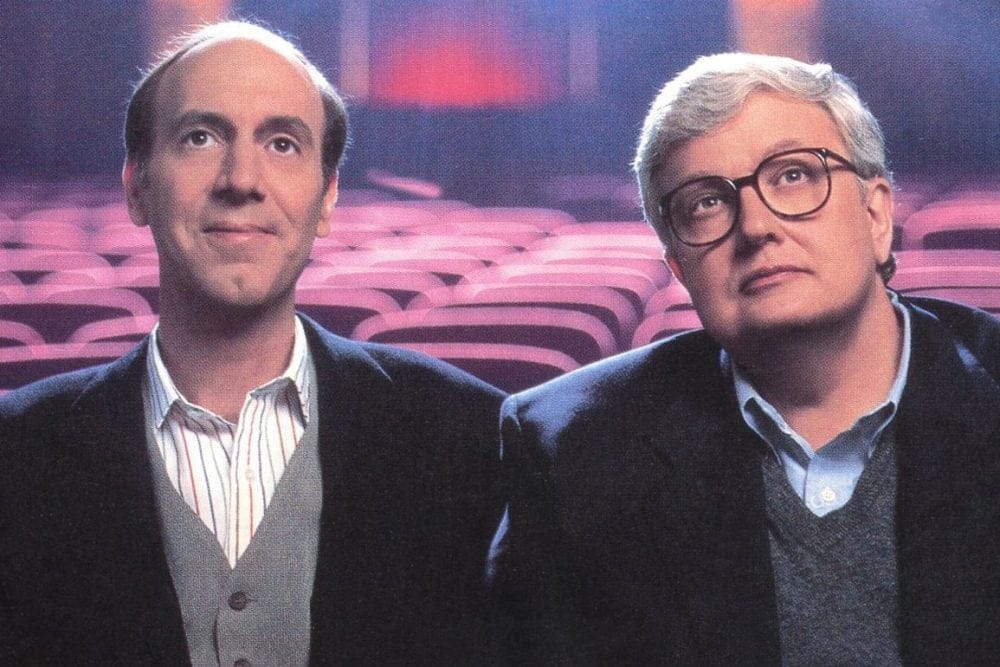
During the peak of covid-19 and all the tensions that came with it, I began to watch all the old episodes of Siskel & Ebert.
At the time, there were very few new movies coming out. But each night, I would go through another week of filmgoing with two of the greatest American film critics. Roger Ebert, in particular, had been a steady companion of mine since high school. For years and years until his death, every Thursday was a morning that I got to read new Ebert reviews. I knew him so well that if you named a movie, I could probably tell you what he rated it.
Listening to Gene Siskel and Ebert talk, the freedom with which they touched on politics and religion and social issues and the light ease with which they critiqued movies (no internet horde in the wings), was like listening to a melanocholic song from the homeland.
At some point in that summer, I got closer to the present day. Siskel disappeared from the show, and then he died. Suddenly it hit me: Ebert was going to get cancer and then I would have to process his death all over again. I quit watching.
The Weekly Digest
Premier Thought Every Thursday.
All of our recent essays and podcasts, delivered to you. Free.
Free. Delivered Thursday mornings.