

Ryan Burge recently wrote about the results of the Pew Religious Landscape Survey, a survey of 37,000 people, who were asked various questions about religious beliefs. One of them was: “Which statement about the development of human life on Earth comes closest to your view?”
There were three response options.
- Humans have evolved over time due to processes such as natural selection; God or a higher power had no role in this process. (“pure evolution”).
- Humans have evolved over time due to processes that were guided or allowed by God or a higher power. (“intelligent design”).
- Humans have existed in their present form since the beginning of time. (“creationist view”).
Here were the results:
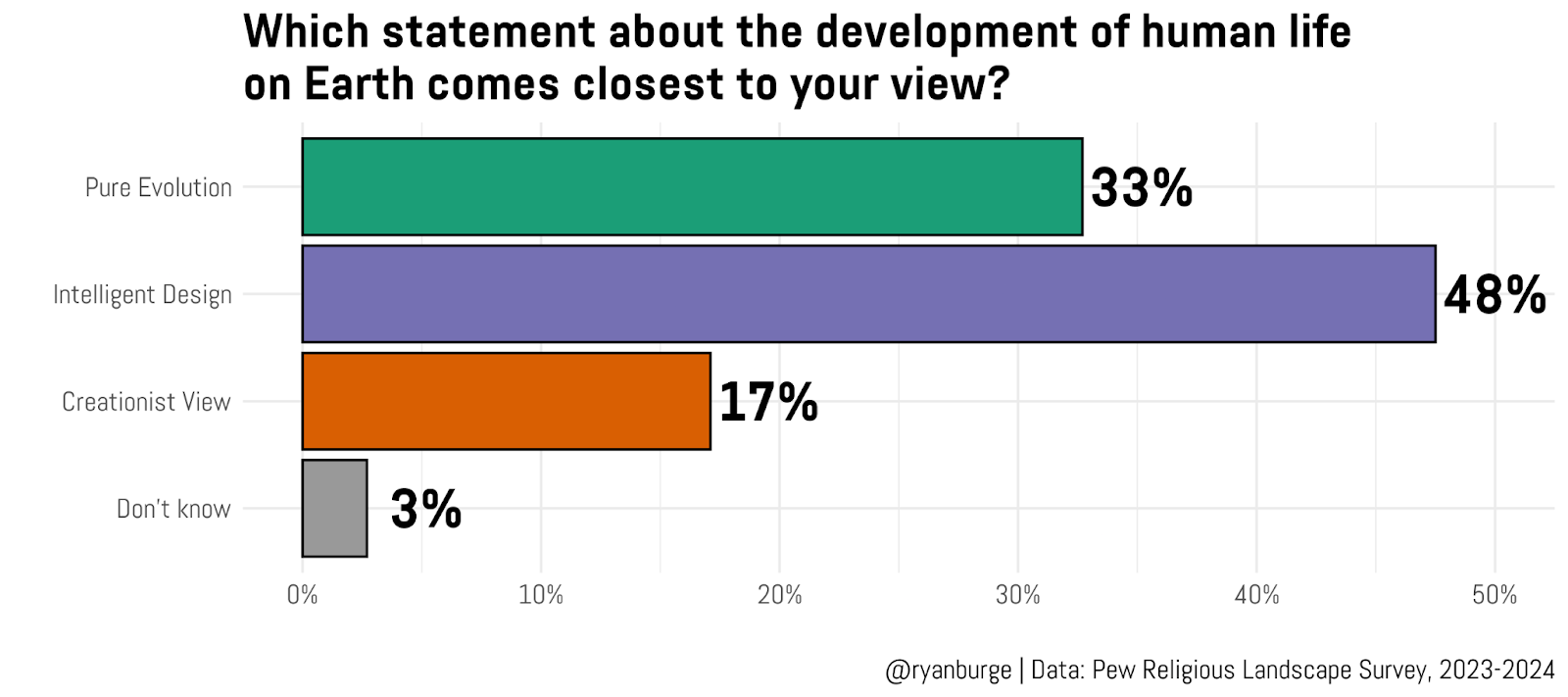
Less than one in five Americans believe in the Creationist view. But what was by far the most surprising finding was when Burge filters the results by religious views:
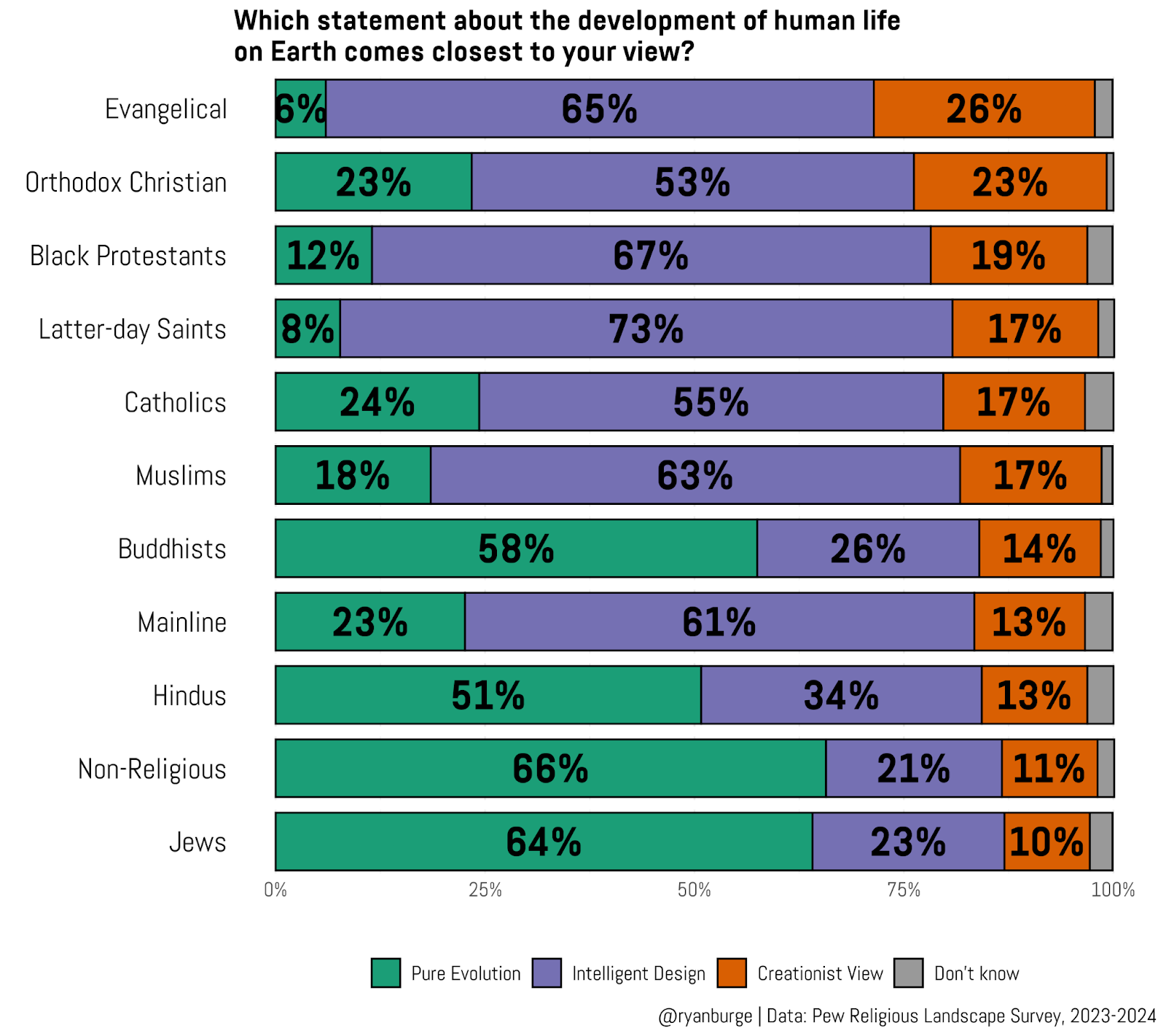
Only a quarter of Evangelical Christians affirm the Creationist view, while a large majority hold to Intelligent Design–the belief that God used evolutionary processes to bring human life into existence. Not a single religious perspective in America has a majority of its adherents hold to the Creationist view.
This is surprising given that it is predominantly Evangelical Christians who support large and influential organizations such as Answer in Genesis, a massive, prominent Young-Earth Creationist ministry who vociferously reject evolution. Their website states:
According to Scripture, God created “the heavens and the earth” fully formed and functioning in six days, about 6,000 years ago (around 4000 BC). The context of Genesis 1, as well as other places in the Bible, make it clear that these days were ordinary, 24-hour days. God’s original creation was perfect, with no death or suffering. Creation stands in stark contrast to evolution and unbelieving thought.
Apparently, the majority of Evangelicals disagree.
Why? I think for two reasons. One is pressure from without, the other pressure from within. I want to argue that the decline in young-earth creationism is a symptom of external cultural pressures (without), but also due to missteps on the part of young-earth advocates (within). If you are happy with the decline of the creationist perspective, the first point is for you. If you are galled by the ascendancy of Intelligent Design, the second point is for you. My aim in this article isn’t to advocate for one view over the other, but to show that there are important influences behind the rise of Intelligent Design that both sides should seriously consider.
External Pressure
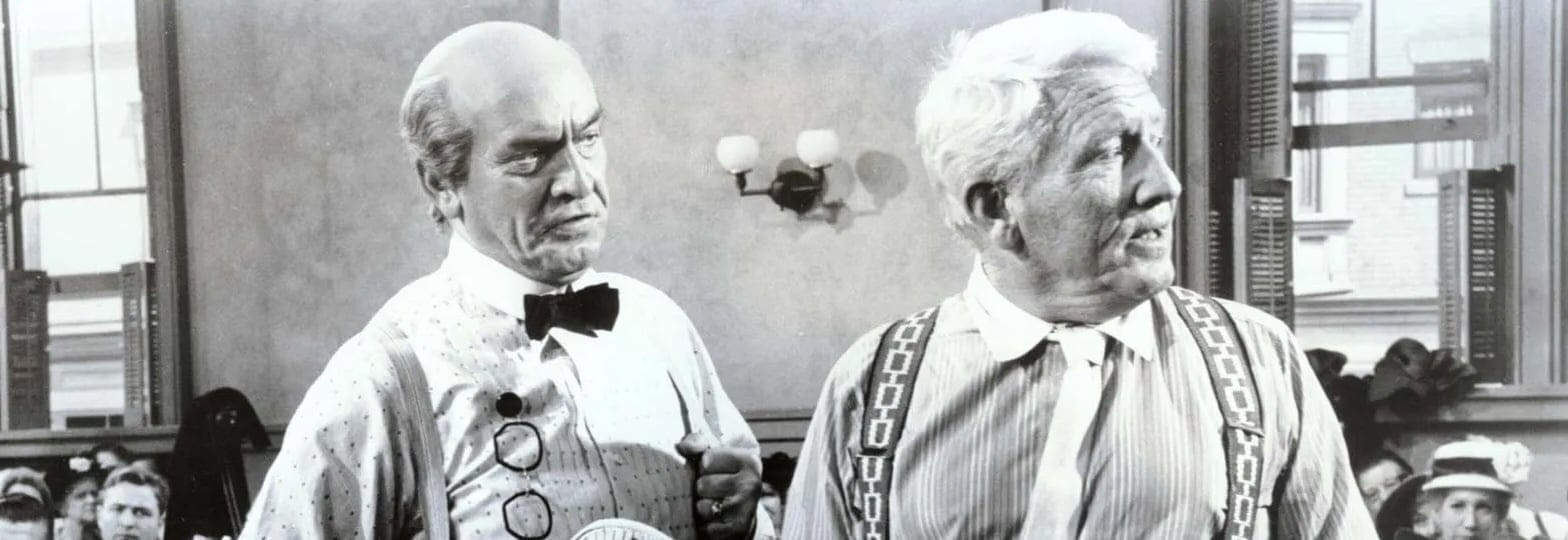
Drummond’s face looks like a block of mottled clay, creased with care, and streaming with sweat. The audience in the courthouse similarly glisten, fanning themselves incessantly while Drummond paces back and forth. His arm pumps like a piston, finger jabbing, face pained at how unjust it all is. Caustic barbs and indignant condemnations shoot from his mouth right and left. The monologues are exaggerative and bear the thespian over-drama of a movie made in black-and-white, but the old defense attorney speaks with a heft that sells. He bangs his fist, and warns the audience as much as the judge:
I warn you…Fanaticism and ignorance is forever busy, and needs feeding! And soon, your Honor, with banners flying and drums beating we will be marching backward, BACKWARD…through the glorious ages of that 16th century when bigots burned the man who dared bring enlightenment and intelligence to the human mind!
The prosecuting attorney, Matthew Brady, who serves as the film’s foil to “enlightenment and intelligence,” looks implacably stupid. He is a simple, God-fearing man, unconcerned with the ravings of men like Drummond. Brady, whose hair seems to be running away from his cocksure face, sits with thumbs hooked around his bulging suspenders, doing his best impression of a Neanderthal while Drummond articulates the wonders of the human mind and powers of reason against primitive superstition. Brady barks and waves these away.
The 1960 film, Inherit the Wind, about the Scopes-Monkey trial 35 years earlier, cemented in the public consciousness of America the idea that evolution represented the perspective of enlightened intellectuals, while a dogmatic insistence on a literal interpretation of Genesis was not only backwards, but unsustainable. When Brady is cross-examined, he quickly begins to contradict himself and resorts to naked assertions of faith. Drummond, on the other hand, represents a view that is “as incontrovertible as geometry to any enlightened community of minds.”
At one point, Drummond hands Brady a rock and asks him: “How old do you think this rock is?”
“I am more interested in the Rock of Ages, than I am in the age of rocks!” Brady laughs.
When Drummond informs Brady that a paleontologist has dated the rock as being ten million years old, Brady shuffles in his seat, like a duck wiggling water off his back: “That rock is no more than 6,000 years old.”
“How do you know?” Drummond asks.
“A fine Biblical scholar, Bishop Ussher, has determined the exact date and hour of creation. It occurred in the year 4004 BC…It is not an opinion, but a literal fact, which the good Bishop arrived at through careful computation of the ages of the prophets as set down in the Old Testament. In fact, he determined that the Lord began creation on the 23rd of October, 4004 BC, at 9 AM.”
Drummond, as laconic as Bugs Bunny, replies: “That Eastern Standard Time? Or Rocky Mountain Time?”
The movie, of course, took artistic liberties to massage the actual facts to fit their narrative. William Jennings Bryan, the prosecuting attorney who is transformed into Matthew Brady in the film, did not hold to Ussher’s dating of the earth. When Clarence Darrow (Drummond, in the movie) asks Bryan about Bishop Ussher’s dating, Bryan replies: “That has been the estimate of a man that is accepted today,” but then adds, “I would not say that it is accurate.”
Bryan’s main concern in the case was not the age of the earth, but fears over the implications of evolution as it was being utilized in social Darwinian ideas, such as eugenics. The high school text book that was the centerpiece of the case, A Civic Biology by George Hunter (1914), made overtly racist claims and chilling summons to engineer a superior society through forced sterilizations. Speaking of the “genetically inferior” members of society, such as the mentally handicapped and criminals, Hunter explains that if
people were lower animals; we would probably kill them off to prevent them from spreading. Humanity will not allow this, but we do have the remedy of separating the sexes in asylums or other places and in various ways preventing intermarriage and the possibilities of perpetuating such a low and degenerate race.
Is any of this presented in the movie? Of course not. Nevertheless, the impact on the social imaginary of America was considerable.
In Carl Trueman’s, The Rise and Triumph of the Modern Self, he explains how powerful the arts are in shaping what Charles Taylor calls “the social imaginary.” Taylor persuasively argues that most people do not think in abstract concepts, like theories. They use their imagination, which doesn't operate “in theoretical terms,” but in, “images, stories, legends, etc.” This becomes the mechanism by which society creates a “common understanding which makes possible common practices, and a widely shared sense of legitimacy.” Which means that the artists (and filmmakers) bear an outsized role in shaping our intuitions. Trueman later notes the influence of the film Inherit the Wind in shaping our social imaginary: “[Inherit the Wind] especially helped fix in the popular mind the image of the Scopes Monkey Trial and the issue of evolution as a battle between religious obscurantism and scientific freedom.” Once that was cemented in the imagination of the American mind, the actual science became significantly less important.
Trumeman writes:
Setting aside the question whether evolution--or, to be more precise, one of the numerous forms of evolutionary theory that looks back to Darwin's work as an initial inspiration--is true, there is no doubt that vast numbers of people in the West simply assume that it is so.
He goes on:
There are numerous reasons for this. While the various theories themselves rest on interpretations of the geological record and on complex genetic science, the basic idea--that one species can evolve from another--is easy to grasp. Indeed, the most popular example---that human beings descended from an ape ancestor--seems to make eminent sense. Apes look like humans; why should there not be a connection? As the world seems very old, there would surely be time enough for an incredibly slow process to take place.
Evolutionary theory makes intuitive sense in many ways. When someone points out that we share 98% of our DNA with a chimpanzee, that sounds like we certainly share some kind of ancestry. That feels plausible. Almost none of us are educated enough to evaluate that claim on its own merits. All we know is that if we have two items before us that are 98% similar, the difference between the two will be virtually non-existent to us.
Further, the concept of “survival value” becomes another simple, intuitive explanation for why human behavior is the way it is. Why are we motivated to bond as family units, tell stories, play games, etc? Because, eons ago, some of our primitive ancestors began doing those things and they survived long enough to reproduce and pass these customs on. These artifacts of human culture thus likely contributed to their survival and so possess “survival value.”
That is a relatively simple theory. You don’t need to be a trained anthropologist to understand the idea to wonder, for example, “Why do little boys seem so eager to fight and wrestle?” You only need to imagine, “Well, I guess a long time ago, when men were needed to fight off predators, it was probably important to train the boys how to fight, so dads probably began wrestling with them. The tribes that did that, survived. The ones that didn’t, didn’t.” Is that true? I don’t know. But it kind of makes sense, doesn’t it?
Trueman similarly notes that it is not only the intuitive simplicity, but also the mystique of scientific authority that makes evolution so popular:
Whether evolution can be argued from the evidence is actually irrelevant to the reason most people believe it. Few of us are qualified to opine on the science. But evolution draws on the authority that science possesses in modern society. Like priests of old who were trusted by the community at large and therefore had significant social authority, so scientists today often carry similar weight. And when the idea being taught has an intuitive plausibility, it is persuasive.
Later, speaking similarly about the impact of Sigmund Freud:
[Freud proposes his theories] through the scientific idiom of psychoanalysis, an idiom that makes his theories, like those of Darwin, inherently plausible in a modern social imaginary in which science has intuitive authority...It does not matter that the strictly scientific status of Freud's theories is now methodologically and materially discredited. The central notion--that human beings are at core sexual and that that shapes our thinking and our behavior in profound, often unconscious, ways--is now a basic part of the modern social imaginary.
Science is the coin of our realm. Perhaps in a post-COVID society, that premium has been discounted some, yet it still possesses the quality that Ross Douthat calls “Official Knowledge.”
Almost all “knowledge production” in the modern world, whether it takes place in universities or bureaucracies or the respectable portions of the media, is informed by a practical atheism, a presumption that you must analyze human life in scientific or at least social-scientific terms, keeping God or the supernatural safely off the stage.
At one point, we may have cited priests or shamans or dreams as a source of Official Knowledge. But no longer. Today, we cite cross-sectional studies and empirical research…or, at least, the hall monitors of Official Knowledge do. And the assumed perspective in that domain is the evolutionary one. And since vanishingly few of us are qualified to make any kind of meaningful evaluation of the science, we are left with a vague sense of, “Every smart person believes this–the same smart people who gave us antibiotics and smartphones and rocket engines. Who are we to disagree with them?”
If you watch the film, who would you like to be: the passionate defender of enlightenment, Drummond, or the dumb Philistine, Brady? Rejecting evolution thus brings the spectre of playground embarrassment into the equation: “Do you want to be one of those backwards Fundamentalists? Don’t you realize how uncool and lame that is?”
Grown-ups are often ashamed to admit how much we are susceptible to the allure of what Lewis called the “Inner-Ring,” the desire to be welcomed into the right crowd, one of the cool kids. But Lewis called that pull “That Hideous Strength” for a reason. He thought that throughout a man’s life, “one of the most dominant elements is the desire to be inside the local Ring and the terror of being left outside.”
We may laugh into our sleeves at fundamentalists who are arguing that the earth is 6,000-years-old but they may be more free from the pull of the sinister powers of worldliness than we are. And we “enlightened” folk may be more beholden to the zeitgeist–vibes–than we care to admit.
My assumption is that a large swath of Evangelicals who have accommodated evolution into their reading of Genesis have not done so because they have earned advanced degrees in microbiology or read Darwin and his progenitors with a fine tooth comb and found their conclusions to be persuasive. Nor have they extensively studied the various interpretive approaches to Genesis. My guess is that they just don’t want to be made fun of by the important people, to be “left outside.” After all, the idea feels plausible.
But that isn’t the only reason.
Internal Pressure
Spend any amount of time on the Answers in Genesis website, and you will see that not only do they ardently reject evolution, but a whole manner of other interpretations of Genesis as well that other Christians (who likewise reject Darwinian evolution) disagree on. For instance, many Christians disagree about how to interpret the “days” of Genesis 1, whether or not there are gaps in genealogical records, how to understand why our earth (and universe) appear very old, the relationship of Genesis 1 and 2, the extent of Noah’s flood, etc. Christians throughout the history of the church have had various perspectives on these issues, while still maintaining the essential doctrines of creation and anthropology orthodoxy requires.
But, Answers in Genesis disagrees. Not only do they believe that all of their interpretations on these different views are welded together (so that if one is compromised, eventually all are compromised), but they also tout their view as being the only faithful view.
Ken Ham argues:
While I do hold to a young-earth creation, it is not “Ken Ham’s interpretation.” Millions of Christians today around the world hold this view, as did Jesus, the apostles, and virtually all orthodox Christians prior to 1800.
Gavin Ortlund replies to this claim in a fantastic video titled “What Ken Ham Misses About Creation.” The only reason that anyone would disagree with a young-earth position, Ham argues, would be because of the pressure from modern science (as detailed above). Ortlund, however, begins with Augustine and then moves through Clement, Origen, Didymus the Blind, Athanasius, Gregory the Great, Isidore of Seville, and Bede, all of whom disagree with how Ken Ham reads Genesis 1 and who (obviously) were not influenced by the external pressures of modern science.
Even more significantly, Ortlund then demonstrates that after modern scientific discoveries which seemed to indicate an old-earth, many faithful Christians–including fundamentalists!–have not insisted on a young-earth view. For instance, B.B. Warfield, J. Gresham Machen, Herman Bavinck, Carl F.H. Henry, J.I. Packer, John Stott, the Scofield Reference Bible and about half of the contributors to the “The Fundamentals”--the foundational text of the Fundamentalist movement–held to an old-earth view. Four years before Darwin publishes The Origin of Species, Charles Spurgeon preaches a sermon where he comments on Genesis 1:2:
We do not know how remote the period of the creation of this globe may be–certainly many millions of years before the time of Adam. Our planet has passed through various stages of existence, and different kinds of creatures have lived on its surface, all of which have been fashioned by God.
And, as noted above, the lead prosecutor in the Scopes trial, William Jennings Bryan, held to the day-age view of Genesis–the perspective that the “days” of Genesis one were not 24-hour periods of time but represented long ages of time.
Obviously, just because Spurgeon, Augustine, and Bavinck believe something doesn’t make it true. But it demonstrates that Ken Ham’s claim that his view represents “virtually all orthodox Christians” throughout time is demonstrably false. While many faithful, orthodox Christians have held to the young-earth perspective (such as Luther and Calvin) it has been a point that different faithful Christians have disagreed on. Spurgeon and Augustine and Bavinck did not see themselves as compromising on the authority of God’s Word by reading Genesis 1 differently than Ken Ham does. And they obviously were not doing so out of the kind of external pressure I described above. There must have been a different pressure–an internal one–that led them to those conclusions. That is, there may be reasons in the Bible itself that seem to require a different accounting for how to interpret the opening chapters of Genesis differently than a strict, young-earth perspective. You do not need to be steeped in the writings of Richard Dawkins or nose deep in comparative creation accounts to notice things like:
- If the sun, moon, and stars are not created till the fourth day, where does the light come from on the first day? Of course, “God is light,” but the light on the first day is created light, and no attribute of God is created.
- If God seems to spontaneously create everything in Genesis 1, why do we see God use ordinary “cause-effect” means to bring about the vegetation of the land in Genesis 2:5?
- If the days in Genesis 1 are 24-hour days, and on the sixth day God creates both man and woman (Gen 1:26-27), then why does there seem to be a large gap of time (long enough for Adam to name all of the animals of the earth) between Adam’s creation and Eve’s creation in Genesis 2? Or why does Genesis 2:4 use the word “day” to summarize a vast period of time clearly extending beyond 24 hours?
- If Adam and Eve (and their children) are the only humans on the earth, who does Cain marry and who is he afraid of in Genesis 4:15-16?
It is not the purpose of this article to investigate those extensively, but to simply point out that they–and many others–are there. I know that young-earth creationist have replied to each one of those questions, as well as to questions of natural science regarding the fact that the earth and our universe appear to be very, very old.
But part of the reason why Evangelicals may be losing enthusiasm in the young-earth perspective may be because they are not only experiencing those external pressures, but perhaps they are also encountering some of the internal pressures of the Bible themselves. They may not find the answers that Answers in Genesis provides to be entirely satisfying, or even necessary, as they begin to read more widely throughout church history and see that the strident claims of figures like Ham do not, in fact, represent the consensus.
If there is any patron saint of Evangelicalism, it is probably C.S. Lewis. He not only rejected a young-earth, but held to a form of theistic evolution. And when young Christians discover that he held that view while sharply delineating it from a Darwinian model–and even satirically mocked that position in his poetry and criticized it in novels like That Hideous Strength–they may begin to see that it is possible to strongly resist Darwinian evolution, while endorsing views like an old-earth, or even Intelligent Design.
So What?
On the one hand, if you are part of the majority of Evangelicals who affirm Intelligent Design, then the decline in the young-earth creationist perspective is not alarming. You may even feel grateful. But if my analysis above is correct–that the majority of Americans have arrived at their views on evolution primarily through vibes and cultural pressure–then that should be reason for concern. On matters of Christian liberty, Paul’s counsel is that we must be “fully convinced in [our] own mind,” (Rom 14:5). Meaning, we should be convinced through deliberation and reason, not the felt pressure of our peers or culture–what Paul seems to be deeply concerned with on matters of conscience.
If, at the end of the day, the hand that shapes our views is the spirit of the age, then we will be beholden to it elsewhere; possibly in more consequential ways. Our religion is not premised on being inherently unpopular or bizarre, as if the weirder and more obnoxious we are the more fervent our devotion proves to be. But our Lord does promise us that there will be times where our faith will put us squarely in opposition with the world, will require us to resist the allure of the Inner Ring, to follow Christ “outside the camp and bear the reproach he endured,” (Heb 13:13). But if we have let those muscles of “bearing reproach” atrophy, we will not endure what faithfulness requires.
On the other hand, if young-earth creationists can see that many of the heroes of our faith throughout the history of the church have not interpreted Genesis as Ken Ham has, then perhaps that means that we can have more productive and more interesting conversations about creation with one another. And perhaps we can extend more charity towards brothers and sisters who disagree with us.
When being questioned by Darrow in the trial about whether the earth was made in six days, Bryan replies: ‘I think it would be just as easy for the kind of God we believe in to make the Earth in six days as in six years or in six million years or in 600 million years. I do not think it important whether we believe one or the other.’ Though Answers in Genesis generally speaks positively about Bryan, in an article about this interchange, Ham speaks in lurid tones:
This was a turning point in Christendom, and the Christian influence in our culture has declined ever since. Bryan unlocked a door—on behalf of Christians, he ‘told’ the secular world that Christians really didn’t take the Bible as seriously as they claimed. This seriously weakened the authority of the Bible in the eyes of the public.
So it is not surprising that today’s church leaders not only question the days of Creation, like Bryan, but increasing numbers of them have gone on to disbelieving in the bodily Resurrection or the Virginal Conception of Christ, and no longer affirming marriage as heterosexual-only.
Ham makes it clear what he thinks is on the line: Deviate from a young-earth and you are on a slippery slope to deny the essential tenets of our faith; disagree on this issue and you do not take the Bible seriously. One could wonder by what remarkable telepathy Ham is able to spirit into the mind of Bryan (or Charles Spurgeon, or J.I. Packer, or Augustine) and discern that when these men reach the fork in the road in how to read the days of Genesis 1, the signs that point to “Young-Earth” or “Old-Earth” can really be read as directions towards an attitude to God’s Word in general: “Serious” or “Not.” And down the dark, and harrowing path that diverges from Ham’s own lies a veritable Sodom and Gomorrah, while down the bright and faithful path of Ken Ham one arrives at a place that looks like…well, Ken Ham. And yet, how strange it is to find that so many of the heroes of our faith have chosen differently have not gone on to deny the resurrection, the virgin birth, or heterosexual marriage, but go on to write books which defend those very things–men like B.B. Warfield, J. Gresham Machen, and C.S. Lewis.
It seems that a central argument of some young-earth creationists is this: “If you deviate from the panoply of interpretations we offer on Genesis 1-11, it is because you are succumbing to secularism and downgrading the authority of the Bible.” But, as soon as you find Christians who deviate from their interpretation, but have demonstrably not been animated by secular science nor have abandoned their high view of Scripture’s authority or the historicity of the miraculous…then the argument starts to fall apart. If young-earth creationists want to regain ground on this issue with the wider culture it might, paradoxically, come from being more open-minded towards other Christians who disagree with them.
When Copernicus and Galileo strove to demonstrate that the earth revolved around the sun, not the other way around, the church was able to provide sophisticated (if not convoluted) Biblical and naturalistic arguments to refute the claim. But they were wrong. And, in time, the Church realized this and adopted heliocentrism. This wasn’t a concession that science had more authority than God's Word, but an admission that they had simply interpreted the Bible incorrectly.
This realization did not diminish what God’s Word told us about the rising and setting of the sun or the foundations upon which the earth rested, but it moved us closer to seeing what the author originally intended when he used those word pictures. Similarly, if we approach Genesis 1 assuming that its primary function is to refute figures like Darwin, we will miss the meat and marrow of what the Divine Author intended for us to receive from His Word and therefore may fundamentally misunderstand His world.
The Weekly Digest
Premier Thought Every Thursday.
All of our recent essays and podcasts, delivered to you. Free.
Free. Delivered Thursday mornings.