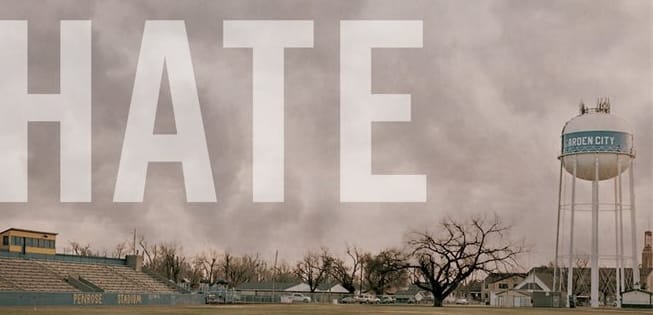
I wrote this essay several years ago, reflecting on Dick Lehr’s White Hot Hate and the narrowly thwarted 2016 bombing plot against a Somali immigrant community in Garden City, Kansas. Since then, public rhetoric about immigrants—and Somali communities in particular—has re-entered American political life with renewed force, sometimes echoing language and suspicions that once circulated largely at the margins.
This rhetoric has been especially heated amid ongoing federal investigations into large-scale fraud schemes in Minnesota that first drew major attention in 2022. Prosecutors have charged nearly one hundred defendants in connection with alleged fraud involving state and federal programs, many of them Somali Americans. Against this backdrop, at a December 2, 2025 Cabinet meeting, President Trump declared, “We’re going to go the wrong way if we keep taking in garbage into our country,” referring to Somali immigrants.
I have resisted revising this essay to track these recent developments in public rhetoric directly. One reason is that White Hot Hate itself resists being reduced to a simple explanatory frame. It tells a story whose moral weight does not depend on aligning villains neatly with a single party, region, or ideology. Instead, it shows how dehumanization takes root when fear, grievance, and belonging are narrated apart from real neighbors and shared places.
That story, sadly, has not lost its urgency.
In recent years, much public life has been organized around competing stories of threat and innocence. Facts are still invoked, but often as weapons—tools for defending “our” side rather than for seeking shared understanding. In such an atmosphere, neighbors become abstractions, and fear readily masquerades as moral seriousness.
Christians, in particular, are not immune to the ways perceived threats can narrow our moral vision, drawing us into stories where vigilance can easily slide into self-righteousness. When we narrate the world primarily through cataloging the sins of our enemies, we risk missing the slower, harder work of discernment—work that requires attention to place, persons, and the ambiguities of human motivation. Our struggle is not against a sociologically defined group of “progressives” or “conservatives,” whoever our ideological foes may be. It is against the lordless powers, against the evils that corrupt our shared human life and mock the lordship of Christ. “We aren’t fighting against human enemies but against rulers, authorities, forces of cosmic darkness, and spiritual powers of evil in the heavens” (Eph. 6:12, CEB).
Fact-checking can be an important step in the process of discernment in our confusing, polarized age. But even more challenging may be how to tell and hear a different story than the one our tribe has been primed to hear. For this reason, I found Dick Lehr’s White Hot Hate: A True Story of Domestic Terrorism in America’s Heartland (HarperCollins, 2021) to be a suggestive and even profound narrative.
It dives much deeper than an ordinary “media account” on an event that evokes both the terror of human evil and the wonder of human compassion and connection. And, in its strongest moments, it transcends a “tribal” way of telling a story about goodness and evil in our midst.
At first glance, White Hot Hate would appear a very unlikely candidate to tell such a complex story. The basic story-line might sound like a “blue versus red” narrative made for Hollywood: Fueled by the fear of immigrants fanned by Donald Trump in his presidential campaign, along with right-wing media figures like Alex Jones, members of a local militia in Garden City, Kansas gathered the provisions and did the calculus of how to carry out an attack on the local community of Muslims, who had immigrated from Somalia. They set their sights on November 9, 2016, the day after the presidential election. In all likelihood, this group (“the Crusaders”) would have carried out the attack if not for Dan Day, an unemployed Garden City man, who eventually worked with a small group of FBI agents to infiltrate the Crusaders and bring down the plot.
So, Lehr is an east coast journalism professor, and this is a book about right-wing extremism in the state of Kansas. What could go wrong? Having grown up in Kansas and later spent five years in the Boston-area as a graduate student, I could think of quite a few things. I half expected the book to be like a series of cartoons that reflected the common (mis)perceptions of Kansas, as a land led and dominated by Democrat-hating, gun-toting extremists. This storyline was already hinted at through accounts by the national media (e.g., CNN, New York Times) over the course of several years. Looking back, these accounts were factually accurate and, on the whole, quite even-handed, albeit brief. But a brief fact-checked article can still fit into an overly simplified story.
The book White Hot Hate tells a different story.
On the one hand, Lehr refuses to sugar-coat any aspect of this horrific bomb plot or the plotters, whose plan to bomb mosques and apartment complexes housing Somali refugees would have caused more carnage than the Oklahoma City bombings. A large part of the book’s dialogue is taken, word for word, from over one-hundred hours of secretly recorded conversations among the Crusaders. This dialogue is jarring and hard to read, both because of the highly de-humanizing language (the group referred to the Somali immigrants as “cockroaches” to be “exterminated”), and because it is soaked in obscenities.1
On the other hand, drawing upon numerous interviews and his own historical research, Lehr also brings a great deal of detail to this story and humanizes all involved—the Somali immigrant community, the community leaders in Garden City, the local Garden City residents, and even, in some ways, the plotters themselves. None of this detail excuses the horrific evils involved. But it does make clear that this battle is not simply (or mainly) one about “red versus blue” or “east coast versus Midwest” or “conservative versus progressive.” It is much more messy, and much more human.
Lehr’s story-telling is detailed and compelling. Two features of the book, in particular, extend insights far beyond media accounts of the bombing-plot: its highly variegated portrait of Kansans, and a surprisingly divergent role for the Christian faith in the unfolding of these events.
Lehr opens the book on June 12, 2016, the day of the mass-shooting at the Pulse nightclub in Orlando, committed by a shooter who claimed to be acting on behalf of ISIS. On that day, in Garden City, Kansas, Patrick Stein called Dan Day, screaming in rage that someone has got to stop the Muslims. Sure, Trump could talk about stopping Muslims at the borders. But someone needed to “exterminate” them. Patrick had set up a meeting later in the day to develop a plan.
On the same day, Adan Kenyan, a Somali businessman in Garden City, received a strange letter from the city on official letterhead. It was difficult to understand. But the ultimatum was clear: “You have thirty (30) days from the date of this letter to discontinue retail use at this location.”
For the last nine years, Adan Kenyan had lived in Garden City and had helped the growing Somali immigrant population settle in — through relational networks, help for those in various forms of need, and through his business, “The African Store.” His store sold various food items such as spices that were imported from East Africa, as well as clothing, rugs, and pillows that Somalis customarily preferred. He would frequently make the twelve-hour drive in his van to acquire these imports. The African Store became a kind of community connection center for the Somali immigrants.
Although Adan Kenyan and other Somali immigrants had experienced suspicion and discrimination, they also had experienced numerous forms of welcome from business and community leaders in Garden City, as well as other local residents. The initial move to Garden City had been urged by business leaders involved in the meat-packing plants. These were jobs with long hours of redundant work, which was physically demanding. Yet Tyson foods, in particular, made special accommodations to attract the Muslim workers to Garden City, as they were known as faithful workers in these challenging jobs. Tyson allowed workers two prayer breaks for each eight-hour shift, with prayer rooms, rugs, and compasses (so that Muslims could pray toward Mecca) at the slaughterhouse. They also installed foot-washing stations for ritual washing. For the last nine years, the Somali immigrant community grew rapidly in Garden City, and Adan’s store provided both products and the space for community connection.
Having fled civil strife in Somalia, many in the immigrant community were coming to love Garden City. "This town is so nice," noted Somali meat-packer Ahmed Ali to an NPR journalist in 2017. "The people in this town, they are so great people. We love them, and also they love us." Lehr paints a similar portrait of the Somali immigrants as Kansans, who in years preceding 2016 had come to love and invest in this particular land and place. It is precisely because they had come to love western Kansas that they felt unease in 2016, not only because of the letter to Adan Kenyan, but with the sweep of anti-Muslim sentiment that swept the country after the Pulse Night Club shooting.
Lehr paints this portrait without ever romanticizing the great losses and hardships involved in immigration, and without ever sugar-coating the systematic and personal evils within the story. It’s an immigrant story that is not a story of “foreigners,” but of the Somali diaspora, who also became Kansans as well, bringing new life to their community.
Moreover, most non-Somali Kansans in Lehr’s story defy the expectation that Garden City was dominated by white nationalist sentiment. Besides the initial accommodations provided through Tyson, the mayor and other Garden City community leaders made a habit of reaching out in welcome, holding ongoing conversations with Adan and other leaders within the Somali community, and seeking to develop ways for connection and mutual learning. Eight days before the Pulse shooting, for example, community leaders and a local doctor organized an evening to celebrate Somali food and culture, complete with “I love Somalia” t-shirts. Attendance from the Somali community and from the white western Kansas community was large, with members of both groups wearing traditional Somali dress, amidst the joyous sounds of East African music and long-cooked meats and sauces of Somali food.
The beauty of this response from lifelong Kansans makes all the more poignant his account of the malicious, racialized culture which found a home among some of the western Kansas militias, including KSF (Kansas Security Forces), from which the small group of Crusaders were drawn. Well before the Pulse shooting, KSF and other local militias were highly suspicious of the Muslim immigrants, speculating that they are a training-ground for ISIS. Lehr points out that ISIS is almost non-existent in Somalia, and narrates their history in a way that shows how this speculation was a projection, a fear of the “dangerous immigrants” who were “invading” the country.
Most remarkable to me was how KSF was brought together through social media — uniting those with like-minded suspicions who were geographically proximate, all the while refusing and avoiding any interaction with the Somali community, often just a few blocks away from KSF meetings. In this racialized, conspiracy-based culture, neighborhood disappeared — indeed, place itself seemed to disappear.
This may be a key part of how polarization moved to radicalization: the like-minded become connected through ideology, while others who are geographically proximate remain total strangers. Members of the Somali community could be just feet away from KSF members, yet the book does not note a single conversation between KSF members and these neighbors. While city leaders would often make a practice of dropping by the African store to buy some rice or other supplies, for militia members, the Somali community was always at a distance, held behind a skeptical gaze.
This contrast between the different responses among local Kansans in Garden City is not only a way to complexify the story of the bomb plot. In Lehr’s account, it is key for understanding the anger and rage of the Crusaders themselves. Early in their quest to spy on the Somali community, it was the welcome that many locals gave the immigrant community that infuriated the militia members the most. After hearing a report from a member of the militia who was tasked to attend (and spy) at the June 4 event, the fury of the militia’s leaders was, above all, against the mostly white leaders and other locals who welcomed the immigrant community. One leader of the militia joked that, before “we blow the top of their heads off,” we should put a sign around their necks that reads: “I SUPPORT ILLEGAL IMMIGRATION. I GO AGAINST THE CONSTITUTION ON A DAILY BASIS. I DO NOT HAVE ANY CARE FOR MY FELLOW CITIZENS IN THE STATE OR THE TOWN THAT I REPRESENT.”
Although often brief in scope, Lehr’s account of different forms of the Christian faith in this Kansas drama is striking as well. Some might expect that those at the forefront of welcoming the immigrant community and celebrating their culture would be “secular,” relatively unattached to faith. This was far from the case. For example, Dr. John Birky, a committed Christian, had been a primary organizer and promoter of the June 4 event to celebrate Somali culture and life. But that was one just one small moment in a larger pattern of hospitality consistently offered by Dr. Birky, both before and after the events of 2016. Over time, Dr. Birky played a key role in building trust and belonging for the Muslim community, in his service to them as a trusted, culturally sensitive medical doctor; a local friend who would host and be hosted for meals with the Somali families; and ultimately, as a passionate advocate in local politics which eventually overturned the local order for the closing of the African Store.
Dr. Birky was transparent that his Christian faith was at the core of his motivation. When asked by a newspaper reporter about his rationale for building friendship with the local Somali community, he did not draw upon the more general, civic language of “celebrating diversity” or “pursuing justice” (as fitting as those may be). He offered words that don’t fit squarely within a “culture war” narrative at all:
“Jesus said that the first command is love God, and the second command is love your neighbor,” Dr. Birky later told a reporter. And, he noted, the neighbor whom Jesus had cited in his teachings was someone “of a different culture.”
On the other hand, key planners of the bombing also offered avowals of the Christian faith. Patrick Stein often made references to the “Constitution” along with the Christian faith in justifying his plan to “exterminate” the local Muslim community. Stein’s earnestness for the white nationalist cause was striking; he naively dismissed any news that seemed to downplay the “Muslim threat,” and sought to frame his role in the bomb plot as a form of martyrdom. Expecting that he would likely be killed in the attack, he studiously told his parents and his two sons that he was giving his life for the cause, and would likely not make it into 2017. In a message that is jarring to read, he wrote:
“I might come home in a pine box,” he typed…“Brother, I have never been more serious, more prepared, more ready and willing to defend this country, the Constitution, and the citizens at all cost,” he said. “I do all of this in the name of Jesus my God and for my kids and grandkids and future generations.”
A third expression of the Christian faith shows up in a form that, like the first two, may be surprising to observers: the local who became an informant for the FBI, Dan Day, and his teenage son, Brandon. Day was hardly the “hero” that the Blue-versus-Red culture war scenario would have expected. A western Kansan local, he loved his guns, was a stern supporter of second amendment rights, and opposed President Obama.
Yet, after being invited to a militia meeting, he was shocked to learn about their wild suspicions of the local Somali community. Shortly after, he was approached by two local FBI agents who were concerned about the increasingly fiery rhetoric used by local Militias. These agents convinced Day to accept the invitation to join the militia, in order to record the conversations and infiltrate the group.
This called forth considerable sacrifice for Day, which repeatedly brought him to the questions of faith. Day had recently lost his job, and his family struggled to make ends meet financially. Yet, even as Day’s participation started to take twenty, thirty, forty hours a week, the FBI could not offer significant financial incentives. That would risk scuddling the later trial against the bombers, due to “entrapment.” Amidst physical and emotional exhaustion, Day seriously considered pulling out. How could he justify all of this sacrifice and this deception, even if it was for a good cause?
In a conversation with his dad that proved decisive for him continuing to serve as an FBI informant, Brandon Day spoke about his faith (he was considering converting to Catholicism) and how he had researched the theology of the issue at hand. Using the deception of Rahab in the book of Joshua as an example, Brandon presented a nuanced account of how and why a self-sacrificial act of deception could be one of bravery and faithfulness to display the power of God. For the sake of their Muslim neighbors, this deception — so painful, emotionally and financially, to his family — could be an act of faithfulness. After a season of further prayer, Day came to a point where he received “peace” about continuing his deception to support the FBI plan to foil the plot, for the sake of God and neighbor.
An internet search will retrieve numerous news stories about the Garden City bombing plot. Many of them would likely make it through a “fact-check” exercise with little problem. But without hearing a more intricate, layered story of what took place in Kansas in 2016, we are likely to simply have our own prejudices of “us” against “them” reinforced.
I am grateful for how White Hot Hate offers a narrative with breathtaking detail about the mundane yet terrible idolatries of race and nation in our midst, yet it avoids being reduced to a jeremiad against a predictable social-cultural foe. Jeremiads which double-down on simple, cartoon-like portraits of cultural enemies have become popular in recent years, some becoming bestsellers. They simultaneously horrify the readers, and reassure them of their righteousness, since their opponents are cast as a dangerous threat.
The lines of dehumanization traced in White Hot Hate remain as wrong—and as dangerous—as ever, precisely because dehumanization so readily slides toward violence. This is part of what makes Lehr’s account resist a “blue versus red” telling: the decisive moments do not arise from ideological purity, but from concrete acts of neighbor-love in particular places. Yet Lehr’s story presses a quieter and more unsettling question. When such lines are being crossed in Kansas, in Minnesota, or Maine, who will be the one to come alongside a Somali neighbor? It may not be the loudest voices on social media, locked in familiar cycles of shouting and counter-shouting. It may instead be the NRA member who votes Republican, or another unlikely figure, who nevertheless decides that there is a line that cannot—and must not—be crossed.
Aleksandr Solzhenitsyn’s arresting insight bears repeating: “The line separating good and evil passes not through states, nor between classes, nor between political parties either — but right through every human heart.” White Hot Hate refuses to let us forget this; Lehr’s account unsettles any easy alignment of tribal identity with particular moral roles.
Yet it nevertheless exposes horrific evil for what it is. In doing so, the book calls us not merely to denounce dehumanization in the abstract, but to be formed as the kind of neighbors who—sometimes at real cost—stand with those whose humanity is being denied when the line is crossed and the moment demands a response, whether or not that response aligns with our tribe.
Footnotes
1. Language of this kind once seemed confined to extremist subcultures. By 2026, it has increasingly been echoed—and at times legitimized—by figures and institutions that shape mainstream public discourse in the United States.
The Weekly Digest
Premier Thought Every Thursday.
All of our recent essays and podcasts, delivered to you. Free.
Free. Delivered Thursday mornings.