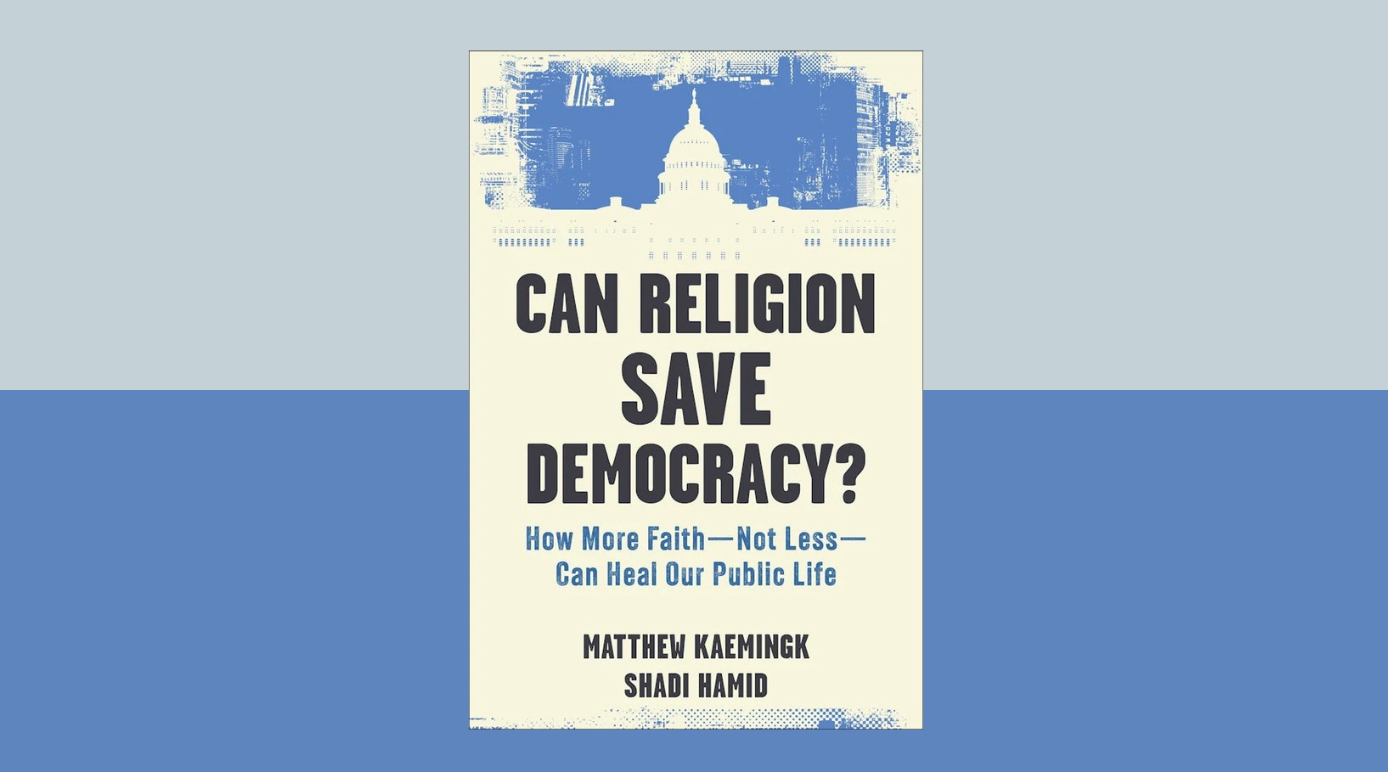
Matthew Kaemingk and Shadi Hamid. Can Religion Save Democracy? Brazos Press, 2026. $26.99. 224 pp.
Matthew Kaemingk and Shadi Hamid want to make religion in the United States great again.
In an era of increasing secularization and declines in religious affiliation, attendance, and practices, these men—one a Reformed theologian, the other a Muslim social scientist—long for religion’s return to relevance in American society. They do so not because they want to see their fellow citizens adopt a particular tradition or set of principles, but because they believe religion can shore up America’s ailing civic order. Religion, they think, really can make America great again.
Kaemingk and Hamid are the authors of the provocatively titled new book Can Religion Save Democracy? They suggest that organized religion, rather than being a cause of the sorts of divisions tearing our political communities asunder, is actually a force for good in any healthy and thriving democratic society. Drawing on empirical data, theological discussion, and personal reflections, they contend that religious contributions to public life—through encouraging shared moral commitments, strengthening the bonds of social capital, and more—can be a salve for the dysfunction plaguing American politics.
Kaemingk is Professor of Public Theology at Theologische Universiteit Utrecht, and Hamid is a columnist at the Washington Post after a stint at the Brookings Institution. Yet these experts do not write as disinterested observers; they have, for years, practiced what they preach. Together they host Zealots at the Gate, a podcast they describe as exploring “the future of democracy and religion.” Both are fellows at Georgetown University’s Center for Muslim-Christian Understanding. This book is, in many ways, a culmination of the work the authors have been doing for quite some time.
Can Religion Save Democracy? is written to a lay audience without sacrificing the authors’ learned and lived expertise. Kaemingk and Hamid adeptly draw on historical and social science research, noting that the steady decline of corporate worship and religious communities mirrors a decline in our collective political health. They argue that religion provides more than spiritual benefits to adherents, encouraging people to live alongside those with whom they disagree on important questions. A culture increasingly without religion, they write, is not the utopia John Lennon envisioned in “Imagine.” When secularism aims for neutrality in the public square, seeking to banish religion to private spaces, all it does is create a void longing to be filled.
In her excellent book Uncivil Agreement, political scientist Liliana Mason explains how voters are increasingly motivated not by deeply rooted ideology, but rather attachment to a political party. Preferences and principles are secondary, she argues, to being on the right team. When religion declines in people’s lives, they inevitably find something—like, say, partisan politics—to replace it. Kaemingk and Hamid are aware of and troubled by this phenomenon: “As more Americans abandon their churches,” they write, “they’re carrying their longing for belief and belonging into the political arena.”
If Can Religion Save Democracy? begins with outlining a problem, then the book’s next several chapters explain how religion might address it. Religious belief, Kaemingk and Hamid contend, introduces a degree of doubt to a person’s political convictions, leading people to hold these views less tightly and closely while acknowledging their own limitations. “A healthy democracy,” they write, “requires citizens who possess some level of intellectual humility, who can shrug their shoulders from time to time and say, ‘God only knows.’” Christians and Muslims—indeed, any faithful person—can be “citizens of conviction but not certainty.”
Religion also puts politics in its right context as an important yet secondary pursuit in human affairs, discouraging political idolatry and primacy in our hearts and minds. Religious traditions, they argue, “offer not a set of policy prescriptions but a framework for keeping politics in its proper place.” Religious belief and practice might even lead people to reject “cancel culture,” instead prioritizing a patient and humble posture towards one’s opponents in the public square. Kaemingk and Hamid propose applying a covenant mindset to our civic environment, emphasizing “the sacred ties that bind” us to our fellow citizens, rather than seeking to tear down or destroy one another over past errors.
But if the authors are right about the importance of religion to democratic values and healthy political regimes, where, exactly, do we go from here? Make no mistake, religion in the United States, as we’ve known it, is changing. Denominational Christianity has declined over several decades, the “nones” are increasing as a share of the population, and younger Americans are more likely than ever to not identify with any religious tradition. Virtually every empirical metric paints a dispiriting picture of the future of American religion.
While religion may not command the same share of cultural cachet as it did in generations past, its contributions to the American project remain. A chapter titled “Schools of Democracy” references thinkers like Alexis de Tocqueville, Robert Putnam, and Robert Bellah in explaining how religious institutions—including houses of worship and nonprofit organizations—have been crucial for training citizens for the important work of self-government. Religion also provides people with “communities of memory,” providing “the thick sense of belonging that democracy requires.” Religion, belief, and institutions are not chains to be cast off in the name of progress, but essential guardrails for preserving pluralistic democracy.
Can Religion Save Democracy? is a compelling book at an important moment. Kaemingk and Hamid believe our democratic order may be revived just yet, starting with more religion, not less. I am quite sympathetic to their argument. I teach at a Christian university that takes its religious mission seriously. We believe deep and practiced faith is not a barrier but a requirement for meaningful public service and engagement. And as a political scientist I need no convincing of the symptoms and causes of our current political malaise, driven largely by a disordered emphasis on partisan and ideological identity and phenomena like negative partisanship and affective polarization.
And yet—or, perhaps, because of this—there are moments throughout this book when I wished for greater clarity and deeper engagement from the authors. Yes, this is a book about how religion benefits the practice of democracy, even in complex societies marked by deep difference. But consider the question of how one’s faith tradition should inform one’s political participation. Christians, the authors encourage, “can chill out about politics because the real election is already over and won.” I tend to agree. However, this may not be especially satisfying to people of faith discerning whether and how they should advocate for certain policies and outcomes. Religion certainly should influence our democratic behaviors and postures, but it cannot help motivating our political viewpoints and activism as well.
Consider the past decade of legal conflicts in the shadow of Obergefell v. Hodges, with lawsuits and challenges involving sexual orientation in employment and vendors with religious objections to same-sex marriage ceremonies, among other things. All of this was predictable – during Obergefell’s oral argument, Justice Alito asked Solicitor General Donald Verrilli whether nonprofit organizations could lose their tax-exempt status, and Verrilli answered, “It’s certainly going to be an issue.” Citizens’ responses to these sorts of conflicts are driven not just by political ideologies and theories of legal interpretation, but also religious (or nonreligious) traditions. Some Christians may encourage future iterations of Jack Phillips to “just bake the cake” as an exercise in Christian hospitality, while others may stand alongside him in defending his deeply held religious beliefs.
Kaemingk and Hamid characterize religious belief not as a cudgel to batter opponents, but as an impetus for meaningful civic participation. And though I affirm this sentiment, at some point the rubber must meet the road. In any democratic political society, where there will inevitably be winners and losers, some preferences are going to prevail at the expense of others. What follows, and how people of sincere and different religious faiths respond, isn’t exactly clear from the reading. More religion—and the framework it provides for better engagement—may be necessary to sustain our political communities, but that doesn’t mean it is sufficient.
Nevertheless, in highlighting the essential role religion plays in flourishing democratic societies, these authors remind us of what David Foster Wallace famously told an audience of graduating students at Kenyon College: “Everybody worships.”
For Kaemingk and Hamid, secularism has failed to improve our politics by encouraging people to direct their worship to finite and flawed sources, bound to fall short and disappoint. Even if Can Religion Save Democracy? is more of a framework than a checklist, it is essential reading for anyone concerned about the downward spiral of our political culture while looking for reasons for hope moving forward.
The Weekly Digest
Premier Thought Every Thursday.
All of our recent essays and podcasts, delivered to you. Free.
Free. Delivered Thursday mornings.