

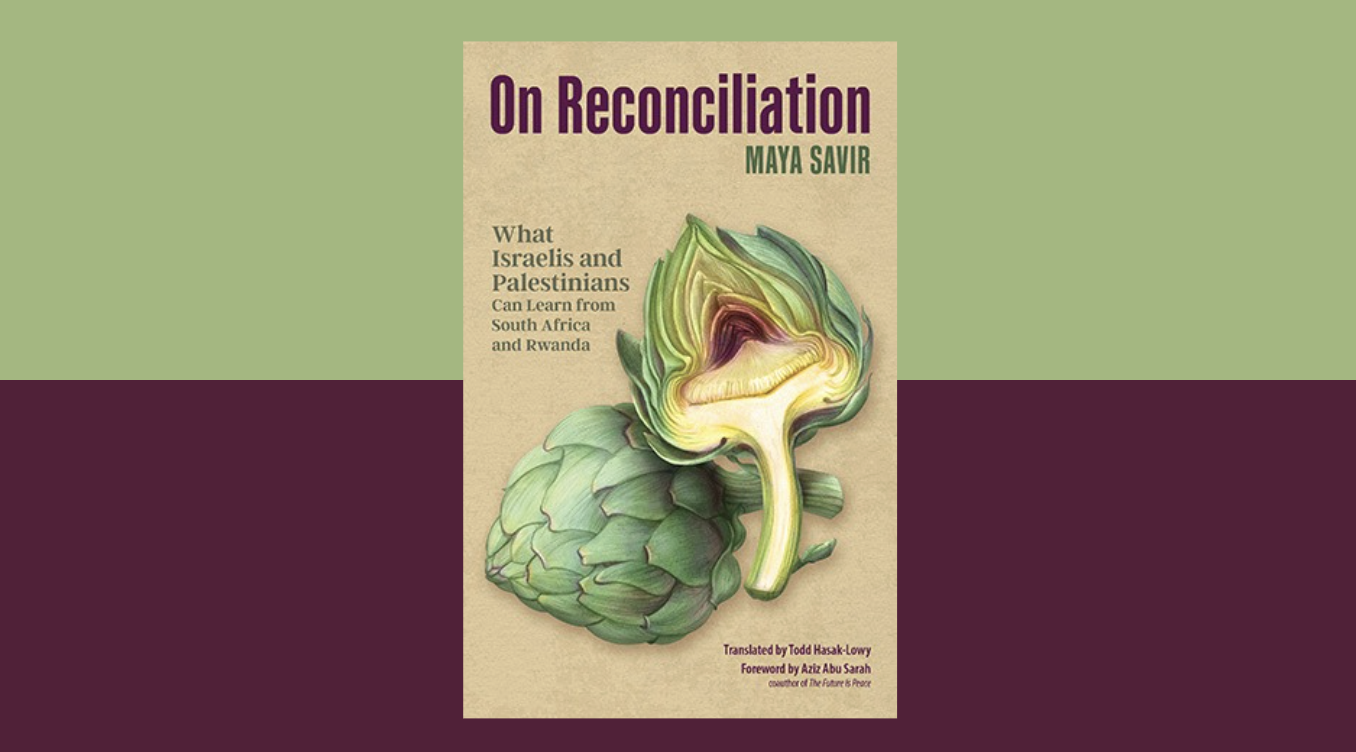
Maya Savir. On Reconciliation: What Israelis and Palestinians Can Learn from South Africa and Rwanda. Plough Publishing, 2026. $24.95. 216 pp.
About a decade ago, I attended a meeting in Jerusalem between a small handful of Israel’s Messianic Jewish leaders and several key Palestinian Christian pastors. Beyond their faith, both groups were outliers and minorities in their respective communities—the majority of Jewish people don’t see Jewish followers of Jesus as part of the Jewish community; Palestinian Christians are a minority in their majority-Muslim community.
The discussion that day focused on mutual fellowship efforts between the two communities. The gathering started out amicably enough in prayer and acknowledgment of shared faith in the resurrected Messiah Jesus. But as the conversation continued, initial expressions of good will dissolved into the tense, familiar tribal divides that had long defined the two communities. At one point someone asked, “Shouldn’t Jesus be enough to hold us together?”
There was a moment of silence before another person responded wearily, “He should. But maybe that’s not enough.”
I thought of that tense meeting as I dove into Israeli human rights activist Maya Savir’s On Reconciliation: What Israelis and Palestinians Can Learn from South Africa and Rwanda. If a small group of leaders that typically functions at the margins of their respective cultures struggles to find a way to work together in Israel even when animated by their shared faith and geography, is reconciliation possible in this place that has been marked by conflict throughout recorded history?
Savir, a Jewish Israeli peace activist, believes it is possible. She lays her hopeful cards on the table at the beginning of the book: “All conflicts end. It’s in their nature. Even the very worst of wars – world wars and genocides – are proof of this…Another truth is hidden inside that first truth: we are less rigid and closed up than we think. Humans are capable of change and societies are as well.”
Extensive experience provides the foundation of this book. Savir spent extended periods of time inside two former hot conflict zones in South Africa and Rwanda that were once defined respectively by codified, oppressive racism and a breathtaking blitzkrieg genocide. Her years of humanitarian work serving malnourished children afforded her an opportunity to spend time with a wide mix of people involved in reconciliation efforts in both places.
South Africa’s legal codification of the racist policies of apartheid (an Afrikaans word meaning “separateness” or “aparthood”) put into legal writ the deeply held beliefs of the white minority that they were superior to their Black and Colored neighbors. Political and economic power was concentrated in their hands, and resulted in a segregated society, vast economic inequality, and punitive persecution of those who opposed (or appeared to oppose) this social order. On Reconciliation digs into the timeline and personalities leading to the end of apartheid, the work and limitations of the Truth and Reconciliation Commission that was tasked with documenting human rights abuses and working to create specific programs and processes that could bring healing to a society that had been divided by color for generations, long before the laws enacted beginning in 1948. She writes,
The commission transformed apartheid from a nameless, faceless system that existed simply because it existed, much like the weather, into a system that was built, maintained, and operated by real people with names and faces, people who committed crimes for the sake of this system. In doing so, the commission fulfilled a request made by a nineteen-year-old daughter of a murdered anti-apartheid activist: “We want to forgive, but we don’t know who.”
She notes that justice has been a core part of the reconciliation work in South Africa, but it was far from the only thrust in ongoing healing efforts in the fractured society. To put it in the harrowing words of South African Anglican bishop Desmond Tutu, “If justice alone is done, the country will turn to ashes.”
This truth had a different application nearly 3,000 miles to the north in Rwanda. Over a span of about 100 days in 1994, the Hutu militia running the country unleashed a genocide against the Tutsi people. It was the result of long-simmering tensions between the two groups. The outside world proved powerless to intervene. Official estimates from the Rwandan government place the death toll at one million, and the number of rapes between 250,000 and 500,000.
As the nation sought to make sense of what it had done to itself, the International Criminal Court spent 20 years listening to testimony of victims. Savir notes that while this court was the first to declare rape as a separate war crime, the process was far from comprehensive as it focused primarily on the leaders and instigators of the genocide. The sheer numbers and the specifics of Western-style court proceedings throttled the possibility that every person who engaged in criminal activity would be brought to justice. Instead, a traditional conflict resolution process known as a gacaca (a Kinyarwandan word for “grass”, where offended parties would gather, sitting on the grass together to tell their stories and invite the community come to a decision) was employed because so much of the violence was of neighbor against neighbor.
Trauma continues to permeate Rwandan society, but so does a shared determination to keep moving forward while never forgetting the past. Savir notes that the definition of reconciliation that Rwandan society has adopted is simply living together. “In this sense,” she writes, “it is difficult to challenge: there has been no ethnic bloodshed for over three decades.”
Savir offers this deep and detailed dive into the conflict and reconciliation process in South Africa and Rwanda in order to tease out some principles that might be applied to the conflict in her own homeland. She writes,
On one side, the Jews are victims (and accordingly, the Palestinians are the victimizer) and on the other side the Palestinians are the victim (and accordingly, the Jews are the victimizer)… The central question of the conflict may be whose land this is, but the central question that seems to stand in the way of any attempt to end it is this: Who has the right to claim victimhood and who, as a result, is the victimizer?
Because we tend to assign righteousness to the victim, we use that metric to decide who should win the conflict. But Savir maintains that the virtue of tolerance allows those involved in a conflict to push beyond choosing a side and instead hold the experiences and convictions of all parties in tension. She notes with sadness that tolerance has disappeared from the conversation in the wake of the Hamas-led attack in southern Israel on October 7, 2023, that killed about 1,200 people and took 251 people hostage that day. Estimates from the Palestinian Information Agency inside Gaza state that over 70,000 lives have been lost in the territory as a result of Israel’s response to October 7. Savir notes, “…killing, destroying, razing, expelling, raping, kidnapping, starving are actions that require the psyche to detach itself from the acting body. And this is how Israeli Jews and Palestinians communicate with each other. They appear to speak different languages, but in actuality they communicate with one another in the shared language of soulless action.”
Savir’s examples of civic and societal reconciliation in Rwanda and South Africa aren’t tidy ones. She does an excellent job showing the tensions and weaknesses in them, and notes that they are also specific to the culture and history of the place in which they’re enacted. What is striking in her exploration of these reconciliation stories is that there were all along people dreaming of what reconciliation could look like when the conflict burned itself out, just as there are people like Savir herself, seeking to lay the groundwork for reconciliation in Israel for the “someday” when the conflict comes to an end.
I appreciated Savir’s care in telling the stories of those involved in reconciliation efforts in those African countries as well as those struggling to build a foundation for reconciliation in the midst of ongoing conflict in Israel. If there is one omission in the book, it is in the way she talks about faith. She tends to talk about faith primarily as a social identifier, rather than allowing to play an active role in both individuals and groups involved in the work of reconciliation.
And it is work. Impossible, mountain-moving work. I had that illustrated for me in that Jerusalem meeting room more than a decade ago. On Reconciliation is an invitation to readers to imagine themselves beyond the headlines and horrors, in a room where former enemies can begin to repair the world together.
The Weekly Digest
Premier Thought Every Thursday.
All of our recent essays and podcasts, delivered to you. Free.
Free. Delivered Thursday mornings.