

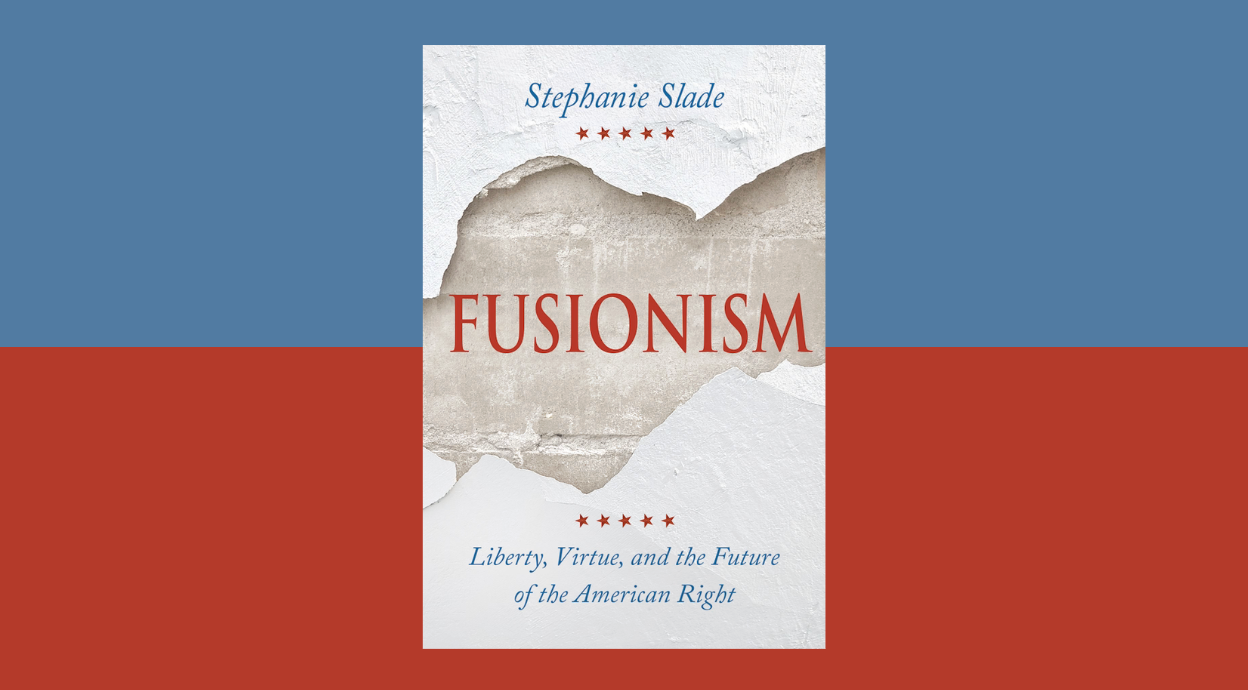
I recently got my copy of Reason editor Stephanie Slade's new book Fusionism, published by Notre Dame Press. But I thought it might be interesting to try something new with this particular book. The conversation, in this case, is likely to have some fairly predictable turns, but also is the sort of thing that really should be lingered over rather than glossed over quickly. So I'm writing one piece foregrounding the questions I have before I start reading. Then in a few weeks I'll have a review after I'm done with the book. (This will run alongside two other reviews.)
This is the frame I am bringing to the book. Supposing you are an orthodox Christian living in the west who cares about Christian ideas about the family and sexuality and also about justice, political economy, and mercy (amongst other things) it is probable that you have a fairly conflicted relationship to our dominant political paradigms in the west. The post-religious right is increasingly open to much more pagan ideas regarding natural hierarchy, the nature of justice, the (un)importance of mercy, and so on. The progressive left, meanwhile, to my eyes still hasn't gotten over the idea that unchosen constraints are inherently tyrannical, that the only way for an individual to be truly free is to live as an isolated entity crafting their own identity from nothing.
As long as those are the dominant paradigms on the right and left, orthodox Christians of good will are going to struggle to place themselves in the political life of their respective nations. This is why I'm excited for the Slade book: the older fusionist paradigm on the American right was one attempt to incorporate Christian thought and wisdom into a dominant political agenda. If you show me the heroes of fusionism, which I take to be figures like William F. Buckley, Ronald Reagan, and George Bush and then show me figures like Costin Almariu, Charles Haywood, and Tucker Carlson and ask me which version of the Right I prefer, it is not a difficult choice.
And yet it is a choice I do not like either. Many years ago a friend of mine remarked that if the American Right becomes a fight between Zombified Reaganism and the Wolves of Vinland, everyone will lose. And I still think he was right. So I am hoping that the champions of fusionism today will not simply be recapitulating Buckleyism—which will simply invite new forms of Bozell-ism as a response—but will be retrieving and modifying the fusionist thinkers in order to define a workable project for our day.
Toward that end, these are the questions on my mind as I begin Slade's book.
Question One: Are we still doing "Mater Si, Magistra No"?
My understanding of the fusionist project is that it basically worked by giving "social" questions concerning marriage, the family, and life issues to the conservative Christians and giving "economic" questions to the aggressively free trade, free market libertarian types. Even in Buckley's day, however, this was a contested move. The aforementioned Brent Bozell Jr., Buckley's brother-in-law, rejected the framing because Christian moral norms are obviously concerned with things beyond the narrow life of families and the sexual behaviors of men and women.
More importantly, the Catholic Social Teaching tradition is quite explicit on this point. Both Popes Pius XI and fusionist darling St John Paul II make some radically anti-libertarian statements in their social teaching. Does Slade's brand of fusionism account for this problem or does it simply restate Buckley's position, at least as he stated it in the early 1960s, that the church is our mother but not our master in political matters? It seems to me that a retrenched Buckleyism on this point makes any kind of reborn fusionist project dead on arrival because most young Christians engaged in political life that I know of are, for a variety of reasons, highly skeptical of a broadly libertarian economic philosophy. The one exception here, of course, would be the Christians Nationalists, who are happy to say "mater si, magistra no" on the dignity of refugees and immigrants. But then I rather expect them to all be exploited and played by the Thielite transhumanist right anyway, as I have been saying for years. So though they are an exception here, I do not think they are terribly relevant to the conversation.
Question Two: Is it ever licit for government to intervene in markets?
The argument someone like Buckley would make on the economic issue will be some version of the claim that outside intervention in the market by the state introduces distortions to the market that, eventually, do more harm than good, quite often harming the very people the intervention was designed to help. This is a common claim in right wing economic discourse and it is not entirely wrong, of course. There are plenty of forms of state intervention in markets that are deeply destructive. That said, as an absolute principle the claim is nonsense: We are all grateful, I hope, for the interventions the government made in our food system after Upton Sinclair's The Jungle was published, for example. We are also grateful, I would hope, for the interventions that banned child labor and established the 40 hour work week.
So: Does Slade's version of fusionism allow for the idea that market interventions by the state are sometimes good and admissible? (Hayek, to take one relevant example, would say it is sometimes licit for governments to intervene, from what I have gathered.) Or does her version take a more absolute stance against government power being aimed at regulating or interfering in markets? The former position allows for conversation and the prudential application of government power in selective cases. The latter does not.
Question Three: The Problem of Technologically Mediated Public Vice
How does a renewed fusionism account for the technological and legal changes that have normalized public vice in ways that did not exist during the prior era when the fusionists were dominant? I am thinking particularly of companies like DraftKings, FanDuel, and Kalshi, though others would fit here as well. We now have immensely powerful devices we carry in our pockets all the time that make it extraordinarily easy to spend money and we have normalized public vice in ways that make destructive vices immediately accessible on those very devices. The consequences have already been awful and may well become worse.
I'm something of a Christian social democrat in my politics so I look at this problem and don't find it hard to answer: these companies shouldn't exist. I expect that is also how someone like Sen. Josh Hawley would approach this issue, and it is at least a plausible position for the Bernie Sanders wing of the Democratic party. How would a renewed fusionism address this issue?
Question Four: The Dissolution of the Commons
In trying to anticipate how a person generally averse to state intervention in markets might address the question above, the obvious place they could go is to say something like "soft social pressures and stigma from the broader community a person belongs to as well as broader society should be used to discourage public vice and spending on vice." If that is the line a renewed fusionism takes, then we have simply backed the problem up a step: What if "broader society" and personal communities and even the idea of social stigma have all been liquified and dissolved via technological innovation, as Jon Askonas has argued? If your mechanism for controlling public vice is to appeal to something that no longer exists... then what?
Conclusion
The point of raising these questions here is that I think the fusionism conversation is enormously important. Whatever else one wishes to say about it, the fusionist paradigm was one way that conservative Christians in the post-war world found to articulate how their faith informed their politics. It also provided a way for Christians to be included in political coalitions and have real power.
The dominant paradigms we have now, whether from the post-religious right or the progressive left, fail this test. Obviously one way of dealing with that problem is to simply imagine an entirely new paradigm for the interaction between Christianity and public life and then seek to impart that paradigm to others and build a movement around it. But that is immensely difficult for many reasons, if not impossible. If we can work with existing paradigms, we would do well to do so. So my hope for the Slade book is that it can move this conversation forward in constructive ways such that orthodox Christians of good will can find some existing traditions and thinkers and ideas to unite around in order to present a viable alternative to the revolutionary paradigms of the right and left. If Christian fusionists and Christian social democrats can find common cause around a broad range of issues, that would bode well for many things. If we cannot, then we have a different and much thornier problem, I fear.
The Weekly Digest
Premier Thought Every Thursday.
All of our recent essays and podcasts, delivered to you. Free.
Free. Delivered Thursday mornings.