

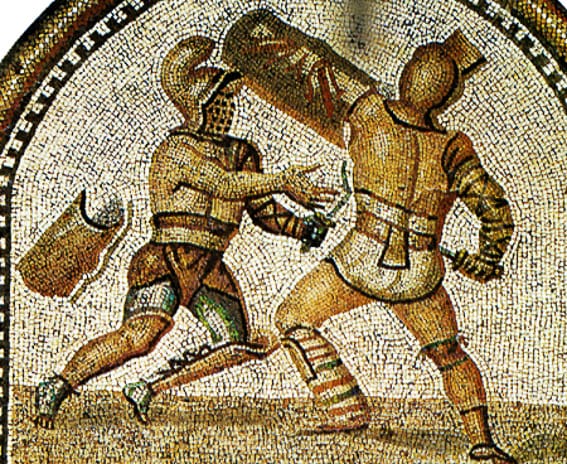
Roughly 1,600 years ago, a man named Alypius confidently proclaimed that witnessing the bloodshed of gladiator combat would not change him. St. Augustine later tells us that what Alypius witnessed wounded his soul more than the violence he observed wounded the gladiators’ bodies. He was not unchanged, and neither are we.
The decision by Secretary of Defense Pete Hegseth to livestream the execution of mass shooter Nidal Hasan has provoked many responses amongst Christians. Some are calling not only for public executions, but for executions to be broadcast widely to the nation. Some are even appealing to scripture to justify it. I understand the impulse behind public executions, and I take it seriously. Romans 13:3-4 describes the sword of justice as a deterrent: Those who do evil should fear. Old Testament law also prescribes public executions, and we’re told that this is, at least in part, so that “all Israel shall hear and fear” (Deut. 13:11). If deterrence is the goal, why not let the whole nation see?
Before answering that question, I should be clear about what this article is not arguing. My concern here is not to argue for or against capital punishment. I favor it in the abstract, though the practice must go hand-in-hand with virtuous systems and a virtuous people. But this piece is not the place to argue it. Nor is it obvious that Mosaic law should woodenly prescribe how a modern nation carries out justice. It should not be lost on the church that some of the texts cited in favor of public executions are texts mandating the execution of apostates. But since those calling for broadcast executions appeal to those laws, for the sake of argument I will grant both that capital punishment can be just and that Mosaic law speaks to the question. Thus I ask a narrower question: if a society does execute, what does it do to us to watch?
Death changes us. How we kill and how we watch others die not only reveals our virtue (or lack thereof); it shapes us. That is why, even when it is necessary for us to witness death, such witnessing belongs in its proper and intimate context, among those with a real stake in the act. Mosaic law prescribed public executions in precisely this way. Taken out of that context and broadcast to millions, witnessing death becomes voyeuristic and disordered.
Under the guidance of Mosaic law, ancient Israel’s public executions were carried out primarily by witnesses to the crime and the community in which the victim lived (Deut. 17:7; 21:21). Executions were not secret government acts performed in dark rooms behind closed doors, but they were also not spectator events for millions of strangers with no social or moral bond to the victim, the guilty, or the community. These were dreadful acts carried out before—and often by—the community in which the crime happened. Those witnesses threw the literal first stone. As Matthew Henry put it, the witnesses “are really, and therefore it was required that they should be actually, the death of the malefactor.”
This means onlookers were not neutral spectators who bore no responsibility or carried no cost. Instead, they were participants in the punishment. The early church understood this. Athenagoras, an ante-Nicene church father writing in the second century, said that Christians stayed away from the arena, “deeming that to see a man put to death is much the same as killing him.” Israel’s onlookers were witnesses to justice both to hold one another accountable and to testify to the consequences of serious crime. These onlookers bore a responsibility to ensure that justice was done and that others would fear the sword. But this responsibility also exacted a price.
This burden fell on the community and especially those most directly impacted by the crimes. This arrangement honored both the rights of victims and the dignity of even the most heinous criminals. Deut. 17:7 and 21:21 show us that public executions were performed by the witnesses and men of the local community, and Deut. 13:11 and 19:20 show that this was, in part, so that all would hear and fear. However, hearing and fearing is not the same thing as participating. In other words, there were two groups in view: the local community who acted and witnessed, and the wider nation who heard and feared.
In an era of mass communication and mass consumption, we should be careful to not anachronistically equate public executions performed at the city gates in ancient Israel with public executions broadcast to millions of online spectators. While a healthy fear of justice is good, it is not good for our souls to make a habit out of being witness to the destruction of image bearers of God. Even where it is necessary, this is a weighty task, and not one that rightly belongs to everyone. Rather, it belongs to those bound to the crime. And that natural and embodied restriction serves to safeguard both our souls and justice. Deterrence is a genuine good, but it is not meant to be absolutized as if human bloodshed has no cost once a sentence is passed. C. S. Lewis saw where that logic leads: if deterrence is all that matters, “it is not absolutely necessary that the man we punish should even have committed the crime.” Similarly, if deterrence were the only factor in justice, it would be justified to torture the guilty on a live broadcast. Or even the innocent. We do not do that. Why? Because even the guilty bear the image of God and are owed dignity, even in death.
Alypius bore a radical form of the cost of watching. Augustine tells the fuller story in Confessions 6.8. Alypius was a friend of Augustine, and when other friends pressed him to go to the gladiator fights, he resisted the peer pressure and even boasted that his mind would not be polluted. “You may drag me there bodily . . . but do you imagine that you can make me watch the show and give my mind to it? I shall be there, but it will be just as if I were not present, and I shall prove myself stronger than you or the games.”
But eventually he gave in. Even after he arrived, Alypius was determined to keep his eyes shut and not see the violence. Sadly, Alypius did open his eyes. Augustine writes that Alypius’s “soul was stabbed with a wound more deadly than any which the gladiator, whom he was anxious to see, had received in his body.” After Alypius watched the slaughter, Augustine explains, “he carried away with him a diseased mind which would leave him no peace until he came back again.” He had meant to be present in body only. He left a participant.
Now, I am not equating public executions with the gladiator combat of Rome, nor am I saying that every witness to an execution will revel in the bloodshed. A modern execution does not involve combat, and being drawn to the violence is not a foregone conclusion. However, Alypius was also certain of his own strength, and Augustine writes that he drank in the madness without realizing it. While a hypothetical public execution is not the circus of ancient Rome (and my prayer is that it will never be), we would do well to guard our eyes, minds, and hearts against the sinful perversion of being fascinated with bloodshed.
We can readily see a milder version of this in the mania of publicly broadcasting criminal trials. Regardless of the intention, this practice turns something grave into reality TV. Hordes of people outside the affected community, without any cultural or relational context, and certainly without any legal expertise, pick sides and fight about the case as they would about their favorite Survivor contestants or basketball teams. Real lives are at stake, and real lives have already been lost, and real suffering is being experienced by the community actually affected by a heinous crime. But now millions twist legal proceedings into a spectator sport or an opportunity for virtue signaling. Not every spectator is indulging in the worst possible behaviors and motivations, but the tendency is plain—and so is the price of carelessness. If witnessing the drama of culturally volatile court cases can tempt otherwise faithful men and women into treating the lives of actual humans like reality TV contestants, how much more careful should we be about normalizing spectatorship of the bodily destruction of image bearers of God?
While some may fall into the raucous sin of Alypius, many others may become desensitized to death. They might not applaud the killing, but they may well stop understanding and rightly feeling the weight of death. Death, which Scripture calls the last enemy (1 Cor. 15:26), may become something they are comfortable with, or simply indifferent to. And even if witnessing death does not push us into either extreme, it still changes us.
The danger of falling into the madness of Alypius or succumbing to callous apathy is present even for judges, court officials, and the families of victims. But whether by vocation or by relational context, these individuals have a genuine stake in the act. The same is true of the communities affected. When members of a community witness or take part in a death, they are bound to it by grief, loss, or at least a feeling of closure. However they feel, they are not disembodied online spectators divorced from the act, but rooted in a time, place, and relational context that naturally gives weight to it. For these invested members of a community, witnessing an execution is a profoundly intimate experience.
That intimacy is exactly what a broadcast removes. Though this metaphor cannot be taken far, there’s a sort of voyeuristic pornification in taking such an act outside of its proper, personal, and natural context and commodifying it for those with no stake in the act. To borrow Marshall McLuhan’s phrase, the medium is the message. A livestream does not simply show an execution to more people; it catechizes those watching.
Those who participate in this kind of justice carry a burden, and we, as a society, should weigh it. Even if executions should not be hidden away among a handful of government officials, that is a far cry from broadcasting them to millions who do not know the victims, do not know the guilty, were not impacted by the crime, and had no role to play in the prosecution. Whatever public character God’s law gave to executions served a purpose, and community participation in justice is not the same as a livestream for all of society.
Alypius thought he could sit in the stands as if he were not present. He was wrong, though Augustine adds that God later graciously pulled him out of that madness and taught him to trust not in himself but in God. Human life matters, and observing its destruction is never a casual act. It changes us, and it should only be done under weighty and serious conditions and by those who have a real stake in the act. Sisters and brothers, we are not made to destroy one another, and that creational reality does not change even when death becomes necessary. To forget that is to forget ourselves and the one in whose image we are made.
The Weekly Digest
Premier Thought Every Thursday.
All of our recent essays and podcasts, delivered to you. Free.
Free. Delivered Thursday mornings.