Not long ago, I was invited to speak at a gathering in New York of pastors from across the Tri-State area. My assigned topic was the necessity of prayer in ministry. While scanning the schedule, I noticed another session—on Sabbath keeping. It didn’t conflict with mine, so I attended.
I had recently begun taking the Sabbath more seriously, and the session left me encouraged. The speaker affirmed the importance of setting aside a day of rest. He quoted staggering statistics about burnout, especially among clergy. He spoke of how he and his staff had become more productive by observing a weekly Sabbath—recovering from the previous week and preparing for the next.
There was no arguing with his presentation. The data was persuasive. Even beyond church life, he cited business research: high-performing companies with four-day work weeks often outperform those that demand nights and weekends. Sabbath, it seemed, was not only biblical—it was strategic.
I don’t doubt it. A life shaped by the rhythm of creation—six days of work, one day of rest—does often lead to greater emotional health and sustainable fruitfulness. But when we read the creation account of God resting on the seventh day or the commands given to Israel that follow this pattern, productivity and efficiency are never the point.
In our modern culture, productivity and efficiency are the point. L. M. Sacasas, who researches technology and culture, calls this the “dogma of the one best way”—a relentless obsession to optimize everything.
Just scroll through YouTube:
“The best way to . . . ”
“The only way to . . . ”
“If you adopt this technique, you will never have to worry again about money, clients, or stubborn fat again.”
Or the ever-popular rebuke: “You’re doing it wrong!”
The tragedy of the “one best way dogma,” Sacasas says, is “living with the unyielding pressure to discover it (the ‘one best way’) and the inevitable and perpetual frustration of failing to achieve it.” He continues: “And not only frustration. It produces anxiety, fear, compulsiveness, resignation, and, ultimately, self-loathing. If there is ‘one best way,’ how will I know it? If I have not found it, have I failed? And is it my fault?”
This mindset, says Sacasas, is “necessarily inhospitable to the human person.”
We should resist seeing the Sabbath as just another “best way” toward productivity and efficiency. When God gives the command, he doesn’t say, “Keep the Sabbath, because it’s good for your output.” He says, “You shall keep the Sabbath, because it is holy for you” (Exodus 31:14).
Looking back at the creation week in Genesis 1-2, God worked for six days and called it good—very good. But the seventh day he calls holy. Our world pushes us toward maximum output. God calls us to goodness and holiness.
This is an important detail: God did not rest because he was tired. Creating the sun didn’t exhaust him. Stretching out the expanse didn’t take a toll. He wasn’t running on fumes after creating a generative system of fertility in plants and animals. God does not grow weary or change in his pace.
Have you not known? Have you not heard?
The Lord is the everlasting God,
the Creator of the ends of the earth.
He does not faint or grow weary;
his understanding is unsearchable. (Isaiah 40:28)
Even after six days of work, creating the ends of all things—from the Milky Way to the single-celled microbes, God didn’t need a break. He never changes. Never in a hurry; never procrastinating. He is always in control, always patient, and present.
Nor is he resting up, getting ready for the week ahead. He isn’t anticipating the demands of what’s coming and reserving energy to offer his best self. God simply stopped, delighted in his creative work, and blessed the world.
Of course, we are not God. We do get tired. We do need to recover. If we do not rest, we will suffer. But if we are to follow God in his weekly rhythm of work and rest, we must also follow in his motivations. “Man is not a beast of burden,” says Abraham Heschel, “and the Sabbath is not for the purpose of enhancing the efficiency of his work.”
Many of us, if we’re honest, practice a weekly Sabbath rhythm as a strategy to recover from or a precaution against exhaustion. Those concerns are legitimate—but they are not God’s reasons. Not for himself, and not for us. God sees it as a day designed primarily for goodness and holiness, not recovery. Weariness and burnout are good reasons to come to the Sabbath. But they shouldn’t be the reasons that keep us there.
To assume that Sabbath keeping is primarily designed for recovery from and a precaution against exhaustion or a strategy for productivity, we are in danger of making the Sabbath only for those who have the health, energy, and vocations of productivity. But what about young children? What about the disabled? What about the elderly? In our world, there are increasing measures to exclude these neighbors of ours—aborting our infants and abandoning and euthanizing the disabled and elderly. When people can no longer produce, we question their value.
But the God of Sabbath thinks differently. Jesus welcomed the children and paid special attention to the disabled. The New Testament church gave special emphasis to elderly widows.
The Sabbath is not a mechanism for recovery, nor a tool for better performance. It is a holy day—a window into what God experiences. A weekly rhythm of delight, goodness, and joy. Sabbath is God saying, “I enjoyed this so much—I want you to experience it too.”
Some things are not for function but for delight.
The Butter Rule
There are two kinds of butter in our house. One is for greasing the pan we cook our eggs in, or for when our kids make pancakes on Saturday mornings. We buy it in bulk—sticks of butter for baking or frying. But then there’s the other kind of butter. The good kind. It comes in a gold wrapper, shaped like a small brick instead of a stick. It sits out on the counter in a dish, soft and ready—for fresh sourdough or warm scones straight from the oven.
Do you see the difference between the two? One is an ingredient, the other is an experience. One comes in bulk, the other comes in gold. And in our house, you don’t make the mistake of greasing a pan with gold butter. Gold butter is holy, set apart for particular purposes.
At least, you don’t make that mistake for long.
I remember when the gold butter started to make an appearance on our countertop. It was laid out on the counter in one of our small dishes with a butter knife. I grew up in the ’80s and ’90s, when most kids I knew used margarine for whatever butter needs you had. Margarine came in a tub, and the tub went into the fridge. You scooped it cold, used it for everything, and put it back. Leaving it out would’ve turned it into a separated, oily mess. But this new countertop-butter? It was a revelation.
Let me be clear: Between my wife and I, Jena is the superior cook. By a mile. That sourdough and those scones? That was Jena’s doing, not mine. We’re all just lucky to be near the action.
Still, I’ve got two culinary contributions I’m proud of: omelets and grilled cheese. (Grilled cheese secret: sourdough + parmesan on the crust.) The key to both? A well-greased cast-iron pan. One morning, I was prepping an omelet and saw the gold butter right there by the stove. It looked convenient. I took a generous chunk (I measure butter with my heart) and got to work. Until Jena noticed.
“Did you use the butter on the counter to cook your eggs?”
Maybe.
“That butter is for spreading, not cooking!”
Got it.
Just like I needed reminding of which butter to use, let us tell you again: Don’t simply use the Sabbath for recovery and productivity. Don’t use the gold butter for your eggs. The Sabbath is for goodness and holiness.
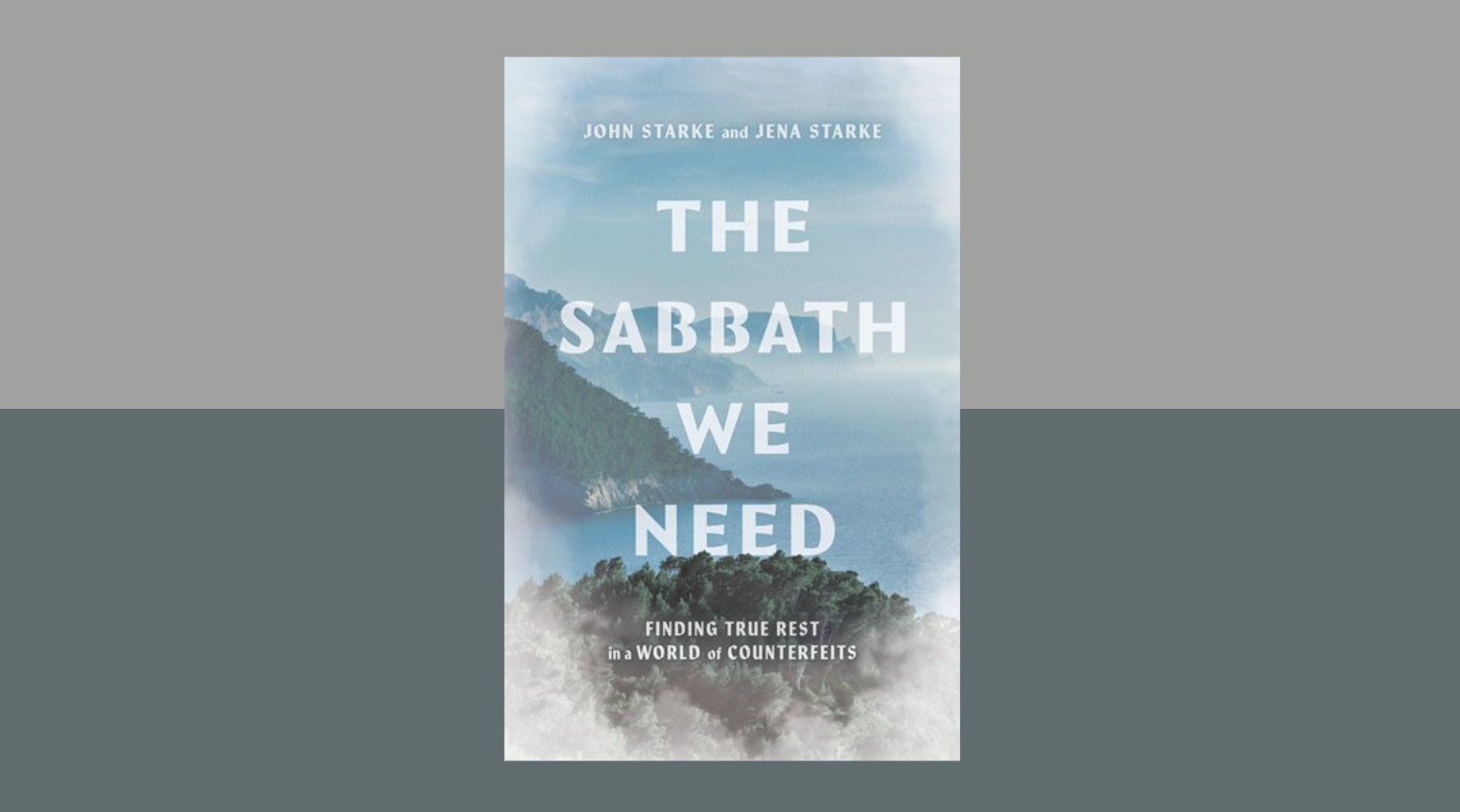
Taken from The Sabbath We Need by John Starke and Jena Starke. ©2026 by John Starke and Jena Starke. Used by permission of InterVarsity Press. www.ivpress.com.
The Weekly Digest
Premier Thought Every Thursday.
All of our recent essays and podcasts, delivered to you. Free.
Free. Delivered Thursday mornings.