

Glen Scrivener, a pastor and evangelist who serves in the UK, says "yes":
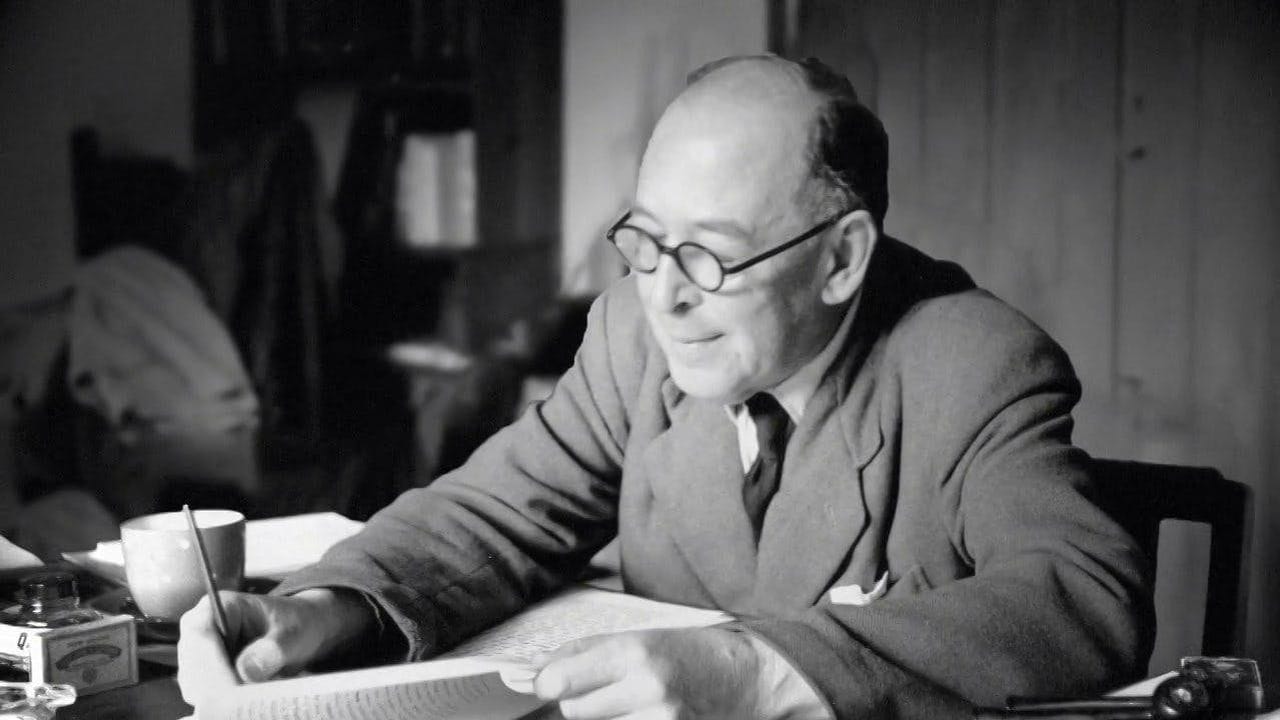
Scrivener's argument, which is worth hearing in full in his video, is that the defining aspect of the post-World War II settlement that has defined western life for 80 years is a certain universalizing impulse that tended to establish common cause by relativizing and minimizing differences between groups. Within the Christian church, the work of C. S. Lewis offered a relatively easy way to justify that intellectually through invoking the idea of "mere Christianity" as a kind of trans-ecclesial unifying concept.
So we had an era of "mere Christianity," Scrivener argues, in which the distinctive beliefs of specific church traditions were minimized or relativized. During that era, a great deal of the work done by Christians of all types was aimed at solving the problem of how to create an intellectual and cultural system that could ground our political life while credibly minimizing our theological differences. So for Rome we saw documents like Dignitatis Humanae promulgated by the Vatican. Amongst evangelicals, we saw the ascent of figures like Billy Graham. The hard edges that divide separate Christian churches were sanded away in the name of preserving a system founded on universalism.
Scrivener says that system is now dying. Younger people who have grown up without tradition or custom and often strapped to a screen for hours every day desire belonging, desire to enter into something that offers moral direction, identity, and a fixed way of life they don't have to generate for themselves. But the only way to have something like that is through particularity and even some hard edges. So, Scrivener argues, Mere Christianity is out. Orthodoxy is back. Rome is back. Distinct Protestant traditions are back. In short, denominationalism is back.
In one sense, I think he is obviously correct. Certainly, the number of people interested in Orthodox and Catholic apologetics online is quite high, although there is not a lot of broader sociological data (yet?) to suggest that this movement has translated into broader society. Likewise, as Scrivener himself notes, the fact that Gavin Ortlund set out to create YouTube videos defending Christianity now finds himself regularly drawn into Protestant apologetic work is notable.
That being said, I have two quibbles with Scrivener's argument, or perhaps an extension of his argument and a quibble. One point is actually quite adjacent to the direction Scrivener eventually goes and I imagine he would agree. The other is a point that he doesn't develop in the video but on which I'd be keen to hear his thoughts.
To Speak of "Mere Christianity" at all is to Speak as a Protestant.
First, the adjacent point: One of the ironies of the way C. S. Lewis has been received by American evangelicals is that Lewis himself was never really a "mere Christian" in the way Scrivener describes it in the video. Rather, Lewis was a rather ordinary lay person in the Church of England, as I argued in these pages 12 years ago. Indeed, if you read his work more closely or read a bit about him, you'll be struck by how deeply Anglican he really was. (Scrivener is fully aware of this, of course.)
The point of "mere Christianity" for Lewis was not to minimize ecclesial distinctives, but rather to help people make useful distinctions as they think about their relationship to faith. Yet, and Scrivener himself develops this point in his own way in the video, to even conceive of such a project as being legitimate is itself to be committed in some limited way to Protestantism. It is not really possible for a Roman Catholic or Eastern Orthodox Christian to separate belief in "mere Christianity" from membership in and submission to the ecclesial life of Rome or Constantinople. To imagine that there is a set of cardinal doctrines that transcends ecclesial divisions and unites all people as "Christian" is inherently to speak and think as a Protestant.
So in that sense the best way to read what Scrivener calls the era of "mere christianity" is probably to regard it as a period of deficient Protestantism in which people presupposed Protestant conceptions of the church without understanding that they were doing that. They mistook their implicitly Protestant commitments for a kind of broadly Christian and ecclesially indifferent set of commitments. That is never what Lewis was trying to do in his own work, but it is how his work was received by highly democratic and anti-institutional American readers.
Again, I think Scrivener and I agree here and I found his discussion of this point in the latter part of his video quite beautiful. But whereas Scrivener is making this point in an evangelistic register, I am trying to draw out the same idea from a more analytical perspective with an eye on movement dynamics.
The Danger of Factionalism
The second point is more challenging. On the one hand, Scrivener is obviously correct that interest in distinct ecclesial traditions and the differences that divide Orthodox from Catholic or Reformed from Lutheran are of greater interest to many today than they were 20 years ago. However, that does not mean it is correct to say, as he does several times, that "denominationalism" is back. Denominations are essentially administrative containers for groups of Christian congregations that are bound by the distinct practices of a particular ecclesial tradition. But they remain distinct from the tradition itself and, to my eyes, show little evidence of being "back." Rather, what we seem to have is growing theological factionalism existing alongside denominational decline.
Given recent trends, it is probable that we will continue to see a broad decline in associational life, including denominational life in churches. Virtually all the numerical growth in American Christianity over the past several decades is in non-denominational contexts. It is hard for me to see how that trend would be reversed. Protestant denominations aren't doing great either and Rome is in a pretty bad spot too, while American Orthodoxy is too small to be cultural or statistically significant in American public life. In other words, all the actual institutional vehicles that exist to help someone actually live as a thick Roman Catholic or Eastern Orthodox or Reformed or Lutheran or Baptist Christian are struggling significantly.
Yet Scrivener is correct to note the increased interest in the theological distinctives that separate one ecclesial tradition from another. The problem, at least so far, seems to be that even though many seem to feel an impulse to study theological traditions and distinctives more deeply in order to place themselves in a particular tradition, these people are still mostly relating to those traditions in consumeristic and highly online ways, which is why the interest in theological distinctives doesn't seem to be translating into actual growth in denominational membership so far. (The other possibility, of course, is that the interest in these theological debates is still a highly online problem and one that doesn't have much real world import yet.)
Given that, the likeliest outcome seems to be that our non-denominational churches will continue to grow, but their membership may shift. The de facto system we had is that our non-denominational churches tended to be full of people who were implicitly Protestant but didn't really know it. As a result, they were actually able to get on well with most people since they did not think they have strong and highly specific theological commitments.
If theological factionalism is back but denominationalism isn't, then what we are heading for is a church world that swaps out those types of members for new non-denominational members who are more exercised about theological distinctives and more inclined to fight about theological topics that divide, say, Baptists from Catholics or Calvinists from Orthodox.
If you are the media you consume or the information ecosystem you live in, then we may be headed for a scenario where pastors in non-denominational settings are being confronted by congregants who are, in terms of information intake, basically Catholic or Orthodox or Calvinist, and yet they remain as members in churches that are none of those things.
What should happen is that people with a sharper interest in these more defined and narrow theological traditions should move into denominations governed by those traditions. So far, however, that doesn't seem to be happening very much. And that likely means one of two things:
One possibility is that Scrivener and I are overstating the point about resurgent interest in theology and really the thing we're seeing is a largely online-only phenomenon and the non-terminally online are much more like the boomers in their relationship to Christian distinctives. There is some evidence to suggest this is true. It may be that the factionalism danger is a predominantly online thing that doesn't translate much into local churches. If Burge is correct and the majority of young churchgoers today don't know what "Protestantism" is, then that suggests the factionalism angle that so interests Scrivener and I is not as widespread as we think.
The second option is that there is an actually significant resurgent interest in narrower, more particular theological traditions. But so far that resurgent interest is not translating into growing denominationalism, but merely in more sectarian Christians who are still attending non-denominational churches. If that is correct, then it raises many questions about the future of non-denominationalism in the American church: Is it possible for independent churches to essentially place themselves within a theological tradition but not within a denominational vehicle that typically protests and promotes that tradition? And if it is, how do they do that in healthy and sustainable ways?
That being said, my fear is that the task of non-denominational pastors is about to get harder as they face more and more congregants with wildly different information diets and, therefore, wildly different relationships to the Bible and theology.
If my analysis is right, then it may well turn out that the best case scenario for us is that Scrivener and I are wrong and the borderless "mere Christianity" of Graham persists while the trends pointing toward greater factionalism remain confined to the internet. I do not think that is what will happen. But as outcomes go, it is probably preferable to the scenario I have described.
The Weekly Digest
Premier Thought Every Thursday.
All of our recent essays and podcasts, delivered to you. Free.
Free. Delivered Thursday mornings.