


To begin, we need to cover two key topics: the words, behavior, and associations of Zachary Garris and the teaching record of the Presbyterian Church in America on issues of racial sin. After that, I want to move toward a broader point regarding the stewardship of our institutions, including our denominations.
The Words, Behavior, and Associations of Zachary Garris
Rev. Zachary Garris is a teaching elder (TE) in the Presbyterian Church in America (PCA). Rev. Garris pastors at Bryce Avenue Presbyterian Church in White Rock, New Mexico, which is part of the Rio Grande presbytery. (Presbyteries are bodies of regional governance in presbyterian congregations, roughly equivalent to a diocese in churches that use an episcopal polity rather than presbyterian.)
In addition to his work at the church, Rev. Garris is a regular conference speaker, author, and runs a publishing imprint called Reformation Zion. In the past, Garris has authored a book with the independent scholar and ethnonationalist Stephen Wolfe and initially accepted an offer to speak at a conference alongside the anti-semitic white nationalist pastor Joel Webbon, which he later withdrew from after a number of pastors in the PCA strongly encouraged him to do so. The launch video for the event, however, is still visible on YouTube and includes Garris's photo alongside the other speakers. One of the promotional graphics for the conference, created when Garris was still scheduled to speak and featuring his photo, is used as the feature image of this essay.
In his work as a publisher, Rev. Garris has published Assailing the Gates of Hell, a book by the South African Calvinist author Adi Schlebusch. Schlebusch is a self-described kinist. Schlebusch himself works at the Pactum Institute, a South African think tank that has in the past published a series of essays by defrocked presbyterian pastor Michael Spangler on what Spangler calls "race realism." Spangler has also posted many times on social media regarding the supremacy of the white race and has said that the Nazi treatment of the Jews was not a failure in Christian love:
Michael Spangler explaining that he agrees with Cajus Fabricius that what the Nazis did to the Jews was not "lacking Christian love" and describes it as a "great act of Christian charity".
— Hitler Hated Christ (@not_our_guy) August 27, 2025
"In the treatment of Jews by Germans, no violation of Christian love is to be found" pic.twitter.com/5OrokKsPde
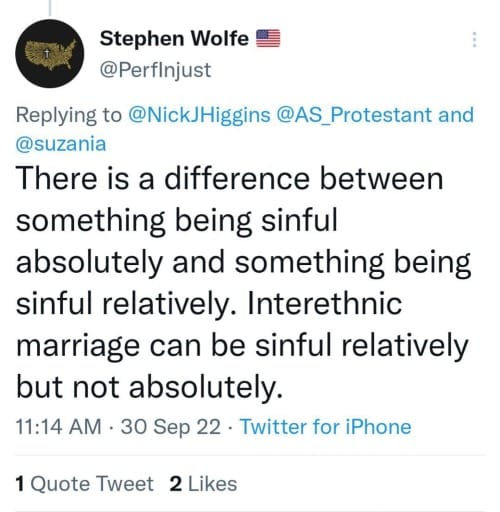
Spangler also argues that, "This is the secret reason violent crime rates are so high in America, and especially in the South: it’s not our guns, it’s our blacks." Wolfe has made similar claims in his own work, arguing that "blacks in America, considered as a group, are reliable sources for criminality, and their criminality increases when constraints diminish." Both Spangler and Wolfe have also claimed that interracial marriage is (or can be) sinful:
Garris's own writing also aligns with the general viewpoint of his friends and associates. For example, in 2019 Garris wrote an essay on the southern presbyterian theologian R. L. Dabney, whose own views on race were quite clear. Writing in reply to a critic of his original piece on Dabney, Garris said,
There are two issues raised in Mr. Whealton’s response. The first is whether biblical hierarchy extends to racial hierarchy. The Bible does not specifically address this. Though the Bible affirms that all humans are made in God’s image (Genesis 1:27) and that Jesus redeems people from every nation (Revelation 5:9), there is nothing in Scripture that teaches that all men are created equal.
While Garris does not explicitly say here that the white race is superior, he does possibly accept the reality of "racial hierarchy" and then goes on to note that the Bible never explicitly teaches that all men are created equal. The conclusion one would be expected to draw from the above is fairly obvious, I think, even if Garris does not explicitly spell it out.
Additionally, Garris has been published by New Christendom Press, which is operated out of Refuge Church in Ogden, UT, a non-denominational congregation which is pastored by Brian Sauve and by Eric Conn. New Christendom Press has also published the work of the anti-semitic author Andrew Isker. Sauve and Conn have both in the past boosted social media posts made by the white nationalist Ethan Holden, and appeared in a video produced by Holden which spliced footage of Sauve, Conn, and Wolfe into a video alongside a variety of white nationalist and Nazi figures and designs. The video was sufficiently explicit and extreme that even Moscow, ID pastor Douglas Wilson, who has himself in the past defended southern slavery, expressed concern about it.
Finally, Garris contributed a book foreword to a recent volume published by Sacra Press. Sacra Press is notable because it is run by Cody Justice, who cohosts a podcast with the aforementioned Michael Spangler. Sacra Press has also published volumes from Schlebusch and Spangler (an adaptation of his essays on race realism for Schlebusch's Pactum Institute). Most notably, Sacra Press has published a volume by an early 20th century German Lutheran called Positive Christianity which sought to reconcile Christianity and Nazism. This is a publisher Garris is plainly willing to be associated with.
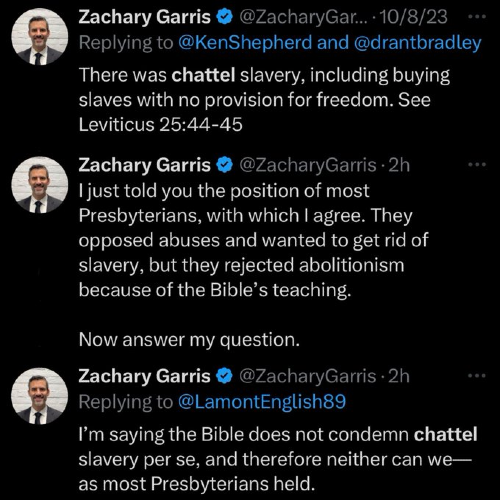
Later this year Garris will be speaking at the New Christendom Press conference alongside Conn, Sauve, and Wolfe. Additionally, Garris has in the past defended chattel slavery on social media.
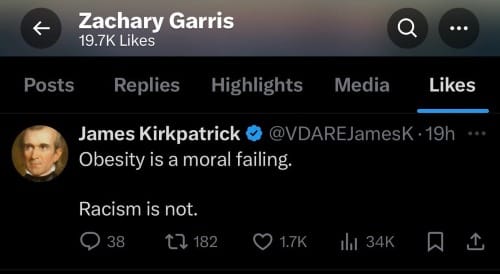
He has also liked social media posts claiming that racism is not a sin:
This, then, is an overview of Garris's speech, behaviors, and associations as they relate to questions of racism, kinism, and Nazism. It is not in any way ambiguous. His record is quite clear. Garris has a direct commercial relationship to a self-described kinist in Schlebusch. Garris has co-authored work with an ethnonationalist in Wolfe. And we see that Garris's own commercial associates, Schlebusch and Justice, are closely tied to a self-described white supremacist and defrocked minister.
In his publishing, writing, speaking, and public associates Garris is deeply intertwined both financially and through professional connections with a network of public and avowed ethnonationalists, white supremacists, and kinist thinkers. These ties go back a number of years. To whatever degree an interrelated network or project of far right Christian kinism exists, Garris is an active associate of this movement.
The PCA's Handling of Racism
The Presbyterian Church in America is a denomination of roughly 2,000 congregations and 400,000 members. The PCA has on at least four separate occasions taken some kind of formal action to address the sin of racism.
In 2004, the denomination's General Assembly, the highest authority in the church, formally adopted a pastoral letter addressing racial sins and the denomination's own history with racism.
In 2016, General Assembly passed an overture which amongst other things said that the PCA resolved to,
recognize, confess, condemn and repent of corporate and historical sins, including those committed during the Civil Rights era, and continuing racial sins of ourselves and our fathers such as the segregation of worshipers by race; the exclusion of persons from Church membership on the basis of race; the exclusion of churches, or elders, from membership in the Presbyteries on the basis of race; the teaching that the Bible sanctions racial segregation and discourages inter-racial marriage; the participation in and defense of white supremacist organizations; and the failure to live out the gospel imperative that “love does no wrong to a neighbor."
In 2018, General Assembly received a report on the sin of racism drafted by an ad interim committee of the church.
Finally, in 2025 General Assembly affirmed,
That the 52nd General Assembly of the Presbyterian Church in America does hereby join with the Associate Reformed Presbyterian Church (221st General Synod) and with the Reformed Presbyterian Church in North America (193rd Synod) in condemning without distinction any theological or political teaching which posits a superiority of race or ethnic identity born of immutable human characteristics, and does call to repentance any who would promote or associate themselves with such teaching, either by commission or omission.
It also should be noted that there is a theological reason the PCA has staked out these positions. The PCA is a confessional denomination, which means that ordained leaders in the PCA take vows to uphold a certain confessional standard. In the case of the PCA, that standard is the Westminster Confession of Faith as well as the Westminster Larger and Shorter Catechisms.
One of the strengths of the PCA's confessional standards is the expansive way they treat the Ten Commandments, which is fully in keeping with the way the Reformed tradition has always understood them. Following the example of Our Lord in the Sermon on the Mount, who argued that hating our brother is a form of murder (and therefore a violation of the sixth commandment), the PCA's confessional standards adopt broad readings of each of the Ten Commandments—which you can read for yourself in the Larger Catechism particularly.
So when addressing issues of racism, the PCA has often linked sins of racism to specific violations of the Ten Commandments. In the 2004 Letter, for example, it argues that the sin of racism is a violation of the first, sixth, and ninth commandments in as much as racism involves having other gods before God, leads to hatred of other racial groups, and requires lying about the status and capacities of other racial groups. So the argument the PCA has made on this issue is not simply driven by 21st century egalitarian politics; it is rooted quite explicitly in our confessional standards.
Given all of this, it seems almost self-evident that Rev. Garris is in violation of the teachings of his denomination on the issue of racism.
Even if you only considered his associations with Schlebusch, Wolfe, Isker, Webbon, and Spangler and set that next to the 2025 General Assembly's call to repent of "any who would promote or associate themselves" with racist teaching, Garris is in violation. He has, since the church adopted that statement last summer, co-authored a book with a man who, as noted above, says that Black people are a reliable source of criminality in the USA and who has suggested that inter-racial marriage is sinful—a position explicitly condemned by the PCA's own past statements on the issue. That alone seems like a quite brazen and obvious act of defiance directed at last year's General Assembly.
If you take the broader scope of Garris's work and the broader scope of what the PCA has said about race, the problems become even more apparent and undeniable.
That, of course, is why it was no surprise that Garris was brought up on charges over precisely this issue. Unfortunately, that is the last part of the story that makes sense. Because after charges were filed, the process seems to have fallen apart. Since Rio Grande Presbytery has not issued any statement at time of publication, we cannot definitively say why the process failed. But that it has seems difficult to deny.
To begin, it took roughly two years from the time Garris was first accused at the presbytery level to when the trial was completed. Regardless of what one thinks of the merits of the case against him, it is highly irregular to initiate a process that could lead to the revocation of a pastor's ordination credentials (and thus the loss of employment) and then leave that pastor (and his family and his church) dangling for two years. It may be the case, of course, that Garris himself contributed to the slow process—he has several cases already pending with the PCA's Standing Judicial Committee, so that may have contributed to the delay or Garris may simply have dragged his feet at certain points. We cannot say for sure unless the presbytery releases information regarding the process, which they have not done so far.
Then last week, when the trial finally took place, the rulings were even stranger. The presbytery exonerated him of the charge related to racism, which suggests that they either failed to do their due diligence, which is a failure of process, or that the prosecutor did not present all the relevant evidence, which is also a failure of process.
Additionally, the presbytery found him guilty of intemperate speech, citing two tweets he sent to Dr. Anthony Bradley several years ago and which, it must be said, are relatively innocuous, particularly relative to the ways in which countless other teaching elders on all sides of the PCA have sometimes spoken of one another. Again, there may be more here than has been publicized so far—other examples of Garris's speech that the presbytery considered and caused them to make these charges.
Yet since the presbytery has not made any public statements, we are left with a minister charged with a ninth commandment violation over what are pretty innocuous tweets, relative to how ordained ministers in the church routinely speak on social media. Not only that, but because he was formally charged and because he did not repent, the PCA's Book of Church Order (30-1) requires his indefinite suspension—meaning that the presbytery's decision to make this particular charge in the way they did combined with Garris's refusal to repent automatically triggered an indefinite suspension.
One hopes that more information about the proceedings of Garris's trial will be made public soon. But based on what is publicly verifiable at time of writing, it certainly appears that the Rio Grande presbytery handled the affair poorly by failing to do due diligence regarding Garris's words, behaviors, and associates, by failing to anticipate how this case would affect the purity and peace of the denomination, and by failing to make details of the case which can be publicized public in order to avoid outcomes in which onlookers lose faith in denominational processes. We can only hope that when the meetings of the presbytery's meetings on this are produced that a less incompetent picture emerges.
In any case, as things stand right now the outcome of all this is likely to be quite bad for the peace and purity of the PCA. The presbytery took what ought to have been a fairly simple case regarding the sin of racism and managed to handle it in a way that has made Garris a sympathetic figure both by the way the timing of the trial was stretched out and by convicting him over what is, if an offense at all, a fairly minor one—and one that would, if applied equally across the denomination, tie the church up in endless trials and adjudication. And that, of course, is precisely what may happen if things continue to go poorly.
Why Organizational Competence is a Non-Negotiable
There are many things one might say about this sad affair. But the main thought I have had is the same one I've had for years when I consider the health of the PCA, which is my home denomination and has been for 20 years.
The challenge for the PCA is that the overwhelming majority of our teaching elders are simply ordinary pastors. They love to preach, to shepherd, and to evangelize. They are not terminally online. They do not know the ins and outs of esoteric political theology disputes. They are not kinists. And yet a sizable portion of our communion, precisely because of their admirable and good pietism, are radically unprepared to navigate the procedural rules that govern presbyterian churches. If it is accurate, as some have reported, that Garris's defense was led by multiple lawyers while the prosecution in his case had no lawyers... well, there you have it.
Too often, these common failures of the pietists in our church have been minimized or dismissed by many. Set next to the realities of preaching, shepherding, and evangelization, knowing the ins and outs of the Book of Church Order (the rule book which defines how our denomination functions formally) seems unimportant. But a case like this highlights precisely why procedural competence is so important.
This ought to have been a simple and straightforward case. You take Garris's words, behavior, and associations. You take the PCA's official position on racism. You compare the two. You conclude that Garris either needs to repent or he needs to be suspended because he has violated the first, sixth, and ninth commandments and is not repentant. It should not be hard—the publicly verifiable record here is quite clear. Yet because too many in the PCA have an indifferent relationship to polity and procedures, we make it difficult.
I am writing this not only because I care about the PCA, which I do, but because I care about the state of the broader church around the world. The Anglican Church in North America (ACNA) has had its own struggles with institutional mismanagement in recent years, after all, as have most other evangelical denominations that I know of, to say nothing of the many non-denominational independent congregations that have had similar issues.
There is a broader difficulty here, of which the PCA and ACNA's difficulties are exemplary: Evangelicals as a class tend to have an indifferent relationship to procedure, policy, and institutional norms. We value charisma and talent, but charisma and talent cut loose from the constraints and demands of healthy institutions have, repeatedly, proven themselves to be enormously destructive. That is the thread that runs through so many of the depressingly long list of stories that have plagued American evangelicalism over the past 10 years—whether it is the death of Mars Hill Church in Seattle, the decline or collapse of so many evangelical colleges and churches, the shocking waste of denominational funds across many different communions, or the specific scandals currently vexing so mny of our churches, far too often our organizations have been led by people that may be personally virtuous but who lack institutional competence. The outcomes of this are never good.
What we need—and I am inclined to place this quite high on the list of our needs—are healthy groups and movements that learn how to become healthy institutions. But if that is to happen, we will have to learn to care about administration, about policy, and about procedure. We will need to spend far more time in our proverbial Books of Church Order than most of us have to this point. Such work is unglamorous and even boring. But if good things are going to endure, that will usually require the support of an institution. And for institutions to endure, they need to be led by people who understand and value the procedures that govern and guard an institution's life.
The Weekly Digest
Premier Thought Every Thursday.
All of our recent essays and podcasts, delivered to you. Free.
Free. Delivered Thursday mornings.