

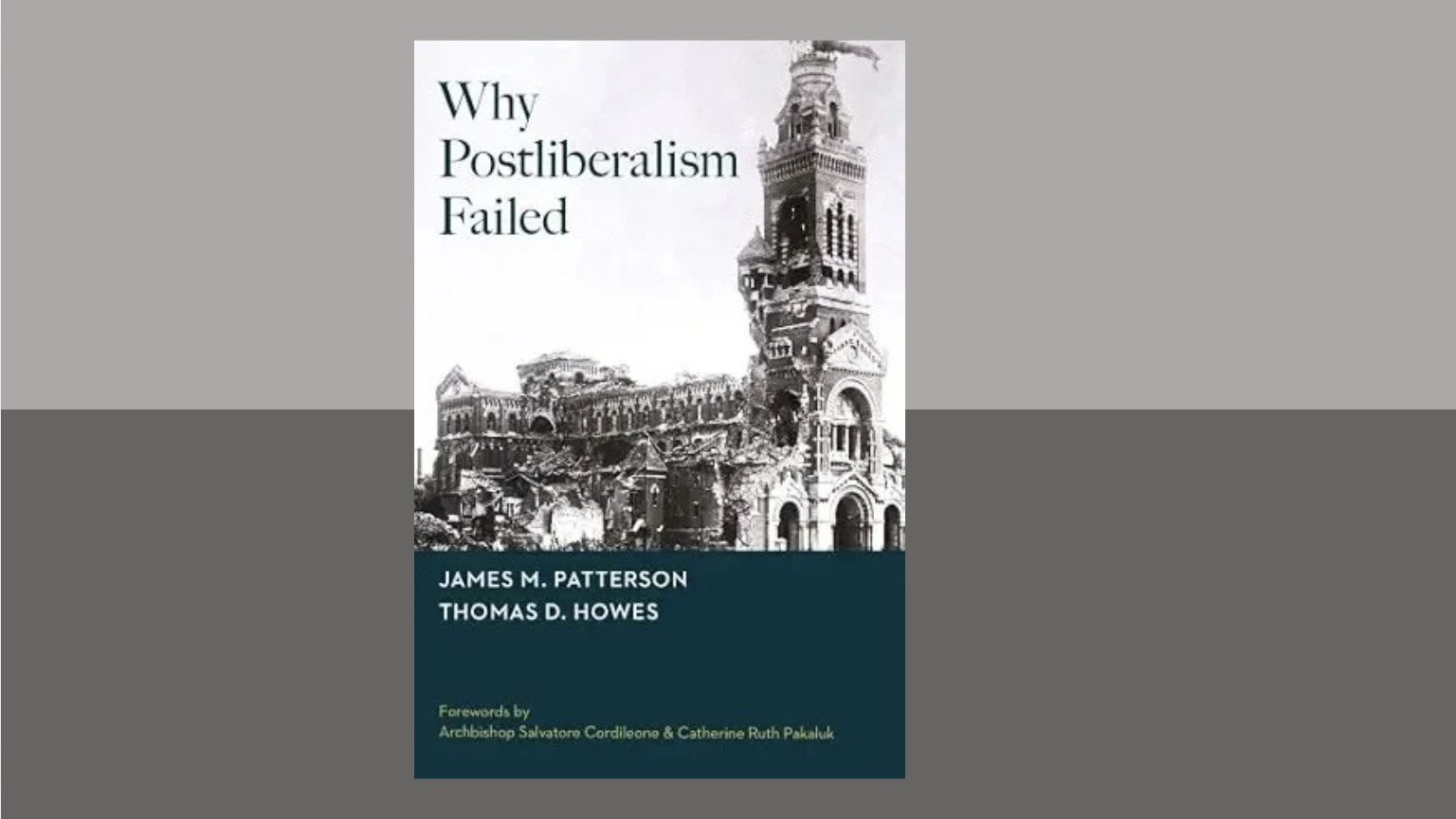
The following excerpt from James M. Patterson and Thomas D. Howes, Why Postliberalism Failed, is published with permission from Acton Institute.
After taking conservatism by storm with his 2018 book Why Liberalism Failed, Patrick J. Deneen spent a November afternoon with what was then a surprising host and at a significant locale: Prime Minister of Hungary Viktor Orbán at the Carmelite Monastery in Budapest. There, Deneen spoke highly of Orbán’s postliberal family policies. As a press release has it, Deneen’s praise “underlin[ed] that the future belongs to local communities resting on national and family values, instead of liberalism which still continues to prevail in many places.” Four years later, upon the launch of his most recent book Regime Change, Deneen sat with then-Senator J.D. Vance of Ohio. Vance declared himself to be a “postliberal” like Deneen, and Deneen said of Vance, that he was a “a man of deep personal faith and integrity, a devoted family man, a generous friend, and a genuine patriot.” Postliberalism was not just mainstream but international in scope, forming a potential new basis for conservatism across America and Europe.
Over the past few years, the subject of postliberalism has gone from a small corner of Catholic conservative academics and journalists to a major force in the West. When we began our efforts to critique it, many of our colleagues warned us not to waste our time on a marginal, largely online debate. As it turns out, postliberalism is an important and rapidly growing area of scholarship and one with major implications for the future of conservatism at home and abroad.
What is postliberalism? We answer in more details in a later chapter, but for now a brief definition is that postliberalism is the name for an authoritarian ideology dedicated to using state power to impose a reactionary Catholic vision of the Church, family, and labor. In this respect, we focus on one among three strains of postliberalism described by Julian Waller. The first comes primarily from conservative Protestants primarily from the United Kingdom like Adrian Pabst and John Milbank. According to Waller, their approach “engaged broader ideas about the needs of a healthy, re-enchanted society with thick community bonds and reduced social and cultural alienation” along with “general critiques of so-called neoliberal economic and social orders.” In sum, they are “Blue Labour” or “Red Tories.”
Another “postliberalism” is a rebranding of what American conservatives have historically called, “the Old Right” or “Paleoconservatism” pioneered by Paul Gottfried and Patrick J. Buchanan. These postliberals argue, “that the classical tradition of liberalism, properly understood, died long ago with the advent of mass politics, universal suffrage, mass immigration, the welfare state, centralized managerial governance, internationalism, and the dissolution of the public-private distinction in law and custom.” Whereas the first group of postliberals focus on localism and communitarianism, these “paleoconservative” postliberals are decidedly nationalist in scope. They work to define the American people by ethnic terms to disqualify most immigrants and seek to use political power to insulate American business from foreign competition (such as with tariffs or domestic industrial subsidies). Today, those carrying the torch for this kind of postliberalism are Christopher Caldwell and Daniel J. McCarthy.
However, the focus of our book is on a third group of postliberals. Their postliberalism has its roots in “Catholic integralism” or “political Catholicism.” Waller defines it well when saying:
This new Catholic postliberal approach to political action asserts the necessary and inevitable connection between religion and politics, largely grounded in the Catholic tradition, and asserts a counter-framework that moves away from a strict secular reading of the idea of church-state separation in favor of greater integration and alignment between the two. It is characterized most importantly by an emphasis on the use of assertive government activity to pursue ideological goals, interest in economic protectionism to support community cohesion, reasserting the role of the natural law in jurisprudence and governance, and broad-based moral-cultural reaction against 21st-century progressive assumptions about the family, gender, sexual relations, procreation, secularism, in alignment with other social-conservative issue sets.
This version of Catholic postliberalism is something of a combination of the other two with a Catholic twist. On the one hand, Catholic postliberals offer a Christian critique of liberalism for what ideological alternative should come next; on the other hand, that successor ideology is not so much about localism or communitarian as it is about a powerful, centralized government imposing from the top down a theologically informed vision of the public good on all national subjects regardless of their faith.
Postliberals portray themselves as “traditionalists,” in that they want to reverse a civilizational decline they see beginning at the Reformation. For postliberals, the Reformation was an exogenous shock, something that happened from the outside in, because the “sacral kingships” of the period were themselves the best regime. The Reformation spoiled this by introducing a division in the Church, and the division in the Church prompted the Wars of Religion that gave rise to secular states deciding religious matters on their own. These states discarded religion as anything other than a political tool; otherwise, religion was a private matter. Instead of prioritizing spiritual salvation, secular states focused on expanding material wealth, giving rise to capitalism in the economic sphere and liberalism in the political sphere. Because there can be no going back to the Middle Ages, postliberals aim to use existing “liberal” state institutions against liberal purposes, annihilating individual liberty, economic opportunity, and freedom of conscience to establish a postliberal order that is even better than the sacral kingship of yore.
Initial reactions to postliberalism were dismissive. After all, there is no way that Americans or anyone in Western Europe would vote for such an ideology, and yet here we are with postliberal politics achieving political success without the support of public majorities. The reason is that postliberals have engaged in a kind of an elite coup of political conservatism in America and abroad for the past decade, one enabled by the surprising inability of more established conservatives to meet new political realities with any sense of urgency or originality as well as the patronage of figures like Orbán.
This book aims to explain three things: first, how postliberalism became an important ideology with international implications; second, how contemporary postliberalism has its roots in similar reactionary and clerical fascist movements of previous centuries; and third, that the ideology of postliberalism is entirely wrong in what its proponents argue in terms of politics, economics, and theology.
This is not the first book-length treatment of postliberalism, or its stricter iteration, Catholic integralism. Jerome Copulsky groups American Catholic postliberals with a minor American religious tradition opposing the American Constitution and the development of a mainstream liberalism into the twentieth century. He details how contemporary postliberals stand on the shoulders of earlier critics like L. Brent Bozell Jr. and those who wrote for a small but influential magazine, Triumph. Kevin Vallier offers a comprehensive critique of Catholic integralism, illustrating how the effort to impose a postliberal order would violate Catholic social teaching and undermine the very ends postliberals believe they are serving. Laura K. Field has examined postliberals as part of the emerging political coalition hoping to control the Republican Party during and after the presidency of Donald J. Trump.
While these are excellent contributions to the field, we hope to add some more philosophical, historical, and theological contexts for postliberalism that they are missing. Copulsky is certainly right to group postliberals as part of the American anti-Constitutional tradition rooted in a concern that the republican Constitutional frame lacks an overt service to the Christian religion. What is missing is how postliberals had to import their critiques from reactionary and clerical fascist theorists from Europe and Latin America to make their arguments.
Vallier argues from an analytical philosophical frame, positing that the imposition of integralism requires political injustice to transition, govern, and resist opposition. What we show is that Vallier’s arguments are not just grounded in reason but in fact. Integralist and postliberal regimes have over a century-long history of political injustice of the highest order. These regimes run the gamut of right-wing authoritarianism from António de Oliveira Salazar’s Estado Novo in Portugal to the Nazi collaboration and genocide of Ante Pavelić’s Independent State of Croatia. Field is right to include the postliberals as part of the new Trump coalition, but to do so she spends less time with the errors postliberals make in nearly every position they take on policy, governance, and even religion.
Our book is divided into three units. The first covers the history of contemporary postliberalism in America and the intellectual sources from which postliberals draw. There are two major traditions, the papalist and the reactionary. The papalist tradition is one that treats the Catholic Church as the spiritual authority over Christendom and, subsequently, an institution that possesses extensive political or “temporal” authority over governments. The reactionary tradition is the European and Latin American conservative opposition to the French Revolution and its effects. At its heart, the reactionary tradition depends on the “Judeo-Masonic” conspiracy theory to explain how liberalism became a powerful ideology and how its ultimate purpose is to annihilate Christian monarchies and ultimately the Catholic Church Herself.
The second unit covers historical postliberal regimes that adopted the same two traditions as the basis for their rule. The two political inspirations for these regimes are Charles Maurras and Benito Mussolini. Maurras and his party Action Française illustrated to historical postliberals how to organize a monarchist party with the aim of overthrowing parliamentary government. Mussolini provided the template for how postliberals can govern by way of a dictatorship directing bureaucratic administration, the police, and the military to impose a postliberal order. These postliberal regimes surfaced during the “Interwar Years” between the end of the First World War and the end of the Second World War.
We group them into two categories. The first are right-wing authoritarian governments in which postliberals attempted to join a coalition of support but failed. These include Portugal, Brazil, Argentina, and Belgium. The second are clerical fascist governments explicitly grounded in postliberal politics. These include Vichy France, Austria, Spain, Slovakia, and Croatia.
The third unit illustrates how contemporary postliberals draw from these same papalist and reactionary traditions and favorably refer to historical postliberal regimes from the Interwar Years. Contemporary postliberals make repeated reference to key papalist texts like Unam sanctam, Singulari Nos, and The Syllabus of Errors. They also draw inspiration and directly rely on reactionary political thinkers like the aforementioned Maurras, but also Joseph de Maistre, Louis Bonald, Louis Veuillot, ex-Cardinal Louis Billot, Carl Schmitt, and many others. Some contemporary postliberals, like Deneen, try to “structuralize” liberalism into a blind historical force rather than as an avatar of the “Judeo-Masonic” conspiracy, but they too often lapse in these efforts and refer sometimes even directly to notable advocates of this conspiracy theory, such as Bonald and Veuillot. We then explain how their account of politics is essentially no different from those of the historical postliberal regimes, all of which failed in their efforts to create anything except human misery.
Next, we explore the subject of Catholic integralism in theological terms by engaging the work of Thomas Pink and his efforts to read integralism into Dignitatis humanae. Specifically, Pink offers the interpretation that Dignitatis humanae is a change of policy for the Church to discard integralism but still regards the arrangement as ideal. We should note that the Church has progressed beyond a backward-looking ideal for restoring Christendom in favor of a better understanding of the place of the Church in a pluralistic, democratic world. Finally, we review the history of Catholic corporatism, the political economy both historical and contemporary postliberalism favor. The legacy of corporatism is that of grim failure to produce even basic necessities, let alone the well-managed economic order for the common good. The problem was not that corporatists economies were badly managed but that there is no way to manage them well at all.
Here is the bad news: postliberalism is nothing less than authoritarianism dressed up in Catholic vestments. Its history is one of religious scandal, poverty, starvation, religious persecution, genocide, and Nazi collaboration. The good news is that postliberalism has always failed. Unfortunately that failure has historically come at a tremendous human and spiritual cost. Not only have hundreds of thousands died under postliberal regimes, but in their aftermath were left empty churches, dwindling numbers of priests and religious, and the very spiritual ennui that postliberals dare to blame on liberalism. Indeed, the Deceiver himself could not have developed a weapon more onerous to the faith than postliberalism.
As a final note, this book is not a defense of liberalism. One of us is comfortable calling himself a Catholic liberal and the other prefers to think of himself as a Catholic republican (“Republican” here refers to an advocate of constitutional, representative government, not the American political party). Our purpose here is not to serve liberalism but the Catholic Church and Her mission to provide material relief to the suffering and spiritual salvation to all who choose it. We do not wish to see postliberal regimes come into being because we wish to see people live full lives both materially and spiritually, something we show that postliberalism cannot offer.
The Weekly Digest
Premier Thought Every Thursday.
All of our recent essays and podcasts, delivered to you. Free.
Free. Delivered Thursday mornings.