
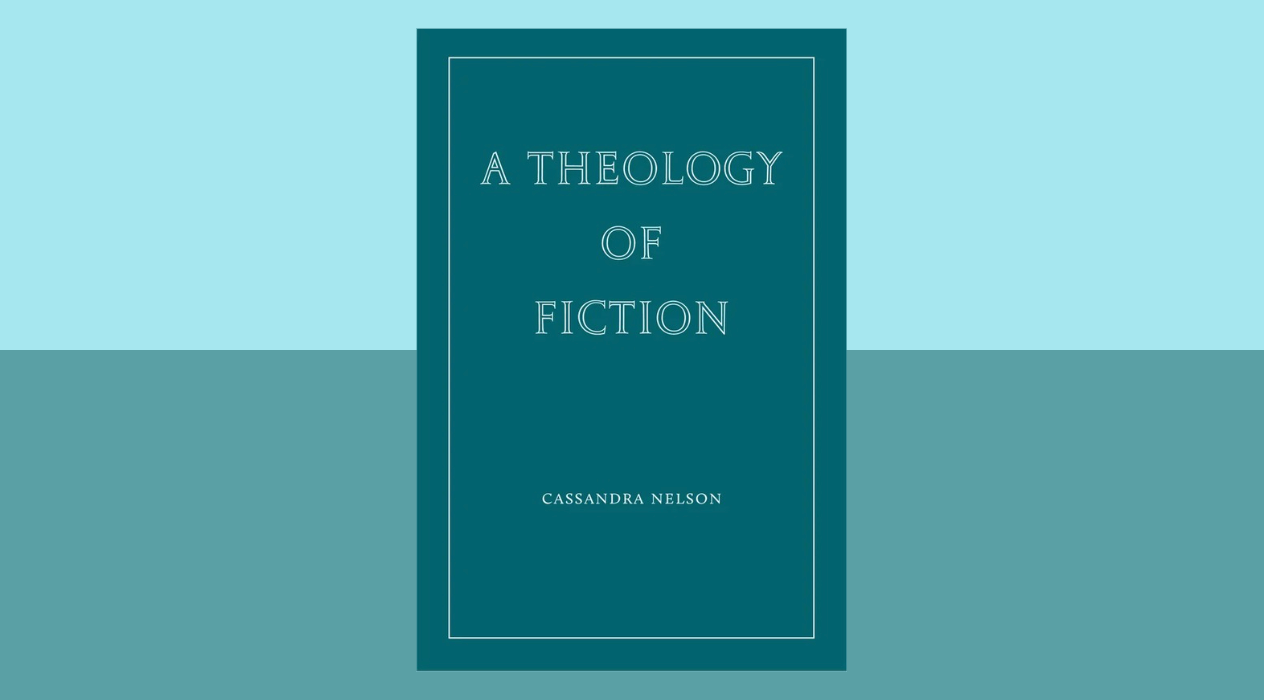
Cassandra Nelson. A Theology of Fiction. Wiseblood Books, 2024. $10.00. 116 pp.
In the March/April 2015 issue of Books & Culture, Catholic essayist and poet Joseph Bottum proposed that the modern novel is a Protestant art form, particularly in how the form developed in the post-Reformation Anglophone world. The novel, as Bottum saw it, is “the device by which, more than any other, modernity tried to understand itself.” It is no accident that the history of the novel runs parallel to the development of the modern idea of the self.
It’s a fascinating proposition. Bottum contrasted the “clean, moral” nature of the quintessential Protestant novel to Catholic literature. The latter, as Dana Gioia’s essay on “The Catholic Writer Today” puts it, “is rarely pious. In ways that sometimes trouble or puzzle both Protestant and secular readers, Catholic writing tends to be comic, rowdy, rude, and even violent.”
But then what makes Catholic fiction Catholic? And do these terms have merit? Is there a small-c catholic vision of fiction that encompasses Jane Austen and J. C. Scharl, Kenneth Grahame and Graham Greene?
Cassandra Nelson’s A Theology of Fiction, a little-book version of her essay of the same name published in the April 2022 First Things, adds to the faith-and-fiction conversation by presenting the ideas of Sr. Mariella Gable, English teacher, editor, and critic, who also promoted the work of Flannery O’Connor. (Side note: More presses should follow Wiseblood’s example of publishing meaty little books; not every book needs to be 200-300 pages!)
It is significant that her book is published by Wiseblood Books, the indefatigable little press helmed by novelist Joshua Hren, who penned Contemplative Realism: A Theological-Aesthetical Manifesto, which could be read as an apologia for recovering a robust literature rescued from the blinkered metaphysics of the B.F. Skinners, and of those who have a paper-thin metaphysics that denies spiritual and sacramental reality. The manifesto’s signatures include those of poets and novelists who have been published by Wiseblood: Sally Thomas, Katy Carl, Glenn Arbery, and James Matthew Wilson. Wiseblood is a publishing house of recovered and translated classics (e.g., Dana Gioia’s translation of Seneca: Madness of Hercules and the double feature of novella and libretto of Hugo von Hofmannsthal’s Woman Without a Shadow) as well as of contemporary fiction and poetry. It also sponsors a writer-in-residence as well as, through editor Joshua Hren’s leadership, cultivates promising new writers through the MFA program at the University of St. Thomas–Houston. All of this makes the publication of Nelson’s book appropriate. Both the Wiseblood team and Sr. Mariella have set themselves the task of not only cultivating but also advocating for great literature informed by a sacramental view of the world.
I intentionally did not use the term “Catholic literature” or even “Christian literature” above, since the question of how to apply such terms is itself part of the question Sr. Mariella tackles. And her answer is paradoxical.
First, she says that a piece must be a work of art. Slapdash pieces do not qualify as art, and thus hardly as Catholic art. But what counts as a Catholic novel (fiction being Sr. Mariella’s focus)? Disagreements on this question stem from “overemphasis on one part of a complex truth. To bring into focus the whole of truth about Catholic fiction,” she writes, “it is necessary to keep in mind three facts”:
Each one of the following statements is true; without a grasp of their coexistence, no satisfactory definition of Catholic fiction can be formulated.
- Strictly speaking, Catholic fiction does not exist.
- All the great literature in the world is Catholic fiction.
- Fiction which artistically communicates through the use of Catholic symbols something of the spiritual and moral mystery of the human condition may properly be designated Catholic fiction.
Why the paradox?
If Christianity is true, then it seems two things follow. First, our reality is one huge story of redemption; second, any art that we create that has any truth in it will reflect the metaphysics of redemption. So a Christian story, in one sense, would be redundant: we might as well simply say that it is a good story. To say that a story is great is to say that it is true and beautiful, and therefore good stuff indeed. All truth is God’s truth; all good art is God’s art.
This doesn’t mean at all that art created by non-Christians has no value. It remains true that goodness and truth partake of Truth Himself. To get at the truth of things through art in the world God made is to align oneself with God’s truth. To make bad art and to do bad metaphysics will always be un-Christian.
At the same time, sinners do make good and great art—and thank God! Or else we would be exceedingly poorly off, living constantly like castaways. But this doesn’t let the Christian artist off the hook. One could put it this way: Just as aiming at heaven, we will get earth “thrown in,” as Lewis says, if we aim at holiness, maybe we’ll make some good art along the way.
Perhaps this is how a Catholic sense can redeem the more austere Protestant form of the modern novel, if we accept the analyses of Joseph Bottum and others, while also taking up the modern psychological form, knowing that every good story is the story of a soul’s journey to God—and all the metaphysical and mystical richness that entails. Here Pilgrim’s Progress meets the Way of a Pilgrim.
Nelson mentions Caroline Gordon telling her mentee Flannery O’Connor of the “first principles” for “Catholic fiction writers,” which she can “name outright” to O’Connor but which she has “to approach cautiously with my secular pupils.” It comes to this:
There is only one plot. The Scheme of Redemption. All other plots, if they are any good, are splinters off this basic plot. There is only one author: The Holy Ghost. If He condescends to speak at times through a well-constructed detective story, which I think he does, he certainly will condescend to speak often through Flannery O'Connor.
So then, Christian writers (and readers) are simply in on the joke. “Stories will save the world,” says Angelina Stanford of the House of Humane Letters and the Literary Life Podcast, echoing Gordon’s words. Every other story is a version or a splinter of that one story. Every story is a version of the drama of the soul’s salvation.
*
But what about other religions? Isn’t there also, say, Islamic art, as Paul Pastor points out in “Can Christians Write?” Also, isn’t “the essential quality of personal fatalism that is the core of Classical narratives” exclude such narratives from the domain of great art? Can Sophocles be Catholic?
Let’s take a small-c catholic view of things now. Sophocles may not be Catholic according to Sr. Mariella’s third axiom (at least not simply speaking), but is if we begin with axiom 2. The theology of a culture will certainly affect the kind of stories told, just as, Pastor points out, Islamic art is recognizable in its calligraphy and geometric patterns and conspicuous lack representation of humans. But also, even as the artist drawing from the Islamic tradition may be making marvelous calligraphy, he remains in a world in which Christ is the Logos. He can’t get away from it.
But then, what about those artists who do not wish to get away from the Logos? What assumptions does Christian art have? Paul Pastor summarizes these features of Christian and Catholic art that were earlier articulated by Dana Gioia:
- human struggle in a fallen world
- the sacramental sacredness of nature
- the redemptive quality of suffering
- a sense of continuity between the living and the dead
Pastor himself adds “the profound value of the individual person as the locus of the image of God” to the list and notes that “with minor caveats, these are true of all Christian writing, far beyond the Roman Catholic”: “It has a great regard for overlooked things and people and considers no subject to be too high or too low for the attention of the artist. One can find God in a potato by Van Gogh…. In this artistic tradition, as in our faith, nothing and no one sits below our sacred attention, for they are held (like even the smallest seed or sparrow) in the gaze and love of God. Nothing and no one are beyond redemption, for ‘all things’ will, in the end, be caught up in Christ.”
In Nelson’s analysis, the novel perhaps uniquely focuses on the journey of individual souls toward God, but even here there is room for all manner of complexity, for each soul is unique, irreducible. No path of redemption will be quite the same as another. One of Sr. Mariella’s students, the novelist Betty Wahl, proffered that the way the “artist fit[s] into the Church” is as a prophet. An artist, said Wahl, must aim “to see and to make others see.” Sr. Mariella herself tried to do her own work in helping others see by writing about fiction as well as teaching it: Nelson writes of Gable’s anthologies as well as criticism, in which work she explained how different kinds of fiction—not only stories with, say, clergy or monastic characters and stories by Flannery O’Connor and J.F. Powers, but also the fiction of Aldous Huxley and George Orwell—can be enlisted “to the cause of the Catholic Church.” Both Huxley and Orwell’s famous satires are razor-sharp in their vision of what happens when humans lose their freedom to an omnipotent state. That they do not offer any solution to their terrifying allegories, “Sister Mariella suggests, is tied to their lack of faith.” But such “negative fiction” can inspire the search (as Walker Percy called it): the search for meaning, for being found in the cosmos and not forever lost. And one’s own search will not be quite the same as another soul’s.
But also, no encounter between text and reader will be quite the same. Nelson offers that “the meaningful unit of a novel or story is each time that a specific person sits down to read it, usually alone, or that a specific group of people comes together to discuss the work.” The story is instantiated when the reader becomes present to the story, and vice versa; what is eternal in the work meets with the eternal soul that is encountering it. Just as a play does not truly live till it is performed; a story read, chewed on, communed, we might say, is truly alive.
Let us remember what Emily Dickinson wrote? “A word is dead, / When it is said / Some say. / I say it just /Begins to live / That day.”
*
Arguably, what is perhaps most needed in contemporary fiction, however, is a vision of goodness. Nelson notes that David Foster Wallace’s short story “Good People” is “the closest thing I have yet found to Sister Mariella’s vision for contemporary fiction.” The story “gives insight into what she called the psychology of goodness and into the kind of heroism needed for family life today.” And Nelson’s perusal of this story is one great gift of this little book: How do we both read well, but also how do we write? Can we write contemporary fiction that avoids easy truths and sentimentality, and that retrieves the realm of reality and realism from the cramped metaphysics of mainstream novels?
What Sr. Mariella and the Contemplative Realists offer is a pathway of writing fiction that is contemplative—meaning, a way of writing and seeing that demands that the writer be constantly challenging himself with Rilke’s dictum that “you must change your life.” In other words, the writer should strive to be a saint.
Hren cites St. Bonaventure, who says no one “arrives at contemplation except through penetrating meditation, holy living, and devout prayer.” In addition to the practical work of developing artistic skills—facility with the materials and skills and tricks of the trade of storytelling—we artists need to develop our souls, and this means recognizing, with St. Teresa of Avila (the Contemplative Realist’s patron saint, says Hren), that “God moves amidst the pots and pans.” Further:
We commit to the daily hard work required to train our souls to ascertain the action of Grace in and around the contests of the human spirit.
This side of the beatific vision, the contemplative realist is content to do lowly tasks, sweeping the floor of a decrepit cave to make room for some roofless travelers afoot. Fed by the majestic poverty of the Word he will write another novel of the nameless nobody who happens to be made in the imago Dei, numbering the hairs of her head very carefully, surprised to find in her insignificance some of the deepest drama in the cosmos.
The educational philosopher (and Anglican) Charlotte Mason also noted this truth in School Education. She cites Michelangelo, who wrote that “good Christians always make good and beautiful figures,” but a higher standard was needed for those who would “represent the adored image of our Lord”: “it is not enough that a master should be great and able. I maintain that he must also be a man of good morals and conduct, if possible a saint, in order that the Holy Ghost may give him inspiration.”
If possible a saint. This language would not be intelligible to the evangelical world I grew up in. Then, being a saint was simply to be a Christian. Now that I’ve leaned more deeply into Christian tradition—that great tradition that includes the greatest works of art in the world, as Paul Pastor points out—I see this language of “being a saint” as pointing to the goal shared by both Catholic and catholic Christians: to be a saint is to be in communion with God, for our souls to be so a part of Him that our will and heart are as one with His. It means to become Christ-like in our very depth. Is this not what every Christian longs for? Is not this journey the fulfillment of “the search”?
So while there seems to be a clear distinction between sacred art (art proper for liturgical use) and secular (that is, not necessarily for liturgical use) art, both must be good to be worthy. And perhaps we could say that part of the goodness of good stories is that they help us on the way to God.
As Angelina Stanford of The Literary Life podcast reminds her listeners: “Stories will save the world”—stories understood as an art form that aligns with metaphysical, and hence also theological, reality. Stanford echoes Sr. Mariella: There is only one story, that of Redemption. Every other story is a version or a splinter of that one story. This is why Frederick Buechner could describe the gospel as “tragedy, comedy, and fairy tale.” Every good story is a version of the drama of the soul’s salvation.
The Weekly Digest
Premier Thought Every Thursday.
All of our recent essays and podcasts, delivered to you. Free.
Free. Delivered Thursday mornings.