

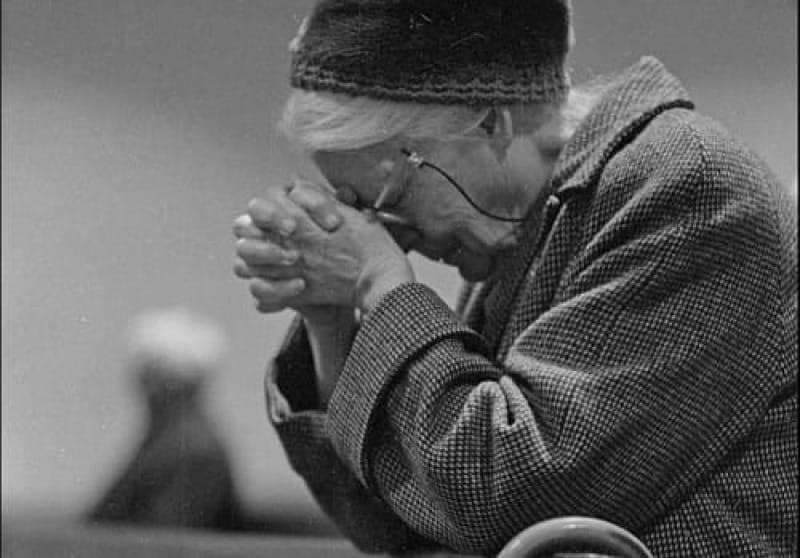
America is a country that generally does not imprison her chaotic saints.
There is a wildness to American Christianity that certainly comes with much pain. There is a vulnerability to hucksterism here, perhaps best summed up in the famous Bible salesman scene starring John Goodman in O Brother, Where Art Thou? American Christianity loves a good salesman and that is to our loss.
Yet the same indifference to custom and single-mindedness that makes us vulnerable to the Elmer Gantrys of the world also opens us up to something else: I cannot think of other western nations that so reliably produce such remarkable and unruly saints as we seem to grow quite predictably in America. Think of Dorothy Day or Francis Schaeffer or Rich Mullins or the Jesus People. If you reach back further, think of Sojourner Truth or Francis Asbury. Think, for that matter, of the outpouring that took place at the college bearing Asbury’s name only a few years ago.
There is an unruly and untamed spirit that runs through Christianity. You see it in figures like John the Baptist, wrapped in animal skins and eating bugs in the desert while preaching to the crowds or in the early monastics retreating to the deserts of Egypt. You can see it, I think, in a figure like Martin Luther. You might recall, for instance, that at the Leipzig Disputation the great Catholic debater Johann Eck informed the unruly Augustinian that he was effectively recapitulating the teachings of the condemned heretic Jan Hus, who the church had burned 100 years prior at the Council of Constance.
Luther asked for time to revisit Hus’s teachings before making a reply. He came back a couple days later and, to the astonishment of many, patiently explained that actually Hus was right and Rome was wrong. You can certainly see that same ungovernable streak in the modern missions movement, perhaps most of all in the famous story of William Carey defying the elders of his church who told him that if God wished to save the heathen he could do so without Mr. Carey’s help. What I am saying is that there is a kind of benevolent and faithful goblin mode quality to certain leaders in the historic church.
Yet while that disagreeable quality is present throughout the stories of the church, it is also true that Christendom has often struggled to reconcile itself with that quality: John Bunyan was thrown into prison in England. The only reason Luther wasn’t thrown into prison is that he happened to be blessed with a quite powerful local lord who protected him. But that, of course, did not stop Luther’s followers from frequently throwing other chaotic saints into prison. It crops up everywhere.
When the French Calvinists were becoming too influential and numerous, the French Catholics dealt with it by murdering them. And yet despite being subject to such monstrous behavior, my Reformed ancestors did not refrain from throwing fellow Christians into prison or, indeed, murdering them. (The only obvious example I can think of in which a Christendom country is able to accommodate these unruly saints is found in Russia, whose tradition of the holy fool has given them a way to understand such figures. Yet in Russia the tradition of the holy fool has at times lapsed into a quite jarring and, to my eyes, alarming disdain for creation and for creaturely health in the world. So I would not see the Russian example here as something to emulate, even if they are, in a fashion, better at incorporating chaotic saints into Christendom than some other nations have been.)
For the most part, America has not done as these other countries have. Our record is not perfect, of course, but it is preferable to that of most countries of European Christendom, I think. Indeed, it is immensely telling that perhaps my most favorite chaotic saints—my brothers and sisters in the Bruderhof–began their life together in Germany, yet were forced out of Germany, only to then be forced out of England, to which they had first fled. We did not receive them immediately in America, leaving them to endure and hope and suffer for a decade in the jungles of Paraguay. And yet eventually we received them. And while there are now Bruderhof communities all over the world and while it is certainly true that they do not need American-style religious liberty to thrive… well, in places that have our style of religious liberty they have done well. They have been welcome.
Certainly, there is much that is wrong in the American church today and much that is wrong with America herself. Even so: as we mark this Fourth of July I am thinking about my great-grandfathers who came to America 144 years ago and 116 years ago. Both had a certain wildness to them.
Carl, my Swedish Lutheran great-grandfather, was a tenant farmer, lay preacher, and lifelong depressive who attempted suicide many times, yet seemed to die (at age 83 and of natural causes) at peace with God and his fellow man. The last photos we have of him, at any rate, show a lightness in his eyes that is not detectable in the older photos, and the memories his grandchildren share of him strike quite a different note from what one imagines he was like in his earlier days. This man was welcome in America.
Constantine, my Greek Orthodox great-grandfather, meanwhile, worked in a Boston paper mill for many years with other Greek immigrants, was a cantor in the Orthodox church, and a veteran of WW1 who doted on his grandchildren and took his granddaughter, my mother, to professional wrestling matches at the old Pershing Auditorium in Lincoln when she was still an elementary-aged child. My mother tells the story of the time my great-grandfather shouted something at Mad Dog Vachon which he seemed to take offense at. So he spat at Constantine, which of course only made Constantine (and his granddaughter sitting next to him) more upset. Constantine, too, was welcome in America.
And so if there is something I am grateful for this week it is that I live in a country with space for men like them. Too true, we also have our frauds and our con men. But to live in a place that doesn’t squelch the radicalism of Christian discipleship and that is able to accommodate the unruly and the boisterous and the simply uncomfortable who show up in our churches needing to be loved… well, for that privilege I am grateful.
The Weekly Digest
Premier Thought Every Thursday.
All of our recent essays and podcasts, delivered to you. Free.
Free. Delivered Thursday mornings.