
Near the end of his essay on poetry and marriage Wendell Berry considers how free verse fits into his broader consideration of the relationship between fixed poetic forms and fixed forms of life, such as marriage.
To answer the question, he considered the work of American poet Walt Whitman, suggesting how Whitman's own style of free verse could be understood in a way that reconciled with Berry's insistence on the importance of forms which caused him to say, at one point, "the impeded stream is the one that sings."
Here is how Berry addressed the problem:
One analogue of free verse, I think, must be courtship, a way of accommodating our minds to something new, of finding out what it is that we are doing or about to do. The encounter between the English language and the subjects and objects of a new continent strange to it and to its poetic tradition seems to have required this of a succession of American poets from Whitman's time until now. Who can help feeling in the early Leaves of Grass a kind of falling in love? The lines must reach out impulsively, become capacious and tensile, to include in their full stance and particularity the images of American experience.
Later he continues,
If Whitman's work is the prime example of the freeing of verse, it is an example of something else too, for at its best Whitman's line, as we will see if we try to shorten or lengthen it, is a form. He set his line free only to make it into a kind of line that we recognize anywhere we see it—a new poer, a new music, added to poetry which can be learned and used. ... And such newness does not destroy the old set forms, but renews them in renewing our understanding of what a line of verse is, our sense of its properties of duration and coherence, beginning and end.
I hope that no one will consider accusing the author of these words of relativism. Berry can be attacked in any number of ways, but a relativist he is not. What he is, I think, is someone who is keenly attuned to place and context, such that he can recognize the times when an uncompromising rigor in the name of fixed forms can actually attack and undermine the goods that form was originally meant to encourage.
Good farmer that he is, I am sure Berry would consider the ways in which specific landscapes make specific demands on a farmer. "Good farming" is a recognizable thing, and yet what is "good farming" on one type of land is "bad farming" on another. The acknowledgement of this does not make one a relativist, but merely a person who pays attention to particularity. (And, of course, there are some practices that are 'bad farming' anywhere, no matter the local geography.)
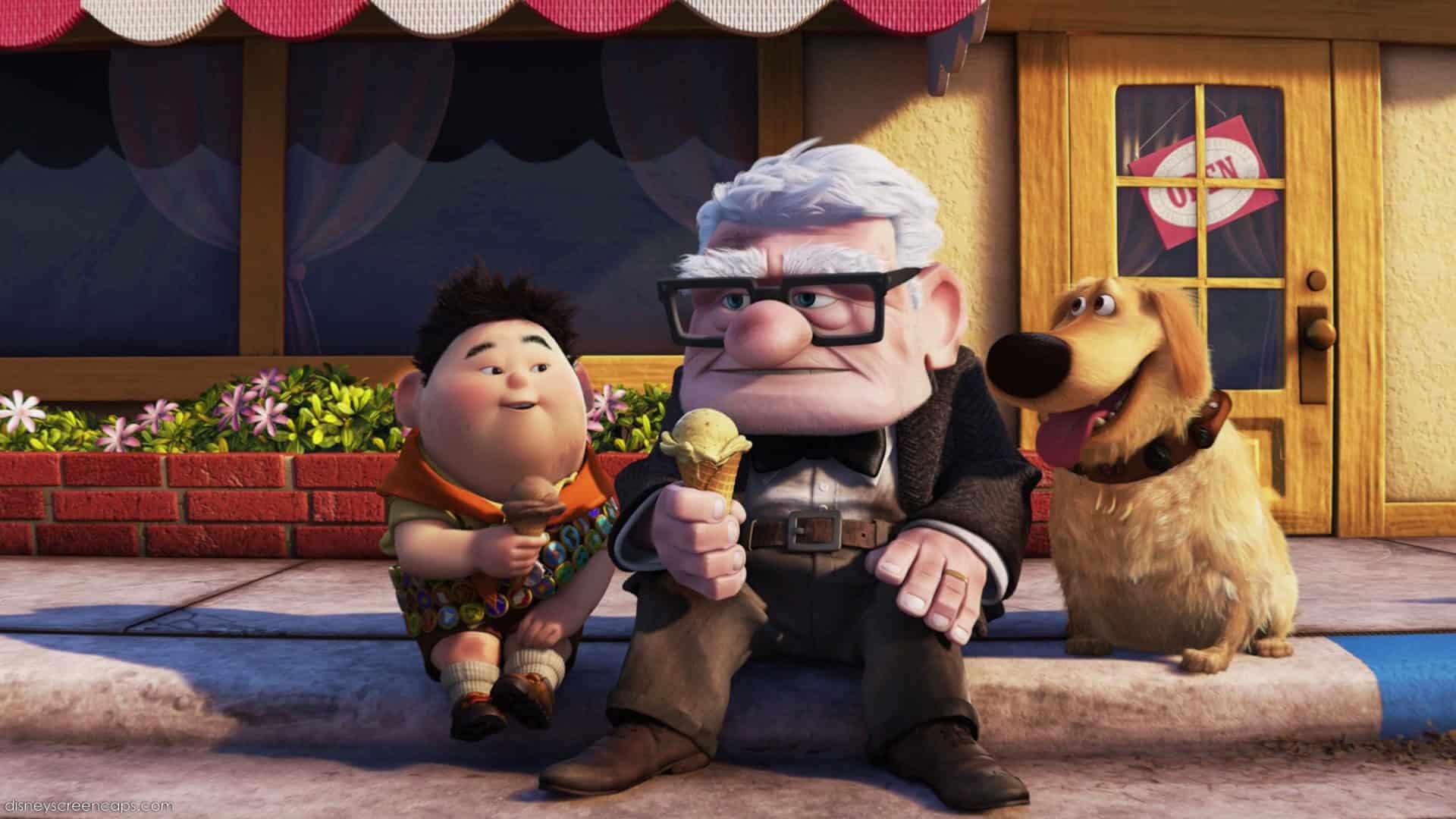
I had just re-read that essay of Berry's when my family sat down to watch Up for a family movie night. I was surprised by the ways the film seemed to rhyme with Berry's insight regarding renewal and the need to distinguish between generalized goods and the particularized forms that those goods can take. It struck me while watching that the two main characters for much of the movie, the protagonist Mr Frederickson and the antagonist Charles Muntz, are faced with the same basic question: The life you thought you would have, the good you thought you would experience, has been taken from you. Now what?
One character tightens his grip on the old life and squeezes and squeezes until he loses life itself, literally disappearing from screen as he crashes into the world he tried to grasp. The other nearly does the same, but at the last is rescued from that fate.
What rescues him? The answer would please Berry: it is love. Frederickson has spent his life dreaming of going to Paradise Falls with his wife Ellie, only to have her die suddenly, just as he had purchased their plane tickets to go. The life he thought they would have is gone, and much of the movie is taken up with his attempt to avoid knowing that fact. And then, like Muntz, he hits a point where he has a choice to let go of that specific life while maintaining his grip on the good that life was meant to actualize. And, at first, like Muntz he can't let go. He begins to fall. He holds onto the house so tightly that he allows an innocent creature to be taken and abused by another. But then he learns again to see what he needs to do and to have the resolve to do it. How?
He opens the scrap book his wife had made as a child and discovers final pages he had never seen before in which Ellie's imagined adventures through life are transformed by love—visions of galavanting off to Paradise Falls are replaced by the ordinary treasures of a banal day lived with one's love. And as the book comes to a close, Frederickson reads a note left for him by Ellie: "Thanks for the adventure! Now go have another one!"
From that point on, Frederickson is a different character. He is able to let go of the house he and Ellie had loved. He lets go of the dream of Paradise Falls. And he goes to do the thing he needs to do, rescuing that innocent creature and repaying the faith of a young boy who had befriended him over the course of the movie. And so while Muntz falls to his death at Paradise Falls, Frederickson's old life falls from the sky as well, landing at Paradise Falls, but Frederickson himself returns to life (in Muntz's ship) and finds his new adventure. The good he seeks remains the same. The form changes due to circumstances outside his control.
There is a mirror here, I think, to the way Berry speaks of Whitman's verse. Berry believes that Whitman's verse does for America what, say, Chaucer had done for England. The difference in form, Berry says, is a necessary difference that honors the particularities of the place without losing its hold on the good that the poem is meant to name and commend.
I want to suggest, as I close, that there is a lesson here for us in other domains as well. Ross Douthat has written well of what has led to our "post-liberal" moment: It is the product of the complex intersection of cratering birth rates, mass migration, and technological disruption. In response to this moment, two dominant schools have emerged, both of which end up imitating Muntz, I think. There is a kind of civic libertarian who desperately wishes it could still be 1992. The Cold War was won. We lived in a unipolar world. History was at an end. Democratic, liberal capitalism would sweep the world, world without end, amen. And all of their proposals and goals in encountering this new moment seem to be "How can we turn back the clock to 1992? How can we take back the life we had and that we still want?"
That is not the world we have. And there is no way for that world to return, given the ascent of China, the lack of political will in America to police the globe (and the apparent ineptness of the American armed forces, at least if the Iran War is any measure), and the transformations coming now due to the factors Douthat named. The world the civic libertarians long for is never coming back.
Another response is that of the Christian nationalists and Catholic integralists, both of whom regard the failure of that regime as a welcome development and suggest that the whole thing was one big mistake and now that it has failed our path back to something sturdier is clear. The difficulty is the goals they envision—a monoethnic state led by a caesarist Christian prince who shepherds the life of the volk or an integrated state in which the government repents and submits to the pope—are entirely unworkable and impossible, and would require monstrous evils to achieve. (Consider how one prominent Christian nationalist was recently suggesting the forced deportation of 120 million people on Twitter.)
The question before us, I think, is not how we can magically coerce the world into being 1992 again or 1592, perhaps. Those worlds are gone and we can no more recreate them today than we could use the verse of Chaucer to provide the verse that would define American life. I am inclined to agree with Berry and think that we need new forms to answer the new challenges of our particular moment. To say this is not relativistic anymore than Berry's own thought is relativistic. We should seek to render to God what is due to God and to neighbor what is due to neighbor. We should seek to retain the structures and norms that have allowed us to have things like free speech, freedom of religion, freedom of assembly, a free press, and all the rest.
And yet we now, like Whitman, must find ways of preserving those goods under wildly different circumstances—circumstances in which given forms of membership and meaning have been badly weakened, when the unborn and the natural family are often attacked or, at best, forgotten, in which rampant injustice is increasingly regarded as tolerable as long it is one's enemies who are victimized by it, and in which technological innovation makes vice easier than ever before and virtue more remote. A Christian prince cannot fix these problems, nor can a free trade loving civic libertarian with a taste for foreign intervention. Indeed, it is entirely possible that the problems are unsolvable and we are entering a season of political and cultural winter. But if they are to be solved, then I think it will be in the way Berry describes, by identifying the 'new adventures' that allow us to find renewed forms which preserve the same goods.
The Weekly Digest
Premier Thought Every Thursday.
All of our recent essays and podcasts, delivered to you. Free.
Free. Delivered Thursday mornings.