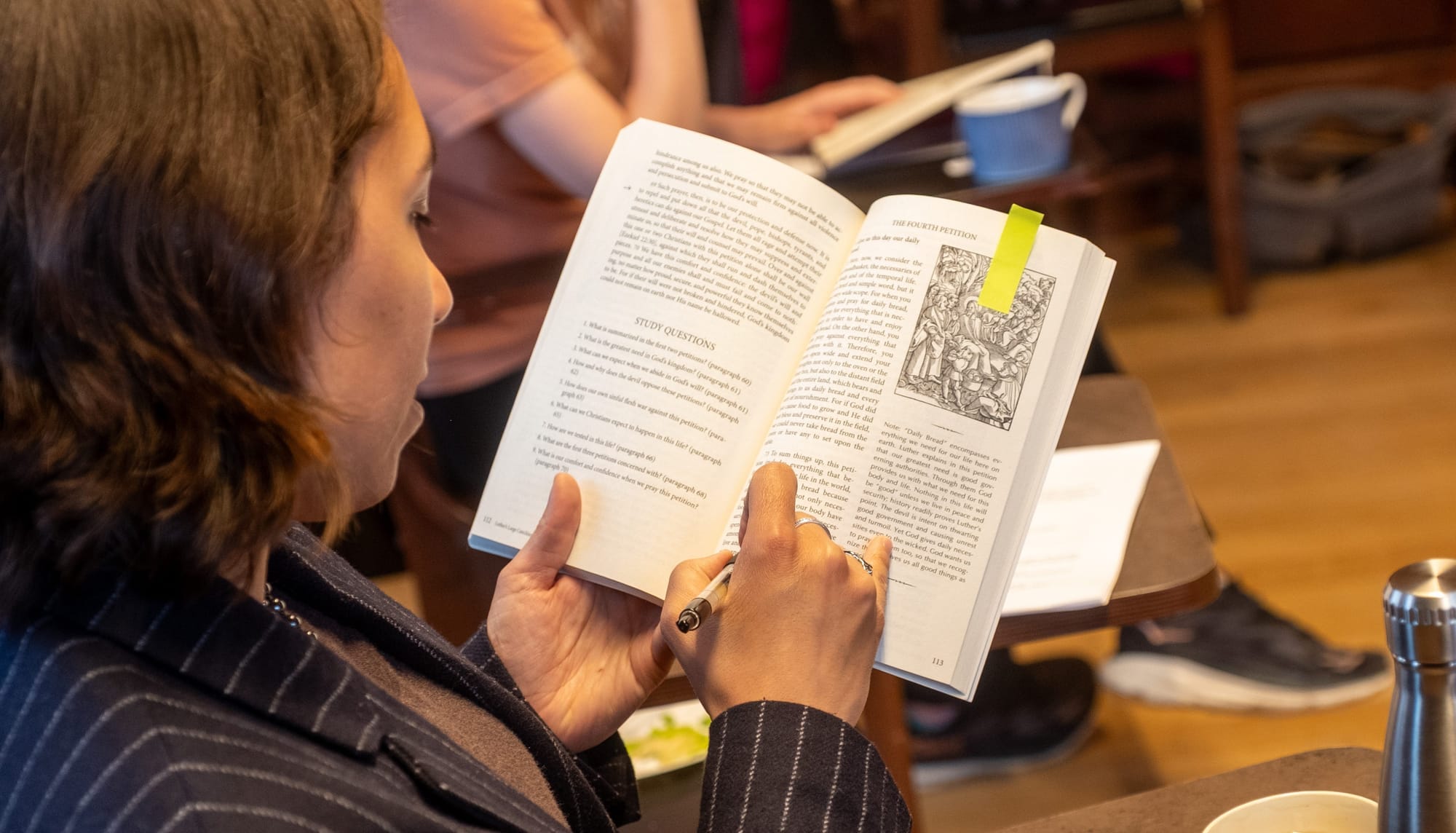
As students met this spring to launch our first Coverdale House reading group, we followed a standard format for the evening: we ate, we prayed, and we got down to the business of carefully reading and discussing. It’s the second step of that process that I would like to talk about here. Prayer is an important part of the intellectual life. The great Presbyterian theologian B. B. Warfield, in his famous address “The Religious Life of Theological Students,” critiqued an overly pietistic contrast between the spiritual life and the intellectual life thus: “Sometimes we hear it said that ten minutes on your knees will give a truer, deeper, more operative knowledge of God than ten hours over your books. ‘What!’ is the appropriate response, ‘than ten hours over your books on your knees?’” Evidently Warfield wished his seminarians to study their books, yes, for ten hours, but be praying all the while. Hans Urs von Balthasar put it even more succinctly: the Christian thinker is engaged in a kind of “kneeling theology.”
But at Coverdale House events, our prayers together are structured and even scripted: the Lord’s Prayer, the Psalms, and other readings of Scripture. This is, of course, what some would call “liturgy”—a tricky word, since, to some, it implies certain church traditions as opposed to others, or a particular vibe or aesthetic (vestments, thuribles, Ember days, and so forth). This is not the sense in which I’m speaking when I say that we prayed liturgically. All I mean is that we prayed with words which were normed and governed by Scripture, and particularly by the Psalms.
This liturgical prayer is a part of the long-term vision of the Coverdale House, because we think it is especially important for academics tasked with keeping their focus on Christ in their scholarly endeavors. There are many wonderful things about such prayer. For instance, as we prayed together, we heard whatever Scripture and prayed whichever Psalms were appointed for that day by a pre-determined lectionary. I think there’s particular benefit in this for academics, since there can come to be certain passages of Scripture we wouldn’t choose on purpose, certain passages after which we would rather not say “Thanks be to God.” Keeping that habit of gratitude alive and well, regardless of the appointed reading, is likely salubrious for the spiritual hygiene of the average Christian academic.
But there is an even deeper reason why I think liturgical prayer is crucial to the formation of Christian scholars. Insofar as we shirk this kind of liturgical prayer—by which, again, I mean prayer normed and governed by Scripture, and particularly by the Psalms—we stunt the growth of Christian scholars. I’m not here arguing for the superiority of one particular church tradition over another, since (as I hope to show below) this has been, at times, a common desire of many traditions (even Presbyterians and, yes, even Baptists!); rather, I’m insisting that liturgical prayer is particularly useful for the life of the Christian scholar. This is because liturgical prayer uniquely forms Christian imaginations. I hope to explain how in what follows.
How have different eras evaluated intellectual genius? What characterizes the great mind in the Middle Ages as opposed to the modern period? Mary Carruthers answers just that question in the introduction to her 1990 The Book of Memory: A Study of Memory in Medieval Culture.
Her introduction begins by contrasting two biographical descriptions, one of Albert Einstein and the other of Thomas Aquinas. The contrast is instructive: two contemporaries describing the greatest minds of their respective generations. The question is, how do the two different eras understand genius and intellectual greatness?
Here’s a bit of how Einstein was described by his Princeton colleague, the Polish physicist Leopold Infeld:
The greatness of Einstein lies in his tremendous imagination…. Originality is the most essential factor in important scientific work. It is intuition which leads to unexplored regions, intuition as difficult to explain rationally as that by which the oil diviner locates the wealth hidden in the earth. …The clue to the understanding of Einstein’s role in science lies in his loneliness and aloofness. In this respect he differs from all other scientists. …This aloofness, this independent thought on problems which Einstein formulated for himself, not marching with the crowd but looking for his own lonely pathways, is the most essential feature of his creation. It is not only originality, is not only imagination, it is something more.
And here is what the Dominican friar Bernardo Gui recounts about Thomas Aquinas, based on contemporary accounts of Thomas’s life directly from his friends:
His memory was extremely rich and retentive: whatever he had once read and grasped he never forgot; it was as if knowledge were ever increasing in his soul as page is added to page in the writing of a book. Consider, for example, that admirable compilation of Patristic texts on the four Gospels, which he made for Pope Urban and which, for the most part, he seems to have put together from texts that he had read and committed to memory from time to time while staying in various religious houses. …Nor did he seem to be searching for things as yet unknown to him; he seemed simply to let his memory pour out its treasures…. He never set himself to study or argue a point, or lecture or write or dictate without first having recourse inwardly—but with tears—to prayer for the understanding and the words required by the subject.
Carruthers first notes how much the two descriptions are alike, particularly in the emphasis on solitude and extreme concentration on problems to be solved. Yet, she notes, the central contrast lies in the source of genius: for Einstein, Infeld emphasizes his creative imagination, whereas for Gui, Thomas’s genius lies in his retentive memory. Here we sense the gulf between our own era and the Middle Ages: it isn’t hard for us to accept that someone is a genius based on his or her creativity and imagination. Less intuitive to us is the idea that someone is an intellectual giant merely because of their memory. Retentive memory may make a person a savant or a geek, but it isn’t immediately clear what the good of that retentive memory is unless it’s harnessed toward some further end. We are inclined to think of an education that emphasizes memorizing bits of information as useless on its own and even a dangerous substitute for actual thought, the sort of education John Dewey rejected as the mere “accumulation of information in the form of symbols.”
But there’s a strong case to be made that both kinds of intellectual genius are crucial, and that moderns, if they don’t overvalue the creative imagination, at least tend to undervalue the retentive memory. Our typical metaphors for scholarship (e.g. “knowledge production” or “pioneering research”) betray a certain bias in how we think knowledge goes all of the time: it’s about innovation, thinking the previously unthought. Less often do we acknowledge the fact that this innovation is often reconfiguration or re-imagination of an existing body of knowledge. From this perspective, knowledge is full of pre-existing building blocks, and the main task is their holistic and integrated arrangement, their ready and new application to a changed world. If the building blocks are already there, awaiting the perfect configuration, then the retentive memory quickly becomes the prized commodity. Lest my readers think I’m only talking about the humanities, I should clarify—there is good reason to think this is how science is conducted at its best, no less than the humanities. Eugen Rosenstock-Huessy was not wrong when he defined scientific process as “the organization of all thinkable errors in order that, as a later result, error may be overcome.” Here he was describing the affordances of Faraday’s laboratory, but he could well have been describing Thomas Aquinas’s Catena Aurea—if not an organization of thinkable errors, then at least an organization of thoughts and authorities with which one might or might not agree.
There shouldn’t be any binary between retentive memory and creative imagination. In fact, Carruthers argues, for the Medieval period, the two were a unity: the imaginatio or phantasia was, in fact, a repository and factory of images (whether literally images or more abstract thoughts). Take, for example, the Unikitty lego, undoubtedly a product of the imagination. From a Medieval perspective, it’s merely several images (rainbows, unicorns, kittens), stored in the memory, then reconfigured. Thus the productivity and quality of your imagination is directly dependent on the fruitfulness and quality of the images you choose to put in your imaginatio. Your imagination is what it eats, so to speak, and it will be creative only according to the materials it is fed upon. Those materials are the images stored in your memory.
Let’s assume, for a moment, that there’s some truth to this perspective. For a scholar hoping to form a Christian imagination in that more Medieval sense, how is it done? How does one think about one’s field or discipline or methodology as a Christian? The answer is clear: your scholarly imagination must be provided with good images. And that is precisely what liturgical prayer does well. With your own lips, in company with other Christians, you are making Scripture your imaginative stock. You allow Christ’s words to dwell in you richly. You offer back to God his own words, since, after all, what do you have that you did not receive? George Herbert, in his wonderful poem “Prayer (I),” describes prayer precisely this way, as “God’s breath in man returning to his birth…reversed thunder.” By praying Scripture aloud (or even singing it), regularly and systematically, you are capturing these words in your memory—and that will, in the end, be the wellspring of creativity and scholarly energy. This approach to Scripture, I’d argue, is more likely to accomplish this than the exclusively private study of Scripture (the “quiet time”).
Take a literary example: in Dostoevsky’s Brothers Karamazov, Ilyusha’s father is unable to prepare himself for the likely death of his young son. His son consoles him, urging him to adopt another boy like himself, to which his father replies, “I don’t want another boy! If I forget thee, O Jerusalem, let my tongue cleave….” Later, Kolya, the irreligious and precocious teenage boy, asks Alyosha Karamazov what the father meant by this. Alyosha explains, of course, that this is from Scripture, but Kolya is unlikely to get the full resonance that Alyosha does: the grief-filled imprecations of Psalm 137 and its context are immediately available to the father as a way of expressing his sorrow.
How? Well, Ilyusha’s father is a decently churched Orthodox Russian, and the Psalms are repeated so often as to become parts of one’s very vocabulary. The same thing happens in James Agee’s Death in the Family, also about grief and death: here Mary, the wife grieving her husband, reaches a depth of sorrow so low she has no words left, and in this very moment a voice from within Mary prays, “Out of the depths have I cried unto you, O Lord.” She too, a good Catholic who knows her Psalms, has the words of Christ in her, interceding on her behalf when she has no words of her own. This is the great power of regular liturgical prayer: the words of Scripture spring to one’s lips unbidden. Spontaneity is only ever conditioned on the possibility of a replete memory, well-trained upon its materials.
This liturgical encounter with Scripture is different from (but not a replacement for) the “quiet time” of private study, for several reasons: it is in community with other Christians, it is spoken back to God in prayer, and it is spoken aloud repeatedly and systematically for our own inward retention. Theologians have often pointed out that this is the basis for theology, not just Scripture studied in the ivory tower, but Scripture read in community and in prayer. “Dogmatics,” says the Catholic theologian David Fagerberg, “bobs in a liturgical stream.”
Although we may think of this scripted and less spontaneous form of prayer as an exclusively Catholic phenomenon, it is not. Martin Luther insists that praying to God in public worship is directed toward an inward retention of God’s word. “Know, therefore,” speaking of worship specifically, “that you must be concerned not only about hearing, but about learning and retaining God’s word by memory. Do not think that this is optional for you or of no great importance. Think that it is God’s commandment, who will require an account from you about how you have heard, learned, and honored his Word.” John Calvin, for his part, also advocated for a more scripted approach to prayer, especially in catechetical contexts. Even the Puritans, often thought to be the godfathers of spontaneous prayer, are more complicated. Lori Branch, in Rituals of Spontaneity, brilliantly analyzes the Westminster Directory of Public Worship, an attempt to chart a middle path between advocates of spontaneous prayer and the English Book of Common Prayer. The Directory included liturgical rubrics and pre-scripted prayers in order to guide worshipers, but always worded them in such a way that it could not quite be read word-for-word, in hopes that the affective power of the worship would not be lost in dull or rote repetition. Princeton’s own Charles Hodge, for whom Presbyterianism was Christianity come into its own, also praised the practice of Morning and Evening Prayer, begrudgingly admitting that the Church of England’s Book of Common Prayer nailed it in that limited respect. He praised these liturgies for their “evangelical sentiment, fervor of devotion, and majestic simplicity of language.” But Hodge notes that, ultimately, these services are “derived from forms already drawn up by the Reformers on the continent,” and, indeed, one could add, they derive from forms going back farther into the Middle Ages—a truly ecumenical form of prayer.
There is one particular subset of Scripture which lends itself to prayer more than others and holds a special place in the catechizing of the Christian mind. “The choice and flower of all things profitable in other books,” says Richard Hooker, “the Psalms do more briefly contain, and more movingly also express by reason of that poetical form wherewith they are written. …This is the very cause why we iterate the Psalms oftener than any other part of the Scripture.” Myles Coverdale, in his “Preface” to the Bible, says that “In the Psalms we learn how to resort only unto God in all our troubles, to seek help at him, to call upon him to settle our minds by patience….” Even Baptists, as I mentioned, have emphasized this sort of pre-scripted prayer as powerful. Charles Spurgeon, in his Treasury of David, says,
Time was when the Psalms were not only rehearsed in all the churches from day to day, but they were so universally sung that the common people knew them, even if they did not know the letters in which they were written. Time was when bishops would ordain no man to the ministry unless he knew "David" from end to end, and could repeat each psalm correctly; even Councils of the Church have decreed that none should hold ecclesiastical office unless they knew the whole psalter by heart. Other practices of those ages had better be forgotten, but to this memory accords an honorable record.
Dietrich Bonhoeffer, in his The Prayerbook of the Bible, points to a yet more profound reason for the Psalms’ place in Christian worship: Psalms are the prayers of Christ to the Father, and when we pray them, we pray Christ’s words after him, and thus participate in the life of the Trinity itself. “It is the Son of God made man who has borne all our human weakness in his own flesh, who here pours out the heart of all mankind before God, who stands in our place and prays…it is the prayer of that humanity which he has assumed that comes before God in the psalms.” Even in our prayer, we do not offer what is only ours to him; he initiates even this, does it on our behalf: “Of thine own have we given thee.”
A disturbing corollary follows, if we assume that the Christian imagination is fed on images (or words or thoughts). Christian scholarly imaginations are getting formed, one way or another. If it is not the words of Scripture, imbued in liturgical prayer, it will be the other sorts of things we do in community repetitively.
In Hans Christian Andersen’s “The Snow Queen,” the boy Kay finds his sled tethered to the back of the Snow Queen’s sleigh, and he is unable to unhook himself. He is terrified, and he tries to pray, “but he could remember nothing but the multiplication table.” Nothing against multiplication tables, of course; the point is, when the pressure is on, we reactively fall back on what resources we have within ourselves. This is why it’s urgent that we build institutions that take on the role of consciously forming Christian minds according to the pattern of Scripture. If we don’t do it, it will be done anyways, but not in ways we want.
originally published at Coverdale House
The Weekly Digest
Premier Thought Every Thursday.
All of our recent essays and podcasts, delivered to you. Free.
Free. Delivered Thursday mornings.