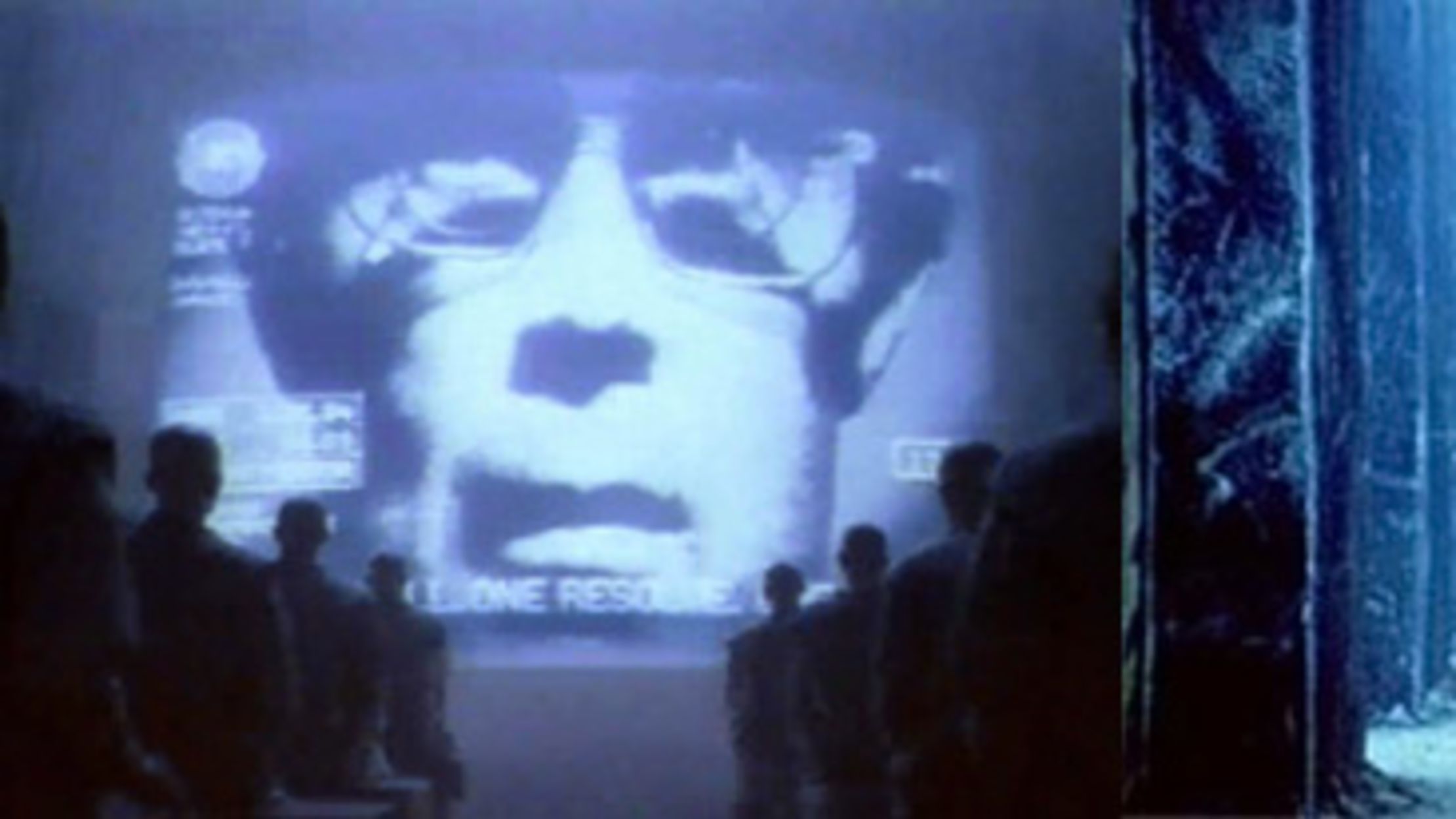
In 1984 Apple ran a Super Bowl ad ushering in a new era. The commercial featured a dystopian panopticon (a central observation tower occupied by the ever-watchful “Big Brother”) enforcing discipline and conformity to prisoners under its gaze. This surveillance screen was shattered by a rebel woman in a red tracksuit, hurling a hammer into the giant face projected on the screen. “1984 won’t be like 1984” was the closing line––a nod to Orwell’s famous dystopian novel 1984. Apple was unveiling their first personal computer and the message was simple: now we are truly free.
The irony, though, is teased out in Byung-Chul Han’s work Psychopolitics. Han argues that while the looming gaze of Big Brother has been smashed, we have merely replaced it with the even more present scrutiny of self-surveillance. Technology has equipped us with the tools of endless communication and optimization. Big Brother has no need to discipline us into production; we awake every morning with the frenetic buzz of guilt propelling us to engage, consume, and produce in order to justify ourselves to the world. To this end, technology no longer prohibits, but endlessly permits––all resources are at our disposal for our project of self-magnificence.
This freedom, however, comes at a cost. Once exploited by the surveillance of Big Brother, we now voluntarily and ruthlessly exploit ourselves. While our bodies are free from harsh prohibitions and restrictions, they are enslaved to production by means of consumption and optimization. It is the very habitat of our technological freedom that dictates how we optimize ourselves: we are served endless enhanced images of beauty, narratives of sexualization, and visions of lucrative hustle culture—all possible if we just get this procedure, use this product, or subscribe to this influencer’s workshop.
These techniques, however, do not stay within our private lives and present unique challenges when individuals obsessed with body-optimization join the spiritual body of Christ. The same methods we employ to optimize our physical bodies in light of various standards of beauty lead us to relate within the spiritual body of Christ, the church, in ways that are contrary to the vision of Scripture.
From Bio- to Psycho-politics
In the 1970s, French philosophical historian Michel Foucault traced the shift from a society under Sovereign Power to one under Disciplinary Power. The mark of Sovereign Power was conscription––one had little choice over how they were to function within society, rather, they were forced to participate and behave at threat of public punishment and shame. This system was simple: disobey the King and go to the stocks or gallows. Cultural change brought about through industrialization, however, moved us into being ruled not primarily through public punishment but through systems that regulated bodies—schools, factories, hospitals, and prisons. Here, Foucault developed the concept of “biopolitics”––the idea that the human body is the primary tool used to control production. Foucault noted how physical demographics such as reproductive cycles, birth and death rates, levels of general health, and life expectancy were exploited to regulate and subjugate individuals.
Han argues that Foucault’s biopolitics has extended into what he calls psychopolitics. The goal is still bodily control, but the means is no longer allo-exploitation (exploited by another) but auto-exploitation (exploited by self).
No longer subjects under disciplinary power, Han says, we are now projects encouraged to maximize consumption in order to optimize ourselves so the world can see our magnificence. Han teases out the difference between subjects and projects with the shift from “Should” to “Can”:
The freedom of Can generates even more coercion than the disciplinarian Should, which issues commandments and prohibitions. Should has a limit. In contrast, Can has none. Thus, the compulsion entailed by Can is unlimited. And so we find ourselves in a paradoxical situation. Technically, freedom means the opposite of coercion and compulsion. Being free means being free from constraint. But now freedom itself, which is supposed to be the opposite of constraint, is producing coercion. Psychic maladies such as depression and burnout express a profound crisis of freedom. They represent pathological signs that freedom is now switching over into manifold forms of compulsion.
The irony of Apple’s announcement of freedom is that it in many ways paved the way for the tool of self-exploitation: social media. These platforms in their various forms enable us to both perfect our magnificence and project that persona to the masses. We curate, craft, filter, and even sexualize ourselves, marketing our bodies and gifts for monetary and societal capital. However, our newfound “freedom” to curate and craft the project of self is bound by a certain vision of bodily perfection and thus has led to a profound dissatisfaction with our physical bodies.
Nicholas Carr describes our media-driven identity as a “mirrorball self”––a whirl of fragmented reflections from a myriad of overlapping sources. The result is a self that feels constantly exposed, fractured, and less than compared to the endless competition. Jonathan Haidt reports that Meta’s own research found one in three teenage girls said Instagram worsened their body-image issues. And this fractured self-image is not partial to one gender. Freya India notes how as a result of social media use,
boys and men are struggling too, as teenage girls typically do, with eating disorders, body dysmorphia, anxiety about aging, thinking they cannot be loved if they are not the perfect product.
Few deny this reality of increased social media exposure leading to depression, burnout, and poorer body image. However, less emphasized is how this auto-exploiting of our physical bodies has profound effects on how we view and interact with the spiritual body of the church.
The church as an institution within culture can fall prey to the same cultural visions of beauty, success, and flourishing, and we––as members of its body––bring our techniques of optimization into its body.
From Physical to Spiritual Body
In 1 Corinthians 12 when Paul instructs the church on what it means to be the body of Christ, he makes specific claims about the inherent diversity of a healthy body:
[14] For the body does not consist of one member but of many. [15] If the foot should say, “Because I am not a hand, I do not belong to the body,” that would not make it any less a part of the body. [16] And if the ear should say, “Because I am not an eye, I do not belong to the body,” that would not make it any less a part of the body. [17] If the whole body were an eye, where would be the sense of hearing? If the whole body were an ear, where would be the sense of smell? [18] But as it is, God arranged the members in the body, each one of them, as he chose. [19] If all were a single member, where would the body be? [20] As it is, there are many parts, yet one body.
[21] The eye cannot say to the hand, “I have no need of you,” nor again the head to the feet, “I have no need of you.” [22] On the contrary, the parts of the body that seem to be weaker are indispensable, [23] and on those parts of the body that we think less honorable we bestow the greater honor, and our unpresentable parts are treated with greater modesty, [24] which our more presentable parts do not require. But God has so composed the body, giving greater honor to the part that lacked it, [25] that there may be no division in the body, but that the members may have the same care for one another.
Paul’s imagery is beautifully clear: every member is indispensable. Even––or dare we say, especially––those that seem weaker and less-optimized. Indeed, there is no body without all of its parts. But we have been trained in anti-Pauline ways: to bestow honor and glory on what is already beautiful, impressive, or magnificent (in our eyes).
In Paul’s context, to adorn a part of the body with clothing was to show it a special honor. Understood this way, the impressive gifts were left to shine with the honor inherent to them, but the unpresentable gifts were shown more honor, covered with honor they lack on their own. This is precisely the opposite of how we function with our own bodies, and the body of Christ by extension. Our hyper-visual, online existence trains us to adorn the already impressive “gifts” of a beautiful face or a certain body type, and then to continue poking, filling, stretching, and injecting in order to emphasize these gifts while filtering out, airbrushing over, or detoxing away unimpressive members.
Recall Han’s Should-Can distinction. Scripture is an external authority with legitimate and inspired prohibitions. The problem is that we smashed the “Shoulds” of authoritative texts along with Big Brother and adopted the unlimited compulsions of “Can”. We now operate as though we are free to endlessly optimize the body of Christ toward our same warped standards of bodily beauty.
The result of such optimization, however, are phenomena like “copy-paste face”––a beauty trend marked by celebrity and influencer faces being beautifully bland and lacking distinction. Essentially, everyone looks the same because we have been sold the same vision of beauty and resourced with the same tools to achieve it.
This same phenomenon plays out in Christ’s body too: we platform teachers with similar communication styles. We promote leaders with certain management approaches. We organize around particular charismatic talents. We overly emphasize certain gifts, while subconsciously covering and cropping out those gifts that are less impressive or that don’t serve our overall image of ecclesial magnificence. For example, gifts of encouragement, generosity, or administration do not optimize well visually. And, because we have learned to equate “impressive” with what can be leveraged visually (and liked, shared, etc.), those gifts are relegated to a position of hidden necessity.
This “copy-paste” approach in the worshiping community results in shallow religious entertainment that attempts to replicate successful church (or business!) models, regardless of the unique gifts in their actual community. The outcome is a bland, uniform “beauty” unbecoming of the body of Christ.
A Way Forward
In another passage on the body of Christ, Paul says the goal of the various gifts of the church is maturity—attaining the unity of the fullness of Christ (Eph. 4). Healthy bodies are ones in which all its members are simultaneously and equally matured. Over-optimization of one body part does not lead to health, but a system stressed by underfunctioning and overcompensation. Maturity, not optimization, is the metric of health in a body. Optimization presupposes an end––namely, efficiency––and exploits to that end. Maturity, in contrast, is the end––completion––and seeks to esteem all parts as indispensable as essential to that completion.
The path toward such maturity is guided by the context of 1 Corinthians 12. Paul’s letter––where he will deal with issues like division and unity––begins with a treatment on the wisdom of God. Basically, Paul lets the church know if they apply the wisdom of his letter, they will look like utter fools to the world.
Han lands close to this in his own work. The one who stands outside of this self-exploitive system is, Han calls him, an idiot (in the sense of idiosyncratic; i.e. distinct). Han’s idiot is the only one who preserves the magic of the outsider––not enslaved within the system of self-exploitation. He is a figure of resistance opposing the violence of consensus, much like Wendell Berry’s Mad Farmer. Such resistance reflects the foolishness Paul prescribes in 1 Corinthians 1. The source of Paul’s foolishness, however, is not rogue nonconformity but the message of the cross. The cross was an idiosyncratic spectacle––the distinctive power of God displayed through the death of his Son.
What does a life lived in the power of such an idiosyncratic spectacle look like?
In his small work Life Together Dietrich Bonhoeffer warns against the danger of an idealized vision of community, what he calls a “dream world.” Such idealism is the result of optimization. Our attempts to optimize the body of Christ are futile attempts to manifest a dream world. Any such dream injected into the body is a hindrance to genuine community. Bonhoeffer ensures, however, that by sheer grace God will not permit us to live even for a brief period in a dream world. He goes on:
Only that fellowship which faces such disillusionment, with all its unhappy and ugly aspects, begins to be what it should be in God’s sight, begins to grasp in faith the promise that is given to it.
The body of Christ is only the body God intended when all its members—impressive and unimpressive alike—are present, honored, and share in the unhappy and ugly aspects of their union. Such is the mark of true maturity.
Freya India, writing on the unique challenges facing girls and young women in a digital culture, shares Bonhoeffer’s rejection of wish-dream optimization when it comes to maturity in relationships:
Because the truth is you will not learn about love from YouTube Shorts or TikTok experts or Reddit threads, and I seriously doubt the answers are one more self-improvement podcast away. You will only learn about love in the presence of real people, in late night conversations talking until your eyes turn red, in getting things wrong and trying to put them right again, in your beating chest when you bet your life on someone else, in the joy and rejection and hope and sting that comes from trying and from living. You will learn about heartbreak from the wounded eyes of your mother and the shaking shoulders of a friend, from the broken and brilliant lives you see all around you. That’s life, and that’s where advice lives, where it comes from, chiselled out of regrets and mistakes, chiselled out of the pain of people you know and love. The rest is useless.
India is touching on the disconnect between platforms that seek optimization over maturity. Maturity is not achieved through amassing information from various platforms, or copy-pasting images of beauty seen on them––it is chiselled out of regrets and mistakes and pain.
However, maturity like this, Bonhoeffer says, requires confession. Confession provides the context for speaking truth in love, which Paul says grows us into the head, into Christ. This is, then, one practical step toward embodying Han’s idiot and the foolishness of the gospel.
Specifically in the context of church relationships, confession should take a central role. What could be more idiotic––more foolish––in an age of self-optimization than to pull back the curtain, to remove the filter, and lay our regrets, mistakes, and pain bare? Bonhoeffer says such confession obliterates the last stronghold of self-justification. And what is self-optimization but a way to visually justify our worth to the world?
Confession levels the spiritual playing field––it grinds the self-exploitive endeavor to a halt, as it invites other members to exercise their priesthood on our behalf, regardless of their impressiveness. The body functions as one when we make our failures known to others, who in turn point us to our forgiveness in Christ, and offer assurance of pardon rather than assurance of our magnificence. This requires vulnerable commitment to relationships with a broad cross section of members in the body.
***
Confession, Bonhoeffer says, is the key to “break through.” He shows how confession breaks through to both community and to the cross. As we expose our projects of self optimization, we open up the genuine possibility of real relationships, letting others see the mistakes and pains under our facade of magnificence.
Likewise, when we confess the inability of our self-optimizing pursuits to justify us, we open up the possibility to receive the foolish message of the cross: that the perfect head of our body––Jesus Christ––has accomplished justification for us through his death and resurrection. Indeed, he gave his body so that we could be covered as its honored members.
When we cease optimizing the physical and spiritual body, we embrace the true freedom of “Can.” Freed from bondage to self, our “Can” receives godly redirection––away from self-optimization to other-honoring. Ours is a body with aches and pains, strains and breaks; confession like this will painfully set our bones. Such is the foolish divine order of the body of Christ.
Did you find this helpful?
Mere Orthodoxy publishes serious Christian intellectual thinking. Subscribe and get our best writing in your inbox every week.
I’m very grateful for the work of MO and have really appreciated the things I’ve learned and the companion that it has been for me on my spiritual journey.
Mere Orthodoxy reader
Thank you for offering thoughtful, reasonable and decent commentary. It is a boon to my sanity at this stage of my life in this cultural moment.
Mere Orthodoxy reader
Mere Orthodoxy is (for me) a counterpoint to social media, a place of depth and critical thought.
Mere Orthodoxy reader
You're in. Check your inbox.
Something went wrong. Try again.
Hayden Nesbit is an associate pastor at Walnut Creek Presbyterian Church.