.png?width=5000&height=2188&name=Mere%20Orthodoxy%20-%20Banner.png%20(1).png)
Our lives are full of trouble. That much is clear.
Marriages fracture. Families feud. Churches split. For those serious about faith, the complications compound — unanswered questions about God, revelation, salvation that no one can fully resolve and everyone argues about anyway. The menu of ancient and modern wisdom promising to help is longer than anyone could absorb in several lifetimes.
What if most of it traces back to one thing?
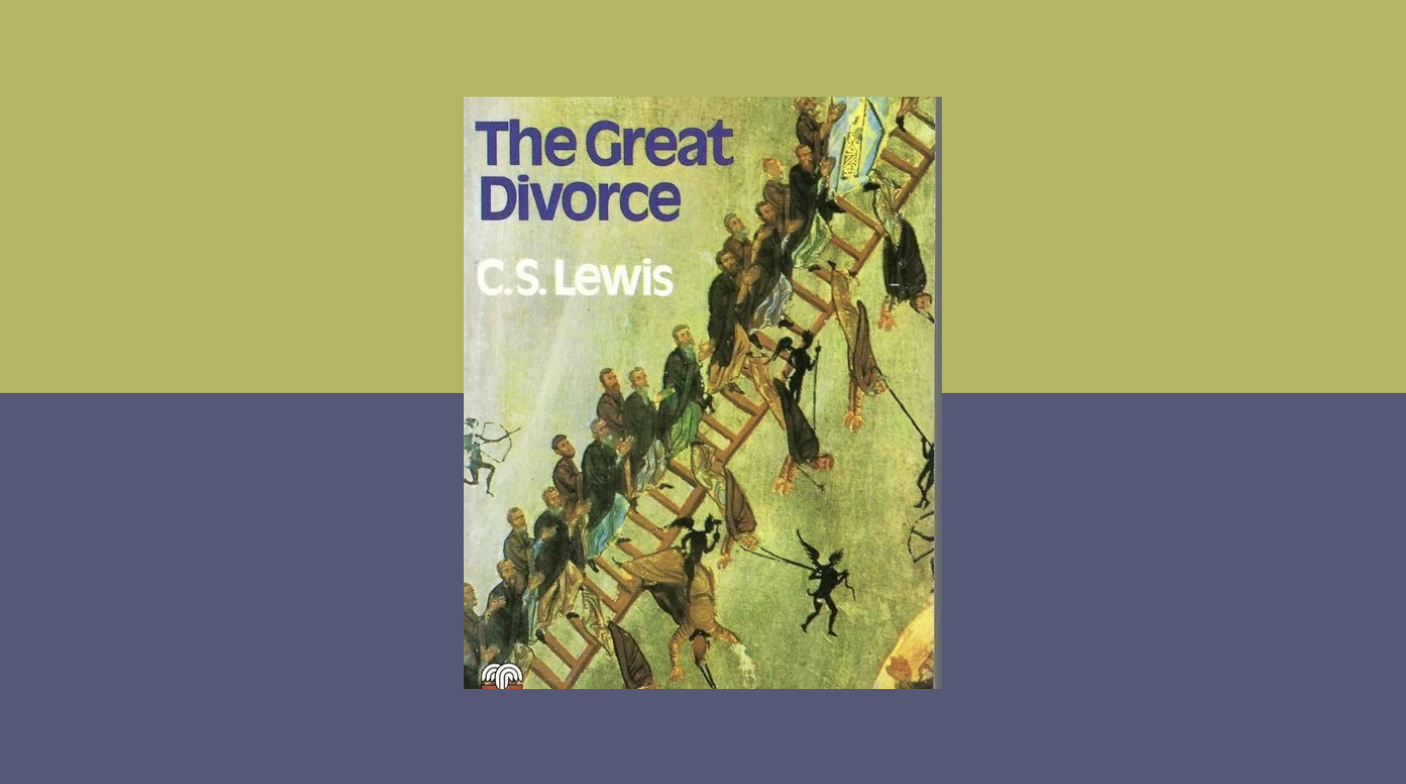
C. S. Lewis didn't set out to write a book about pride. The Great Divorce is a fantasy about souls who refuse Heaven's invitation — some pious, some pitiful, all fatal. Look closer, and the reasons for their refusal collapse into one. Every shade in Lewis's gallery is a variation on the same theme: the deadly sin of pride, the self turned inward, the will that insists on its own way even at the cost of everything else.
Pride hides in plain sight, usually wearing the face of a virtue. Inwardly, it inflates — overconfidence in one's intelligence, moral standing, ability, or control. Outwardly, it pushes — into self-promotion, narcissism, envy, and the relentless ranking of people. Worst of all, it blinds us to itself. We don't want to see our own pride precisely because we are proud. And once pride curdles into envy, it stops merely inflating the self and begins resenting the good it sees in others.
The book is nearly eighty years old. Their modern equivalents surround us — and indict us.
The Big Man: Self-Righteousness
Here, pride takes the form of an inflated sense of personal virtue and a refusal of grace that cannot be earned. A blustery, working-class ghost convinced of his own decency, the Big Man insists he deserves Heaven on the strength of his good behavior. His pride rests in moral self-sufficiency, and grace offends him precisely because it treats all as equally undeserving.
The Big Man insists on being admitted to Heaven because he has “done his best”:
“But I done my best all my life, see? I done my best by everyone, that’s the sort of chap I was.”
His Spirit-guide corrects him gently, shifting the ground from merit to grace:
“Oh no. It’s not so bad as that. I haven’t got my rights, or I should not be here. You will not get yours either. You’ll get something far better. Never fear.”
When the Big Man resists, the guide confronts him directly:
“You weren’t a decent man and you didn’t do your best. We none of us were and we none of us did. Lord bless you, it doesn’t matter. There is no need to go into it all now.”
Pride here is, above all, self-righteous — the delusion that one could merit eternal life on one’s own merits. This echoes the mindset of the rich young ruler who approached Jesus in the gospel accounts. The Big Man’s pride is compounded by envy: his grievance is not only that he lacks Heaven, but that a convicted murderer like Len already enjoys it. Envy, as explained by Aristotle, is the experience of pain and disappointment over another’s good fortune. We see it reflected in today’s culture, where the societal goal (in the eye’s of some) has shifted from the elimination of poverty to the elimination of inequality – as if it were morally objectionable that some might succeed more than others.
The Bishop: Intellectual Pride
The Bishop embodies intellectual (or epistemic) pride, an unwarranted certainty in one’s own opinions and beliefs. An urbane clergyman who prefers theological speculation to the presence of God, the Bishop hides from truth behind endless “honest” questions. Though he seems to avoid any expressions of personal dogma, he’s quite confident in his dismissal of orthodox Christian dogma. His intellectual hubris is on full display – flaunting his imagined wisdom, assuming he alone is immune to bias, and insisting that God ought to respect to his opinions, rather than submitting to Him in humility.
The Bishop relishes the idea of returning to Grey Town to continue his lectures and debates, avoiding paradise for the pleasure of attention. He asserts that honest opinions, “fearlessly followed,” are never sins. His Spirit-guide spots the flaw in reasoning:
“It all turns on what are honest opinions.”
And then more directly:
“Our opinions were not honestly come by.”
The guide lists the “sins of intellect” — hide-bound prejudice, intellectual dishonesty, timidity, and stagnation — and invites the Bishop to “the land not of questions but of answers” where he shall “see the face of God.”
Contemporary psychology affirms the guide’s claim: our beliefs are rarely the product of pure, bias-free reasoning; they are shaped by self-interest, emotional commitments, and social pressures. The Bishop’s pride lies in assuming he is immune to these distortions. It’s a universal affliction that pervades every nook and cranny of our politics, churches, and public discourse. Yet, there is a simple remedy: intellectual humility, the humble admission that we could be sometimes wrong.
The Hard-Bitten Ghost: Superiority
In this ghost, pride expresses itself as the conviction that seeing through everything is a mark of superiority. A tough-minded cynic, the Hard-Bitten Ghost prides himself on never being fooled. He “sees through” everything, but his skepticism has eaten away his capacity to see anything at all.
“It’s up to the Management to find something that doesn’t bore us, isn’t it? It’s their job… they won’t catch me that way.”
C. S. Lewis elsewhere warns of the danger of “seeing through” everything until nothing is left to see. In a time of mass disinformation, our default posture ought to be one of skepticism. But sometimes, healthy skepticism grows into an unhealthy cynicism that acts as a firewall against truth itself.
Cynicism functions like armor: it prevents the sting of disappointment but also prevents the embrace of joy. Such a mentality is pervasive in modern society, with widespread public skepticism of the government, public institutions, and the scientific and medical communities. Yet the skepticism is rarely consistent – those who reject the authority of more mainstream sources are often too eager to believe anything from a FaceBook meme or YouTube video.
The Well-Dressed Woman: Narcissicism
The Well-Dressed Woman reveals a form of pride rooted in obsessive self-promotion, where dignity and appearance are idolized. Terrified of embarrassment (real or imagined), the Well-Dressed Woman clings to her image and dignity as though they were her life. Pride leads her to a self-consciousness so complete that it eclipses all other loves.
When asked to let go of her self-image, she protests:
“You’ve no right to ask me to do a thing like that.”
Her Spirit-guide urges:
“Could you, only for a moment, fix your mind on something not yourself?”
Her pride is expressed in her self-serving insistence upon admiration and recognition, along with the idolatrous presumption that outward appearance is the truest measure of a person’s worth. In an era of self-branding and image curation, her fixation on her personal appearance feels disturbingly commonplace — and therefore more dangerous.
The Grieving Mother: Control Over God
Here, pride masquerades as devotion, while asserting moral superiority over God in the name of love. The mother is eternally grieving over a lost son. She is assured he awaits her on the other side. But Pam demands her son back on her terms, even if it means rejecting Heaven. Her “love” is really possession, an unwillingness to love God unless she controls the relationship.
“I don’t believe in a God who keeps mother and son apart. I believe in a God of love. No one has a right to come between me and my son. Not even God. Tell Him that to His face. I want my boy, and I mean to have him. He is mine, do you understand? Mine, mine, mine, for ever and ever.”
Her guide offers the humility lesson all must learn:
“That’s what we all find when we reach this country. We’ve all been wrong! That’s the great joke. There’s no need to go on pretending one was right!”
Here again we see the essence of intellectual humility, and how essential the virtue is to every other aspect of life. Pam’s “devotion” is not an excess of love, but of selfishness — an unwillingness to love God unless she first possesses her son. Pride further puts her in the role of judge over God — and leads to envy, her resentment that anyone else (even God) should enjoy what she cannot possess. It is the nature of possessive love in any age, but in ours it mirrors the parent whose identity is wholly bound to a child’s loyalty or achievement, unable to bless any relationship not under their control.
The Tragedian: Control Over Others
Frank’s pride takes the form of sanctified suffering, using misery as leverage to control the emotional lives of others. Augustine wrote of the libido dominandi – the lust for power. The power he attempts to wield is not political but emotional. Frank appears as a small, shrunken figure leading a tall, melodramatic puppet — the Tragedian. He weaponizes self-pity, demanding that others be held hostage to his misery.
Sarah Smith names his demand for what it is:
“Did you think joy was created to live always under that threat… that theirs should be the final power; that Hell should be able to veto Heaven.”
Lewis then expands:
“The passion of pity… was used as a weapon by bad men against good ones: their weapon will be broken.”
Frank’s pride leads to envy, and envy to domination — a demand that others be as joyless as himself. His misery cannot bear the sight of anyone else’s happiness; joy in others is an offense that must be vetoed. Through this lens we can understand the impulse driving grievance culture, where other people’s joy is treated as a personal insult unless it conforms to one’s own terms.
Ikey: Self-Promotion
Ikey’s pride appears as opportunism and radical self-sufficiency, transforming gift into resource and abundance into advantage. Ikey appears on the outskirts of Heaven carrying a black bag, intent on gathering golden apples. But his aim is not to enjoy them here; it is to carry them back to Grey Town, where others have none. The apples’ value lies not in their beauty or nourishment, but in their scarcity — they become a means to set himself above others and profit from their lack.
Aquinas describes one form of pride as the pursuit of goods “in order that others may be exceeded.” Greed seeks to possess; pride-linked greed seeks to surpass. Ikey’s plan is a textbook example: it’s not that he really wants the apples for their intrinsic worth, but for what personal advantage they confer against others. And yet the absurdity is plain: from selling the apples in Grey Town, what could he possibly gain that would be superior to the bounties of Heaven? Pride will cling to its own little advantage even when surrounded by infinite abundance, measuring worth not by joy received, but by how it exalts the self over others.
The Ghost with the Lizard: Sensual Pride
In this ghost, pride binds self-serving desire so tightly to identity that transformation feels like annihilation. This ghost carries on his shoulder a sly, whispering lizard — the embodiment of lust. At first glance, lust might seem less obviously connected to pride than self-righteousness or intellectual arrogance. But Lewis presents it here in its truest form: a passion oriented entirely toward the self. Lust is not ordered toward the good of another, but toward personal pleasure and gratification. In that sense, it is pride turned inward — with self enthroned as the final end.
The ghost’s resistance is revealing. He does not argue that the lizard is good, only that killing it would be unbearable. Pride speaks here through fear: fear that surrender would mean loss, diminishment, or annihilation. To admit the lizard must die is to admit that something in him is disordered and in need of repair. Pride recoils at that admission. Better to remain damaged than to concede dependence on grace.
Only when the ghost consents — haltingly, painfully, perhaps humbly? — does transformation occur. The lizard is destroyed, and in its place emerges a great stallion, strong and free. What pride insisted would be the end of the self becomes the beginning of something larger and more real. Lewis’s point is precise: repentance does not erase desire; it redeems it. But pride cannot imagine this, because pride equates change with a loss of self rather than its restoration.
This logic manifests in many ways; for instance, wrapping one’s identity around unbiblical sexual conduct and rendering that identify sacrosanct. However, all of us are broken. All of us are in need of radical transformation. But we do not often welcome it. What truly threatens the self is not transformation, but the proud refusal to be transformed.
Lewis's Theological Frame
The narrator’s guide through Heaven’s foothills, George MacDonald, is a towering, solid Spirit patterned after the real-life Scottish author and preacher whom Lewis revered. He serves as both interpreter and theologian, explaining the deeper meaning behind each ghost’s refusal. MacDonald frames the encounters in terms of freedom, self-will, and the unyielding choice between “Thy will be done” and “my will be done.”
““One will say he has always served his country right or wrong; and another that he has sacrificed everything to his Art; and some that they’ve never been taken in, and some that, thank God, they’ve always looked after Number One, and nearly all, that, at least they’ve been true to themselves.” [emphasis added]
“Every shutting up of the creature within the dungeon of its own mind — is, in the end, Hell. But Heaven is not a state of mind. Heaven is reality itself.”
MacDonald observes:
“There is always something they insist on keeping, even at the price of misery.”
And gives Lewis’s most famous summary:
“There are only two kinds of people in the end: those who say to God, ‘Thy will be done,’ and those to whom God says, in the end, ‘Thy will be done.’ All that are in Hell, choose it… Those who seek find. To those who knock it is opened.”
(Lewis’s depiction of Hell here is, in his own words, a “fantasy, not even a guess or a speculation at what may actually await us.”)
Hell, he says, is small and shrinking:
“All Hell is smaller than one pebble of your earthly world: but it is smaller than one atom of this world, the Real World.”
And pride is the stubborn rejection of grace:
“Their fists are clenched, their teeth are clenched, their eyes fast shut. First they will not, in the end they cannot, open their hands for gifts, or their mouths for food, or their eyes to see.”
Grace is offered to any who open their hands, their mouths, or their eyes. They don’t want it and refuse to admit they need it.
Conclusion
Lewis’s ghosts are not caricatures of evil, much less an allegorical catalog of vices to overcome. Each lost soul clings to something once recognizable as a virtue — intellect, love, justice, caution, artistic calling — but held in a disordered way. Pride’s danger is that the deification of self leads to the corruption of whatever virtue is present, even when doing so makes us smaller, colder, and less free.
What Lewis exposes is not merely moral failure but moral intransigence. Pride does not simply lead us into sin; it steels us against grace. It tightens the fist, hardens the will, and convinces us that surrender would mean ruin, not restoration. Hell, in Lewis’s telling, is not imposed from without so much as chosen from within — the final consequence of insisting on “my will” over reality itself.
The antidote is not self-loathing or moral heroics. It is humility: the willingness, at minimum, to admit we are in need of repair.
Pride promises satisfaction. It delivers a shrinking world. Lewis said as much in Mere Christianity, written a few years before The Great Divorce: pride "leads to every other vice" and "has been the chief cause of misery in every nation and every family since the world began." The gallery of ghosts in The Great Divorce is that claim given form — each figure a case study in what pride costs when the bill finally comes due.
Are you holding something you'd rather keep than surrender? The phantoms know that feeling well.
Did you find this helpful?
Mere Orthodoxy publishes serious Christian intellectual thinking. Subscribe and get our best writing in your inbox every week.
I’m very grateful for the work of MO and have really appreciated the things I’ve learned and the companion that it has been for me on my spiritual journey.
Mere Orthodoxy reader
Thank you for offering thoughtful, reasonable and decent commentary. It is a boon to my sanity at this stage of my life in this cultural moment.
Mere Orthodoxy reader
Mere Orthodoxy is (for me) a counterpoint to social media, a place of depth and critical thought.
Mere Orthodoxy reader
You're in. Check your inbox.
Something went wrong. Try again.
Steven Willing is board-certified in diagnostic radiology and neuroradiology, with an MD from the Medical College of Georgia and an MBA from the University of Alabama at Birmingham. He has held faculty positions at the University of Louisville, the University of Alabama at Birmingham, and Indiana University, where he taught and practiced diagnostic and interventional neuroradiology. Currently, he is a clinical neuroradiologist at Children’s of Alabama, a consultant in radiology at Tenwek Hospital in Kenya, a visiting scholar with Reasons to Believe, and an adjunct Professor of Divinity at Regent University. Dr. Willing is the author of Superbia: The Perils of Pride. The Power of Humility.
Topics:
