
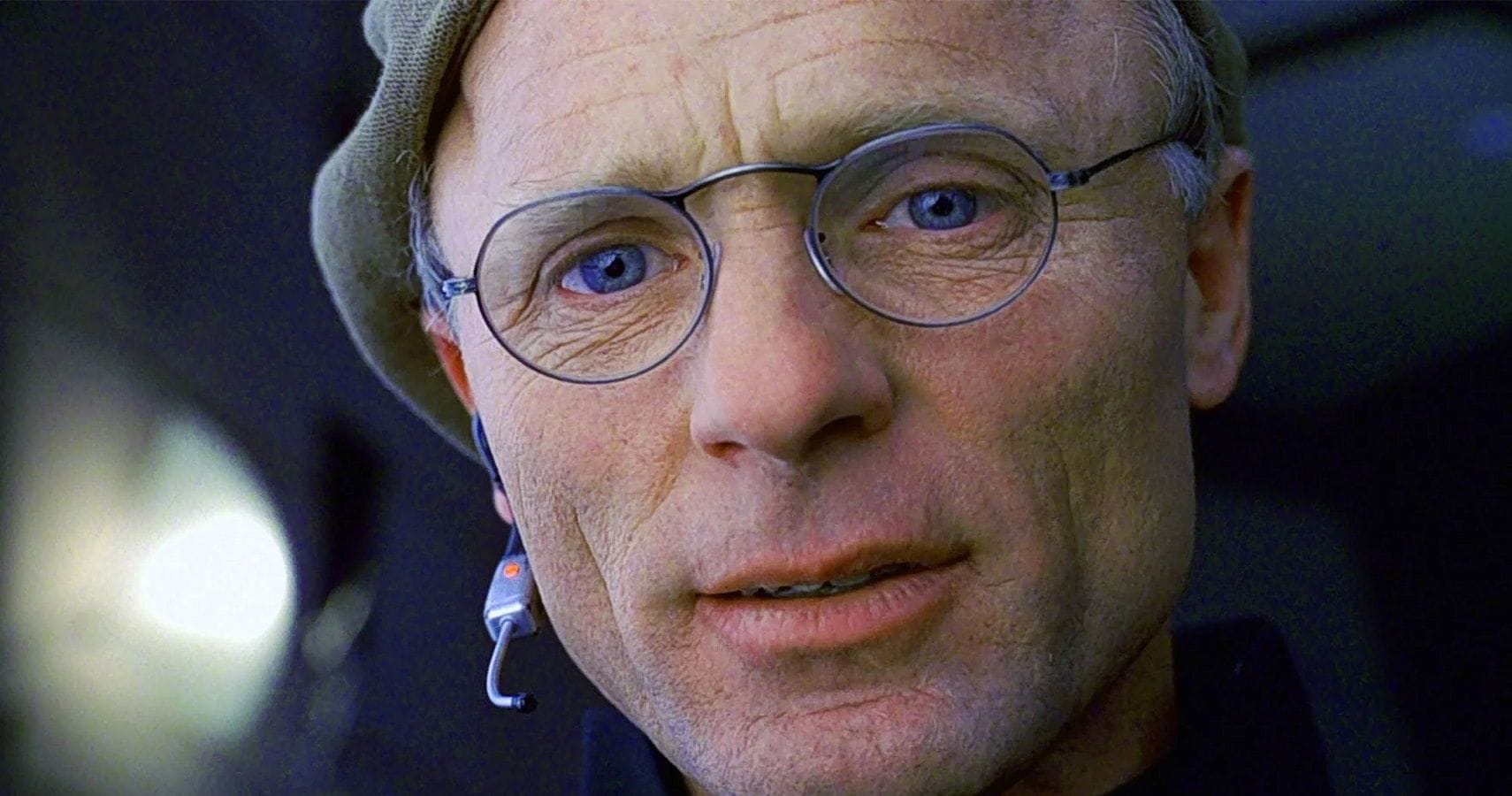
In the 1998 psychological satire The Truman Show, Truman Burbank (played by Jim Carrey) discovers his entire life has been a fabricated social experiment televised to the world. Orchestrated by a director named Christoff, Truman’s experience is situated in a highly choreographed, repetitive, and completely artificial environment. Every relationship is with a paid actor; every decision is ultimately controlled to keep Truman fearfully tied to his small town, lest he adventure too far and realize the horizon is really the wall of a painted dome.
Such satire is an apt example of one anti-human aspect of our increasingly artificial environments. Even though Truman is unaware of the artificiality of his world, it slowly but nevertheless hinders his flourishing as a human being. He begins exhibiting a disturbing dissonance as he grinds against his simulated existence.
This is the same danger situated as the philosophical spine through Pope Leo XIV’s first encyclical, Magnifica Humanitas. Throughout his robust treatment of humanity’s nature, uses and concerns over AI, and a charge to Christ followers to rebuild together is this implicit reality: that humanity––being made in the image of God––has a unique means of flourishing in this life, and that our technology has a great potential to mislead us in the very ways we seek to flourish. That is, our various technologies are increasingly offering a manufactured resonance.
Resonance as Flourishing
In his 2019 book, Resonance: A Sociology of Our Relationship to the World, sociologist Hartmut Rosa argues that resonance is foundational to human happiness and flourishing. Rosa defines resonance as a responsive and mutually transformative relationship between subjects––to resonate is to be in right relationship with others and the world.
While such resonance according to Rosa is not exclusive to people of religious faith, the Dutch theologian Herman Bavinck argues that no one can resonate with the world unless a feeling for its beauty is placed in their heart by God. Resonance––genuine flourishing––happens when we are in conversation with the created order. Vigen Guroian poetically affirms that, “man is a microcosm in whose flesh resonates and reverberates the pulse of the whole creation.” Biblically speaking then, we can think of resonance as the very vibrations of shalom––resonance happens when we tap into what Alvin Plantinga calls the,
rich state of affairs in which natural needs are satisfied and natural gifts fruitfully employed, a state of affairs that inspires joyful wonder as its Creator and Savior opens doors and welcomes the creatures in whom he delights.
When we resonate with something, then, we are experiencing a tinge of shalom––of things as they ought to be. Understood this way, resonance can be yet another sense in which we flesh out biblical blessedness. Blessed––happy, fortunate, flourishing––is the one who resonates with things as they ought to be.
Such blessed flourishing is the fundamental desire of every human being. We are all after fullness of life, with varying visions of what such fullness looks like. However, this fullness is at risk in unique ways, as laid out by Pope Leo XIV:
Today, the human desire for fullness of life is at risk of being misled by deceitful goals, such as the prospect of a technology that promises to free us from all weakness.
While we are increasingly aware of our need for resonance in a digital age, it is the very digital environment we inhabit that threatens to cut off pathways to resonate with the world. The end of technology is control, yet nothing stifles resonance quite like control.
Resonant Design in AI
One growing area in the development of algorithmic technology and artificial robotics is Resonance Theory. Not to be confused with Rosa’s theory of resonance, this is the science of statistically engineering environments for resonant responses. Essentially, machines—both algorithms and physical machines—are equipped, calibrated, and trained to mimic the stimuli most likely to trigger resonance in humans.
In his recent book, Superbloom, Nicholas Carr notes how such advancements can help us understand how mindless machines can command so much of our attention––they are calibrated to analyze our behavioral variables and adjust in ways that foster resonance. This is uniquely insidious, as it offers the husk of what we deeply desire––flourishing via resonance––while void of its substance.
In a 2022 journal article from Frontiers in Neurorobotics researchers Lomas et al. proposed that resonance can serve as a design strategy to guide human relationships with artificial agents. They argue that resonance is a physical mechanism that can not only be measured, but harnessed. Their research is based on identifying “external oscillations”––outside vibrations––that align with an individual’s natural vibrations, thus likely causing “synchronization and amplification effects.” In layman’s terms: they identify stimuli that are most likely to trigger meaningful attunement with humans and then design robots to engage accordingly.
The goal, says Lomas, is that perhaps “resonant robots” might dance with us, show love for us, or even offer spiritually fulfilling interactions.
However, I believe most of us intuitively see the folly of such aspirations. This was, in fact, the downfall of Christoff’s experiment with Truman. His entire world was calibrated to create resonance––for Truman to flourish through simulated relationships and surroundings. But the artificiality of these could not sustain meaningful flourishing. The more he realized this, the more he exhibited all the symptoms of late modern life: skepticism, cynicism, agitation, depression.
As the “Creator” of Truman’s world, Christoff wanted an authentic, unscripted human experience. However, his techniques of executing on this vision cut off the very possibility of authentic resonance he was after.
Likewise, these researchers cite Rosa for their understanding of resonance as a physical mechanism needed for well-being, but they cut off any possibility of manufacturing such resonance by ignoring Rosa’s core tenet: unpredictability.
The Essential Unpredictability of Resonance
Harnessing “external oscillations” to produce resonant responses simply cannot result in meaningful transformation. Rosa takes pains to show how inherently uncontrollable resonance is! However, while unable to be manufactured, Rosa does identify what he calls “axes of resonance”––pathways where resonant encounters are more likely to occur. For Rosa, this is not an exercise in harnessing an external force to behave synchronistically. Rather, it is a matter of placing oneself in the way of unpredictable vibrations.
Rosa’s three primary axes are:
- Meaning — art, history, religion
- Relationships — family and friendships
- Objects — food, music, work
Each of these, Rosa shows, are inherently uncontrollable. They uncover in unique and unpredictable ways various frictions, limitations, and weaknesses. These are the paths to flourishing.
Pope Leo XIV agrees:
Everything that appears as a “limit” — incapacity, illness, old age, suffering, vulnerability — tends to be seen primarily as a defect to be corrected, rather than as a reality through which our humanity matures and opens itself to relationship. And yet we must remember that humanity flourishes not despite limitations, but often through them. The light of faith offers a perspective on reality that helps us recognize what we call the “contingency” of the things of this world.
Limitation is one shade of unpredictability. That is, our initial experience with what is uncontrollable is fundamentally limiting. But limitation––unpredictability––is prerequisite for flourishing. Lomas’ attempts to design, measure, and harness are antithetical to this. Such attempts, by nature, remove the unpredictability needed for resonance. Lomas admits the difficulty of controlling the uncontrollable:
Part of the challenge of operationalizing human resonance from a brain-to-stimuli correlation measure comes from the challenge of decoding how a stimulus produces a brain response.
In other words, the challenge of making resonance operational is due to the fact that it is deeply unpredictable!
For Rosa, this unpredictability of resonance lies in it being between two subjects, each with distinct otherness. A robot designed to analyze behavior and synchronize oscillations cannot meaningfully be understood as a subject. Truman only truly resonates with a woman outside of the simulation—a subject whose unpredictability gets her removed from the experiment.
Pope Leo likewise notes:
So-called artificial intelligences do not undergo experiences, do not possess a body, do not feel joy or pain, do not mature through relationships and do not know from within what love, work, friendship or responsibility mean… They may imitate language, behavior and analytical skills, or even simulate empathy and understanding, but they do not understand what they produce, for they lack the affective, relational and spiritual perspective through which human beings grow in wisdom.
Thus, a “resonant robot” is an ontological oxymoron. The reason resonance “works” is because a personal Creator has woven it into the fabric of his creation. This personal Creator then entered into his creation as the Subject, Jesus Christ. Therefore, to resonate with others and the world is to be aligned with the oscillations of his general revelation in creation, which is able to result in common grace flourishing. On the other hand, true flourishing––shalom in the fullest sense––is an encounter with the Spirit-spoken oscillations of his special revelation in Scripture, himself being its fulfillment. Thus, resonance resulting in genuine human flourishing can only result from an encounter with the otherness of the Divine Subject, either in his creation or in his person.
No matter how advanced AI’s resonant-mimicking capabilities become, it simply does not have the ontological ability for this resonance. Further, attempts to manufacture such resonance with humans will stifle the very ability to flourish it seeks to simulate.
Keeping the Axes Clear
To experience true resonance in the way Rosa means it, it is important that we keep the three axes he describes relatively clear of technological interference or planning. Because the use of AI is such a unique and complex issue, there will be as many specific uses and philosophical approaches as there are individuals. However, we can at least start with Rosa’s identified axes—pathways to—resonance.
Rather than offer practical guidance (which too will be unique and numerous) we can consider questions that will encourage keeping these axes “clear” of too much dependence on AI:
Axis of Meaning:
- How has my knowledge of or familiarity with a topic or idea deepened recently?
- How have I experienced or pursued beauty recently?
Axis of Relationships:
- What was the most meaningful face-to-face conversation I had recently? How would I describe that person's voice––their tone, inflection?
- How could I make one person feel known and loved?
Axis of Objects:
- What’s the last thing that made me pause (Tree, sunset, meal)? Can I describe it in detail?
- What song, image, poem do I keep coming back to? Why is it capturing my attention?
***
The hope of the Christian faith is shalom—resonance in the fullest sense, in a new heaven and new earth in right relationship with our risen Lord. This is the fullest vision of what it means to be human.
Regardless of our convictions on AI, we must resist overtly anti-human outcomes. Using AI responsibly is not anti-human; AI using our behavioral variables to manufacture flourishing is anti-human. May we seek flourishing along the paths given to us by God, and seek it not alongside AI servants but alongside the Subject, Jesus Christ.
The Weekly Digest
Premier Thought Every Thursday.
All of our recent essays and podcasts, delivered to you. Free.
Free. Delivered Thursday mornings.