
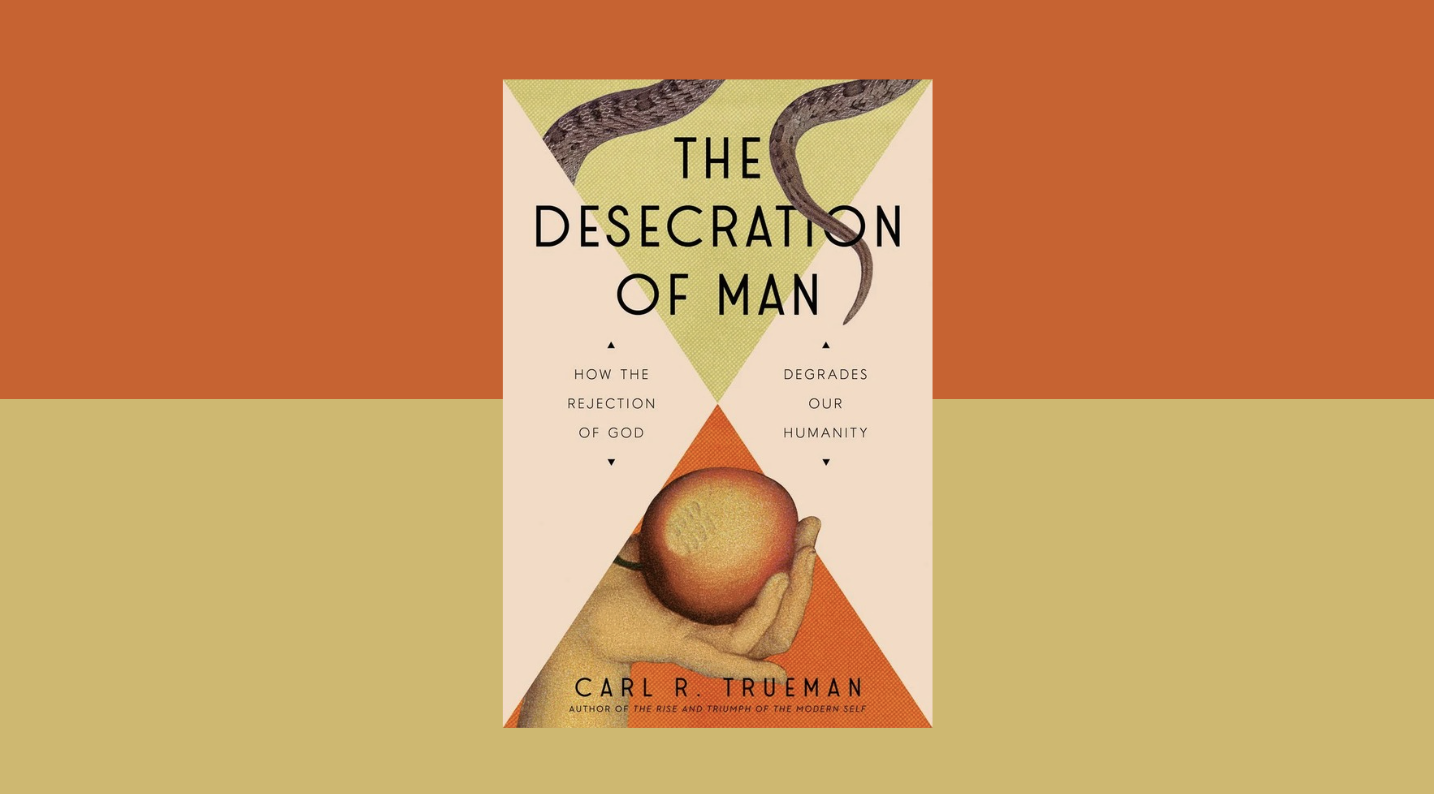
The Desecration of Man: How the Rejection of God Degrades Our Humanity. Carl Trueman. Sentinel Press, April 2026. $29, 256 pp.
-
Over a century ago, Max Weber characterized modernity as a period of disenchantment, inspired by Frederich Schiller's poem, Die Götter Griechenlands, where lamentation is raised for the disappearance of supernatural creatures and the world of divine significance:
But lost and never to return again
Is all that I had known of these fair worlds,
No more can one this earthly bliss regain—
Gone is all which breathed life into these words.
The absence, even forceful eviction, of the weird and the divine, Weber's Entzauberung, has haunted the pages of criticism of modern times ever since. In Weber's hands, disenchantment was a way of capturing the rationalizing dispensation which loomed over modern society. The arenas of politics, philosophy, and science had sloughed off the past's deposit of mysterious rites, folk tales, and strange beliefs, and replaced them with measurable, quantifiable systems. There was nothing else to uncover beneath dead matter. Divine nature, if it was real, was not present, and if present, not felt. Its many deputies, emissaries, and diminutive expressions -- influential planets, fairy, angelic and diabolic powers -- had gone out of sight, out of mind, out of belief.
Drawing on Weber, Charles Taylor would later give students of modernity an array of tools for reflecting upon the nature and effects of disenchantment in our secular age. Reading him more than a decade ago, I found his distinction between the porous and buffered self especially illuminating, where the porous person believes there are powers in the world capable of entering in and influencing his life, while the buffered self imagines a barrier between himself and the exterior world, granting each individual a walled-off space for self-determination.
For all its explanatory power, disenchantment does not capture our modern crisis without remainder. Nor did figures like Charles Taylor or others imagine it was so. As a way to capture the malaise of a materialist world, the spiritual void left over when our tie with the transcendent was cut, disenchantment provides a needful part of a more complex account.
All the same, there are domains where disenchantment may be unfit for, perhaps even a distraction from, a far more pressing crisis than belief in the mysterious. We need more than one framework to diagnose the modern crisis. Is it enough to say that man has been disenchanted? Or is something else also at work?
This is where Carl Trueman, in his new book The Desecration of Man, proposes the adoption of a different framework. In the case of anthropology -- what it means to be human -- he calls for the use of more serious terms. The term Trueman points us toward is desecration.
As Trueman admits, "Desecration is a strong word, stronger than others that have been used to describe the modern world such as disenchantment." He argues on two points that the word is nonetheless more fitting. First, it captures an essential quality of those things which have fallen victim to modernity's nihilism and wanton disfigurement. He primarily focuses on how we have depreciated our human nature. Desecration better names what sacrality and holiness has suffered than disenchantment does. Humans are no longer seen as exceptional, unique creatures, placed higher than the animals and lower than the angels. Our persons and our bodies have been reduced to objects. How we choose to live our lives, how we choose to treat our selves, what counts as our final end have all turned into an array of options and preferences provided by technological research and legal license.
With an eye for these consequences, Trueman surveys such topics as sexual ethics, abortion, IVF, surrogacy, and man's war against mortality. In every case, Trueman points out that if our souls and bodies are in fact sacred gifts given into our care by God, there are ways in which their treatment can only be described with the same language we would use for the act of burning down a church, violating the altar, or destroying a relic.
The analogy between body and building of course harkens back to Paul's reminder to the church in Corinth, that the body is a temple of the Holy Spirit, and we ought not to defile it with sin. With such a governing image, one can see more clearly how disenchantment's demystification gives way to the violence of desecration. Disenchantment may have provided the conditions, but desecration best captures the results.
There is another aspect of modernity's rejection of human nature which the idea of desecration captures more strikingly than disenchantment. Those who commit acts of desecration understand their behavior as a form of trespassing upon sacred ground. There is a rush and a thrill in the act of violating the sacred. While unintentional acts of desecration are certainly possible, Trueman notes, "the person who topples the gravestone or smashes the windows of a house of worship knows what they are doing: They are striking at the heart of what the religious community considers most sacred" (16). Trueman observes the common experience of the violators: desecration is exhilarating. "The sheer delight taken by many in toppling the moral codes of the past cannot be explained simply by the loss of an enchanted world. … There is a delight being taken in destruction" (21).
"Put provocatively, [what is happening to man] is not disenchantment. The death of God in modernity has led to the desecration of man. And many of us seem to find that exciting" (21).
The unsettling lens of desecration is what gives new force to the litany of biological and technological challenges which are otherwise familiar topics of concern. Addressing technological advancements, the ethical and legal battles, the surge of research and funding from institutions and governments, and our expanding powers of manipulation in areas of sexuality, fertility, and life-extension, Trueman's analysis is rich in both research and reflection. Many cases are themselves the best warrant for desecration as the more fitting term. Certainly the awful threat of such trends as womb surrogacy, artificial wombs, or the eugenic potential in IVF companies such as Orchid strike the moral imagination no less than the violation of an altar in one's local parish.
In one way, Trueman is arguing that we place at the center what has been on the periphery of our analyses. Scientific advancements, which one might have judged as a network of neutral methods employed at times for horrifying goals, are colored red from the moment the idea of such research enters into the minds of scientists. The outcome is not disbelief in the divine but the destruction of its embodiment. The excitement surrounding scientific and technological progress echoes the cries of revolutionaries. The vapor from heating vents atop an artificial-womb research lab blends with the smoke rising from a smoldering church.
Desecration requires nothing less than a wholistic response, and Trueman argues for three elements which must remain integrated with one another for Christians truly to survive and flourish in an age where the holiness of embodied souls is under threat. Christians must adopt orthodox belief, right worship, and proper practice, a trio he summarizes as creed, cult, and code. Adopting one or two and leaving the others will not do.
He points out the trend among some intellectuals to defend the cultural effects of Christianity or its aesthetic beauty – without submitting to the wholistic Christian way of life. Richard Dawkins's praise for the cultural benefits of Christianity falls flat, for those effects are nourished by genuine, not selective, belief. "The problem is not solved," writes Trueman, "by living as if Christianity were true" (187). Beliefs based on mere benefit, he argues, amount to a Christian nihilism. The beliefs are made subject to our will, to the condition that they be useful for us. The irony, as Trueman points out, is that Christianity can be misunderstood as merely useful because of the profound belief of those who came before us, who surrendered themselves to the faith and shared with their children and grandchildren the harvest of their simple submission. Belief must be placed into our hearts and minds, our imaginations and actions. Better perhaps to say, we must be taken into it.
"The truth of Christianity," he writes, "must reshape our intuitions so that our moral limits, or obligations, and our ends dictate how we relate to our bodies, our loved ones, our neighbors, our communities, and the world around us, near and far" (187).
The quiet obedience to the creed, cult, and code of Christianity points us to our larger aim: we must reconsecrate the world. This comes in many forms, and Trueman gives a series of examples, all organized into instances of creed, cult, or code. We must train our beliefs by reading and understanding the Genesis story, through catechisms asking the believer what is the end of man; our worship should emphasize prayer, song, reciting and speaking with each other. Our rites must re-member us with our bodies. We must be a cult of nativity and funeral. Our buildings must be restored as venerable places, and in this way will we see more easily the respect owed to the temples of our bodies.
Last, Trueman turns to code, the way in which our beliefs and worship is carried into the wider world through moral habits. As Trueman sees it, this must begin through Christian hospitality and kindness. As he turns to offering a path forward, he writes, "The battle against desecration does not begin so much with boycotts of blasphemous arts as with acts of human kindness extended to neighbors" (207). A time of desecration is sure to be full of souls neglected and mistreated by systematic sacrilege: The elderly, for whom assisted suicide is offered at state expense. The sickly and malformed, for whom early scanning might have saved the soul from the pain of existence. The infants born from an artificial sack swirling with industrial fluids. Children whose parentage is either anonymous or mechanically fabricated. The mothers whose babies were handed over to others through a moneyed transaction. These, too, must be shown their humanity, and invited into places of comfort and holiness.
These strangers must be welcomed in. Trueman reflects on the passage in Deuteronomy where the Israelites are enjoined to welcome in the stranger, as they too were strangers once. The relevant part reads, "for the Lord, your God ... executes justice for the fatherless and the widow, and loves the sojourner, giving him food and clothing. Love the sojourner, therefore, for you were sojourners in the land of Egypt." Thus, Trueman argues, is desecration challenged: by the loving invitation into a consecrated space filled with a consecrating people: a friend to church, the lonely to a conversation, the lost to a home.
Trueman has paved for each of us a "little way" to walk in. Instead of chasing the elusive and perhaps undesirable qualities of enchantment, persons, families, churches, and communities are oriented toward a concrete vision of reconsecration, to love the human in a hostile world.
This, however, is not the end of the story. Trueman proposes the turn from enchantment toward consecration in the context of modernity's abuse of human nature and the physical distortion of human bodies. This is a fitting place for its introduction, yet the language of consecration invites wider application. After all, surely desecration is not found solely in the treatment of our bodies, but can be found throughout society. What does it look like to reconsecrate an economy? What about a reconsecration in education? What does political reconsecration demand?
Seeing how many forms of desecration have invaded not only technological or scientific development but a richer tapestry of bonds and relationships between souls, such questions linger after reading Trueman's account. They promise to bear fruit for Trueman and others who investigate them.
Trueman, however, expresses some hesitancy. Near the end, Trueman gestures toward some of the political consequences, by way of a warning against Christian nationalism. "Of course, the wannabe Christian warlords who talk tough online will dismiss this as pietism or ineffectual intellectual idealism. But that is only because they want power and they want it next week." However true this may be -- it seems hard at times to pin down what Christian nationalism is, much like enchantment -- Trueman frames his caution in terms of acting too quickly in too short a period of time. He argues that the Christian nationalists are fantasists, since they imagine a recovery of Christendom in the short- or medium-term. "Christianity is too weak and too fragmented to be a significant ecclesiastical or political force in the world at large." Reconsecration is a long-term vision, whereas many a political movement seems to overextend itself. The local church may have the resources to effect their neighborhood, county, or city in profound ways, but nothing at the scale of organizing a nation.
All the same, this caution against fantasies of imminent political change does not extend at least to intellectual reflection. If desecration is indeed definitive of our time, this seems all the warrant one needs to consider the effects of desecration on, say, politics, even while Christian traditions and communities lack the integrity and strength to effect change. Even if prudence discourages us against incorporating consecration into political action, it seems that consecration would provide a clear and deep source for consideration, especially in the sphere of politics. This can, and I think should, be explored alongside our daily practice of hospitality. We needn't wait for, or indeed plan for, political influence before we see how consecration shapes our concepts of the political, the economic, or the technological. Hospitality already stands within a political philosophy, with implications for many areas of life.
There is another influence upon our notion of political consecration, however, which offers ample material for thought. The history of the Church, in Europe especially, is bound up with that of Christendom, a period in time when the institutions of palace, cathedral, and university were deeply shaped by Christian virtues, and vices. The period between the 9th and 14th centuries is an unsettling time to look into, full as they are with creeds, cults, and codes that disturb our modern predilections. In the Middle Ages, there were seasons of stability and cycles of warfare. Scandals and superstitions and saints abounded. People walked through the mud; Crusaders had blood on their hands, yet consecration was in the air. Not that consecration is peculiar to an era of fiefdoms and holy empires. Throughout its history, Christianity consecrated whatever and whomever it touched. What could we learn from past eras of Christian presence regarding what reconsecration looks like?
As Trueman pointed out, desecration is a strong word. He might also have called it a perilous word. Unlike disenchantment, it has the power, once deeply felt, to move people to action. His call for hospitality seems laudable, but the term implies more than an invitation to the stranger. Desecration is not only something, at least historically, that people have rescued others from, but have defended themselves and others against. This seems to be the challenge of the term which Trueman has chosen. It carries within it more than what Trueman attends to. I might agree that Christian response to desecration does not begin with boycotting art, but surely it includes it. Does it entail more than boycotts?
Desecration demands of us a great deal of wisdom to handle, but if Trueman is correct, handle it we must. He is to be thanked for taking the first step in turning our attention in its direction. As Christians and other believers ponder its significance, a rich and sober conversation awaits our minds and hearts and hands.
The Weekly Digest
Premier Thought Every Thursday.
All of our recent essays and podcasts, delivered to you. Free.
Free. Delivered Thursday mornings.