


Francis Schaeffer, in his lesser-known essay Two Contents, Two Realities, once described the four requirements he believed the church needed to possess to reach the next generation:
- Sound Doctrine
- Honest Answers to Honest Questions
- True Spirituality
- The Beauty of Human Relationships.
Schaeffer made this list in 1974. Even if a church has not always possessed these four things–which he summarized as the "orthodoxy of doctrine" and "orthodoxy of community"–I don't know a single pastor who doesn’t yearn and pray for his church to be known for these four things. Of those four things, "Honest Answers to Honest Questions" sounds wonderful in theory but seems hardest to put into practice. How can a church, or a ministry within a church, foster this kind of “content,” as Schaeffer names it, in a meaningful way?
For the past three years, the youth ministry of Redeemer Christian Church (where I formerly served as Youth Associate and now Director of Youth) has done weekly Q&A. Students can anonymously text in questions to a Google Voice number and a panel of volunteers will answer them from stage after the teaching for the night. We close out each semester with a "Q&A Megathon Night" where we have several different Q&A panels focusing on different topics, including one where students can grill me on the hardest questions they can come up with. It was an immediate hit from day one, and as the youth ministry grew, so did the number and complexity of the questions students were texting in.
At first, these questions would only be answered on stage on Wednesday nights. But in the period of time since I left my youth ministry role to go work at The Gospel Coalition, an intern decided to start texting back individual responses to students. When I returned to my church as Director of Youth last fall, I kept the practice going. After two semesters of logging 459 serious questions from over 94 individual students and 384 responses totaling over 45k words, I want to share what I learned about the questions my students are asking, how responding to their questions became a core part of my weekly pastoral duties, and how you can implement this practice in your church.
The Questions My Students Are Asking
Before I go on, I want to be transparent about what follows in this section. Each week, I would copy and paste each question and reply into a spreadsheet, along with the student's phone number and date. I did this because I intended to give that spreadsheet to Claude to see what insights it would have. I could have combed through all this data and analyzed all this by hand. I did this regularly in my work for TGC. But I confess: when I saw Claude's summary and breakdown of the data, it was far more thorough and comprehensive than anything I could've done on my own. What I am presenting here in this piece are insights I gathered from Claude's summary of the data.
So what did Claude find? From a quantitative standpoint, most of the data reflected the operational side of the text line and is not worth conveying here. However, some of those insights are worth sharing. For example:
- There was a clear U curve of student engagement: 31% of students asked 5 or more questions, 34% of students only asked one question, and 18% and 17% asked 2 or 3-4 questions respectively.
- This averages out to 4.9 questions per student, which is much higher than I expected.
- Both the Fall and Spring semesters saw nearly the same number of questions submitted (223 and 236 respectively).
- Claude noted that students who engaged more in the Spring tended to ask longer questions that were more personal in nature.
- Of the 45k words written in response, the average length was 118 words–slightly less than the length of this paragraph.
But it's the qualitative analysis where things get interesting. Below is the chart Claude generated of the topics of the questions, as well as the number of responses written to them:
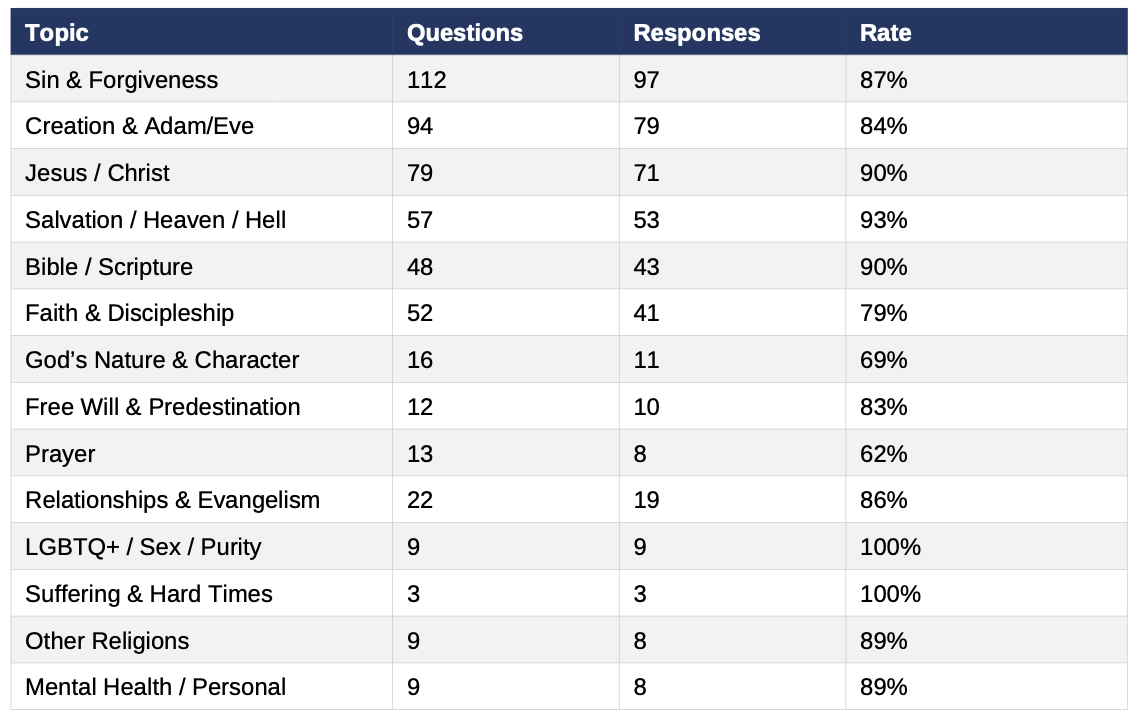
For context, in the Fall we taught on the 10 Commandments and in the Spring we taught Part 2 of the New City Catechism, which covers Christ, grace, and salvation. Most of the data here reflects engagement with the content of our teaching. But some of it is also surprising. I did not expect questions about Creation & Adam and Eve to rank so highly, nor questions about relationships and evangelism to be relatively higher than questions about mental health, suffering, or sexuality. Remember: these questions are anonymous. When given full cover to ask any question they want, what are students interested in? Sound doctrine. The fundamentals of the faith. The forgiveness of Christ in the Gospel for their sins.
Yes, there are students who text silly questions, and while those questions (and the occasional response to them) are not included here, the data shows that my students are deeply curious about Christian doctrine and practice. And with the advent of AI, the fact they're willing to ask these questions to a human is now one of the most important pastoral responsibilities I have.
The Pastoral Ministry of Giving Honest Answers to Honest Questions (In An Age When Students Can Just Ask AI)
There was also something Claude highlighted that I wouldn't have thought to look for, much less been able to easily capture. Three of the students with higher engagements had three discernible arcs in their questions from the start of the Fall semester and the end of Spring:
- The most engaged student texted 36 questions spanning theology, current events, science, and personal struggles.
- Another student started the fall semester with strictly theological questions, and by mid-Spring was wrestling with anxiety about a difficult friendship and how to navigate it as a Christian.
- A third student only asked one question in all of Fall 2025, but then returned to ask 10 questions in the Spring ranging from free will in heaven, new creation, the predestination of Judas, and more. Even if this student was a newcomer who started attending late-Fall, it is encouraging to see such thoughtful engagement.
Each of these three students–and the other students who texted questions–could've just taken these questions to an AI chatbot. Given how pervasive LLMs have become, I would not be surprised if students texted in a question and asked an AI and compared my answer to the AI's answer. Compared to how quick and thorough an AI can be, this text-line ministry is slow. Q&A only happens once a week. I don't always respond back the same day, much less the same hour or minute. My writing likely isn't as polished or precise as an AI can be.
But I have an advantage AI doesn't have: I know these students, and they know me. I'm in the room with them. I greet them on Wednesday night and Sunday mornings. They make jokes about my long beard and bald head. They know I care about them and I know they care about me. I cannot compete with the speed and thoroughness of a machine, but a machine can't compete with the fact that I am human and it is not. Students can take their questions to AI, but AI can only give them answers. I also can give my student answers, along with a warm smile, a hearty chuckle, and sustained eye contact. I can give them my humanity, which includes far, far more than just my ability to think and speak deeply about Christianity. Students need honest answers to honest questions, yes, but they need humans to walk with them as they grow in their faith through their questions. Though it can take me several hours a week to respond to all their texts, I can't think of a better way to spend my time than by answering the questions my students have about their faith.
How do you implement this in your own context? The technical setup is the easy part. The Google Voice number is the hinge that makes the back-and-forth possible on both Wednesday nights and throughout the week. It only costs a couple dollars a month and can be used on a phone, tablet, or desktop.
The harder challenge is creating a culture where people know they will get honest answers to their questions. It isn't something you can just add atop your existing ministry philosophy and structures; it has to be made foundational to the core of what you do, and that time and emphasis has to be protected. If implemented haphazardly, it will come across as insincere and people will keep their questions to themselves. If implemented thoughtfully and intentionally, it will lead to discipleship opportunities that stage teaching and small groups can't easily capture.
In fact, we recently restructured our entire youth ministry around Schaeffer's two contents and two realities and can now see, in real time, a wonderful feedback loop where Sound Doctrine fuels Honest Answers to Honest Questions, which fuels True Spirituality, which fuels The Beauty of Human Relationships and the desire for Sound Doctrine again.
As I was finishing up my draft for this piece, I realized I hadn't checked the text line for the day. We are now several weeks into our summer break but I still receive a question every other day or so. Sure enough, one was waiting for me: "how do we ensure or at least make steps toward doing things to glorify God, and believing to spread the word, rather than a selfish desire to simply go to heaven?" Looks like I know what I am writing next.
The Weekly Digest
Premier Thought Every Thursday.
All of our recent essays and podcasts, delivered to you. Free.
Free. Delivered Thursday mornings.