God whose service is perfect freedom ~ Book of Common Prayer
Psalm 1 begins: “Blessed is the man . . . [whose] delight is in the law of the Lord.”
But we live in a time when many loud voices defiantly cry out like the kings in Psalm 2: “Let us break their bonds asunder and cast away their cords from us.”
An advertising jingle I heard some years ago has stuck with me. It echoes the rebellious cry of the kings in David’s time:
To know no boundaries,
To let yourself run free,
To know no boundaries,
That’s what the world should be.
I don’t remember what that jingle was advertising, but I do remember thinking: “What a succinct encapsulation of one of the world’s headiest ideals—no boundaries, complete freedom!” But the world doesn’t think it through. What, after all, would a world without boundaries look like?
Consider the picture that accompanied the jingle. It showed a handsome, powerful bull trotting along a shoreline. A bull, of course, has very clear boundaries. Without boundaries where is his beauty of shape—in fact, where is the bull? Without boundaries there is no bull. Without boundaries where is his graceful trot and untapped power? Without four legs as distinct from the head, the torso, the horns, and the tail, his beauty of movement would not be possible.
Further, it would be impossible without each of the muscles involved performing its particular function in rhythm with the others. Without boundaries there would be no beauty of shape or grace of movement. There would not even be a shoreline for the bull to trot along, and such a visually appealing and rhythmically catchy commercial would have been impossible.
I have removed only a few of the boundaries from that picture. What would the world be like if there really were no boundaries? Shakespeare answered beautifully in Troilus and Cressida:
Take but degree away, untune that string,
And, hark, what discord follows! Each thing meets
In mere oppugnancy: the bounded waters
Should lift their bosoms higher than the shores,
And make a sop of all this solid globe:
Strength should be lord of imbecility,
And the rude son should strike his father dead:
Force should be right; or rather, right and wrong,
Between whose endless jar justice resides,
Should lose their names, and so should justice too.
Then every thing includes itself in power,
Power into will, will into appetite. [1.03.109-124]
Before Creation there were no boundaries. “The earth was without form and void; and darkness was over the face of the deep.” Then God said . . . and God separated . . . and God formed. . . “And God saw that it was good.” [Genesis 1:25b]
But man has rebelled against boundaries from the beginning. In Eden God set a very limited boundary regarding the eating of fruit. He put a boundary around only one of the many trees in the garden. But when Eve and Adam ate fruit from the bounded tree, they were driven out of the garden. They didn’t gain freedom; they lost the garden. Freedom didn’t come from violating the boundary. It would have come if they had obeyed God’s restriction and respected the boundary. Obedience would have led to freedom; disobedience led to slavery, a paradox Thomas Howard explains well in An Antique Drum (later published as Chance or the Dance?).
The implication of the Adam and Eve story is that if they had bowed to the interdict placed in the forbidden fruit, life and not death would have been the guerdon. That is, paradoxically, if they had knuckled under to what looked emphatically like a denial of their freedom (“Thou shalt not” is not a very convincing corollary to the “Have dominion” charge), they would have discovered something unimaginable to them—something that, according to the story, was at that very point lost to them and us for the duration of human time.
Psalm 104 tells of a time when God removed a boundary as punishment. When he “saw that the wickedness of man was great in earth, and that every intention of the thoughts of his heart was only evil continually” [Genesis 6:5], he removed the boundary between the waters above and the waters below. He covered the earth “with the deep as with a garment; the waters stood above the mountains.” [Psalm 104:5] But in his kindness he restored the boundary.
At your rebuke the waters fled;
at the sound of your thunder they took to flight.
The mountains rose, the valleys sank down
to the place you appointed for them.
You set a boundary they may not pass
so that they might not again cover the earth. [Psalm 104:6-9]
Startling juxtapositions of law and freedom run throughout Scripture. The God who gave the Law—boundaries—to his people is the one who delivered them from “the house of bondage.” The author of Psalm 119 wrote, without flinching, that keeping the law results in freedom.
I will keep your law continually,
forever and ever;
and I shall walk at liberty,
for I have sought your precepts. [vs. 44-45]
Paul, in one breath, says “you were called to freedom” and “be servants of one another” (Galatians 5:13), and James wrote to his church about the “law of liberty” (1:25). Since then many theologians have joined the choir, adding variations to the theme.
Rudolph Bultman:
Genuine freedom is freedom from the motivation of the moment. It is possible only when conduct is determined by a motive which transcends the present moment, that is, by law.
Eugene Peterson:
Those who parade the rhetoric of liberation but scorn the wisdom of service do not lead people into the glorious liberty of the children of God but into a cramped and covetous squalor.
Stanley Hauerwas
Christians are called to faithfulness and obedience so we can be free from the tyranny of those who would enslave us in the name of freedom.
Christianity teaches that there is a sense in which Sam Levenson’s phrase, “the statutes of liberty,” is not tongue-in-cheek. G. K Chesterton, as one would expect, had a witty way for explaining how walls—statutes, laws, boundaries—lead to freedom and joy. In Orthodoxy he wrote:
Catholic doctrine and discipline may be walls; but they are the walls of a play-ground. . . . We might fancy some children playing on the flat grassy top of some tall island in the sea. So long as there was a wall round the cliff’s edge they could fling themselves into every frantic game and make the place the noisiest of nurseries. But the walls were knocked down, leaving the naked peril of the precipice. They did not fall over; but when their friends returned to them they were all huddled in terror in the centre of the island; and their song had ceased.
When Israel was about to enter the promised land, God, through Joshua (1:6-8), told them to be “careful to do according to all the law that Moses my servant commanded. Do not turn from it to the right hand or to the left.” It sounds so restrictive. But if they obeyed, God promised joy; they would be “prosperous” and “have good success.” The author of Psalm 119 speaks repeatedly of delight and joy that the law brings.
Lead me in the path of your commandments,
for I delight in it. (vs. 35)
Your precepts are my heritage forever,
for they are the joy of my heart. (vs.111)
In a recent article in “Public Discourse” titled “Embrace the Limit: And the Limit Shall Set You Free” (April 7, 2026), Marianna Orlandi gave several examples of “limits that are far from restraints to our happiness.” Among them is language.
Being bound by an alphabet and a common language, one we did not invent but inherited, we can communicate and learn, including from our past. We can ask for help and laugh at someone’s jokes, we can sing, scream, and pray. But for all this to happen, there are rules to follow and grammar to learn.
Or take the arts for example. Nowadays there is widespread belief that great art results from unbounded expression. Edgy and transgressive are popular terms of choice. In James Joyce’s A Portrait of the Artist as a Young Man, Stephen Daedalus, the protagonist, when he announces that he has decided to be an artist, says, “I will not serve that in which I no longer believe whether it call itself my home, my fatherland or my church.” Quite to the contrary, George Herbert—no small artist—wrote, in wonderful “bounded” poetry, of his rebellion, only to be called up short when he “heard one calling, Child.”
I struck the board, and cried, No more.
I will abroad.
What? shall I ever sigh and pine?
My lines and life are free; free as the road,
Loose as the wind, as large as store.
Shall I be still in suit? (“The Collar,” ll. 1-6)
. . . . . . . . . . . . . . . . . . . . .
Forsake thy cage,
Thy rope of sands,
Which petty thoughts have made, and made to thee
Good cable, to enforce and draw,
And be thy law,
While thou didst wink and wouldst not see.
Away; take heed:
I will abroad. (ll. 21-28)
. . . . . . . . . . . . . . . . . . . . . .
But as I raved and grew more fierce and wild
At every word,
Me thoughts I heard one calling, Child:
And I replied, My Lord. (ll. 33-36)
In Orthodoxy Chesterton countered the myth of artistic freedom with characteristic bluntness. “It is impossible,” he wrote, “to be an artist and not care for limits. Art is limitation.” Great artists agree. Shakespeare’s encomium on boundaries in Troilus begins with an example from music:
Take but degree away, untune that string,
And, hark, what discord follows!
Orchestra players know that full well! Good composers know it too. Igor Stravinsky, perhaps the finest composer of the previous century, wrote in his Poetics of Music: “The more art is controlled, limited, worked over, the more it is free.” He went on to say:
My freedom will be so much the greater and more meaningful the more narrowly I limit my field of action and the more I surround myself with obstacles. Whatever diminishes constraint diminishes strength. The more constraints one imposes, the more one frees oneself of the chains that shackle the spirit.
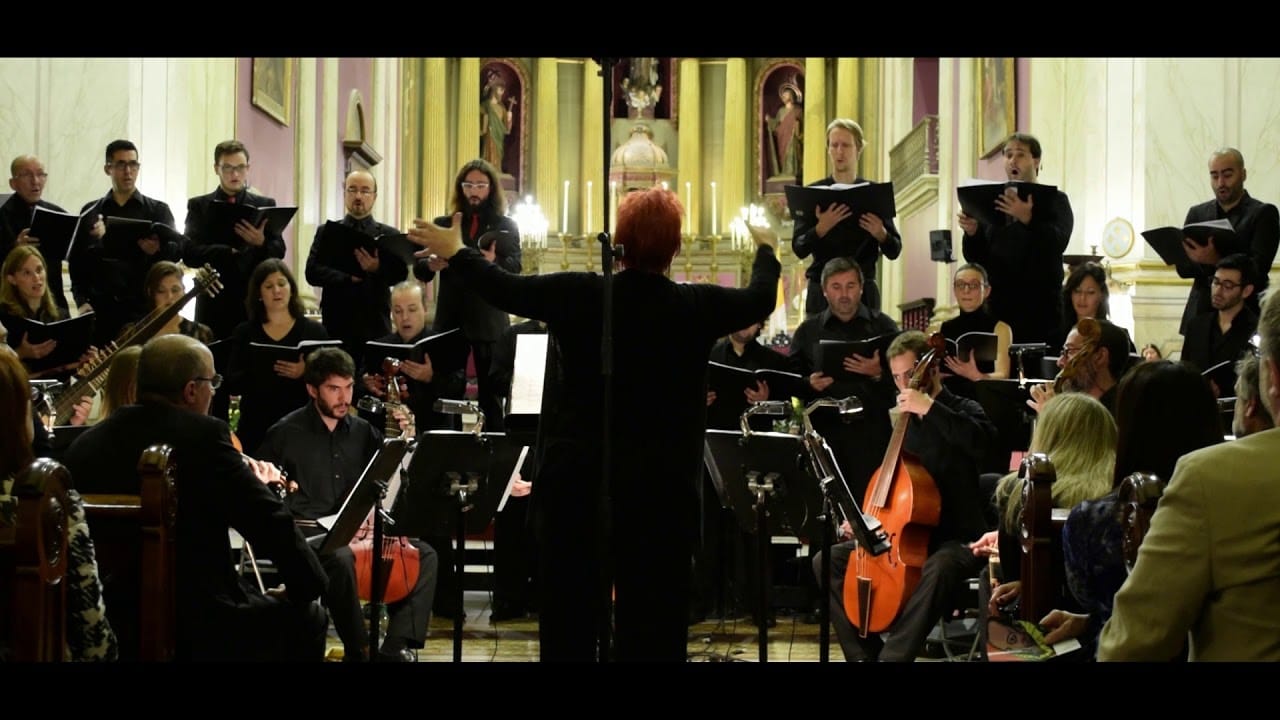
Christopher Hoyt, in a recent article in Touchstone (Jan./Feb. 2026), describes the Miserere nostri by a 16th-century composer, Thomas Tallis. It is a work in which the composer surrounded himself with obstacles and imposed many constraints. It is scored for seven voices. The two soprano parts are in a strict canon (rule, law) in which the second voice imitates the first exactly, as in a round. At the same time the alto begins another melody which turns out to be the lead voice of another canon. This one, called a mensuration canon, is in four parts. The lead voice, alto, is imitated by tenor 1 in notes eight times longer! Basses 1 and 2 also sing the alto’s melody, also in proportionally longer lengths. Bass 1 sings the notes four times longer while bass 2 sings them twice as long. Furthermore both basses sing the alto’s melody inverted—up-side-down! And it all fits and produces a thing of ethereal beauty. Hoyt comments:
In this way, composing musical counterpoint is often more discovery than invention. The composer is not so much creating something as finding it. He is solving an intricate puzzle, and in the process, uncovering a pattern that God has embedded in the natural order.
He concludes:
Tallis’s counterpoint turns a listener away from himself and toward the timeless serenity of measure and proportion, toward the unfailing order of the stars in their dance, toward the song of a harmonious universe, and ultimately toward the divine Maker.
Hearing music as “serenity of measure and proportion” and the “order of the stars in their dance” calls to mind what Martin Luther wrote about music in his preface to a collection of Latin motets by early Renaissance composers. That collection was aptly called Symphoniae jocundae—pieces that “sound together joyfully.” At the climax of an encomium in praise of music, Luther described a prevalent type of music in which the tenor carries the basic tune while the other voices, bound to the tenor, dance around it “in a divine roundelay.” In such music, Luther wrote, “it is possible to taste with wonder (yet not comprehend) God’s absolute and perfect wisdom in his wondrous work of music.”
I have no doubt that Luther would agree that Bach’s music is such music. Out of his vast output, for the purposes of this article, I select just one of his smaller pieces for illustration—the organ chorale prelude for manuals only (no pedals) from Clavierübung III based on Luther’s chorale on the ten commandments, “Dies sind die heiligen zehn Gebot” (“These are the holy Ten Commandments”). In this setting Bach bound himself not only to one of the most binding musical forms, the fugue, but also to the melody of the chorale as the fugue subject. Although he could vary the chorale melody, it still had to bear an audible resemblance to the chorale.
As if those restrictions were not enough, he set himself the additional task of filling the piece with the number ten, the symbol of the Law. He made the fugue theme ten beats long and ten half-steps in range and stated it ten times. And for good measure, he concluded the piece with a ten-beat note in the bass. Further, he chose to write the fugue in the rhythm of a gigue—yes, a jig! And a wonderfully exuberant gigue it is, literally exulting—jumping—for joy. In two minutes Bach expressed as much delight in the Law as did the author of Psalm 119. The freedom with which this gigue, with all its restrictions, joyfully skips along is but one small testimony, among so many bigger ones in Bach’s works, to the relationship of law and boundaries to freedom and joy. It is as if he were saying with the Psalmist:
Your statutes have been my songs
in the house of my sojourning. (Ps. 119:54)
The Weekly Digest
Premier Thought Every Thursday.
All of our recent essays and podcasts, delivered to you. Free.
Free. Delivered Thursday mornings.