
In his preface to This Day: Sabbath Poems, Kentucky poet-farmer, Wendell Berry, laments the sorrowful swallowing of our physical world by the mechanical:
By disfigurements that our time imposes upon our consciousness, by scars of bad history that mark the land, by sounds of machinery dominating the air, the mind may be returned to themes of loss, estrangement, and sorrow. That one is sometimes able, among the disturbances of the present world, to wander into some good and beautiful whereabouts of woods, grow quiet and come to rest is a gift, a wonder, and a kind of grace.
While it is the disturbed and dominated present world that Berry mourns, it is this same world where he also finds a beautiful gift: a place to grow quiet in the rubble and be human again.
This is the mission of the Christian life: to help others wander into the good and beautiful grace of the Son of God amid the disfigurement and estrangement of the world.
However, this implies relationship and presence. In our decentralized, digitally disturbed age, presence has become more complicated. At the risk of being reductionistic, we can separate our lives into two broad spheres of presence: media presence and mission presence. Elsewhere in his preface, Berry likewise notes this fundamental divide between “mechanical” and “natural” life. We can further understand this divide as being between the places we inhabit online, and the places we inhabit physically and are thus called to be on mission with God. To use Berry’s imagery, the technological is devouring the physical; one is increasingly dominated by the accelerated “sounds of machinery” (e.g. clicks and notifications); the other holds the gift of rest and wonder.
While these spheres are not necessarily mutually exclusive per se, they operate on two vastly different understandings of the self, imposing upon our consciousness in drastically different ways.
Media Presence
In the digital age we quite literally bring ourselves into existence. There is no shortage of ways for us to create ourselves with usernames, avatars, pictures, and posts. These are the digital elements that constitute existence in an online environment, in “the machine.” Self-creation and self-sustaining are the modes of being. However, this self of our own making still requires external validation––if no one follows me, if no one shares my post, if no one likes my picture… do I really exist?
In his recent book, Superbloom: How Technologies Of Connection Tear Us Apart, Nicholas Carr considers the contrasting environments of physical vs. virtual worlds:
In the physical world, we remain present even when we're quiet. In the virtual world, we don't. To shut up, even briefly, is to disappear. To confirm our existence, we have to keep posting. We have to keep repeating Here I am!
This phrase––Here I am!––is the quintessential, unwritten caption whenever we click “post.” It is both our desperate announcement of self-creation and our anxious attempt at self-justification.
Consider what these words mean in a media sphere:
“Here”
The here of this announcement is a disembodied and asynchronous anti-location. The very word loses its temporal and tangible meaning in a digital world. Carr notes how online life “removed the constraints of space and time and [placed] them into a frictionless setting of instantaneity and simultaneity.” Here is merely a digital impression; a time-stamped act fed into algorithmic computation. One can be “here” anywhere and everywhere; place has been disfigured by digitization.
“I”
The I that is announced has been carefully curated and polished pre-post. This is a dangerously fragile I, up for debate and in constant need of external validation. This is an I who is consumed by the very media for which it created itself. Carr points out the various roles we must play––“producer and impresario, hawker and emcee, for a show that never stops.” I must keep up, lest I fade into algorithmic oblivion. However, the whole endeavor is a farce; Byung-Chul Han has termed as “smart power” the seductive force social media uses to make us who it wants through the appearance of self-creation.
“am”
Our being is reduced to presenting, proving, and then preserving our existence. All action is aimed at justifying ourselves to the watching world. Lesslie Newbigin argues that the combination of the Enlightenment and industrialization stripped us of any clear cultural telos. There isn’t a uniting end or purpose of being for collective society. Thus, we must each manufacture our own purpose. As a result, fragile, telos-seeking selves flock to social platforms hoping to find one.
We can visualize this self-created self as one that simultaneously presents itself to the world via social media, while also requiring external feedback, validation, and acceptance from social media to confirm and justify its existence:
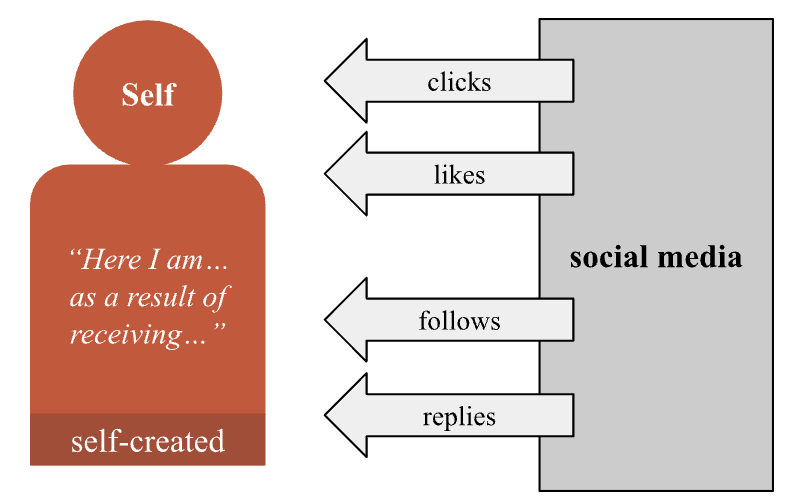
Not only is such a resulting conception of self incredibly unfulfilling and inherently anxious (always one mistake away from having our existence canceled), but it also becomes increasingly anti-relational. Freya India observes how these platforms form us negatively, “We become resentful. Bitter. Competitive. Quietly wishing for others to fail.”
Such resentment is rooted in the zero-sum game of digital glory––more attention for you likely means less for me. We are quite literally competing for our lives, hoping to outperform one another to secure our social validation. This is a unique disfigurement of our time, as Berry would say.
Mission Presence
In contrast to our digital environments, presence in mission is not an act of creation, but rather a responsive act. Throughout Scripture we see several characters respond to the call and commission of God with the very same phrase, “Here I am!”
- Abraham – responds “Here I am” and is called to sacrifice his only son, Isaac.
- Jacob – responds “Here I am” and is called to return to Canaan.
- Moses – responds “Here I am” and is called to redeem God’s people from slavery.
- Samuel – responds “Here I am” and is called to be a prophet to God’s people.
- Isaiah – responds “Here I am” and is called to an unfruitful ministry.
However, in this context these words have an entirely different meaning. Each of these were responses to the God who creates, calls, and commissions his people. Rather than an act of self-creation and self-justification, these are acts of self-subservience and self-submission.
“Here”
Each response was uttered from an actual location in space and time. These men stood before God and were in relationship with others. Many of their calls even included dramatically tangible acts like bearing a knife down toward one’s firstborn son, or shielding one’s eyes from a blazing shrub. Here required their full bodies—Samuel’s running back and forth, Isaiah’s scorched lips—and was often marked with tangible signs like stone altars marking an actual place.
“I”
These were I’s with solid identities in relation to others––fathers of families, shepherds to flocks, apprentices to mentors, prophets to nations. They had concrete, tested, and honed gifts and abilities that were commissioned for the good of others. Further, these encounters were unique––for instance, Moses was the I at the bush, and no other I. Kevin Vanhoozer names such an encounter with God’s word an “I/Thou” affair; who we are is uniquely defined and expanded by our contact with God.
“am”
Being is for the purpose of service. Being is dictated and given shape by the mission God assigns. Rather than justifying ourselves, proving our own righteousness and worth to others, Bruce Waltke argues that true righteousness is lived out by disadvantaging oneself in order to advantage others. Thus, being is applied in the act of serving. We are through God and for others. This is most striking in Moses’ case, who realizes his purpose through being sent by “I AM”.
Now we can see how a biblical conception of self is not self-created, but created by God and lived out via the call of God. And, rather than the self being something pieced together by receiving, it is something discovered during the act of giving in the context of mission:
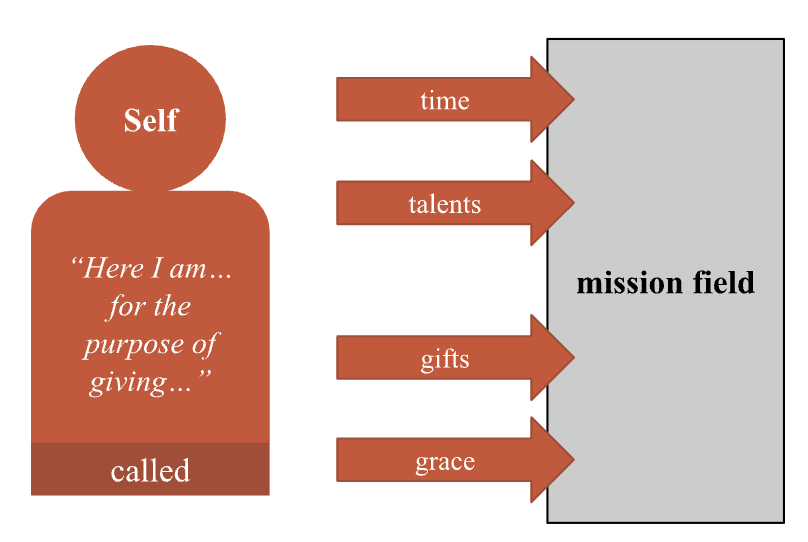
How does such a God-created, called, and commissioned self move forward in mission?
The Self on Mission
We must earnestly answer God’s call in Scripture to mission with the same words, “Here I am!” Tim Keller has outlined a helpful framework for discerning one’s call (i.e. mission). Keller says there are basically three necessary elements: Affinity, Ability, and Opportunity, each of which corresponds helpfully to our phrase:
“Here” (Opportunity)
- Where am I geographically?
- What places do I inhabit?
- What are the actual needs of the people here and what are the real opportunities open for me?
To answer this question, we must have a level of commitment to a physical community—some “good and beautiful whereabouts” where we can be present. This is increasingly unpopular for rising Gen Zers––transience and open options are more exciting. Like one character in Berry’s Jayber Crow, the temptation is to live like “there is always a better place for a person to live, better work to do, a better spouse to wed, better friends to have.” But Jayber is very much a story about membership—what it means to belong mutually to a place and its people. Carr says virtual presence requires physical absence. Thus, the online self belongs to no one. In this way, social media is the graveyard of mission. Mission will starve without membership to a place and its people. Over-involvement on social platforms removes us from the place of mission.
“I” (Ability)
- Who am I in Jesus Christ?
- How has God made and wired me?
- Where have others recognized and affirmed gifting?
- What unique abilities do I have and how can those be used for the good of those around me?
Again, this requires being deeply known and open to feedback via trial and error in community. You will likely have to serve in many uncomfortable ways before you or someone else realizes where you fit. Paul wanted Timothy’s progress in ministry to be a public spectacle. Much less painful than such growth in the spotlight is to carefully craft ourselves in private before making our impressive public (digital) appearance, but, as we have seen, this is a fragile and fruitless self obligated only to its own self-creative purpose.
“am” (Affinity)
- At the core of who I am, what excites me?
- What types of people, contexts, and ministries do I vibrate towards?
This, I think, is a silent casualty of online life. We are inundated with endless amounts of diverse content––the result being the nearly impossible task of focusing on any one interest. We are simply too overwhelmed to notice and act on our own affinities. Bo Burnham’s comedic line, welcoming us into the internet is: “Can I interest you in everything? All of the time?” Catechized and thus formed by everything, we are left amorphous enigmas, even to ourselves! Our being must be shaped by the ancient and tangible practices of the Christian faith—silence, word and prayer, sacraments. In these, novelty is replaced with embodied repetition, providing a stable foundation on which unique interests can be discerned and flourish.
Keller says when these three “plates” align, there is warrant to believe God has uniquely created and called you to be on mission in this area. However, discerning these will likely only happen in non-virtual contexts, away from air dominated by technological buzz.
***
Ultimately, Carr points out that “social media is successful because it gives us what we want.” Thus, the only way to tip the scales of virtual presence toward physical presence in mission is to change what it is we want. That is a work of the missional God alone.
We must pray for hearts that desire not a fragile, fleeting sense of self that must be recreated each day while we await validation via notifications, but one that longs to join the mission of the Triune God to bring flourishing—grace, rest, and wonder—to every good and beautiful place including where you are.
Regardless of our desires, mission is successful because it is what God wants, and he gets what he wants—to undo the themes of loss, estrangement, and sorrow. It is within this glorious and guaranteed divine mission we’ve been invited to respond, “Here I am!”
The Weekly Digest
Premier Thought Every Thursday.
All of our recent essays and podcasts, delivered to you. Free.
Free. Delivered Thursday mornings.