

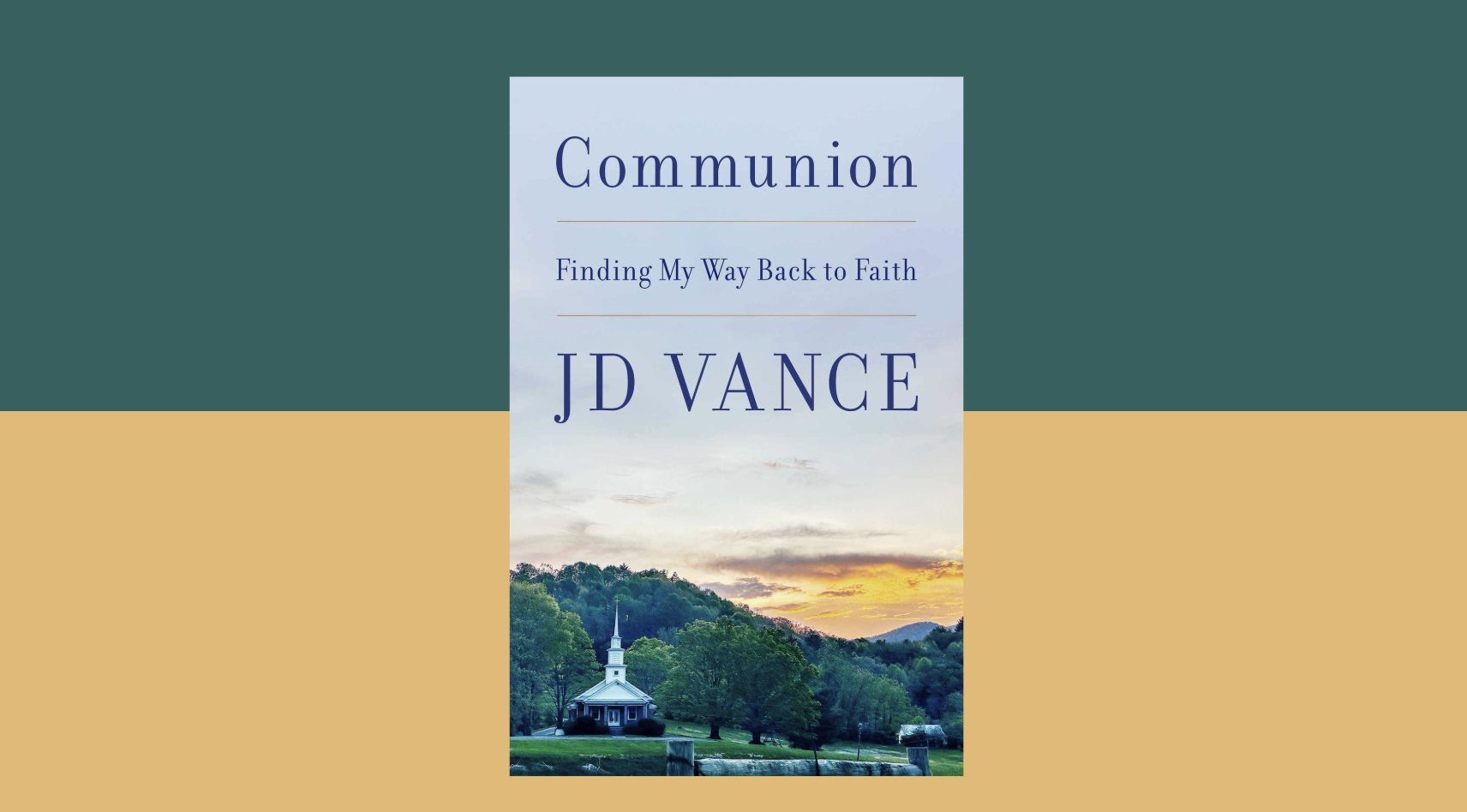
JD Vance. Communion: Finding My Way Back to Faith. Harper, 2026. $35.00. 304 pp.
JD Vance’s new faith memoir, Communion, has been almost universally panned. Rarely has a bestselling author of any political stripe published a book that instantly generates so much negative press from both the left and the right.
The New York Times commissioned three reviewers to discuss Vance’s book, and all three of them gave it a scathing assessment. The book was Vance’s political attempt to “to be kind of a faith man,” one of the reviewers said. “It’s almost like putting Trump and Mike Pence in a blender.” The Atlantic’s review was a little kinder, but still concluded that the book was “a perhaps not-so-subtle way to show how he’s different from the man currently in the White House, whose office Vance is widely expected to seek two years from now.”
The Dispatch’s assessment was most damning of all. Vance is a “knee-walking sycophant” whose “conversion story is bulls-t,” Kevin Williamson wrote in the Dispatch. His book was “imbecilic dreck.” “I have never in my lifetime seen a public man work so assiduously to prepare for himself a place in Hell,” Williamson concluded.
What all of these reviews have in common, whether they’re written by Never-Trump conservatives or by lifelong Democrats, is a refusal to believe that Vance—who transitioned from a fierce critic of Trump to his loyal vice president—could be anything other than a cynical political operator. Whatever he says about his own faith must be hypocritical, they have decided. Seizing on the book’s opening biblical quotation—"Wherefore by their fruits ye shall know them” (Matthew 7:20), a verse to which Vance repeatedly returns throughout the book—Vance’s critics have argued that Vance’s political machinations offer one of the clearest examples of rotten fruit they have seen and thus constitute more than enough evidence to dismiss whatever he says about religion.
To be sure, Vance has left himself wide open for criticism on this front. He has been a remarkably fast shape-shifter in politics, and along the way, he has told some blatant lies (such as his false claim that Haitian immigrants in Springfield, Ohio, were eating cats and dogs). When faced with the choice between supporting Donald Trump’s positions or the Catholic magisterium, he has invariably chosen Trump over the Church, whether on abortion pills, immigration policy, or the war in Iran.
But I think that by dismissing Vance’s faith memoir out of hand, the critical reviewers have missed the opportunity this book gives us to better understand not only Vance’s beliefs but also the beliefs of a large number of other Christians in the United States today. If, instead of approaching Vance’s memoir as cynics, we read it as a genuine account of Vance’s beliefs and spiritual journey, we’ll be able to learn a lot about both the content and the limits of Vance’s Christian faith.
Vance’s Search for Community
Vance’s search for faith was shaped by a longing for community—but not just any community. By beginning his book with his childhood family and ending it with a discussion of his own marriage and children, Vance makes it clear that for him, God has always been closely tied to his family.
As Vance’s first book, Hillbilly Elegy, makes clear, his childhood family was filled with drugs, marital breakups, and other dysfunction. And yet Vance found that he could not distance himself from it. For a while, he tried to substitute academic achievement and professional success for the community and family he had left behind. “In college I was obsessed with the question of social mobility,” Vance says. “Do poor kids have a chance of making it in our country? . . . I was a poor kid, and I was desperate to make it.”
Hillbilly Elegy was an attempt to make sense of that question. The answer it gives is that working-class white culture—especially the Appalachian “hillbilly” culture—is filled with dysfunction and attitudes that keep people from succeeding. To break out of that harmful mindset, people need to take responsibility for their choices. But when they do, they will feel lonely and alienated from their roots.
Several reviewers have asked the question what happened to the “thoughtful” JD Vance who wrote Hillbilly Elegy, because they don’t see a connection between the author of that earlier book and the author of Communion. Instead, Communion “offers a window into just how much the thoughtful boy in Hillbilly Elegy allowed himself to be corrupted by politics,” Molly Olmstead wrote in a review for Slate.
But I actually see a great deal of continuity between Vance’s two books. Hillbilly Elegy was written by Vance at a time when he had just achieved material and professional success, but only at the cost of alienation from his family and community. He ended the book with a lot of anger – anger at the broken homes, anger at the dysfunctional culture, and anger at some level with the “elites” who gave him professional opportunities but never made him feel fully comfortable or accepted. In Communion, he resolves much of that anger through Christian theology, because he found in Christianity emotional reconciliation with his family and the community he had been longing for.
Family and Community in Vance’s Early Religious Journey
As Vance explains in Communion, he grew up in a family that believed in Jesus, even though it was also a family plagued with drug abuse, divorce, and out-of-control anger. Though he did not spend very much of his youth with his father, he attended enough evangelical church services on visits with his dad to absorb a great deal of premillennial expectations about Jesus’s imminent return, as well as a strong conviction that the theory of evolution was opposed to the first chapter of Genesis and was therefore wrong.
And he absorbed from his grandmother (his “Mamaw,” the closest person to a parent that he had in his broken home) a practical working-class Christian faith that fused a liberal use of profanity with a steadfast faith in Jesus as savior. Mamaw’s deep suspicion of ecclesiastical institutions and clerical power made her more comfortable watching church on TV than attending in person, but nevertheless, she raised her grandson to believe in Jesus. For much of his teens, he had enough Christian conviction to read through the entire Bible twice, become an avid C.S. Lewis fan, and defend young-earth creationism in online apologetic forums.
But then, just before Vance deployed for Iraq as a new Marine recruit in 2005, Mamaw died. With his tenuous tie to the faith now gone, Vance found it easy to conclude that churches’ endless preaching about the end-times was irrelevant for his life. But more than anything, he was angry. “What paved my path to atheism wasn’t books or ideas,” Vance says. “It was sadness and a sense of betrayal.”
At the time, Vance says, he would have given intellectual reasons for his unbelief. Scientific evidence supported the theory of evolution; the creation account in Genesis 1 was therefore wrong. The example of radical Muslims in Iraq showed that religious devotion could be used for evil ends. And churches spent their time on irrelevant topics, such as political outrage over Terri Schiavo’s death, instead of the real needs of the people in the pews.
But Vance says he thinks there’s a better explanation for abandoning religion: He left the faith because he was surrounded by friends in the military for whom faith was similarly irrelevant. Perhaps they were nominal Christians, but they were far more interested in “finding girls and drinking too much.” As a result, “Christianity had become completely irrelevant to me. I didn’t even know where to find a church near my Marine Corps base in Havelock, North Carolina. I didn’t pray regularly. My Bibles were gathering dust in Ohio.”
Vance thinks that a lot of other people of his own generation—that is, other millennials—have similar reasons for walking away from the faith. They might be able to cite intellectual reasons for their unbelief, just as Vance once did. But the root cause of their unbelief was that they lost ties to social networks that cultivated faith and exchanged them for social networks that made faith irrelevant. For a decade, Vance inhabited the social networks that encouraged his unbelief. But the cost of that unbelief was further alienation from his family heritage.
Vance eventually felt the emptiness of this life. At Yale Law School, he made socioeconomic advancement a personal god. He read the books that would advance his career, but he had no real love for the law or for the legal profession. Nor did he have any connections to something larger than himself.
When he fell in love with Usha Chilukuri, the woman who would become his wife, he saw for the first time the larger values he was missing. Usha encouraged him to take delight in the beauty of their surroundings. She urged him to begin reading novels and to start noticing the architectural details on the old buildings on the Yale campus. In other words, she helped him to begin caring about something larger than simply advancing himself professionally and escaping the poverty of his family background.
As he dated Usha and began preparing for marriage (and eventually, he hoped, fatherhood), he began considering questions about values that he had not really asked himself before. “The meritocracy had focused my mind on the crude and superficial—credentials, careers, money,” Vance says. “These things might have been necessary, but they could never form the basis of a truly good life.” Because Usha “inspired me to be better, she forced me to follow a different path. And that, more than anything, is the path that led me back to God.”
Vance began attending church again because he wanted to be a good person. When his first son (Ewan) was born, in 2017, he prayed for hours that God would “make me a good dad.” Recalling that he had never really had a dad himself—but only a string of stepfathers and other men who came in and out of his life during his childhood—he realized that having a son “was my opportunity to correct the mistakes of the past. It was an opportunity to make real that American Dream I so desperately wanted. It was an opportunity to show my wife that I could be a good father. It was, in a word, an opportunity for redemption.”
“How to inculcate virtue in a person is the most important question I confront with my son,” Vance realized. The answer to that question, he concluded, is community.
The Community Offered by the Catholic Church
Vance found himself drawn to the one church tradition that offered the deepest tradition of community and the strongest emphasis on developing virtue: Catholicism. With its two millennia of history and its emphasis on a community of saints stretching into eternity, Catholicism offered Vance “communion” in every sense of the word. It offered him a “connection to something unbroken and ancient.” It also gave him the intellectual resources to address the skeptical questions that had kept him away from God for more than a decade.
After reading Augustine’s commentary on Genesis 1, he realized that not all historic Christians had interpreted the first chapter as a literal, scientific account, as the young-earth creationists of his youth had. He welcomed the insight that he could hold onto both the Bible and science. Christianity was not an anti-intellectual tradition, he found.
Similarly, he drew on the literary criticisms of René Girard to answer another common skeptical objection that he once thought had disproved Christianity—the argument that the flood story and other biblical narratives were plagiarized from ancient Near Eastern myths. Girard argued that those stories had a common ancestor, but that the Bible used those myths—and especially the scapegoat myth—to reveal deep theological truths that explained the human condition.
As Vance reflected on his own experiences, he realized that he, too, had commonly “scapegoated” others. “Girard’s work captured so well the psychology of my generation, especially its privileged members,” he wrote. “Mired in the swamp of social media, we would identify a scapegoat and digitally pounce. We were keyboard warriors, unloading on people via Facebook, instant messenger, and Twitter, blind to our own failings.”
During Vance’s years as an atheist, he had thought that the vast amount of suffering in the world was evidence that there was no God. But when he began reading the Bible once again and pairing it with the insights of Catholic theologians, he realized that the Bible fully acknowledged the presence of suffering and was not embarrassed by it.
The Bible was also honest about human imperfection. And Catholic theology was honest about people’s propensity to continue to fall into sin and addiction long after professing Jesus as their Savior—just as Vance’s family had during his childhood. “Grace is not something that happens in a moment,” a priest told him. “Real grace comes through practice. This is why we demand that you live a sacramental life: going to church, taking Communion, doing confession. This is a process. You don’t accept Jesus into your heart—or get baptized—and fix everything. That’s not the promise of the Church. The promise of the Church is that you are lost, and the Church will provide you a road map to God.”
The practice of confession, he found, was better than therapy, because rather than encouraging people to blame their childhood family for their failings, it demanded that they take responsibility for their own sins even while acknowledging the reality of the trauma they had faced. “There had to be some way of understanding that we are neither beholden to the misdeeds of our ancestors nor wholly independent from them,” Vance says. “That third way—a way that could acknowledge the trauma in a child’s life without excusing his behavior as an adult—became more and more appealing. But most of all I wanted to be a better person. I wanted to be worthy of this woman I was madly in love with.”
“What brought me back to my faith was the sense that the Church answered life’s big questions,” Vance says. Throughout the book, he skewers the “meritocratic” class for the emptiness of their values and the inadequacy of their worldview. Time and again he found that Christianity, when properly understood (that is, when processed through the lens of Catholic theology rather than the superficiality of Left Behind theology or the biblical interpretation of Answers in Genesis), offered a more satisfying picture of reality than anything he could find in secular psychology or liberal meritocracy.
Making Sense of Vance’s Faith and Politics
If Vance had published his conversion narrative in 2017 or 2018, as he had originally planned, I think that it would have gained a better reception, because its receptivity would not have been colored by Vance’s politics. I think that to fully appreciate this book, it’s useful to forget for a moment that Vance is the vice president and to treat it instead as a coming-to-faith memoir from one of the numerous young men who are making their way into the Catholic Church because they are attracted to the enduring power of its ancient truths, to the community it offers, and to the promise it holds of making them a better person. If Vance had never entered politics—but had instead, say, taken a job as a Never-Trump writer at the Atlantic or some other venue while continuing to attend Mass each week and spend time with his kids—I suspect that his memoir would have received far less popular criticism.
But, of course, Vance did recant his earlier criticisms of Trump, and he did enter the political realm. According to some of his critics, he sold his soul in the process and abandoned whatever modicum of Christian principles he might have had. How, after all, can a man who professes to care so deeply about virtue bear “false witness” against Haitian immigrants and defend President Trump at every turn, even when it requires going against the pope?
Vance partially addresses these criticisms in his book, the last third of which is dedicated to his political views and his alliance with Trump. I agree with Molly Olmstead’s suggestion that Communion is really two books—one (which focuses solely on Vance’s faith journey) written mostly before 2020 and the other (which focuses on his politics) written after Trump’s second inauguration in 2025. I’m less persuaded than she is, though, that these two books are incompatible.
I think instead that if we consider what motivated Vance to embrace the Christian faith, we’ll better understand the reasons for his alliance with Trump. Vance’s life has been driven by his tortuous relationship with his childhood family and community. He tried to resolve that tension first through professional achievement and then, when that failed, through marriage and fatherhood—which also proved inadequate. His newfound Catholic faith resolved his sense of alienation from his family and finally allowed him to forgive his mother and enter into communion with his family’s Christian beliefs even while honestly acknowledging the trauma that their sins caused. It also allowed him to transcend the patterns of drug addiction and abandonment that had shaped his childhood and give his own children a better environment.
While Vance is intensely ambitious (even addictively so), I think that we can best understand his decision to enter politics and ally with Trump not merely as a cynical calculation but as an attempt to implement his postliberal vision of a family-centered, pro-working-class, local political order. The political vision that Vance lays out in this book—and that he sees as a natural application of his Catholic faith—is remarkably critical of the unregulated free market and supportive of government support for working-class people. It accords much more with postliberal interpretations of Rerum Novarum and other Catholic social teaching than with Republican Party orthodoxy. Vance’s politics are driven by his desire to ally himself with the white working class and turn against the meritocratic “elites” whose values he once tried to embrace but which he decided were vacuous.
Vance allied himself with Trump, I think, partly because he saw how much the meritocratic “elites” hated him and how much the white working class idolized him. He convinced himself that Trump’s policies on trade, immigration, and foreign relations would protect working-class communities and, by extension, working-class families. And he convinced himself that protecting the working class and local communities was what Catholic politics was all about.
The Shortcomings of Vance’s Theology
What’s missing, I think, is the larger global vision that the Catholic Church outlined in Vatican II. American Catholic bishops—along with the late Pope Francis—have been sharply critical of the Trump administration’s immigration policies, but Vance has rejected those criticisms, partly perhaps because his own version of the faith gives primacy to the needs of white working-class American communities rather than the needs of people throughout the world. If Vance’s longing for connection with his family drove him to faith, his faith never really transcended that to embrace a global vision for the kingdom of God. He has discovered one part of Catholicism, but it’s only one part. To discover the full riches of the faith, he will need to disentangle his understanding of Catholic theology from postliberalism and his own longing for reconnection with his family heritage and recognize that the Church cares equally about the dignity and well-being of every person and family from every nation, regardless of their background or ethnicity.
Perhaps Vance’s own personal dishonesty or political sycophancy has been even more troubling, especially given his stated commitment to Christian virtue and desire to be a better person. But even if Vance may have entered politics for principled reasons—as he well might, since he may have done so in order to protect the families and culture of working-class communities—he is certainly not the first politician to justify compromising his ethics by convincing himself that it’s necessary to keep his job and serve the greater good.
In his book, Vance seems to equate virtue with being a good husband and father. While those are certainly important, I wish that he had said more about the larger list of Christian virtues and his own reflections on what those virtues might mean in his own life. I wish that he had said more about how he is dealing with what, by his own admission, is a long tendency to put his own selfish, career-seeking ambition above everything else.
Most of all, I wish that he had said more about Jesus—which I would have expected from a Catholic conversion narrative. Vance says a lot about his longing for virtue, but he doesn’t define virtue as an imitation of Jesus’s life. Yet this idea is central to Catholic theology. The most popular Catholic devotional book of all time is Thomas à Kempis’s The Imitation of Christ, which is a fifteenth-century guide to meditation on the teachings of Jesus in order to increase the Christian’s love for Christ and submission to God. I didn’t see much about Vance’s devotional life in this book. Instead, Vance’s focus is on developing the qualities that make him a loving husband and father.
But as the Catholic Church teaches—and as Vance emphasizes in his book—growth in Christian faith and practice is a long process, not a matter of instantaneous conversion. Since we’re not privy to what Vance tells his confessor, it’s hard to know which of his public sins he’s repenting of or which ones he’s ignoring.
Perhaps Vance’s lived Catholic faith is a bit like that of Evelyn Waugh, the curmudgeonly early twentieth-century English Catholic convert whose novels include Brideshead Revisited. Like Vance, Waugh grew up Protestant, embraced an atheistic hedonism as a young adult, and then converted to Catholicism. Yet he remained something of a cantankerous bully. Once, a woman confronting him about his bad behavior asked him how he could be a Catholic and yet be so cruel. He reportedly responded, “You have no idea how much nastier I would be if I was not a Catholic. Without supernatural aid I would hardly be a human being.”
Maybe the same is true of Vance. His blend of Catholic theology with Trumpism is indeed disturbing. But I don’t think it’s merely a cynical cooption of religion for political gain. Instead, I think that he experienced a genuine longing for the Christian faith and that he’s going to Mass each week because he is genuinely looking for communion in every sense of the word. Like Waugh, his public actions often fall short of the rich tradition of his faith.
But rather than dismiss Vance as a hypocritical imposter, I wish that people would realize that his particular understanding of the faith really does shape his political views and that even when his actions fall short of his profession—as, for instance, when he lies about his neighbors or engages in verbal legerdemain to justify policies he repudiated only a short time before—perhaps Waugh’s statement applies: We have no idea how much nastier Vance would be if he were still a self-focused atheist. And if that’s the case, we can say: Thank God that he has found Christian faith, regardless of whether we would ever vote for him. Maybe his theology is incomplete. But it’s a lot better than it was before he entered the Church.
The Weekly Digest
Premier Thought Every Thursday.
All of our recent essays and podcasts, delivered to you. Free.
Free. Delivered Thursday mornings.