


Our calling as Christians is to be in the world but not of it (John 17:16). We hear and say this so often, it verges on a cliché. But what does this calling mean for us as American Christians on the eve of America’s 250th birthday? Or, to put it another way, how might we think about the nation’s 250th birthday as Christians and Americans? Earlier this week, Jake Meador proposed this answer to open the conversation: “The shortest way of answering the question is to say that America is a country that generally does not imprison her chaotic saints.” In this week’s three-day forum, theologians, historians, and public thinkers share their own responses.
***
Listening to John Adams
Miles Smith
"The Revolution ought to be more carefully studied than it is, and more carefully handed down to posterity." That was one of John Adams’ many valedictories about the American Revolution that he and others created in the last quarter of the eighteenth century.
When the United States was born, there were still Holy Roman Emperors who claimed the mantle of Charlemagne. John Adams’s birthday was closer to the Fall of Constantinople than it is to 2026. On America’s 250th birthday, the world is changing; the United States is changing—culturally, socially, and economically.
Dostoevsky wrote in Crime and Punishment that “taking a new step, uttering a new word, is what people fear most.” How true that has been, especially for that tribe of people, nearly undefinable, but somehow still very real, called Evangelical Protestants. Fear—sensational or sober-minded, real or ridiculous—has driven us back to our roots. We search for something solid, something old and something unmovable. For that reason we look back longingly to the politics and religion of the past, to anything but the apparently sinking ship of the liberal order that has defined Western societies for eight long decades.
That the liberal order is flawed is, of course, an unremarkable observation. That liberalism is not “biblical” or somehow divinely sanctioned over and above other political philosophies might make us squirm a bit. But to claim that the liberal order is worth keeping, or that it is in some ways deeply Christian, and deeply American, is a far more contentious proposition among the generation we affectionately call Zoomers. Left and right, Christian and non-Christian, an entire generation sees the beliefs that held the United States together for a long human lifetime as trite or at worst a lie. Evangelical Protestants are much the same as the rest of society in their intransigence towards what once was. In as much as my tribe—Anglicans—can be called Evangelicals, we don’t have much in the way of good answers. Political theology is on everyone’s minds, but no one seems to be able to make it legitimately useful or serious on a national scale. Maybe the Baptists or Presbyterians will do better; the latter at least are trying.
The American republic is 250 years old, but it seems like a random German tourist here for the World Cup appreciates the country more than some native-born Americans do. That word, “native,” carries more weight than it used to. So too does “heritage.” The bad news for native-born heritage Americans is that, try as we might, we cannot conjure a past where nativity and heritage supplied some sort of congenital morality necessary for the maintenance of a healthy republic. Rural so-called “heritage America” is poor, unchurched, and socially unwell. So it has been for much of our republic’s history. Nor can we invoke a Christian nation that we no longer measure up to; our forefathers were never as Christian as we want them to be. What we can do, however, is take John Adams’s advice and study the Revolution.
***
Seeking the Divine Will
Eddie LaRow
On September 17, 1862, Union forces—87,000 men under the command of George McClellan—engaged with the Army of Northern Virginia, a much smaller 55,000-man army under Robert E. Lee, near Sharpsburg, Maryland. The Battle of Antietam remains the bloodiest single day in American history, with a staggering 22,000 casualties. Though a Union victory, the battle exacted a cost — felt not just by the men, but by Lincoln, who was 50 miles away in Washington, D.C. At this point, the divided nation had already experienced just south of 200,000 casualties, a staggering number for a conflict nearly 16 months old.
Lincoln had been waiting for the right moment to present the Emancipation Proclamation, which sat in draft form on his desk — waiting for a victory before presenting his charge that all men were not only created equal but were free.
As he sat at his desk, he jotted his reflections down on a piece of paper. This reflection was not meant for public consumption but was an internal wrestling with the conflict at hand. Lincoln wrote: “The will of God prevails. In great contests each party claims to act in accordance with the will of God. Both may be, and one must be, wrong. God cannot be for and against the same thing at the same time.” Lincoln was seeking to justify the staggering loss of life. How could so much bloodshed happen? What was the price of freedom—and was it worth it? He went on: “I am almost ready to say that this is probably true—that God wills this contest, and wills that it shall not end yet.”
Now, approximately 163 years later, we celebrate the 250th anniversary of this great nation. As I ponder what it means to be a Christian and an American, I can’t help but think back to the internal turmoil of Lincoln. For while we certainly do not have open armed conflict today, there is spiritual and invisible conflict. With each issue, we seek the Divine Will—and we, like Lincoln, often wonder what is right or wrong.
But I also can’t help but think of Joseph, who in the book of Genesis is dealt every manner of hardship and trial—being sold into slavery by his brothers, falsely accused by Potiphar’s wife, and cast into prison, left to rot in the depths of despair. Anyone would think in that moment that God was not with them—and yet He was, very much so. For through the very hardship that Joseph experienced, God was fully at work. Joseph was ultimately elevated to the right hand of Pharaoh on account of God’s divine mercy, and through the very actions of his brothers and Potiphar’s wife, Joseph was restored by God. For what man intended for evil, God meant for good—that through one man, Joseph, and ultimately Jesus, many should be kept alive.
As Lincoln struggled internally with this conflict—a struggle that would have been forgotten to history if not for John Hay, one of Lincoln’s secretaries—he wrestled with the question that many of us wrestle with today.
This meditation on the Divine Will was, I believe, the kernel that became the Second Inaugural Address, in which Lincoln proclaimed: “Both read the same Bible and pray to the same God and each invokes his aid against the other…the prayers of both could not be answered… the Almighty has His purposes.” In the closing paragraph he pronounced, with the eloquence of the greatest American poet: “with malice toward none, with charity for all, with firmness in the right as God gives us to see the right, let us strive on to finish the work we are in, to bind up the nation’s wounds, to care for him who shall have borne the battle and for his widow and orphan — to do all which may achieve and cherish a just and lasting peace among ourselves and with all nations.”
Today we stand—though quite divided underneath—united in the fact that we are Americans. As I reflect on America’s 250th birthday, I can’t help but think of two blood payments. The first: the men who died on fields like Antietam—who died on American soil, by American weapons, in towns, streams, and mountains with American names. Though they did not live to see the result, the blood they shed was enough to purchase an imperfect Union. But I am also reminded of the blood spilled by Christ, who conquered the grave. For as Paul writes in Galatians 3, “Christ bought us with His blood.”
Two hundred and fifty years later, we may be prone to think back to the beginning—to the birth of a new nation. And while this is certainly cause to cheer, it is the blood paid at the moment of divide that may hold a better lesson for us today. For when we look back at the events of 1861–1865, we see the roots of many scars we still bear, and wounds that remain. Either we will abandon the cause and throw in the towel, or we, like Lincoln, will understand that though the pains are real, the cause is worth it. For together we are Americans; divided we are merely another power doomed to the shipwrecked seas of history. As a Christian, I am thankful that the Divine Will—the Sovereign Hand of God—is at work upholding and sustaining.
***
The Churches of Christ and the American Experiment
Daniel K. Williams
Both Christian faith and American citizenship have defined my entire life.
I grew up attending church since the week I was born. I can trace my American genealogy back to seventeenth-century New England settlers and Revolutionary War veterans. But if, as the saying goes, familiarity breeds contempt, I have been guilty at times of a lack of gratitude for the nation that has shaped me. Ironically, one source of that ingratitude has been Christianity – or rather, the particular American-born version of Christianity that has defined my family heritage.
About five generations ago, in late nineteenth-century Tennessee, some of my ancestors joined the Churches of Christ, an American revival movement dedicated to restoring the New Testament church. The most prominent Tennessee preacher in that movement, David Lipscomb, was so other-worldly that he taught that Christians should not vote or serve in the military—a stance that continued to define some congregations in the Churches of Christ for decades. In the churches in which I grew up, most people accepted at least limited political participation, but many still maintained a strong other-worldliness and a healthy belief in the superiority of the kingdom of God to the American government.
I’m thankful for the inoculation that tradition provided against Christian nationalism. In my writing, I have warned Christians against equating the gospel with American ideology.
But while my desire to avoid the dangers of American nationalism was well founded, perhaps in the process of criticizing those who wrapped God in the flag, I sometimes forgot to sufficiently acknowledge the particular American founding principles that coincide remarkably well with Christian theology.
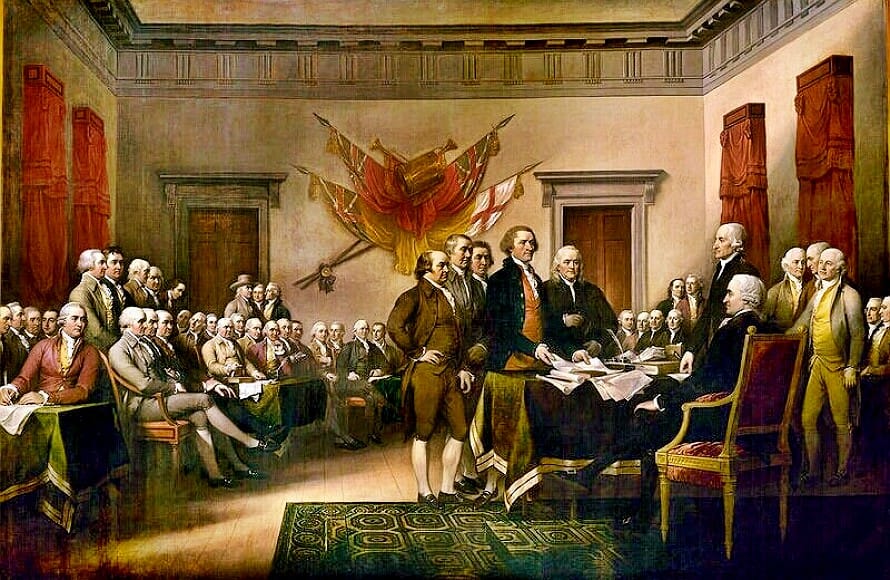
As a Christian and an American, I’m struck by four unique aspects of the American experiment: the combination of religious freedom with church-state separation; the conviction (suggested in the Declaration of Independence) that humans have inherent dignity because they are created by God with God-given rights; the belief that a flawed human nature requires a separation of power to prevent any one person or group from becoming an autarch; and a belief in the rule of law created by self-government. Each of these principles is compatible with a Christian understanding of human nature and a healthy Christian suspicion of unchecked human power – which is largely why the American experiment, alone among world democracies, has endured for 250 years.
I think that my other-worldly ancestors who joined a church tradition that eschewed American political participation in the name of the kingdom of God were actually deeply American after all, because as the Declaration of Independence reminds us, there’s nothing that is more American (or arguably, more biblical) than a suspicion of human political power and an acknowledgment of God’s rule over human potentates. I do not agree with all of David Lipscomb’s other-worldly views, but I applaud him (and some of my ancestors) for valuing the kingdom of God above all else—and I think that in the process, they arrived at a Christianity that was deeply American, even if they didn’t recognize it.
The United States is not the kingdom of God, and it’s certainly not without sin, but it was founded on principles that are compatible with a Christian understanding of God and humanity. Under those principles, Christianity has flourished in a myriad of forms. For that, I am thankful.
***
From Russia, Without Love
Nadya Williams
History is why I’m here—and by “here” I mean living in America during this year of America’s 250th birthday, which is definitely not something I had ever imagined would happen when I was a young child.
I’m here, an American citizen of nearly two decades, because in October 1917, Vladimir Lenin led a revolution that overthrew the Czars and established a new country and government. These events happened just a few blocks from where I was born in 1981 and where I spent the first decade of my life. Today I am here and not there, because by the time I was in elementary school, the tottering edifice Lenin had propped with empty promises and a horrific system of state violence and repression of citizens’ liberty in every area of life could no longer hold. But also, I am here and not somewhere else in the world, because 141 years before Lenin’s revolution (and 205 years before my birth) another, more successful revolution took place—the American Revolution of 1776, which promised genuine liberty as the unalienable right of its citizens.
To be an immigrant is to be aware of this kind of history on a personal level. By our very nature, humans crave roots to thrive and flourish. This means that most people do not move lightly across the world; one does not choose on a whim to uproot and start life over in another country—one that speaks a different tongue, has different cultural norms, and that (more often than not) looks down on beets as something unfit for human consumption.
My love for America comes, first and foremost, from gratitude for the welcome my family and I received here. But also, this love over time has become more difficult to separate from my love for Christ, because through another complicated set of events, it was the move to America that made it possible for me, a secular Jew, to come to know Christ. In other words, through God’s infinite goodness and mercy, it was this geographical move that made the spiritual one possible. For both this place and this time, I remain profoundly grateful. For us while still clothed in our mortal coil, blessings and curses arrive through the times and places we’ve been given. God alone, after all, exists outside of time and space.
The Weekly Digest
Premier Thought Every Thursday.
All of our recent essays and podcasts, delivered to you. Free.
Free. Delivered Thursday mornings.