
David J. Bobb and Tony Williams. Divided Over the Declaration: How an Enduring Debate Sustains the Vision of America. Diversion Books, 2026. $34.00. 336 pp.
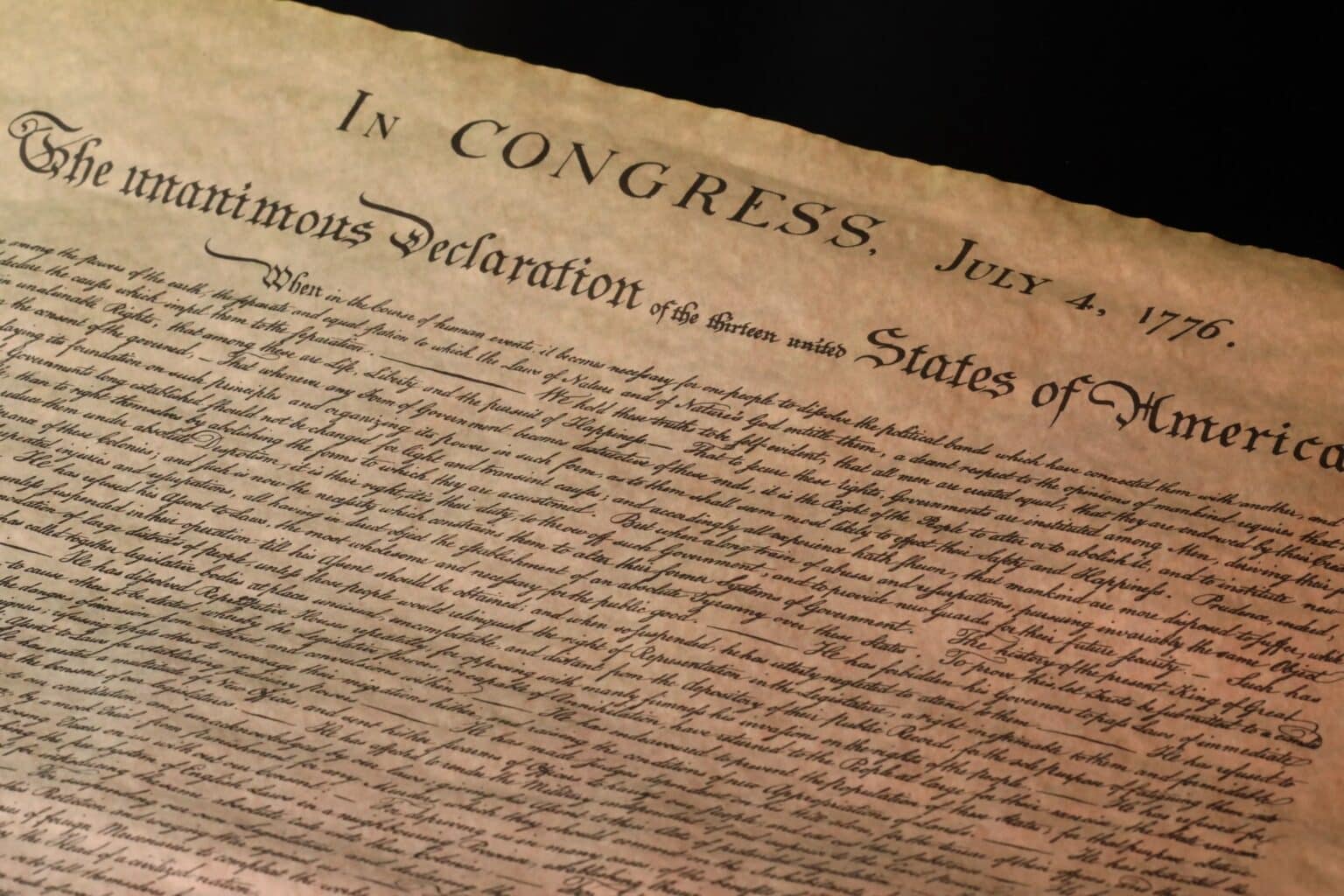
Two hundred and fifty years ago this week, a wealthy slaveholder wrote one of the most enduring lines ever penned about human equality: the declaration that “all men are created equal” and that they are “endowed by their Creator” with certain “unalienable rights,” including the right of liberty.
After writing those lines, Thomas Jefferson returned to his plantation, where he continued to be waited upon by enslaved people for his entire life. Though he expressed great moral reservations about slavery, the only enslaved people he emancipated were members of the Hemings family that DNA tests suggest were his own biological children and other close relatives of Sally Hemings.
And if that’s true for Jefferson, the record of many of the other signers of the Declaration of Independence is not significantly better when it comes to slavery. Nearly three-quarters of the men who signed the Declaration also owned human beings as slaves.
In view of this fact, some have argued that Jefferson and the Declaration’s signers did not really intend to include Black people (or women or other minorities) in the phrase “all men.” By “all men,” they really only meant “all white men”—or perhaps only white men of a particular social class—rather than all people created by God. And if that’s the case, maybe the Declaration was not so revolutionary after all. Maybe America’s real founding was based not on equality but on racism. Maybe the nation’s founding moment came not in 1776 but in 1619, with the beginning of African slavery in what would become the United States.
In their new book, Divided Over the Declaration, David Bobb and Tony Williams push back against this counternarrative by arguing that the Declaration of Independence really did mean all people created by God when it declared that “all men” are “created equal.”
Furthermore, Bobb and Williams show, in a historical narrative that stretches from the late eighteenth century to the present, the Declaration’s promise of equality has been a key guiding force in the campaign for African American civil rights. From the antebellum abolitionists to Martin Luther King Jr. and beyond, advocates for equality have pointed to the Declaration’s phrase as an unfulfilled promise that the nation has an obligation to honor.
As evidence that Jefferson used the phrase “all men” to mean all people, including women and those who were enslaved, Bobb and Williams point to a phrase in Jefferson’s original draft of the Declaration that charged the British king with promoting the international slave trade. The king, Jefferson wrote in that draft, was “determined to keep open a market where MEN should be bought & sold.”
That phrase was excised in the final version, due to concerns from some delegates that an indictment of the transatlantic slave trade might hit a little too close to home, but Bobb and Williams argue that it offers conclusive evidence that Jefferson understood “men” to include enslaved people. And since the people who were bought and sold in the international slave market included women, the phrase “MEN should be bought & sold” undoubtedly referred to women as well. And if that is the case, Jefferson’s opening declaration that “all men are created equal” refers to the rights of all people.
That is also the way that many African Americans and abolitionist-minded whites understood the phrase in the late eighteenth century. In Massachusetts, Quock Walker successfully sued for his freedom by citing a line from the Massachusetts constitution that closely paralleled the Declaration. (The line, written by John Adams in 1780, declared that “all men are born free and equal, and have certain natural, essential, and unalienable rights.”) A Rhode Island emancipation law of 1784 included similar wording: “Whereas all men are entitled to life, liberty, and the pursuit of happiness, and the holding of mankind in a state of slavery . . . is repugnant to this principle.”
Because antislavery activists cited the Declaration’s promise of equality so frequently, pro-slavery advocates after the 1830s began publicly repudiating this part of the Declaration. John C. Calhoun said that the statement that “all men are created equal” was “inserted in our Declaration of Independence without any necessity.” In fact, it was the “most dangerous of all political error,” he said—and it had led Jefferson to advocate the exclusion of slavery from the Northwest Territory (which later became the states of Ohio, Indiana, Illinois, Michigan, and Wisconsin), which Calhoun blamed for dividing the country between slave and non-slave states and producing “deep and dangerous agitation” that could destroy the nation.
After the Civil War, the Declaration’s statement of equality continued to influence advocates of democracy. In the debates over American imperialism in the late 1890s, those who opposed the American annexation of territory (such as the Philippines) to which the United States had no intention of granting the right of self-government appealed to the principles of the Declaration and argued that American imperialists were behaving as the British had done toward the American colonies in the 1770s. In the civil rights movement, Martin Luther King Jr., John Lewis, and others routinely invoked the Declaration’s assertion that “all men are created equal.”
Many political progressives readily acknowledge this history as well, but the difference is that some progressives have argued that whatever promise of equality the Declaration might contain has come about in spite of, rather than because of, its author’s original intent. “Neither Jefferson nor most of the founders intended to abolish slavery,” Nikole Hannah-Jones, the creator of the 1619 Project, declared. “Our founding ideals of liberty and equality were false when they were written. Black Americans fought to make them true. Without this struggle, America would have no democracy at all.”
If that’s the case, what matters is not the Declaration of Independence itself but rather what African Americans of later generations were able to use it to accomplish.
But that’s not Bobb and Williams’s view. If, as they assert, Jefferson really did intend to include all people in his declaration of universal rights—and if, as they also assert, Jefferson and his contemporaries really did understand the implications that this had for slavery and abolition—the Declaration of Independence is the foundation for American equality because of the genius of its author’s vision, and we would do well to study it.
Furthermore, Bobb and Williams assert, the Declaration’s promise works only if we accept its premise of unchanging, universal natural rights that are predicated on the idea of an unchanging human nature. Some of the early twentieth-century progressives, such as Woodrow Wilson, rejected the idea of an unchanging human nature because of their belief in a Darwinian model of human and societal evolution. As a result, they often rejected the idea of fixed natural rights as well.
Although progressives of our own era are vocal advocates of human rights, Bobb and Williams fear that they, too, have unmoored themselves from the unchanging principles of the Declaration—and as a result, they have no foundation within which they can ground their rights advocacy.
The solution, Bobb and Williams argue, is civics education that immerses students in the ideas of the Declaration of Independence. Like Abraham Lincoln, Bobb and Williams view the Constitution as an outworking of the principles of the Declaration—or as “an apple of gold in a picture of silver,” as Lincoln phrased it. That means that the Constitution, like the Declaration, is an egalitarian document that deserves our full attention.
To those familiar with the civics model that is encouraged in programs such as the Ashbrook Center at Ashland University (with which I am affiliated), Bobb and Williams’s interpretation will come as no surprise. Indeed, the book’s acknowledgments list the names of many of my friends and colleagues, including two who teach at Ashland University and several others who participate in the Ashbrook Center’s Teaching American History program. After working in this environment for three years, I found the book’s analysis—and even the choice of sources that it drew on for its arguments—very familiar.
But those who are not familiar with the evidence that Bobb and Williams cite should read this book. Those who underestimate Jefferson’s egalitarian vision or who think that a 250-year-old document written by dead white males is not relevant for the national struggle for African American equality should grapple with the compelling argument this book presents.
As Bobb and Williams readily acknowledge, Jefferson and the many signers of the Declaration who were slaveholders did not, to use the words of Martin Luther King Jr., “live out the full meaning of [their] creed.” But to a certain extent, they understood that when they declared that “all men are created equal,” they could never be fully comfortable with slavery again. They had set in motion an egalitarian revolution that is still ongoing.
If we want to continue that revolution for the next 250 years, Bobb and Williams argue, we must ground our vision of equality in an understanding of the Declaration of Independence. As the document that inspired both the abolitionist and the civil rights movement, its promise of equality lives on—but only for those who are willing to study it and take its message to heart.
The Weekly Digest
Premier Thought Every Thursday.
All of our recent essays and podcasts, delivered to you. Free.
Free. Delivered Thursday mornings.