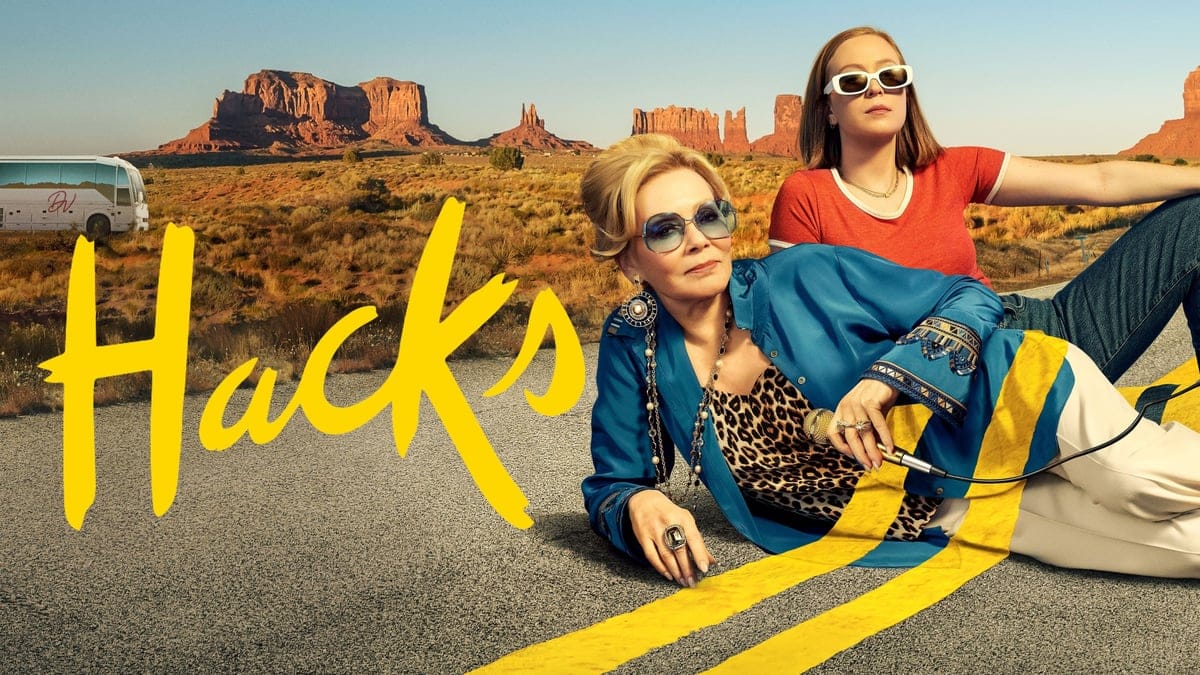
HBO’s Hacks made a splash when it began in 2021. The lead actress is Jean Smart, who plays Deborah Vance, a veteran stand-up comedian looking for a comeback. She finds herself working with an inexperienced comedy writer, Ava Daniels, played by Hannah Einbinder. What initially surprised and captivated audiences was the casting. Jean Smart happens to have been born in 1951. Einbinder was born in the mid-1990s. Audiences and award shows alike have been intrigued by the show’s dark humor and unprecedented celebration of older women. Now, in 2026, the show’s finale has set a different kind of cultural precedent. (Warning, series finale spoilers ahead.)
As we’ve reached the show’s finale, Deborah Vance has achieved everything she hoped for from the first episode of the series. Already a comedy legend, she has regained center stage on her own terms. She has also managed to learn from Ava, while helping Ava mature. Though Deborah has not lost her edge, she is a bit kinder and certainly more capable of friendship at the end of the series. She has even become more open-minded on certain topics.
The show has had a good run and Deborah has had a good run. Should Deborah ride off into the sunset? Comedy shows are notoriously difficult to end well. Despite the passage of time, still no one likes the Seinfeld finale.
Hacks makes a bold choice. In the very final episode, we learn that Deborah has cancer, it is likely fatal, she does not want treatment, and she wants to take a vacation to Paris and then go to Switzerland for assisted suicide. She also wants Ava to come with her. This is one of the first instances of normalizing assisted suicide through plot on a show which is not about medicine or law and which has not had an ongoing illness narrative.
Hacks chooses to interpret assisted suicide through the lens of empowerment. Deborah is sick, but she looks fine and she still feels fine. She wants to die “on her own terms.” She is not choosing death to be put out of her misery, but to avoid misery altogether. Only Ava and Jimmy seem to know about Deborah’s plan. They are both sad and both try to talk Deborah out of it, though Jimmy respects her decision. Jimmy tells Ava that he doesn’t like it, but it is consistent with “her body, her choice.” He understands why Ava doesn’t want to go to Switzerland with Deborah, but says “if you can, I think you should.” Ava is angrier and less accepting. She tries several times to dissuade Deborah from suicide, and is confrontational and openly disapproving. Deborah reminds Ava that she is always preaching about listening to women and respecting women’s right to do what they want with their bodies. In these conversations, Ava feels like her own words are being turned against her. She is always talking about women’s rights and respecting people’s autonomy. Eventually, reluctantly, Ava agrees to go to Europe.
In recent years, assisted suicide has become increasingly legal and mainstream. Once a rare phenomenon in some corners of Europe or a media spectacle around Dr. Kevorkian in America, it is now something else. Assisted dying laws have been hotly debated in England in the past year and medically-assisted dying may soon be legal there. In Canada, Medical Assistance in Dying (MAiD) has been shockingly rapidly adopted. MAiD was responsible for 5% of Canadian deaths in 2024. People can seek assisted suicide for a variety of conditions, not all of them fatal. Where assisted death has become legal and more common, it is seen by proponents much like it is portrayed on Hacks, as a way for people to address their illnesses and meet death “on their own terms.”
In 2023, I wrote for Mere Orthodoxy about the need to make MAiD unthinkable. In 2026, it has clearly become more thinkable. The final episode of Hacks ends with Deborah deciding not to do it and agreeing to try medical treatment. This will no doubt allow the episode to be controversial and attract extra attention while avoiding extreme blowback. But it doesn’t negate the episode’s social commentary. By the time Deborah arrives at her ultimate decision, the show has affirmed her right to suicide and has normalized assisted suicide. Even Ava is on board. In fact, she’s literally about to board the train to Switzerland when Deborah slows down and decides against it.
In recent years, many people have taken up the pen to outline the reasons for Christian opposition to assisted suicide. They are worth reviewing, but I will not revisit them here. I would like to examine the nature of this portrayal of assisted dying on Hacks and what makes it more serious than some others.
All television shows involve fiction, but there is more than a stretch of the imagination between Deborah Vance and most people who pursue assisted suicide. The fictional comedienne is absurdly rich, in her right mind, and not yet feeling the effects of any illness. This presents the decision as something not brought about by necessity. And Deborah has told almost no one, so she is under no pressure to pursue it. If anything, she is only receiving pressure to try medical treatment instead.
The reality of medically assisted suicide is very different. Not only are most people not extremely wealthy, they are often suffering in some form. That may be from a terminal illness or it may be from a long-term condition that seems overwhelming. In Canada, people have ended their lives because of depression and anorexia, in addition to more expected conditions. Deborah makes her decision under no pressure from pain, but some form of pain is nearly always at play with assisted dying.
On Hacks, euthanasia was clearly Deborah’s choice, one which should be respected. In reality, some people are pressured to accept MAiD. It may be that the burden of caring for them seems overwhelming to those around them. Sometimes assisted suicide is the result of caregiver burnout or patient guilt. Though it is a criminal offense to pressure someone into MAiD in Canada, there have been safeguard failures. Some doctors in Canada have expressed concern about pressure to recommend MAiD to patients. In the UK, opponents of a recent assisted dying bill highlighted that the bill had insufficient safeguards for protecting patients from pressure, from family or medical professionals. Assisted dying is likely not to be an expression of autonomy as it is on Hacks, it can actually signal a lack of autonomy.
On Hacks, Deborah’s ability to choose her own death affirms her dignity. So much of the entire series has been about her overcoming stereotypes and limitations and taking on the world, in her own way. Assisted dying would mean taking on death in her own way, too. When we look at the scope of conditions and suffering among MAiD patients, we see that MAiD denies the dignity of the suffering and those who need care. It denies the possibility of a meaningful life for many people. The representation on Hacks is harmful because it is dishonest about dignity in assisted dying.
In the middle of the nineteenth century, the Russian critic Vissarion Belinsky became known as the “conscience of the intelligentsia.” He evaluated books for their writing, but he also judged books as good or bad based on their relationship to the truth. He expected fictional characters and entertaining plots, but if a book was dishonest about the nature of reality and social conditions, he judged it a bad book. When Gogol, who Belinsky had idolized, wrote a book which portrayed serfs as happy in their oppressed state and upheld the knout and illiteracy as proud traditions, Belinsky was beyond disappointed. His public, scathing “Letter to Gogol” was so widely read and appreciated that it was memorized by many young Russians. In the opening salvo, Belinsky wrote that “one cannot endure an outraged sense of truth and human dignity.”
Everything about the portrayal of Deborah’s decision on Hacks is so distant from reality as to be a harmful distortion of reality. It leaves one with an “outraged sense of truth and human dignity.” At the end of that letter to Gogol, Belinsky writes directly to his former idol: “This is not a question of your or my personality; it concerns a matter that is of greater importance than myself or even you; it is a matter that concerns the truth, Russian society, Russia.” To echo Belinsky, this is not a matter of liking or disliking Hacks, which most Mere Orthodoxy readers likely already do not watch (it is pretty R-rated). Even if they did, the show is over now. This is a matter of greater importance, concerning the truth. Our response should be directed beyond Hacks, to broader society.
Belinsky understood the importance of literature. In nineteenth-century Russia, especially, literature was more than only entertainment, it was a method for communicating worldview and political ideals. In all times and places, stories have a way of sinking into how we view the world and a way of shaping our opinions on things. This is why Harriet Beecher Stowe’s Uncle Tom’s Cabin affected people in a way that many existing non-fiction abolitionist efforts did not.
At present, we have an existing and growing body of non-fiction essays and books that argue for a Christian view of human dignity that is inherently opposed to medically assisted dying. What we need more of, and more attention to, is stories—books, movies, television—that emphasize human dignity, in suffering and dying, and which affirm Christian beliefs about suffering and death. And those stories need to be good. In the Hacks series finale, Ava’s grief and distress is moving and portrayed sympathetically, but so is Deborah’s desire for dignity. The scales tip, but not so dramatically that we feel we are being preached at, even if we are.
Joan Didion wrote that “we tell ourselves stories in order to live.” We also need stories to know how to die. For a long time now, most Western Christians have participated in the broader cultural trend of looking away from death and avoiding thinking about it very much. During the Civil War, Americans still had a sense of a “good death.” Now, we don’t know enough about death to grasp the relationship between human dignity and death. This has probably never been healthy for people whose faith hinges on Jesus’ life, death, and resurrection. But now our ignorance about death and dignity poses an increasing threat to life. It is time to get our story straight.
The Weekly Digest
Premier Thought Every Thursday.
All of our recent essays and podcasts, delivered to you. Free.
Free. Delivered Thursday mornings.