
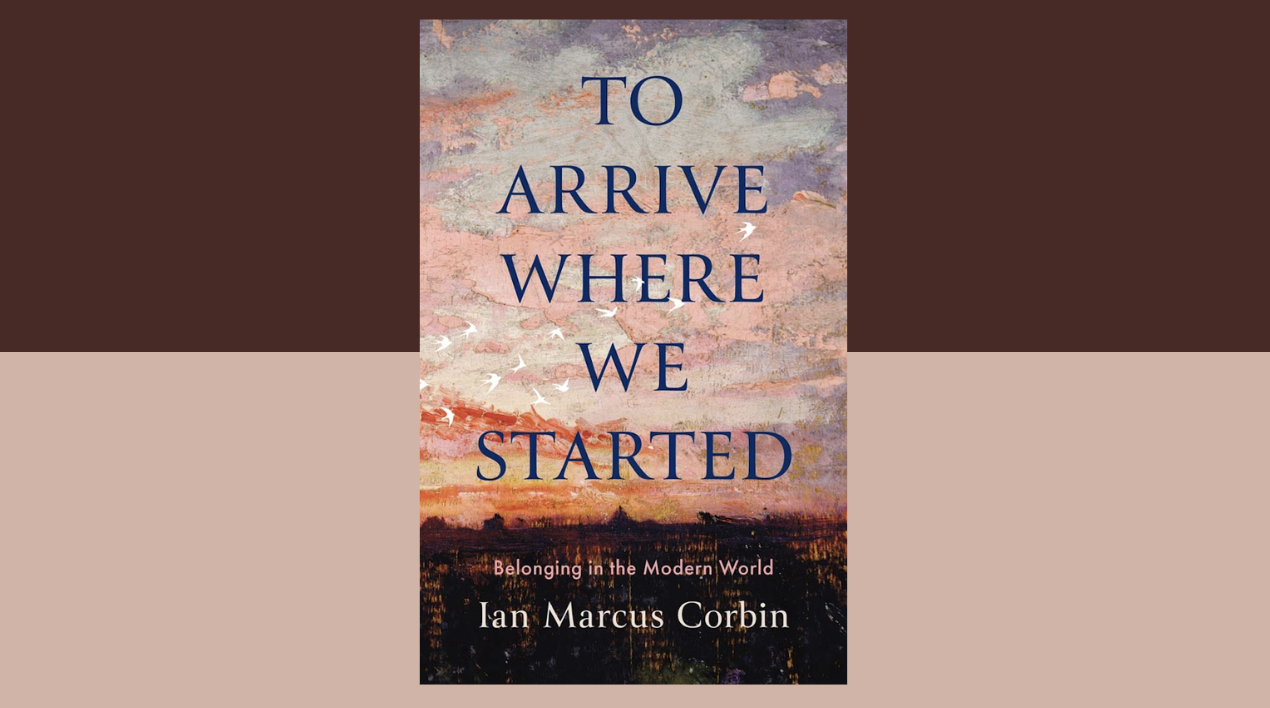
Ian Marcus Corbin. To Arrive Where We Started: Belonging in the Modern World. Yale University Press, 2026. $32.50. 200 pp.
There has been much public buzz of late about Christopher Nolan’s adaptation of Homer’s Odyssey, a story that has homecoming clearly at its center. The title of Ian Marcus Corbin’s new book, To Arrive Where We Started, would make a fitting subtitle for The Odyssey. But while Odysseus’ mission is to return home to his wife and son, to his island of Ithaka, Corbin’s book suggests that we are on an even grander journey—the “human quest to be at home in the world.”
Drawing from his own life and wider culture, Corbin argues that we are afflicted with a type of homelessness. Odysseus could find peace after returning to Ithaka (and killing the suitors), but even when we are in our homes and have material abundance, it all feels somehow “like an exile.” Corbin describes this spiritual and material crisis and some possible solutions, working through the themes of belonging, loneliness, alienation, at-home-ness. He puts much of the blame on the modern conception of the self with its distorted ideals and expectations. We may be changing the climate and spending too much time indoors, but our problem is cultural, not natural—"It is precisely our interpreted world that feels like less than a home.”
Uneasiness in the world is not a new topic, but To Arrive Where We Started has an interesting approach. Corbin emphasizes “life as cognition and metabolism,” an idea that “is indebted to a school of thought that sees life as an autonomous process of autopoiesis, or self-making.” From single-celled organisms to us, we all need external input, and we all interpret as part of existence. Corbin believes humans need collective cognitive energy to reckon with our complex environment. Unfortunately, loneliness has become “a way of life.”
Loneliness and inadequate friendships weaken our ability to practice good judgment. The problem is, though, that “the cognitive energy required to confidently, consistently span the distance between concept and reality does not seem to be the kind of thing that individuals can generate for themselves.” Our poor “cognitive metabolism” also leads to an inability to craft a well-formed understanding of the world. This is a significant problem because “world-tending… is the cardinal human task, the way we make our way here and make our way toward at-home-ness.”
If our cultural Greek chorus is telling us anything these days, it is that our culture is unwell. To Arrive Where We Started contributes to that chorus, but it brings its own distinct voice with its focus on homecoming and belonging. Like many others, Corbin blames the Enlightenment and “Newtonian cosmic nihilism” for many of our ills. Our alienation from each other and the world around us is closely connected to our obsession with the autonomous individual and our belief that we can best be at home in the world through owning parts of it.
But, like Odysseus, Corbin believes that homecoming is possible. He emphasizes relationships with others and tending a world together, drawing heavily on Socratic dialogues and Aristotle’s thoughts on friendship and wisdom. Virtuous friendship helps us expand the self and blur our boundaries in healthy ways. Contemplation takes us further in our efforts to get away from an exclusively autonomous self. Through contemplation, we observe that the world around us—and our own inspiration—seems driven by “some mysterious subjectivity, some agent with awareness and intention.” For Corbin, this connects to Christian belief, but he gives examples to demonstrate that this conclusion can be drawn by others, too. Ultimately, we develop a sense of “at-home-ness” not from aligning our views well with other humans, but from aligning ourselves well with the wider universe (and its Creator).
We need a “friendship with the whole.” Corbin writes:
It is here, in a world suffused with subjectivity, interaction, and reciprocity, where things are valued not only by humans, but in some sense by reality itself, that we can be called into creative participation in the world. We can be truly at home.”
This is not only possible, there are models we can use to develop practices for sustaining a home in this world. Corbin suggests that we can learn from “cultures of participation,” including the Lakota. We can also learn from the Romantics and works like Dostoevsky’s The Brothers Karamazov.
In The Odyssey, Telemachus is as uncomfortable in his home as we often are in this world, if not more. Telemachus’s tale emphasizes filial piety and the importance of his father’s presence in his ability to inhabit his home and, ultimately, his own manhood. Christians have long emphasized the need for a kind of filial piety in our loyalty to God. Without negating that, To Arrive Where We Started looks at home from a different angle, directing our attention to developing a sense of fraternity both with each other and with the world God created and inhabits. After all, God is not absent like Odysseus.
Corbin’s diagnosis of our ills is expected, but his cure is distinctive. Though he sees a problem with ownership, he does not focus primarily on economic distribution or redistribution. Rather than contrast consumerism and the common good, Corbin emphasizes seeing ourselves as participants in the world, not just in society. He writes that, in contemplation, “I cease to hunger because I see myself as a co-participant, brother to everything that is, lacker of nothing.” The final chapters of the book almost quietly echo the words of Clarence the angel in It’s a Wonderful Life: “Remember, no man is a failure who has friends.” In this case, we can have a sense of friendship with the world, fallen as it is. That can make us at home, however little land we own.
In most books about loneliness, we receive recommendations for restoring institutions and communities. Yet Corbin looks beyond church membership and bowling leagues, to virtuous friendship and primordial experiences. He worries less about our associations than what he perceives as our ultimate goal—to “truly belong in our reality.” The sense of belonging that Corbin recommends seems like the “oceanic feeling” Freud dismisses at the start of Civilization and Its Discontents. Freud believed that feeling was a remnant of the infantile experience and an infant’s inability to distinguish itself from its mother and the world. Corbin identifies that feeling as a remnant of an earlier way of relating to the world, one which we should pursue again.
Corbin’s biggest claims may be some of the most contested aspects of the book. Is our primary problem a lack of belonging in our world? Some Christians believe we ought not to see this world as our home. Is world-tending our cardinal human task? Is life best explained through cognition and metabolism? Some historically-minded readers may question how well humans felt we belonged in the world in earlier times—after all, our ancient and premodern forebears sometimes saw the world as a very hostile, antagonistic place. Some others may find the book too religious, or insufficiently religious. Corbin does not disguise his Christian position, but he also includes examples of non-Christians coming to a sense of understanding about the intention behind the universe and the subjectivity that has shaped it and he supports many of his arguments with classical thinkers.
Despite some disputable claims, much of Corbin’s analysis is appealing and plausible. To Arrive Where We Started relies on a helpful blend of classical thinkers, literature, and other cultures. Corbin’s description of the role of interpretation in shaping our experience of the world is compelling and takes into consideration the human condition, not just human nature. He gets beyond headlines and troubling statistics. We are not just lacking generic connections with others, but are missing virtuous friendships. And despite opposing the autonomous self, Corbin is not recommending some form of collectivism. He encourages “a robust sense of self and world.” He also believes that “we can be called into creative participation with the world.”
To Arrive Where We Started joins a long line of works about belonging and homecoming. The homecoming in The Odyssey fulfills the hope of reunion, but it also involves slaughtering the suitors. To Arrive Where We Started suggests a more peaceful homecoming is possible, built on the belief that there are ways of living with others that get beyond the idea that we are always and only autonomous individuals striving in a dark and empty universe, capable of securing things for ourselves best (and perhaps only) through money and ownership. It is possible to achieve friendship with the whole, and in the process, take our part in a world that extends beyond us—a world “charged with the grandeur of God,” as Gerard Manley Hopkins would say.
The Weekly Digest
Premier Thought Every Thursday.
All of our recent essays and podcasts, delivered to you. Free.
Free. Delivered Thursday mornings.