

One of my strongest memories from the late 1960s, when I was immersed in what was then called the counterculture, was sporting colored shirts and pink-striped, grey trousers. My colored clothes gave me a deep sense of having been freed from the conformity of early-1960s male fashion with its white shirts, a mark of the chromophobia that has lurked in the Western culture for centuries.
Chromophobia is, of course, not restricted to the West. An Iranian woman in her twenties recently commented on the various security patrols and checkpoints around the city of Tehran: “I always wear colourful clothes. But now I don’t. I’m afraid of their patrols, worried that if I wear something too bright it might annoy them.” Still, conservative Christianity has often been a purveyor of this distinct suspicion of color.
Alongside this chromophobia, though, the West, like most other cultures, has long used chromatic terminology to highlight thought and affections. Consider the iconic folk song from the mid-1960s, “California Dreamin’.” It seeks to evoke the bleakness of winter through the use of two chromatic terms: “All the leaves are brown/And the sky is grey.” Brown and grey are the two key words in these lines; they capture perfectly the way that northern climes can be quite depressing during the winter months.
Given the way that our world is flooded with color, it is not surprising that Western culture has frequently turned to chromatic terminology to express ideas and perspectives. Here, for instance, is Charles Haddon Spurgeon (1834–1892), the evangelical wonder of Victorian London, commenting on Psalm 19:13a (“Keep back thy servant also from presumptuous sins; let them not have dominion over me,” KJV):
This earnest and humble prayer teaches us that saints may fall into the worst of sins unless restrained by grace, and that therefore they must watch and pray lest they enter into temptation. There is a natural proneness to sin in the best of men, and they must be held back as a horse is held back by the bit or they will run into it. Presumptuous sins are peculiarly dangerous. All sins are great sins, but yet some sins are greater than others… It is wrong to suppose that because all sins will condemn us, that therefore one sin is not greater than another. The fact is, that while all transgression is a greatly grievous and sinful thing, yet there are some transgressions which have a deeper shade of blackness, and a more double scarlet-dyed hue of criminality than others.
In this commentary, Spurgeon adroitly uses two colors, black and scarlet, to drive home his argument that there are certain sins, “presumptuous sins” in the words of Psalm 19, that are worse than others. The association of scarlet with sin has biblical warrant (see, for instance, Isaiah 1:18), but the description of sin’s stain as having “a deeper shade of blackness” does not. Spurgeon’s use of the term “blackness” is shaped rather by a cultural idiom that had become commonplace in the Western tradition. That this cultural idiom is alive and well today can be seen in what is sometimes called a “witness bracelet,” worn by some Evangelicals and which is composed of different colored beads with a black bead standing for our sin. In a world where skin color has major social ramifications, this identification of black with sin is profoundly problematic.
My training as a historian in the late 1970s and early 1980s was in the realm of doctrinal concepts, tracing the way that Christian doctrine developed, especially in what is now called Late Antiquity. In other words, I was trained to be an intellectual historian. By the late 1990s, though, influenced by the Annales school of historiography, I had become convinced of the importance of socio-cultural dimensions in all historical research and writing. One cannot divorce the people who wrote works of Christian doctrine from the cultures in which they were immersed. To understand their doctrinal convictions, both their cultural contexts and their lives had to be taken into account. In other words, my concept of what it means to do history became far more holistic.
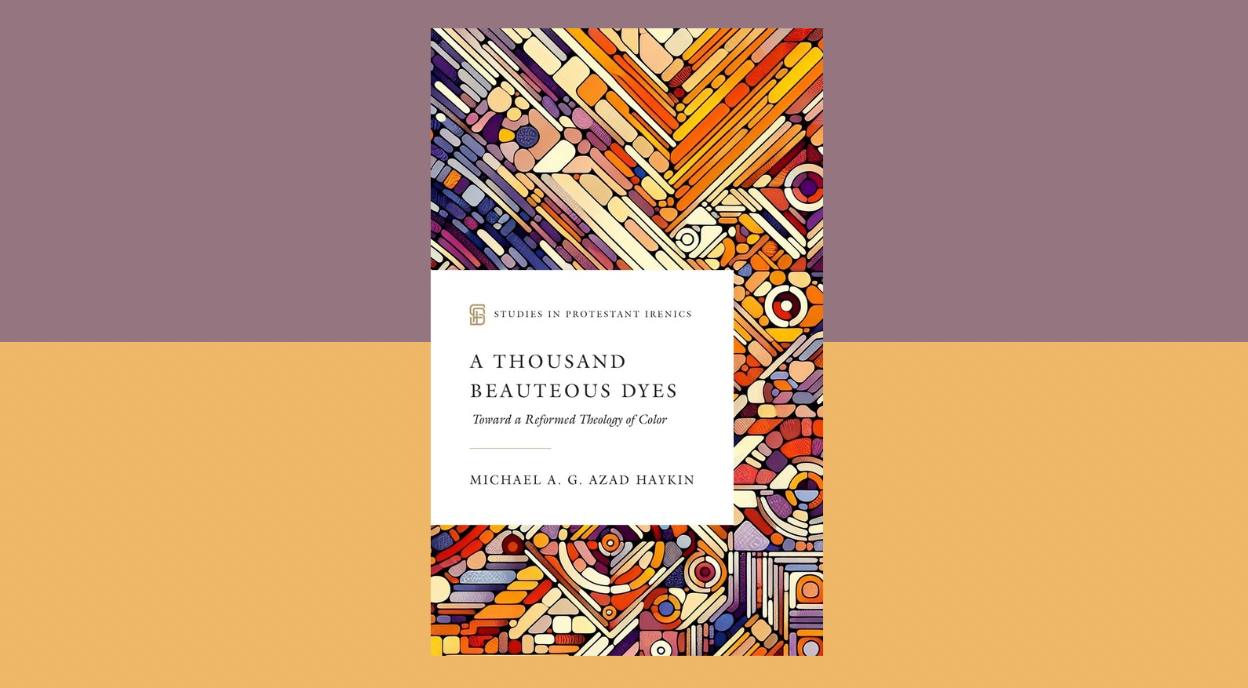
As I began to broaden my practice of history-writing, I came across the work of Michel Pastoureau (1947‒), the renowned historian of color who is the director of the École Pratique des Hautes Etudes in Paris. His series of works on color as “first and foremost a social phenomenon, one with historically grounded realities and effects” (to quote Roland Betancourt’s foreword to White) has profoundly shaped aspects of my research over the last eight or so years on the way that color has been employed to convey and accentuate elements of the Christian Faith. My new monograph, A Thousand Beauteous Dyes, is an initial attempt—a taster, if you will—at formulating a history of color in the Christian tradition.
The first essay in the monograph traces some aspects of the reception history of Song of Songs 5:10a (“My beloved is white and ruddy,” KJV) from the Reformation to the long eighteenth century, particularly, as it concerns the colors red and pink. The other three essays are more narrowly focused. They look at the chromatic theology of two English Baptist hymnwriters, Anne Steele (1717‒1778) and Benjamin Beddome (1718‒1795), and the assertion by the New England theologian Jonathan Edwards (1703‒1758), who has been well described as “America’s Augustine,” that green was God’s favorite color!
The Weekly Digest
Premier Thought Every Thursday.
All of our recent essays and podcasts, delivered to you. Free.
Free. Delivered Thursday mornings.