


Among the many harrowing admonitions of the Lord Jesus, one statement makes me weak in the knees each time I read it: “I tell you that on the day of judgment people will have to account for every careless word they speak. For by your words you will be acquitted, and by your words you will be condemned.” (Mt 12:36–37, CSB)
In addition to nearly making me want to cut out my own tongue, those words have challenged me as a young pastor. A few moments of reflection, and careless words I’ve said to, in front of, and about church members and attendees are replaying on the voice memo in my mind. A few more moments of reflection, and I’m recalling careful words I should have spoken, but didn’t—which may be just as harmful.
This summer, during the earliest days of my first pastoral sabbatical, I spent hours thinking and praying about these spoken and unspoken words and what lies behind them. Upon reflection, I’ve become convinced that all our speech, every word uttered, every conversation basically belongs in one of four categories. Of those four, two will particularly shape the trajectory of our lives, for better or worse. And the fear of man—a matter not of mouth but of heart—will trap us in fruitless speech and block us from life-giving speech.
Four Kinds of Speech
Every word we speak can basically be plotted onto at least two axes:
- Unhelpful—Helpful
- Easy—Difficult
I take this claim as fairly self-evident. A joke, for example, is helpful insofar as it encourages lightheartedness and good humor; it’s unhelpful insofar as it directs the mind to that which is crass or encourages and normalizes vulgarity. A word to one’s spouse can be helpful (“Thanks for all your hard work today!”) or unhelpful (“Why do you always do that?”). A word to a neighbor may be easy (“Good morning!”) or difficult (“Would you mind turning off the loud music a little earlier next time?”). A word to a church member may be easy (“It’s good to see you this morning!”) or difficult (“I’d like to have a conversation about some of the things you’re posting on social media,”).
From these two plot points flow four kinds of speech:
- Speech that is difficult and helpful (what I’m calling “life-giving speech”)
- Speech that is easy and helpful (“kind speech”)
- Speech that is easy and unhelpful (“fruitless speech”)
- Speech that is difficult and unhelpful (“unwise speech”)
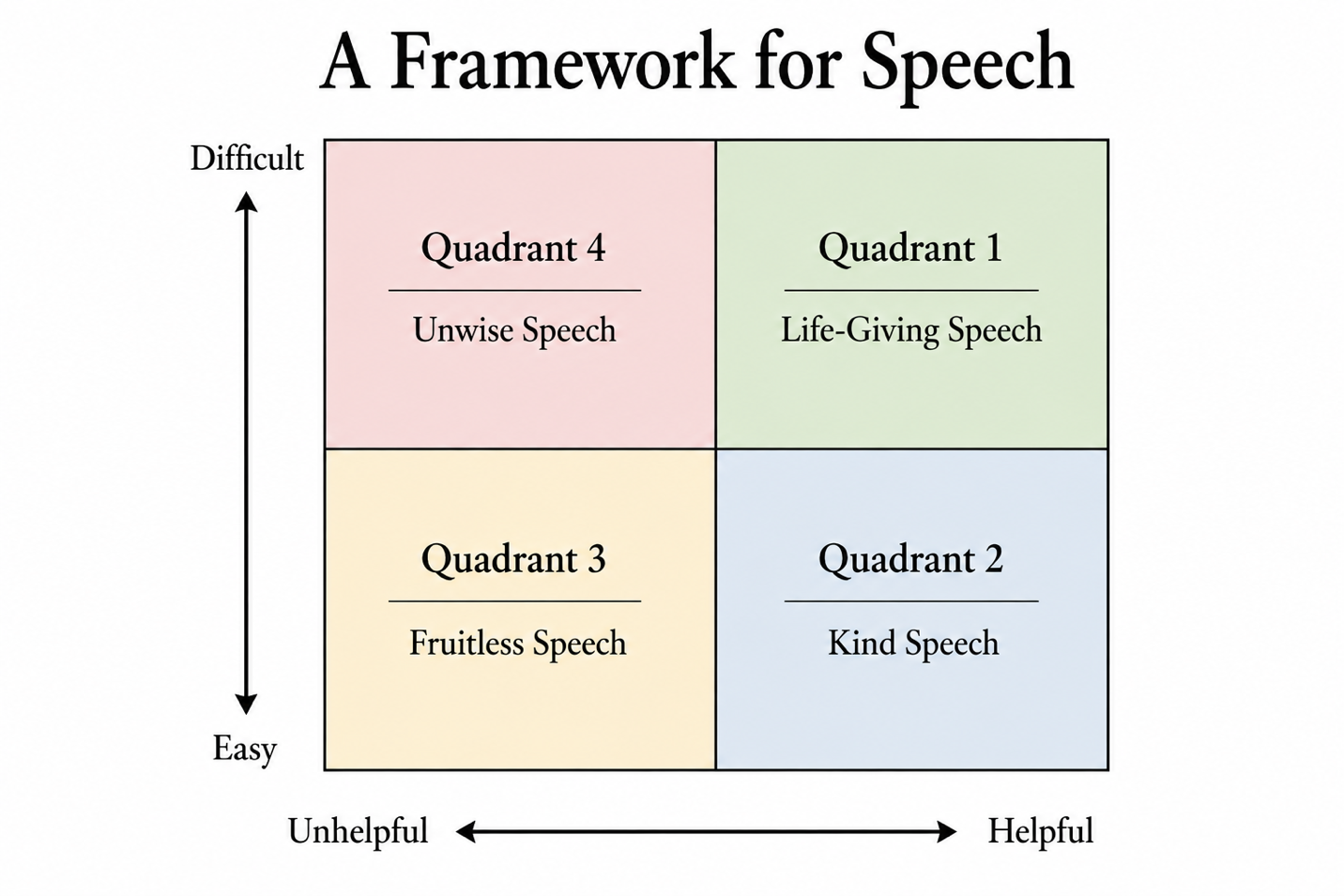
Let’s consider Quadrant 4 first. This is probably the least common category of conversation: challenging but ultimately unhelpful. I have given and received this kind of speech. Though it is rare, it’s likely to leave a mark. For example, my wife and I were once approached by friends who wanted to have a hard conversation with us. They went about it technically in all the right ways—it took a great deal of courage! But the substance of their concerns were selfish and inconsiderate, and the timing was horribly unwise, resulting in one of the most painful conversations (and series thereof) of our lives, and the eventual loss of a friendship.
Quadrant 2 is the exact opposite: low cost, high reward. Easy but helpful. We should all strive to be people who take every opportunity for this kind of speech. It costs you nothing but a few moments and adequate attention to encourage your child in her piano playing, to call a friend on his birthday, to tell your husband he looks handsome, to thank your pastor for his sermon preparation, to stop and pray with a grieving friend, or to celebrate your wife’s promotion in front of friends. A lifetime of this kind of speech only benefits you and everyone around you.
But as helpful as kind speech is, it’s not the most consequential. Similarly, as painful as unwise speech can be, it’s so rare that it’s unlikely to play a large role in that Judgment Day word recall. Rather, it’s the Quadrant 1 and Quadrant 3 conversations that set the trajectory and inform the climate of our lives and relationships.
Up and to the Right
The first realization I had through prayerful self-examination early in my sabbatical was that most of the words I regret saying are in the bottom left—easy but unhelpful—while most of the words I regret not saying are in the top right—difficult but helpful.
Consider the kinds of speech that fall into the “unhelpful” category:
- “Unwholesome talk” (Eph 4:29) and “crude joking” (Eph 5:4) are easy ways to get a laugh, but ultimately neither helpful nor edifying.
- Gossip—prohibited at many points throughout Scripture—can ingratiate you to your listener by scratching the itching ear, giving them the “tea,” or subtly inviting them into the “inner ring,” but it ultimately destroys relationships and reputations.
- Sarcasm, though there is a helpful use for it on occasion, usually tears down people, poisons relational and organizational cultures, and is often just a defense mechanism that allows you for little cost to avoid vulnerable or substantive conversations.
These are the sins of the tongue I regularly fall into. They’re the careless words that I fear to one day give an account for.
Consider, on the other hand, “life-giving” speech:
- Loving correction may temporarily “wound” the hearers, but it is nonetheless “faithful,” because it ultimately helps them grow or heal. (Pr 27:6)
- Discipline of a child or an employee is enjoyable neither for the one receiving it, nor (under healthy circumstances) the one giving it, but it nonetheless is the action of a loving authority figure. (Pr 3:12; Heb 12:6)
- Private confrontation over sin is one of the most nerve-jostling things we can do, but Jesus commands it, and it is a way to “win your brother” and protect integrity of the church. (Mt 5:18; 1 Cor 5:6)
These conversations can be incredibly difficult, and there have been many times as a pastor, friend, husband, father, son, brother, and so on that I have neglected to have them, with the result that issues go unresolved, I grow bitter or jaded, and the other party misses an opportunity to grow.
Out of the Mouth the Heart Speaks
The monumental realization I had during those first days of my sabbatical was that Quadrant 1 and Quadrant 3 are intrinsically connected. The reason I get stuck in unfruitful speech is the same reason I naturally draw back from life-giving speech. Why is it, after all, that I sometimes say things I shouldn’t, and sometimes don’t say things I should? These aren’t two different problems, but two sides of the same problem: fear of man.
Jesus said “the mouth speaks from the overflow of the heart.” (Mt 12:34) This is why our words will acquit or condemn us—not because we are saved by works, but because our works are evidence of the state of our hearts, and there is no stronger evidence than our words. This is probably why James says controlling the tongue is a mark of spiritual maturity—not because it is the last rung on the ladder of virtue, but because it is the clearest evidence of our hearts. If we have a habit life-giving speech, as opposed to fruitless speech, it must be because we are “good trees” (Mt 12:33) or “sweet water springs” (Js 3:11).
And what did the fruit of my words reveal about my heart? That it is still in the grip of the fear of man. Indeed, it is my desire for the approval of others—my desire to be “liked,” that thin and fleeting feeling that isn’t worth much at all in the end—that leads me into fruitless talk, and it is my fear of offending others and falling out of their favor which often keeps me from saying to them things I should say, or saying them as clearly, directly, and thoroughly as I know I ought.
To summarize, the habitual presence or absence of fruitless (Quadrant 3) and life-giving (Quadrant 1) speech will in no small way set the trajectory of your life and the climate of your relationships. The fear of man traps you in Quadrant 3, and it blocks you from Quadrant 1. Ironically, then, the idol of man’s approval will in the long run be a cancer to your relationship with others. The desire to be “liked” at all costs will make you the kind of conversationalist who in the end will be loved, appreciated, and respected by almost no one.
Here, then, is the solution. Solomon told us that “the tongue that heals is a tree of life, but a devious tongue breaks the spirit.” (Pr 15:14) If we want to be life-givers rather than spirit-breakers, people who help others and glorify God with our words, and who will not be condemned by our words on the last day, we must let the Lord transform not primarily our tongues, but our hearts. Specifically, we must fear God and not man. We must let his approval and affirmation of us in Christ wash over our hearts, increasing in us affections for him and genuine love for others, rather than the need for their approval.
How will this happen? Through prayer and practice. In prayer, we rehearse, meditate on, and delight in the gospel. God’s Spirit brings home to our hearts God’s real, objective love for us, and our heart gradually detaches from weaker affections and attached to the God who “so loved us that he gave his only Son” for us. (Jn 3:16) Increasingly, we stop needing the approval of others, because we already have God’s approval, which is infinitely sweeter to us, and we start rather desiring their good—and using our words to work for it.
That’s where practice comes in. Armed with prayer and the Spirit, we watch our tongues. We grow slower to speak, and we examine our hearts before we do. We prayerfully rehearse hard conversations beforehand, and we trust the Spirit will give us the words to say in those sweaty-palmed, heart-racing moments. We mess up, then we pray for forgiveness and ask for help again, and try to do better next time. Through a life of prayer and practice, the Lord releases us from the vice grip of the fear of man and releases us into freedom of fruitful, life-giving, God-honoring speech.
The Power of Life and Death
As I write this, I’m looking toward the end of this sabbatical. Among other things, the Lord has worked into my heart a greater awareness of that small instrument which holds “the power of life and death”: the tongue. (Pr 18:21) My prayer upon re-entry is that he would grant me a renewed commitment to words that give life—that through prayer and practice, my words will build up and not tear down. I pray the same will be true for you.
The Weekly Digest
Premier Thought Every Thursday.
All of our recent essays and podcasts, delivered to you. Free.
Free. Delivered Thursday mornings.