

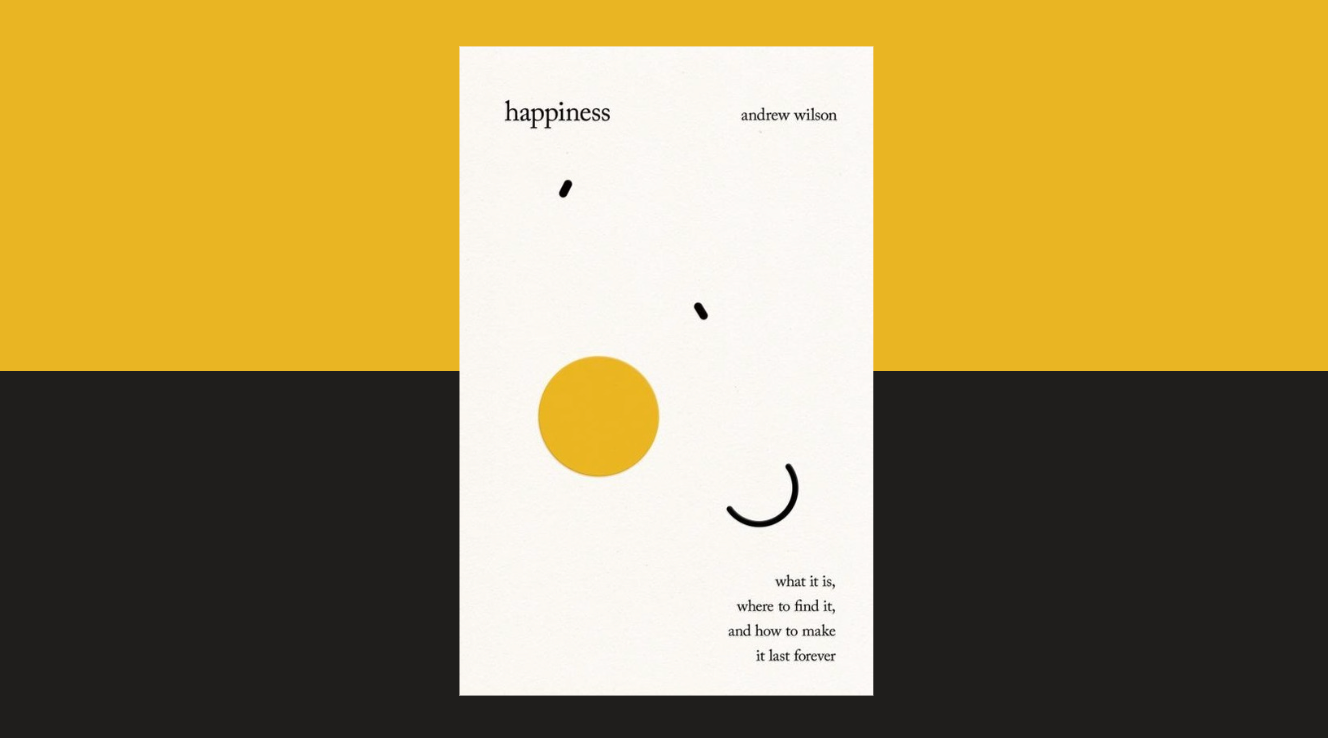
Andrew Wilson. Happiness: What It Is, Where to Find It, and How to Make It Last Forever. Crossway, 2026. $19.99. 184 pp.
Barnabas Piper describes happiness as “life’s most elusive feeling.” For many of us, that’s because we spend much of our lives looking for it in the wrong places.
Yet happiness itself has become an increasingly difficult thing to define. There is no shortage of books, podcasts, studies and self-help resources promising to help us find it. We measure happiness through life satisfaction, mental health, financial security and personal fulfillment. The annual World Happiness Report tracks the subject as a measure of human flourishing. Its 2026 report found that young people in North America and Western Europe are significantly less happy than they were 15 years ago.
So how do we define happiness? Where does it come from, and how can we make it last? There’s also a broader philosophical question underneath it all: Is happiness something we should pursue directly, or is it a byproduct of pursuing something more meaningful?
These are the questions Andrew Wilson, teaching pastor at King’s Church London, explores in his new book, Happiness: What It Is, Where to Find It, and How to Make It Last Forever. The book enters a crowded conversation that includes psychology, philosophy, sociology, neuroscience, self-help and Christian theology. Wilson attempts to bring these disciplines together while making a distinctly Christian argument: True happiness is found in drawing nearer to God rather than pursuing happiness itself. “Wherever there is Jesus, there is joy,” Wilson writes.
Wilson reminds readers at the start of a truth we often neglect: “God wants you to be happy.” The key to that happiness is in the pursuit of God rather than in pursuit of happiness itself, he argues.
“In Scripture, God is the goal and happiness is one of the results,” he explains.
We do not love God because he improves our states of mind...but because we find him supremely excellent and delightful in himself—and a marvelous result is that we experience deep and everlasting joy, glorifying God by enjoying him forever.
In other words, happiness isn’t the ultimate goal of the Christian life. God is. But happiness is one of the good things we experience as we pursue and become more like God—"For the fruit of the Spirit is joy."
Our culture, meanwhile, is often at odds with this view of happiness that the Bible speaks of.
It encourages us to chase a worldly, fleeting idea of happiness through pursuing a larger salary, a bigger house, more friends, grand vacations, a spouse, our favorite sports team’s success, or whatever else we think might finally make us content. These things aren’t inherently bad. They can all be good and enjoyable when kept in proper perspective. The problem comes when we rely on them to bring lasting happiness that they’re simply not able to provide.
Folk-rock band Judah & the Lion captures that version of happiness in the song “How to Be Loved”:
More, more, more, more
I need more
I swеar to God that I'll be happy when I get it.
This mindset is familiar because it reflects how many of us approach happiness through all the things the world tells us should matter most. It’s why some athletes have said they rarely feel satisfied after winning a championship. After winning his third of seven Super Bowl championships, quarterback Tom Brady said in a 60 Minutes interview in 2005, “Why do I have three Super Bowl rings and still think there’s something greater out there for me? I mean…God, it’s gotta be more than this. I mean this can’t be what it’s all cracked up to be…What else is there for me?”
Brady was onto something. Worldly pleasures are ultimately a poor foundation for happiness, because they are guaranteed to end. At some point, an athlete’s playing days will end, and there will be no more championships for which to train. For a businessman, a time will come where there will be no more titles or promotions to chase.
There has to be a greater goal in mind for all of us if we wish to experience true and lasting happiness, and Wilson argues that goal is Jesus. From there, he lays out a roadmap for reorienting our hearts toward him.
A Holistic View of Happiness
Wilson is far from the first Christian writer to explore the topic of happiness, of course. In his book Surprised by Joy: The Shape of My Early Life, C. S. Lewis explores his lifelong search for transcendent happiness. And in Reflections on the Psalms, Lewis describes joy as something that naturally overflows into a desire to share it with others.
In his book Happiness, Randy Alcorn argues that Christians should be happy because of the hope and joy we have in Christ, even though some have been taught to think of holiness and happiness as competing goals. In Hoping for Happiness, Barnabas Piper explores what he considers to be unrealistic expectations of happiness that ultimately end in disappointment and lays out a clear argument for why and how Christians are supposed to have fun.
Wilson goes a step further to explain that happiness is not a choice, but it is affected by our choices. There are tangible body, mind and soul connections to happiness. Psalms, for example, implore people to use their physical bodies in worship. Raising and clapping our hands, singing, even dancing while we worship can “fuel happiness in God.” This is because “body and soul are codependent partners in the quest for divine delight.” We can literally use our bodies to worship, and in turn we can start to reverse some of the chemistry that may be causing us to feel downcast or sad.
Humans are born with a certain type of brain chemistry that predisposes us to a certain level of cheerfulness, Wilson notes, but that can change through our behaviors and habits. He compares it to our physical weight. We are genetically disposed to a certain size and shape, but that too can change depending on our diet and exercise habits. Some people have to work harder than others to maintain a certain physical size. Similarly, some people have to work harder than others to be cheerful, but our habits can play a direct role in that.
Wilson doesn’t reduce happiness to positive thinking, and he recognizes that every person has a different capacity for happiness. He acknowledges the influence of biology, circumstances and mental health while still emphasizing the importance of our own choices and habits.
Community, Humility and Forgiveness
Relationships are a key part of the equation. We know that deep community and friendships help foster happiness. Wilson describes this as “life-in-common.”
“Having people in and out of our home increases our sense of connection even as it decreases our sense of space,” he reflects. In other words, it’s worth it for our happiness to think of others more and share our lives with friends. Community requires us to give up some control. It asks us to make room for other people, literally and figuratively. That type of sacrifice can make us happier.
Jesus teaches us as much in Acts 20:35: “It is more blessed to give than to receive.” Similarly, being in corporate settings, be it a concert, wedding, or a sports bar with like-minded fans, can provide a picture of what it looks like to be joyful in community with others. When we truly enjoy something, we should want to share it with others because that completes the full arc of the joy journey.
Friendships and relationships in general are only successful when both parties approach them with humility and, when necessary, a repentant and forgiving heart. That too is connected to happiness.
In the Sermon on the Mount, Jesus begins by explaining that the poor in spirit are blessed. They’re the ones who will experience flourishing, for they shall inherit the kingdom. Blessed also are the meek, for they shall inherit the earth. Throughout his teaching, Jesus harkens back repeatedly to the idea of humility. What we may not always notice, however, is the connection between humility and happiness, Wilson explains.
“Humble people are far less entitled, far more grateful, and far less prone to grumbling, judgmentalism, and envy than proud people—almost by definition.” Why? “They recognize their own faults and resolve interpersonal conflicts much more quickly than proud people, which means their relationships are characterized by higher trust and higher openness.”
These people also take themselves less seriously and laugh at themselves. They’re often more self-aware of their own flaws. They’re more prone to celebrate others and don’t feel crushed by their own mistakes. Because they’re less self-centered and more others-focused, they tend to be more attractive as friends and colleagues. In general, they’re more thankful. All of these things reflect the heart of God and the ways of Jesus, and they all are signs of a happy person.
Likewise, happy people possess the capacity to forgive and be humble enough to ask for forgiveness when necessary. Forgiveness is the only practice that Jesus includes in the Lord’s Prayer, Wilson notes. Happy people aren’t necessarily people who have experienced fewer reasons to be unhappy. Instead, they’re people who have learned how to respond differently to the inevitable disappointments and frustrations of life.
Finding True Happiness
Perhaps the biggest paradox Wilson brings out is that true happiness often comes when we stop actively looking for it.
Citing the Brazilian pastor Rene Breuel, Wilson notes how people who are truly happy rarely think about their level of happiness. Instead, they’re just doing the things that make them happy. They’re gardening, golfing, hiking, building a boat, playing music, writing or whatever else their interests are.
This idea brings Wilson’s entire argument into focus. We should want to be happy, but Scripture shows how the path to true happiness for the Christian life is not by pursuing happiness on its own, but through pursuing God first. This is outlined in Matthew 6:33: “But seek first his kingdom and his righteousness, and all these things will be given to you as well.”
Ultimately, Wilson points us to a simple truth: Wherever we find Jesus, that’s where we’ll find true and lasting joy.
The Weekly Digest
Premier Thought Every Thursday.
All of our recent essays and podcasts, delivered to you. Free.
Free. Delivered Thursday mornings.