
I sometimes think about what my childhood and teenage years would have been like if I had the same kind of technology available to me that my preteen children now have available to them. I doubt it would have gone well. I learned from an early age the kind of permissions I could get by labeling myself “introverted.” Even without broadband internet, I played the bookish loner. It’s hard to wrap my mind around where I would have ended up with unfettered access to online creations. Infinite scroll? Influencers who looked and sounded like the people I wanted to look and sound like? An AI bot that told me I was an interesting person and enjoyed talking to me?
Thinking along these lines can induce panic. What possible chance do our kids have today? How can healthy attention spans, pure imaginations, and relationship skills survive such an immersive and unchecked technological regime?
Some have answered, “They can’t.” So the answer is to remove our families and communities from the technological regime as much as possible. I’m sympathetic to this answer and think it’s truer and more helpful than its mirror opposite. But I think this answer misses something important. In Job 28, Job reflects that true wisdom cannot be found in this world. Mankind’s strongest and most enriching industries cannot locate wisdom, nor does nature, in all its vast, untamed wonder, possess it. Job concludes:
“God understands the way to it,
and he knows its place.
For he looks to the ends of the earth
and sees everything under the heavens….
And he said to man,
‘Behold, the fear of the Lord, that is wisdom,
and to turn away from evil is understanding.’” (Job 28: 23-24, 28).
In other words, we are not wrong to despair over wisdom from this world. Looking to society, law, and technology to shape the world so that wisdom is obvious and natural is a fool’s errand. Wisdom is not found here. It is found with God.
Withdrawing from mainstream society to form intentional anti-technology communes may not be intrinsically wrong, but it’s not intrinsically right, either, because no such strategy can render wisdom. To be wise is not to be strategic. It is to fear the Lord. It is to turn toward our Creator and away from evil—even when said evil rests in our pockets.
My book Digital Liturgies was an attempt to help my fellow evangelicals approach technology with the right theological and philosophical categories. I wanted myself, my family, my church, and my theological tribe to change the way we saw digital technology, from a lifeless tool that responded to whatever the user wants, to a heart-shaping habitat that’s pressing a particular kind of life into us. After the book came out, however, several people pointed out a dilemma I had dimly felt but resisted confronting: If the arguments in this book are true, shouldn’t our daily routines be radically different; and if so, what are those differences going to look like?
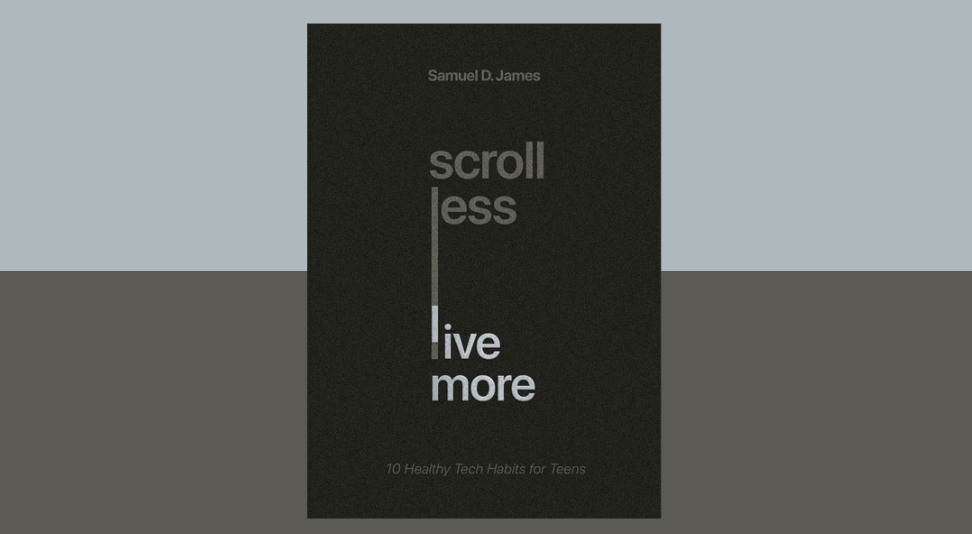
Scroll Less, Live More is my attempt to complete the project I started in Digital Liturgies.
From the beginning, I knew I wanted to talk to a younger audience. Why? Because I’ve become convinced that, when it comes to transforming tech habits, no arena matters more than the home. I represent a Millennial generation that was given digital powers so quickly and so thoroughly that most of our parents were overwhelmed. The discontinuity between the Internet and TV took them by surprise.
As a result, I’ve talked to many fellow millennials, and older Gen-Zers, who grieve the way their intellectual and emotional lives were dominated so early by technology. The way we learn to encounter the world as young teenagers is astonishingly powerful. It calibrates our entire lives. For that reason, Scroll Less, Live More primarily addresses Christian teens who are encountering their own digital technology maybe for the first time. The book is not a lecture. It is what I wish I would have known at 17.
Scroll Less hammers some particular themes hard. One of the most important is the disruption of a worldly notion of “privacy,” especially when it comes to devices. I think one of the most important things Christian families can do right now is to challenge and disassemble the notion that it’s normal for a teen (or an adult!) to have an entire world of images, videos, conversations, and hobbies that nobody else in their family is privy to. A “no-secrets” household is one where parents know passwords; where family computers are set up in common spaces; where texts, DMs, and search histories can become public at any time. It’s not just about accountability or safety. It’s about all of us unlearning mass media’s liturgy of a private existence of consumption.
The book is also about aiming for a life that is far richer than what you watch. In my own life I see very clearly how media consumption has frequently been the center of my existential gravity—the reason I declined invitations, or stayed up too late, or ignored that person. Life is risky. Content is safe. Now that the era of social media is over, replaced by a catalog of content producers and influencers, the temptation to numb the anxieties and uncertainties of life via our devices is intense.
Where does the inner resolve to resist it come from? Many things help (screen time limits, daily sabbaths, etc.), but one thing matters most: Feeling the gift and purpose of life. Our screens dominate our souls first and foremost because our souls have shrunk. I wrote Scroll Less, Live More to help teens see life as the blessing and adventure it is. No app can compare.
The final chapter of the book is titled “Live by Grace Alone.” Of all the tech-wise habits in the book, this is the one that determines how everything else will go. Christians are not just people with a worldview that makes them tech-skeptical. Christians are people who believe that our lives are more than the sum of the good choices we make. Ironically, the world of digital influencers is often a legalistic, punitive culture, where one wrong parenting or health choice can doom us. That’s not the gospel. Christ—wisdom incarnate—died and rose again, not only so that we could be wise like him, but that every moment of foolishness can be turned by grace for our good. That means it’s never too late to become wise with our technology. No one is too far gone.
Scroll Less, Live More is dedicated to my three children: Charlie, Ruthie, and Wesley. I pray the world they grow up in is a world where joy in real people and real things is easy. And I pray most of all that those real blessings lead invariably to the Giver of all good and perfect gifts, who makes all things new.
The Weekly Digest
Premier Thought Every Thursday.
All of our recent essays and podcasts, delivered to you. Free.
Free. Delivered Thursday mornings.