

Several years ago, a friend of mine took a job as a 2nd-grade teacher at a local, Christian school. She enrolled her three children, bought their uniforms, attended new faculty training, and was ready to jump feet-first into the school year. But a week before classes started, she learned that she had lost her job.
It turned out that a parent had looked her up online and discovered a book of confessional poems she had self-published years earlier. My friend had written about her husband’s addiction and the damage it had caused their marriage. Her short, Rupi Kaur-esque poems wrestle with sin, and, by the end of the book, rejoice in God’s triumph over it.
It is, in other words, a classically Christian book, which echoes the narrative arcs of both Peter and Paul and, in fact, all of salvation history. But parents at the school were concerned that her poems had drawn too near the flame of reality. The sin was too real, too grotesque. And so, they concluded, she couldn’t be trusted to teach their children.
The consequences for my friend were, of course, devastating. She left the school in shame and returned only to drop her children off and pick them up, each day experiencing the strange dissonance of entrusting her children to a school that had found her an unfit model of faith.
I tell you that story because one of the questions it raises has become a quiet obsession of mine: What role should sin play in Christian art?
Recently, I asked an evangelical friend what she thought about sin and art. She explained that Christians shouldn’t include details about sin because it could cause temptation. It might be fine to refer obliquely to sin as bondage or brokenness, but Christians, she argued, ought to avoid depicting the grimy reality.
That sentiment is often echoed in Christian publishing. Consider the veritable mountain of popular Christian novels published in the last decade that portray Christian characters entirely void of interior complexity and in which sin is either easily overcome or externalized.
In one sense, it’s an ancient thought, dating all the way back to Plato’s argument in Book III of the Republic for strict censorship in the interest of civic harmony and the health of the soul. Many Christian saints across the centuries have echoed Plato’s warning, encouraging the faithful to refrain from reading anything that could pollute the soul. In the 18th century, theologian Alphonsus Maria de Liguori put it this way:
As the reading of bad books fills the mind with worldly and poisonous sentiments; so, on the other hand, the reading of pious works fills the soul with holy thoughts and good desires.
Given the long Christian tradition of skepticism towards the corrupting influence of art, it is perhaps not surprising that Christian publishers and readers so often avoid literature that contains realistic, unsanitized depictions of sin. When the Christian school fired my friend, it was likely out of a pious belief that that she was operating outside of Christian norms. Her engagement with sin was personal, complex, and at times horrifyingly specific.
But, of course, Christian literature has another history, as well.
In the 4th century, Augustine wrote in detail about his moral failings. In his Confessions, Augustine described an early life spent in a “broiling sea of fornication” until his “restless passions alighted on” a woman he referred to as his mistress. With shocking honesty, he admits to living with this woman in an unmarried state for fifteen years, only to abandon her and their son to pursue a more socially tolerable marriage arranged by his mother.
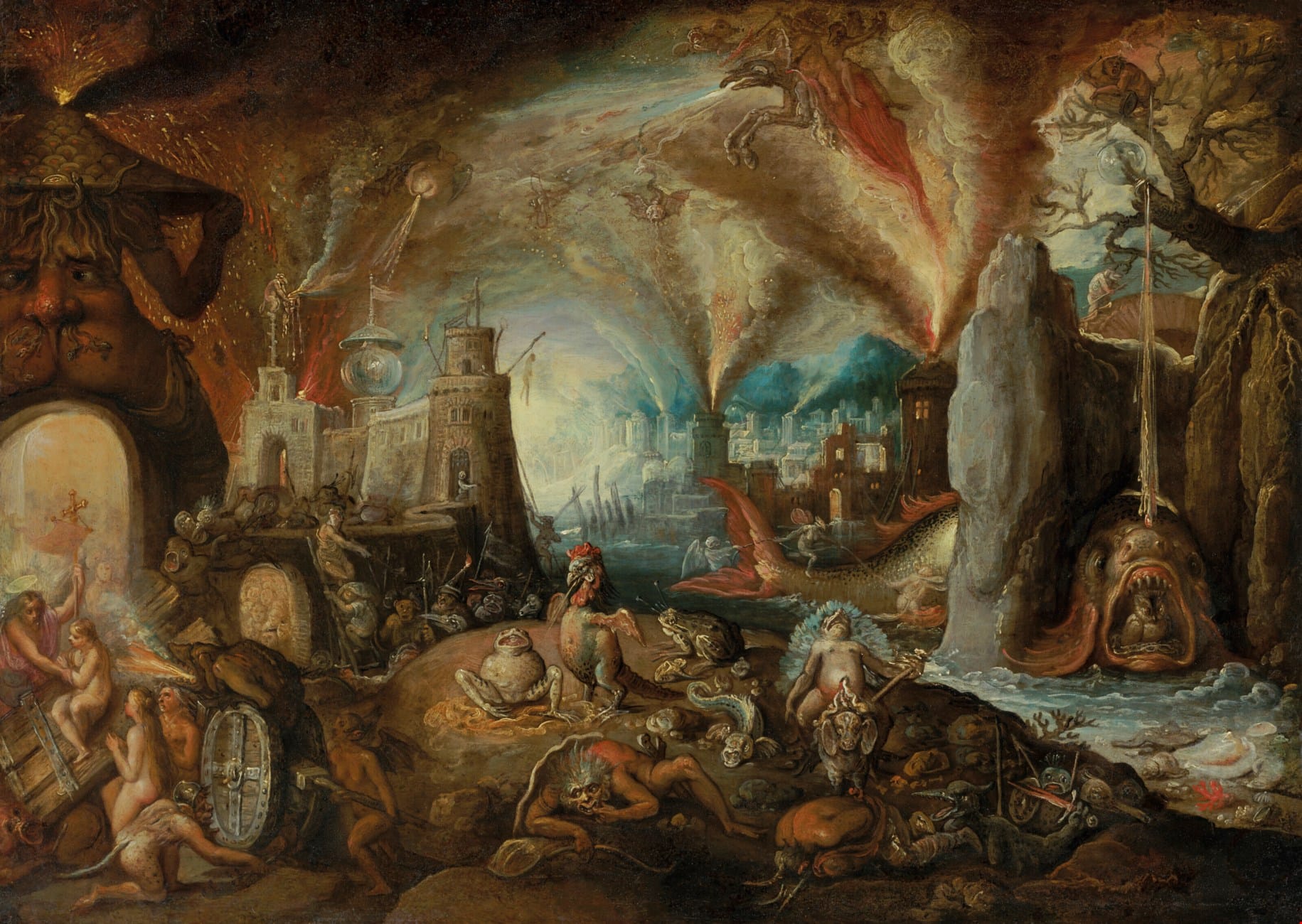
Several centuries on, Dante famously portrays the problem of sin in one of the greatest works of the Western tradition. In both the Inferno and Purgatorio, sin is depicted in nuanced and hideously vivid detail.
In this sense, both Augustine and Dante could be called spiritual realists. Their works hew closely to the reality of human experience in all its shame and glory, giving shape and breath to Saint Paul’s words in Romans: “For I do not do the good I want, but the evil I do not want is what I do.”
In fact, I would argue that all major Christian literary writers have been spiritual realists of some kind or another. Flannery O’Connor, Fyodor Dostoyevsky, Leo Tolstoy, Gerard Manley Hopkins, Graham Greene, C.S. Lewis, John Donne, George Herbert, Marilynne Robinson, and on and on. For each of these writers, sin is the woof of human experience, woven into and against the warp of mercy.
But here we must pause because there is an enormous difference between literature or entertainment that depicts sin as it is, with a robust understanding of its psychological, material, and spiritual consequences, and literature that depicts sin as it isn’t.
For instance, I have a hunch that not many readers of Dante find Francesca, an adulteress, overly seductive. I doubt anyone is tempted by her account of the affair. I would argue that is because Francesca’s sin is depicted as it actually is, which is to say, Dante reveals lust’s nakedness as sin, as fever, disease, and deformity.
On the other hand, Francesca describes how she and Paolo were enticed to consummate their lust while reading the story of Lancelot and Queen Guinevere.
One day, for pleasure, we read a book and learned
about Lancelot, how love trapped him within its spell.
At the time, we were alone and unconcerned.
But often, we blushed, as our eyes furtively fell
into each other’s…
There are layers here. Dante’s narrative voice sees Paolo and Francesca as they are, but Francesca’s story imagines the lovers caught, like Lancelot, in love’s net. A book is to blame. Or, the cosmic force of love. Even Paolo, Francesca suggests, is more to blame than she. By her telling, she was no more an agent of her sin than a leaf is an agent of its falling.
When sin is depicted in its reality and not as a celebration of self-creation, a humorous escapade, or a dark but potent sign of passionate genius, when its various masks are forcibly removed, what we see is an overwhelmingly sad and pathetic little worm. That’s what sin is. But we can’t get there is we’re afraid to mention the real thing.
Christian writers, readers, and publishers are faced with a question that is as theological as it is aesthetic: Can the Christian story survive reality?
I think most Christians will answer immediately in the affirmative. But isn’t that exactly what is in doubt when Christian literature is required to meet a purity standard? Purity, in an age of porn and gambling addiction epidemics, when people, including Christians, are conditioned increasingly to think of fulfillment in terms of personal satisfaction, click-activated dopamine release, and self-making, when hundreds of thousands if not millions of image-bearers on the internet rage at one another and take off their clothes and film themselves eating breakfast.
Aesthetically, purity standards create problems for writers. Instead of paying attention to the real lives of human beings, Christian novelists are encouraged by publishers and readers to deform reality in order to fit an idea of what ought to be. Often, the result is bad literature, although, of course, Eugene Vodolazkin, Alice McDermott, Louise Erdrich, Spencer Reese, and Christian Wiman (and many more) are all counterexamples of this claim. But in the problematic examples, characters defined by ideas don’t live on the page; they become two-dimensional stick puppets. The Christian ought limits which observations of reality a writer can include, a restriction that reduces the mystery, contradictions, confusions, and moral tensions of narrative and character.
Theologically, such standards convey a lack of trust in the gospel to cover and include the whole of creation. It seems that American Christian publishing is making a theological claim, intentionally or inadvertently, that the petty, sad, brutal, and gross realities of life are somehow outside the boundary of Christian consciousness. Sin, if it appears, must be located, either temporally or physically, outside of Christian life.
Flannery O’Connor once wrote of the Christian world’s emaciated understanding of evil:
There is something in us, as storytellers and as listeners to stories, that demands the redemptive act, that demands that what falls at least be offered the chance to be restored. The reader of today looks for this motion, and rightly so, but what he has forgotten is the cost of it. His sense of evil is diluted or lacking altogether, and so he has forgotten the price of restoration.
We want to see the redemptive arc, and, as O’Connor points out, we are right to seek it out in literature. It is the great pattern unfolding in all of creation. But there are two things that happen when we exclude honest engagement with sin (both in the world and in ourselves) from our art.
The first is that Christians who only consume decontaminated literature are setup to develop feeble moral imaginations. If all our stories say that Christians don’t wrestle with sin in the present tense, those who do wrestle (read: all of us) must choose between believing that our sins aren’t sins or that we, among our fellow believers, are uniquely sinful. Neither of which is true. Christians, in other words, are abandoned to sin by stories that won’t acknowledge its existence.
The second is that if our sense of evil “is diluted or lacking altogether,” what could we possibly mean when we said that our hope is in Christ’s mercy, his resurrection, and the joy of final restoration? To whatever extent I dim my awareness of the intractable evil in my own heart, I also diminish the need for Jesus Christ’s saving power. Put another way, how can we have real joy in the belief that we are saved, if we are afraid to talk about what we are being saved from?
One can hardly expect to leap, like Saint Peter, fully clothed from a boat at the sound of the Lord’s voice, heart running out ahead of him, to embrace his savior, if we have not also, like Peter, denied our king and God. Peter knew the depths of Christ’s love and power because he had already tasted the poverty of his own will and courage.
Literature can do many things: laude, lament, satirize, scrutinize, wonder aloud. But one of the most important capacities of literature is that it helps us to engage with reality. We enter the minds of other people, not just to pass the time, but to enlarge our perception of ourselves and the world we inhabit. What is real? What is not? How do we deceive ourselves? What is important? And what only pretends at importance?
Christian literature has the capacity to offer the most coherent picture of reality. There is no more existentially potent way to explain the state of the world than the story of salvation history. But if Christian literature is going to rise to that level, we must have writers and readers willing to abandon themselves to the hope that Christianity has nothing to fear from reality—and publishers willing to take the risk.
The Weekly Digest
Premier Thought Every Thursday.
All of our recent essays and podcasts, delivered to you. Free.
Free. Delivered Thursday mornings.