
In life or literature, tragedy is not so simple. My students may not live in a war zone, but they do know what it is to lose a home or family member to flood, fire, or tornado. They know that cancer or a car wreck can wreak havoc. They live with loss. For every educator, the hard realities of violence, death, and tragic circumstances often complicate what we teach, or more accurately, they complicate our thinking.
When we think of how our modern culture uses the word tragic or tragedy, we might assume it does not relate to the genre of tragedy or the study of Greek, Shakespearean, or modern tragedies. The word is as overused as the word hero or epic. But the overuse of the word tragedy does not negate its relevance. I think the greater understanding comes when we ask ourselves, “In times of tragedy, what is my human response?”
A Modern Response
A decade ago I read that tragedy seeps into a classroom eventually but teachers have a choice about what to do with it. At that time, it was a response to the Las Vegas shooting in 2017. An article in the Atlantic Journal Constitution posed a question to two Georgia literature teachers—“How Do Teachers Respond When Tragedy Seeps into Classrooms?”
In this article, one teacher says her classroom is a haven. Yes, she explores “canonical literature” but she is content to leave the struggles and crises outside. She explains, “While this may seem callous, I remember my school days and how classroom time was a reprieve from chaos outside of school...I craved the day-to-day regularity.”
The second teacher teaches current events and politics in her Advanced Placement Language course. She writes, “We face these very relevant social and political issues head on in the daily experience of the classroom environment. This experience can get emotional...personal. But what we work hard to do as AP Language teachers is to create a safe environment...Sensational news is not the nature of the classroom.” She explains how issues are investigated from many angles and how students must use evidence to support their opinions. Above all, they avoid “divisive, tribal labelling.”
The article, however, poses only two camps. The first teacher wants the comfort of routine, her classroom a haven, while tragedy remains outside. The second teacher implores logic and analysis in a safe environment. “Let’s discuss, use evidence, cut away sensationalism.”
I was left wondering if these teachers truly dealt with the reality and heartbreak of tragic circumstances with their students. What was real life like? It can’t be ignored. How much of the responsibility becomes ours as teachers? The article brought some clarity, but as an educator, a more pressing question came to me—how do we understand and treat with tragedy while also teaching it? Where do the lines blur for life and literature? Or do they at all?
When I took a classroom management course in college, I learned that before a certain behavior occurred in the classroom, I had to know by heart what I would do if I had any hope of being a consistent disciplinarian. Would I really give a detention every time I caught a student chewing gum? If two students stole class time by heatedly arguing in class, what would I do? I had to know how I would respond. My first few years of teaching taught me the truth of this.
In the same way over the years, I realized I had to know how I look at tragic circumstances, to consciously think of it. In the world of psychology, this practice is known as prepared response, to anticipate how we hope to respond to a negative situation. It has been part of company and education training since 2001, but it was nonexistent in my second year of teaching when one of my high school students died in a car wreck. I could express sympathy to his friends and family, but my interaction was limited. After a one semester class, we had not been close, yet his classmates were. They were carrying the sorrow and heavy loss of a young life cut short. I offered what comfort I could and gave some time in class for students to share memories. It felt like so little because it was.
As teachers, we can read about psychological biases and the stages of emergency preparation. We can take the required training and acknowledge that yes, we will talk about hard subjects in the classroom. But it is never easy. As much as we care for our students, we are not trained counselors, especially as we encounter grief and pain. Here we are as literature, history, and humanities teachers. We teach tragedies and likely know them better than we do the hearts of the individuals in the seats in front of us. And that uniquely is where I think part of the answer lies.
A Medieval Response
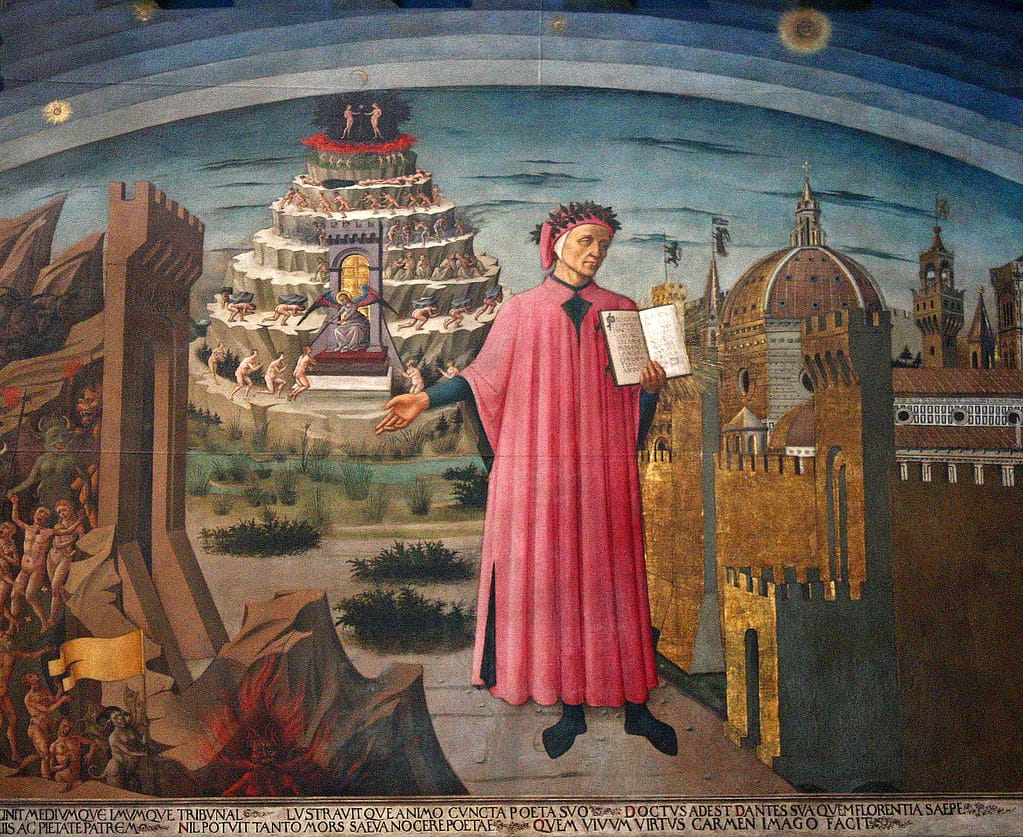
In the 13th century, Dante Alighieri was compelled to delineate between comedy and tragedy since many misunderstood the comic nature of his divine trilogy. Gene Edward Veith, Jr., addresses this in his chapter “Tragedy and Comedy: The Literature of Damnation and Salvation.” From Latin and Italian, la commedia meant “amusing spectacle” or “happy ending.” In light of a spiritual worldview, Dante asserted that his trilogy was comic because a man’s portrayed life could contain suffering and trial, but he knew of a joy to come, the hope and reality of eternity. His end was happy.
However, a story was considered tragic when the man depicted had lived a life with some measure of pleasure and joy yet had no hope of an afterlife or eternity with God. Though this view was rooted in the Aristotelian principles written before the time of Christ, Dante defined the two terms in light of how they begin and end. It was a simple view, but it was undeniably about a greater perspective.
Consider an inverse example. Twentieth century tragedies often reflect a lack of perspective, a lack of an eternal view. My students see this quite easily. Think of Willy Loman, even his son Happy, so ironically named in Arthur Miller’s Death of a Salesman. Does either have any idea of why they are on this earth? Do they know why they are unhappy and discontent? That is what is clear to the audience. This context, this lack, reveals so much in contrast to the earliest tragedies.
A Greek Response
In 300 BC Aristotle fully analyzed the measure of tragedy and comedy and literary theory according to his live observations in Poetics. He shows that it is more about actions than characters, saying “Tragedy is an imitation of action...an image of people acting.” Today, most students learn of Aristotle’s definitions in a much too simplistic way.
Several well-known student-help websites explain how Aristotle’s tragic hero should be virtuous, flawed, and suffer a reversal of fortune. Oh, and the audience should be sympathetic to the hero. That’s it. A bulleted list, nice graphics, and tragedy in a nutshell. No mention of fate or the role of the gods or any concept of a greater or eternal perspective.
It’s a good start, but I think the modern reader and student can appreciate the style and craft of the Greek tragedians. Aristotle saw the greater picture, the effect of the tragedy as a whole which he calls a “spectacle.” In her lecture notes Louise Cowan wrote about the spectacle as a work of art—
The work of art has its own world: that world is not cut off from the daily world in which we live, but it does not relate to it in any literal fashion. It is as works of art, then, that these tragedies must be seen; and that act, the act of seeing truly and clearly what is there is difficult enough.
Seeing a great soul in pain or death should transform these concepts of pain and death for us because tragedy involves the dignity and significance of human life, man’s ability to endure suffering, and more so the depth of shared suffering. Aristotle spoke in great detail of his observations. And those distinctions should not be oversimplified.
Heroes and Hamartia
In the 21st century classroom, one of the most common elements discussed is the simplistic idea of a tragic hero, a character that has fallen from a great height, most often due to a tragic flaw. Aristotle does indeed refer to such a lead character, but he clarifies that “decent men ought not to be shown changing from good to bad fortune (since this is neither frightening nor pitiable but repellent).” It has to be more than just a bad-luck story or one fall from virtue. That is not complex enough or human enough or real enough for Aristotle. Unfortunately, many students are unaware that the Greek term “hamartia” does not mean flaw at all or even “missing the mark.”
According to Aristotle, the tragic figure does not have a flaw. Read his translators. Aristotle never uses the word. The tragic story progresses from “good fortune to bad, not through badness of character but on account of a great missing of the mark.”
In the introduction to his translation, Joe Sachs states that “there is no tragedy...unless a characteristically good central figure is aiming at something exceptionally high. For there to be a ‘hamartia,’ there must first be a mark to be missed.” Hamartia in Greek does not mean flaw, vice, sin, or “badness of character” according to Sachs. That is too simple. It is a good person attempting to do something admirable, and yet they miss. Few students however are aware of this context or the carefully crafted nature of the Greek tragic hero.
Death
Another notion many students believe is that all tragedies must end in death. Or, at the very least, a tragic ending means a negative one. Aristotle agrees with the negative end but includes this as a possibility without limiting his definition. He believes that tragedy speaks “more of things that are universal” and realistic. They include the use of sudden reversals, discoveries, and suffering. Part of the idea of a reversal is that a character can be surprised by new information, revelation, or a “discovery” that is “awe-striking,” such as discovering kinship after a terrible deed.
Macbeth suddenly chooses ambition over life-long loyalty to his king. Oedipus is ignorant that his action is a terrible deed until he discovers the kinship afterwards. Luke Skywalker acts in ignorance for some time, suddenly finding out who his father is. Aristotle would approve. He did not advocate having the protagonist battle a clear opponent either, but if the hero was pitted against friend or family the situation was more pitiable. Yes, the hero’s end and the play’s end could contain death, but the tragedy itself was shaped by many factors.
Emotion
Greek tragedy is also created with an intentional emotional effect. At a live play or with guidance in a classroom, students today do recognize such emotions and empathize with the characters. Our human response is hard to deny. Aristotle clearly states that we should feel pity and fear for our main character “undeserving of misfortune and fear for one like us [ourselves].” Again, human perspective raises its head. Sachs explains,
It is by relation to the happiness or misery of that one character that the story comes to have a direction. If we are drawn toward that character rather than repulsed by him or her, our absorption in the story will dispose us to anticipate unfolding events with hope or fear, and to experience what comes to pass with gladness or regret.
Aristotle’s observations lend to a protagonist who is realistic, truly imitating humanity (“lifelike”), stirring our empathy. He can be both “responsible for and an undeserving victim of his own destruction...he is both guilty and innocent.” Our audience of modern students then can hopefully witness and appreciate the complexity of the tragic figure and experience the full effect Aristotle hoped for.
To me, this is the greatest benefit of reading and studying tragedy in story. Our humanness is clear, and perhaps our purpose in life is clarified, too. Tragedy can stir wonder because some assumption or opinion has been knocked away or held in abeyance for a moment. Seeing a great soul in pain or death should transform these concepts of pain and death for us because tragedy involves the dignity and significance of human life, and often, man’s ability to endure suffering. I could never claim to truly understand tragedy in our world today. It is not something I seek to understand either. But the glimpse into the realism Aristotle sought has given me a way of seeing I didn’t have before. It’s a seeing through and with tragic circumstances.
The Weekly Digest
Premier Thought Every Thursday.
All of our recent essays and podcasts, delivered to you. Free.
Free. Delivered Thursday mornings.