


If you’ve ever passed the mind-numbing hours of a car ride by watching raindrops converge on the window, you’ve witnessed a profound truth about human relationships. At least that’s what C.S. Lewis would argue. In his spiritual autobiography, Surprised by Joy, Lewis says there are some people you encounter who join with you like raindrops on a window.
This type of joining with others is what we were made for. We long for deep connection. In the words of sociologist Hartmut Rosa, we long to resonate with others. We want relationships that flourish in the deepest sense of the word.
Unfortunately, our very mode of life cuts our attempts at connecting off at the knees. In a digital age, our default posture is one of performance. If we are to move toward connection, we must relearn the purpose and art of conversation. To that end, my pastoral counseling professor, Dr. Jim Coffield, gave what has been the single most helpful framework for connecting with others and navigating conversations, not only as a pastor, but as a human desiring relationships.
Types of conversations
Dr. Coffield contends that there are three primary types of conversations:
1. Competitive
Think of these conversations as debate. There is no shortage of competitive “conversations” today. This is the primary mode of relating online. The basic goal of a competitive conversation is to win. Interactions like these are about me; never you or us.
All of us are guilty of engaging in competitive conversations. We wait (not so patiently) for our competitor to wrap up so we can deliver the monologue we have been mentally crafting while they spoke.
But because God’s kingdom is one of reconciliation, competitive conversations are rarely used as the impetus for kingdom transformation. Yes, Jesus had competitive conversations, especially with groups like the Pharisees. But he was always after the heart. It’s also worth remembering that he was God incarnate and could engage in competition with perfectly holy and pure intentions. Even so, his “competitive” interactions were riddled with narrative and parables––rhetorical strategies that connect with people deeply. Competitive conversations, at their worst, result in exhaustion. Jesus offers rest for souls.
Unfortunately for image bearers of God made for deep connection with others, competition is the implicit logic of the modern world. Rosa says such a mode of relating is the greatest enemy of connecting–of resonating–with someone. You simply cannot meaningfully connect with someone you are trying to beat.
But for anyone to keep their place in our accelerating society, according to Rosa, they must perform. He goes on:
The social logic of competition is such that the competitors have to invest more and more energies into the preservation of their competitiveness, until keeping up the latter is no longer a means to lead an autonomous life according to self-defined ends, but the single overarching goal of social and individual life alike.
Competition is not merely a means to an end; it has become the end. Compete or cease to exist (digitally speaking).
2. Content
Think of these conversations as a lecture. The goal of such conversations is to inform or educate; it’s a simple transfer of information. Content conversations serve a distinct purpose: Jesus himself used them in his many teachings like his Sermon on the Mount.
Again, however, Jesus used his information-transfer as a means of connecting. This is rarely the intended end of our content conversations. This much is clear when we step back and realize much of our content-transfer has actually removed the “other” entirely! We are able to give or get the information we need without engaging another soul.
Content conversations are inherently one-directional; however, now we are likely to either unload all our information into an X thread or Reddit post and then log off (literally severing the pathway to connecting with another) or we allow Claude to download his (its?) unlimited knowledge on our desired subject. Either way, we are far from connecting with anyone.
Further, the very role of content/information has developed in interesting ways in our “information” age. Byung-Chul Han argues that it is the overpresence of information–in contrast to narration–that accounts for much of our mental illness and our lack of any sense of meaning. Narrative connects us to others and a broader meaning; information silos us as we individually consume content.
In the digital age we live in 1 and 2. The default posture of online life is competitive, while at the same time one-directional. If we are not actively competing (posting), we are passively consuming (content).
3. Connecting
The third type of conversations are connecting conversations. The goal of these is to connect deeply with others. Such conversations serve as the pathway to resonance, but also redemption. These types of conversations are the ones most typically used as a catalyst for kingdom-transformation.
It’s no surprise, then, that these are the conversations we see Jesus having all throughout the gospels. Perhaps the most familiar is his conversation with the woman at the well in John 4. While not soft on truth, Jesus’ goal was profound connection––a connection that drew out dignity and suffocated shame. It’s telling that the woman went shouting into town, “Come, see a man who told me all that I ever did!” not “Come, see a man who told me I was wrong and he was right!”.
Rarely is anyone changed by, or even remembers, competitive conversations; this woman likely never forgot her encounter with Jesus.
So how do we learn how to do this well?
How do we apprentice ourselves to Jesus in the way of connecting conversations?
Anatomy of a Connecting Conversation
Dr. Coffield gave the building blocks of a connecting conversation and–unsurprisingly!–they coincide with Rosa’s axes of resonance.
Rosa has identified three primary axes where we are mostly likely to experience resonant–deeply connective–encounters:
- Vertical: meaning
- Horizontal: relationships
- Diagonal: objects
The anatomy of a connecting conversation is a movement from external, to internal, to eternal. It is a rough movement from diagonal, to horizontal, to vertical axes, respectively.
1. External
This level of conversation largely plays out in the axis of objects–the physical world around us. It’s made up of mundane “small talk.” However, this is not unimportant. Eugene Peterson chronicles his change in thinking about small talk:
If we avoid small talk, we abandon the very field in which we have been assigned to work. Most of people’s lives is not spent in crisis, not lived at the cutting edge of crucial issues. Most of us, most of the time, are engaged in simple, routine tasks, and small talk is the natural language. If pastors belittle it, we belittle what most people are doing most of the time, and the gospel is misrepresented.
It is at the external level that we must cultivate curiosity. Coffield would always say “God doesn’t write boring stories… if someone seems boring, they’re likely not telling you everything.”
Be curious (and patient) enough to get the details. And as you do, be curious about how they tell them––the body language they use or how they paint themselves in a story.
God writes no throwaway details.
2. Internal
This level moves from Rosa’s diagonal axis into the horizontal axis of relationships. Craig Barnes, in his book The Pastor As Minor Poet, says much of what is shared at the external level are really “veiled laments” over relational hurt. For instance, Barnes recounts the story of a couple who made an appointment with him and began rehearsing their complaints about the new organist. They didn’t like that she never used their old songs. They didn’t like how she conducted the choir. They didn’t like how she played the organ. External complaints.
However, Barnes skillfully realized they had both mentioned the previous music director, who happened to be a close friend of both of theirs. The trajectory of the meeting changed when Barnes commented on the former music director: “He was a great musician, and I know he was also a very close friend of yours. You must miss him a great deal.” From external to internal.
One practical question to aim internally is simply, “What was that like for you?” Now obviously we cannot deploy this question constantly during conversation. However, we must develop the skill of asking it in various ways:
“That must be exhausting…”
“Tell me more about that…”
“How has that been for you?”
Such questions mark an inward movement.
3. Eternal
This level is the goal of connecting conversations, and plays out on Rosa’s axis of meaning. The threads followed here make up the core of what is called “spiritual direction” or the “care of souls.” After drawing out some of their hopes, fears, and dreams, the questions then become:
“So what do you think God’s up to in all of this?”
“I wonder how God might redeem this situation…”
God is always at work in others’ lives and has been long before we encounter them. With questions like these we are (gently and appropriately) inviting ourselves into the work God is already doing.
Peterson said one of the descriptions of a pastor (and we could broaden this to any who seek to connect deeply with others) should be “apocalyptic.” Apocalypse as a genre uncovers; it pulls back the curtain on how things really are. Apocalypse is arson, Peterson says. It has a way of setting a fire in the imagination and boiling out all that is unnecessary and unhelpful, leaving behind the reality of God’s work in his world.
The work of soul care isn’t making something happen in another. It is pulling back the curtain on what God is already making happen. It’s following the divine smoke. It is the work of making clear the “subtext” of life, as Barnes calls it.
We can visualize this process of moving toward connecting on the graph below. Increasingly, our default mode of relating is in sector 1 which remains external and is dominated by competition. Deep connection and soul care happen as we move toward sector 2, where we connect with other image bearers and are aware of how God is at work in their lives.
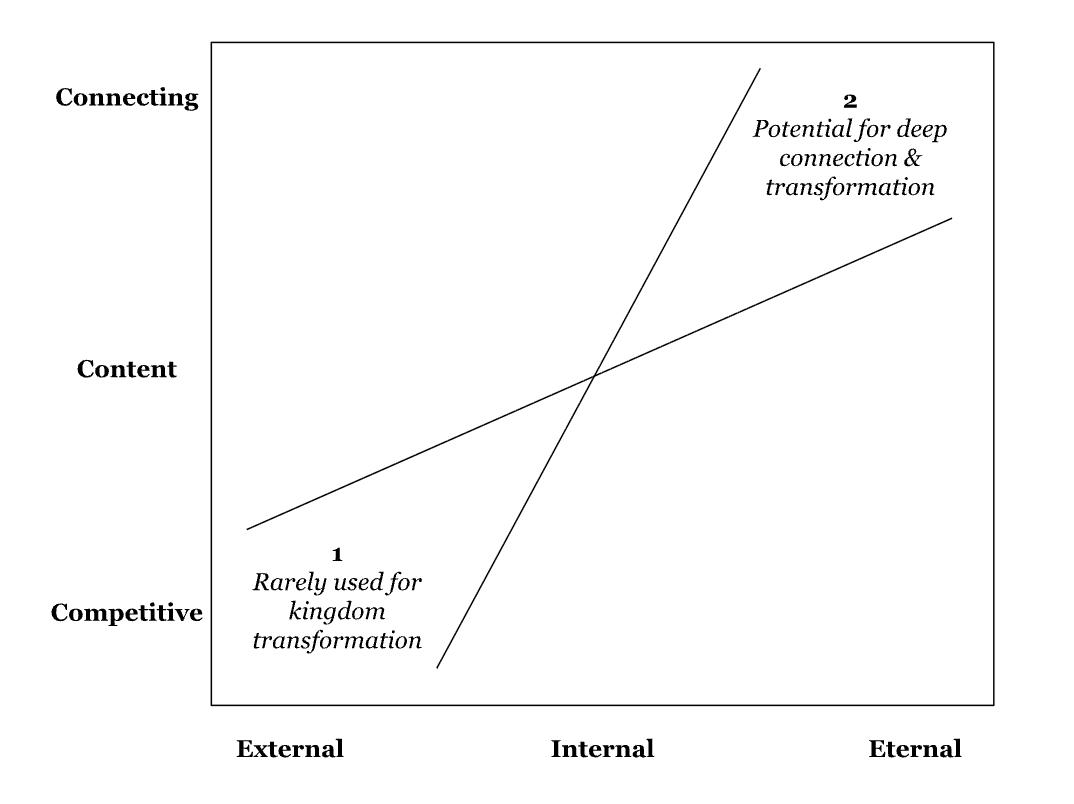
It should be said, though, that this is not a mechanical process––it is an art that we must feel our way through. Oftentimes the movement from just external to internal takes weeks or months. Other times, we are able to connect deeply in a matter of minutes.
As we move upward and toward the right on the graph, purely competitive and external conversations become less likely, while connecting and eternal conversations become more likely. Much of our mode of relating to the world reinforces our tendency to stay in sector 1, while the connection we were made for is at the end of resisting our competitive and information driven world.
***
Jesus, as the Son of God, had every right to “win” every conversation he ever had; indeed, he has no worthy competitors. However, in his grace he moved toward his creation, dwelling among us so that he could share his eternal life with us––drawing us into himself like a raindrop.
It is this shared life of Jesus in us that removes our need to win and enables us to live the life we were made for––to collide with others like raindrops on a window. Only in Jesus do we have the spiritual resources to suspend competition, to be recaptured by narrative over mere information, and to follow the apocalyptic smoke to the eternal flames burning in those around us.
The Weekly Digest
Premier Thought Every Thursday.
All of our recent essays and podcasts, delivered to you. Free.
Free. Delivered Thursday mornings.