
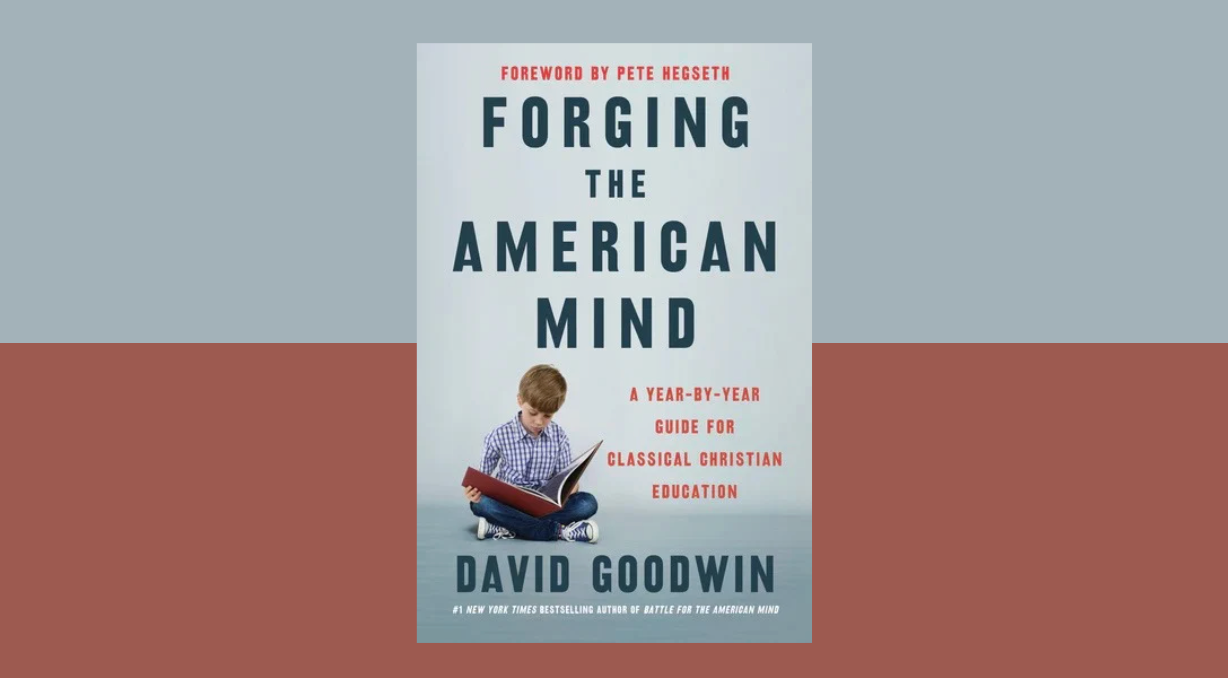
David Goodwin. Forging the American Mind: A Year-by-Year Guide for Classical Christian Education (Broadside Books, 2026).
In 1996, as a new immigrant to America, I started my study of Latin at a North Carolina public school. Fifteen years later, as an adult with a PhD in Classics, I came to Christ, and my academic study of the ancient languages played an instrumental role in that conversion. Reading the Gospels in Greek moved me in ways for which I do not quite have words—this was reading that truly touched the soul.
I have spent the years since then homeschooling my children, and the study of Latin and Greek has been an important part of the program I have adopted. But also, we have generally followed the precepts of what many now refer to as classical Christian education. The term is admittedly nebulous and overused—sort of like every grocery store of late jumping on board with the protein craze to cram protein into the most unlikely things—protein bread, protein cookies, protein pasta, or protein iced coffee. So it is that every private school now claims to be “classical,” simply because that is the buzz word for good education, and if you’re a good parent, obviously you want the best education you can get for your children, right? But what actually is classical Christian education, at its core? And what makes it so good?
These are questions that David Goodwin has thought much about of late, and his new book, Forging the American Mind provides answers, moving from the elementary grades through the end of high school. Goodwin’s own education, he admits, was spotty: “I was about thirty years old before I heard of classical education, and forty before I started my own trek to get one. The payoff is great. I went to state college and got all the way through without even reading a real classic work. I believe anyone can get a classical education if they want one.”
The book is heavy on the prescriptive—for each grouping of grades, Goodwin offers the essential learning outcomes and ideas that classical Christian education would offer for that age, including an essential reading list. In grades K-1, for instance, the key is “cultivating order and memory.” Kids learn how to behave in a particular setting, and they memorize vast quantities of information, because their young brains are naturally wired for this kind of learning. For example, my two older sons were enrolled in Classical Conversations, a classical Christian co-op, for many years. For each child, the early grades were a time of memorizing an astonishing amount of history facts, math facts, and much more. My oldest son skipped a grade in elementary school, because his memorization of math made multiplication and division “click” right away, so we ran out of one grade’s material in the middle of the year and figured we’d go on to another one. The same child later did have to repeat eighth grade, reminding us that children’s learning progression is not steadily linear, but there are developmental leaps and bounds involved.
For grades 2-4, Goodwin emphasizes “introducing history as God’s story” as well as perfecting literacy skills. Then in grades 5-6, students are beginning dialectic training while continuing to cultivate the imagination through the reading of good books. “We should read our children the stories that motivate them to love what God loves and hate what God hates,” he reflects. “This is as true of chemistry as it is of history. It’s as true of math as it’s true of the Bible. Everything has a story, and so everything must be told in a way that leads our kids to love what Christ loves, so they will desire what He desires, so they will live like He lived. Without stories, facts are meaningless.” This is a beautiful and holistic vision, harkening back to the integration of all fields of learning in the Medieval university under the reign of theology, the chief of all disciplines.
While the early grades are the “grammar” stage of education—the building of key foundations—grades 7-12 are where serious learning can happen precisely because students have the building blocks in mind and can retrieve all of these facts they’ve been memorizing all along to put together a more sophisticated picture of the world. It really is fascinating to watch, for instance, a child who has read a novel set during a particular period make connections to the period in question and go on to discuss and analyze the text more deeply. Reading the Chronicles of Narnia, my eleven-year-old can talk about Britain during WWII, and C.S. Lewis’s public evangelism on the radio. His understanding of the historical place and time when Lewis wrote enhances his understanding of the novels, as does his knowledge of Lewis’s broader apologetic writing.
At all stages, Goodwin emphasizes surrounding students with things that are good, true, and beautiful—especially in the literature that they consume. Classical Christian education is rooted in the virtues, he reflects early in the book—“the look and feel of school” has to be built on the cardinal virtues, the faith virtues (also known as the heavenly virtues). These overlap with the fruits of the Holy Spirit, and the code of chivalry could also be useful to discuss with young children. Such foundation of the virtues and discipline is the essential sine-qua-non for learning is what sets the attitude towards learning in classical Christian school apart from public schools, whose students may never hear mention of the virtues, for instance. And that’s a pity. As writers from antiquity to a fairly recent period of modernity openly recognized, virtuous citizens are better for any state than ones who are not. Prioritizing an education in the virtues, therefore, is a political exercise of supreme importance for the wellbeing of any state. Classical Christian education today certainly aims to recover this mission—thus the emphasis in the book’s title on “the American Mind.” This education, in other words, is a key civilizational enterprise for our country’s future.
In making these arguments, Goodwin’s book is not innovative or earth-shattering. Rather, it is a thoughtful, straightforward, and readily usable reference tool for a parent who is new to classical Christian education and is looking for a clear philosophical explanation of what to do with students, when to do it (level-wise), and (most important) why.
And yet, I opened the book with a feeling of unease. Yes, this is a book on classical Christian education—what it is, and why it is good for America. I found myself nodding along a lot as I read. But why does this book boast a foreword from Pete Hegseth, a man whose own life both before and after his entering the political sphere exemplifies none of the virtues that we hope our children will acquire from classical Christian education? Are there no better role models to invoke in this important task?
Indeed, the present book is a sequel to Goodwin’s earlier collaboration with Hegseth—The Battle for the American Mind, which thoroughly criticized the present state of American public education. That criticism was well deserved, yet any talk of discipline and virtues and wisdom from Hegseth, a man utterly lacking in all of these areas, rings hollow and disingenuous. I understand that publishing is a business, and publishers need to sell books. But I also find it alarming that this seems to be the way to sell classical Christian education in America right now—by connecting it to individuals like Doug Wilson or Pete Hegseth, whose public witness is less than savory. With friends like these, who needs enemies?
America does need classical Christian education, but I hope that those who choose this educational method for their children do not overlook the importance of truly following the virtues that this education promises to instill in us no less than in our children.
The Weekly Digest
Premier Thought Every Thursday.
All of our recent essays and podcasts, delivered to you. Free.
Free. Delivered Thursday mornings.