




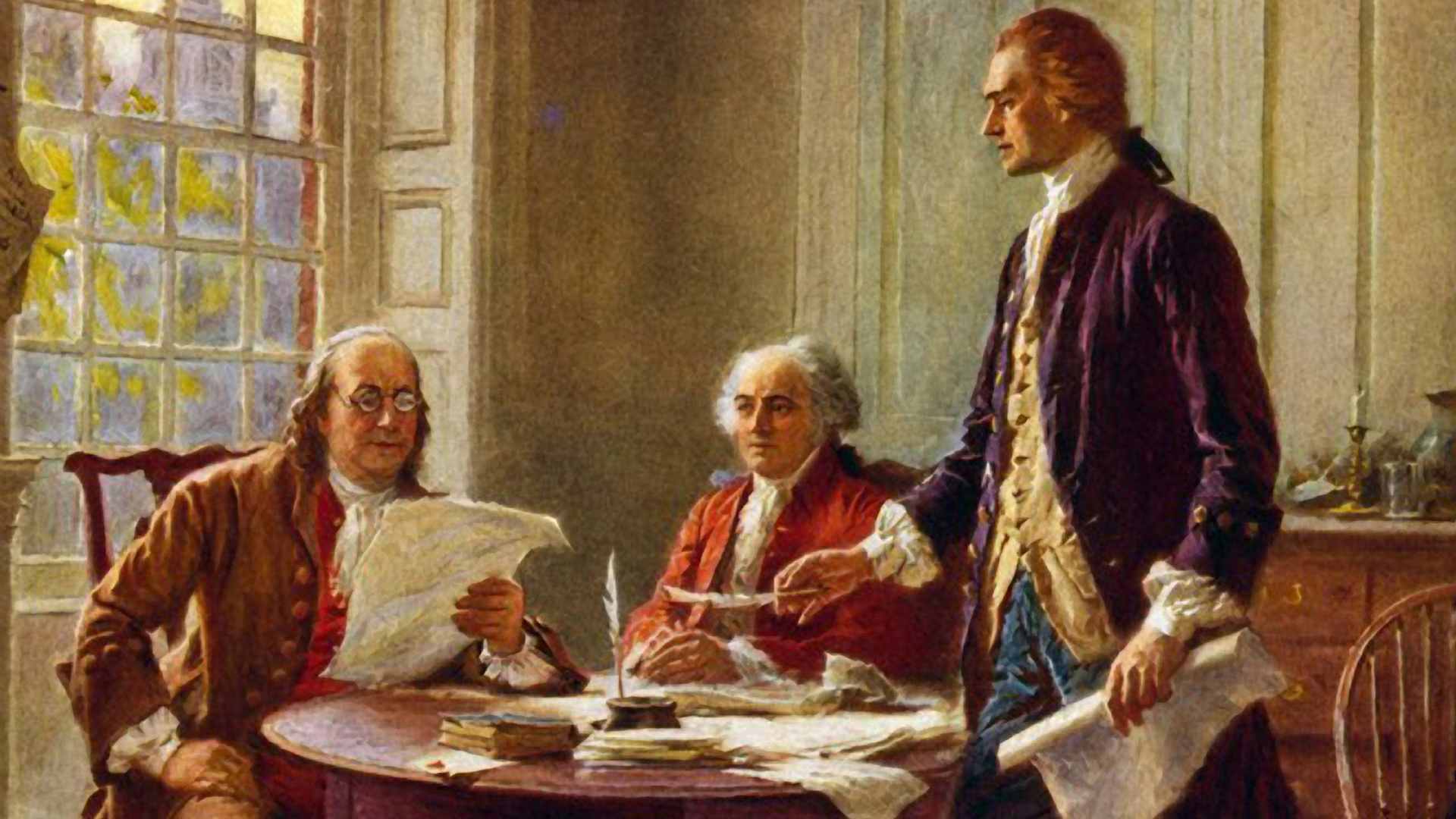
Our calling as Christians is to be in the world but not of it (John 17:16). We hear and say this so often, it verges on a cliché. But what does this calling mean for us as American Christians on the eve of America’s 250th birthday? Or, to put it another way, how might we think about the nation's 250th birthday as Christians and Americans? Earlier this week, Jake Meador proposed this answer to open the conversation: “The shortest way of answering the question is to say that America is a country that generally does not imprison her chaotic saints.” In this week’s three-day forum, theologians, historians, and public thinkers share their own responses.
***
So Much Freedom
Vika Pechersky
Our arrival in the U.S. was in many ways banal and typical of countless immigrants before us—it was driven primarily by economic reasons; we sought opportunities our country no longer offered. Young newlyweds, my husband and I came with two suitcases and enough money for about a month until his first paycheck.
I arrived with certain ideas about what America is. These were typical of immigrants. After all, to quote Bono, America is an idea. I imagined a country of giants—tall buildings glistening in the sun—of all kinds of shapes and breathtaking heights. In my childhood, I tried to imagine what it feels like to ride an elevator to the 100th floor. Freedom and wonder are the best words to describe what I felt as I boarded the plane to come here.
As a Christian who learned about Jesus through missionaries and about American culture through Hollywood, I thought that everyone in the U.S. was basically a Christian. This is also common to many immigrants—an expectation that America is composed of Christians who diligently adhere to the faith of their fathers. Coming from Uzbekistan, one of the most hostile countries to Christianity, living in a Christian culture was a much-welcome reprieve. What I didn’t expect was to find a culture in outright rebellion against its Christian roots.
Now, more than twenty years later, as a parent of teenagers, America today still feels to me like a defiant child, acting out in a fit of hormonal adolescence, standing up to its Christian parents to break away from their influence and assert its cultural independence. Is it just a stage? I surely hope so. Will it outgrow its defiance and realize that a tree with severed roots never truly regenerates? Or, better yet, perhaps America will come to realize that it can never truly sever its roots; that some things come together at conception and remain there, so ingrained, so steady, that no historical process can fully erase them. I hope that what truly lasts, despite the gruesome reality of historical erasure, is a simple Christian belief that God, who became man for us and for our salvation, remains the steady presence that gives us both guidance and meaning.
America offers so much freedom—sometimes more than we know what to do with. It is still the best place for opportunities to build one’s life with God-given talents. However, to be a Christian in America today is to exercise the emotional intelligence of a wise parent who understands that underneath rebellion lies a deeper longing for meaning and belonging that may not have forgotten its way home yet.
***
America is Not a Church, and the Church is Not America
Daniel G. Hummel
Though disestablished, revivalist, evangelical Christianity predates 1776, I can’t help thinking about its legacy on the nation’s 250th birthday. I am one of that tribe and have been my whole life—as were my parents and their parents.
I recently read an academic book that argued that evangelical missionaries exported their spiritual values of individual conversion, church volunteerism, the low church “priesthood of all believers” across the globe. By pursuing the religious aims of conversion, they ended up wielding remarkable political influence in postcolonial countries. Reflecting on my own childhood as a “missionary kid,” I found this an intuitive insight: Evangelical Christianity is deeply formed by both Christian and American values. Though I value many Christians and other faith traditions outside America, I can hardly imagine being a Christian without these values and their implications of individual conversion, congregational polity, lay leadership, and more.
A lack of imagination may be my failing. I might be too much an American and not enough a Christian. Still, I resonate with Tocqueville’s observation that Americans “combine the notions of Christianity and of liberty so intimately in their minds, that it is impossible to make them conceive the one without the other.” Most Americans do this, even those who aren’t evangelicals and those who claim immunity to it. At its best, this majority has understood liberty as both negative and positive (in Isaiah Berlin’s categories): freedom from external coercion and freedom to pursue one’s ultimate purpose in God. My tribe, like American culture generally, has majored in “freedom from” and left others to instill the capacity for “freedom to.” That was unrealistic, and we have paid for it: we are in a major “freedom to” deficit at our 250th anniversary—both the United States and American Christians.
Having overemphasized “freedom from” and failed to articulate “freedom to,” we face a crisis of purpose in which the path forward looks political rather than what it should be: congregations seeking the good of the cities they inhabit. But I am also hopeful, as evangelicals should be. Paul urges the church in Rome, “Do not conform to the pattern of this world, but be transformed by the renewing of your mind” (Romans 12:2). The church in Rome—like those in Corinth and Thessalonica—faced a similar “freedom to” problem. A modern-day Paul could lift whole passages and apply them to the church in Los Angeles, Dallas, or Madison, WI in 2026. God was faithful then and he will be now.
America is not a church, and the Church is not America. This is all the better, as my evangelical commitments should lead me to conclude. But America has many churches on its 250th anniversary, and those churches are called to seek the good of their cities, as past generations were. This political anniversary prompts in me a religious rather than political response—I hope it will prompt congregational responses of Biblically informed “freedom to.” American Christians—plenty of evangelicals among them—are already doing that, especially at the local level, modeling what a faithful witness of “freedom to” might look like for the next 250 years.
***
Was the Founding a Theological Event?
John Ehrett
Ever since I can remember, I’ve been surrounded by arguments about whether America is a “Christian nation.” Virtually always, those debates are pegged to the Founding generation—as if the “Christian-ness” of the nation might inhere for all time in a set of founding documents or a solemn juridical covenant.
But the American Founding itself was rather more theologically ambivalent than any partisan might like. It was grounded in what James Davison Hunter has called the “hybrid-Enlightenment consensus”—a paradigm that blended basic Christian assumptions with emerging scientific pragmatism, and that was characterized by some discomfort with received institutional religiosity and by a high degree of openness to heterodox thinking. Final resolution of theological questions, in any “thick” sense, was deferred.
And so, it seems to me that arguments about whether America was founded as a “Christian nation” often miss the point. Instead, I’d argue that for its entire lifespan, ours is a country and society that has been working, however inconclusively, at becoming Christian, or at least reckoning at some level with the claims of the faith.
All throughout its history, the American nation has been periodically convulsed by society-wide moments of spiritual questing. Most famously, there were the First and Second Great Awakenings—massive-scale social upheavals defined by public attentiveness to, and longing for, spiritual realities beyond the horizon of the mundane. They produced some of the profoundest theology, and most controversial splinter groups, in national history. And—crucially—they were individualist, interiorizing, and highly emotive. They were summons not merely to participation in a common cultural project, but to personal conversion and transformation.
There was a Third—and then a Fourth—Great Awakening, too. The 1960s represented just such an episode, but a more fateful one: this time around, the old wineskins—that is to say, traditional institutions and culture—failed to hold the new wine. And, following Joshua Mitchell, I’d argue something similar characterized the social justice movement that blazed from roughly 2015 to 2023.
Viewed in context, these episodes followed the same pattern as their forerunners: they were far-reaching, culturally transformative attempts to recapture something of transcendent truth against the backdrop of mundane existence. They insisted on interior redemption, not merely acquiescence. And both had a covertly Christian provenance: mystical encounter with God (in the former case) and the quest for eternal justice (in the latter) are both facets of the Christian tradition. But in the end, when torn from a robustly theological mooring, they became forces of disintegration.
Perhaps, in the end, the very theological ambivalence of the Founding is itself a touchstone of the religious vitality of American life. Here in our land, the perennial Christian summons to faithful presence—and personal faith—is urgent precisely because history permits no complacent assumption of a univocal religio-nationalist tradition. Whether American can be a Christian land, and what exactly that means, is a question to be asked and answered over and over again.
There is reason for humility, but also a certain tempestuous grace, in this. I, for one, am grateful for such a country where my ancestors—fleeing religious persecution in the Old World—could make their home. They did not arrive with great ambitions, but came as farmers and teachers and ministers seeking to worship, pray, and teach in their own way, and to weave their lives into the story of America’s ongoing reckoning with its God. May that story continue for centuries more to come.
***
For the Love of America
Amy Mantravadi
Whenever July 4th comes around, people talk about how much they love America. It is a love we express chiefly by setting off fireworks in the driveway and sending every neighborhood dog into a panic. But what do we mean when we say we love “America”? Do we mean this land that gives its bounty or these fresh waters fit to drink? Is “America” an idea of freedom, or goodness, or strength? Is it the factories that forge our steel, the labs that produce our medications, or the universities that train our students? Or is it the host of people who have made this land their home?
The one thing we seem sure of is that there are other Americans who do not love America quite as much we do. But again, what do we mean when we say we love America? Do we love these people, 340 million strong? The light and dark ones, the old and young, the rich and poor, the sensible and wayward? Do we love only those who love us, or do we love all our neighbors? And do we love the stranger, the alien who sojourns among us?
To love America means to love the whole: every person made in the image of God. It is to seek the common good, love your neighbor, pray for your enemy, hope all things, and repent of all wrongs. It is to look in gratitude upon the gifts of God—the fertile fields, the abundant waters, the human ingenuity, the peace our strength has bought us—while acknowledging the sins of man. It is to build homes and live in them: to tend to one’s business, raise one’s family, treasure one’s friends, and not despair in times of hardship.
For we are great when we seek the Giver of life, hope, freedom, and love. As we celebrate the nation’s sesquicentennial, let us remember who it is that allows us to prosper and shows mercy rather than judgment. The call of Scripture is not merely to pray that our land might be healed, but to humble ourselves and acknowledge the unique goodness of the Giver. For only in loving all her people will we begin to love America as God loves her: based not on her deserts, but the mercy only he can give. “America! America! God shed his grace on thee.”
The Weekly Digest
Premier Thought Every Thursday.
All of our recent essays and podcasts, delivered to you. Free.
Free. Delivered Thursday mornings.