Lost baby birds are not very important.
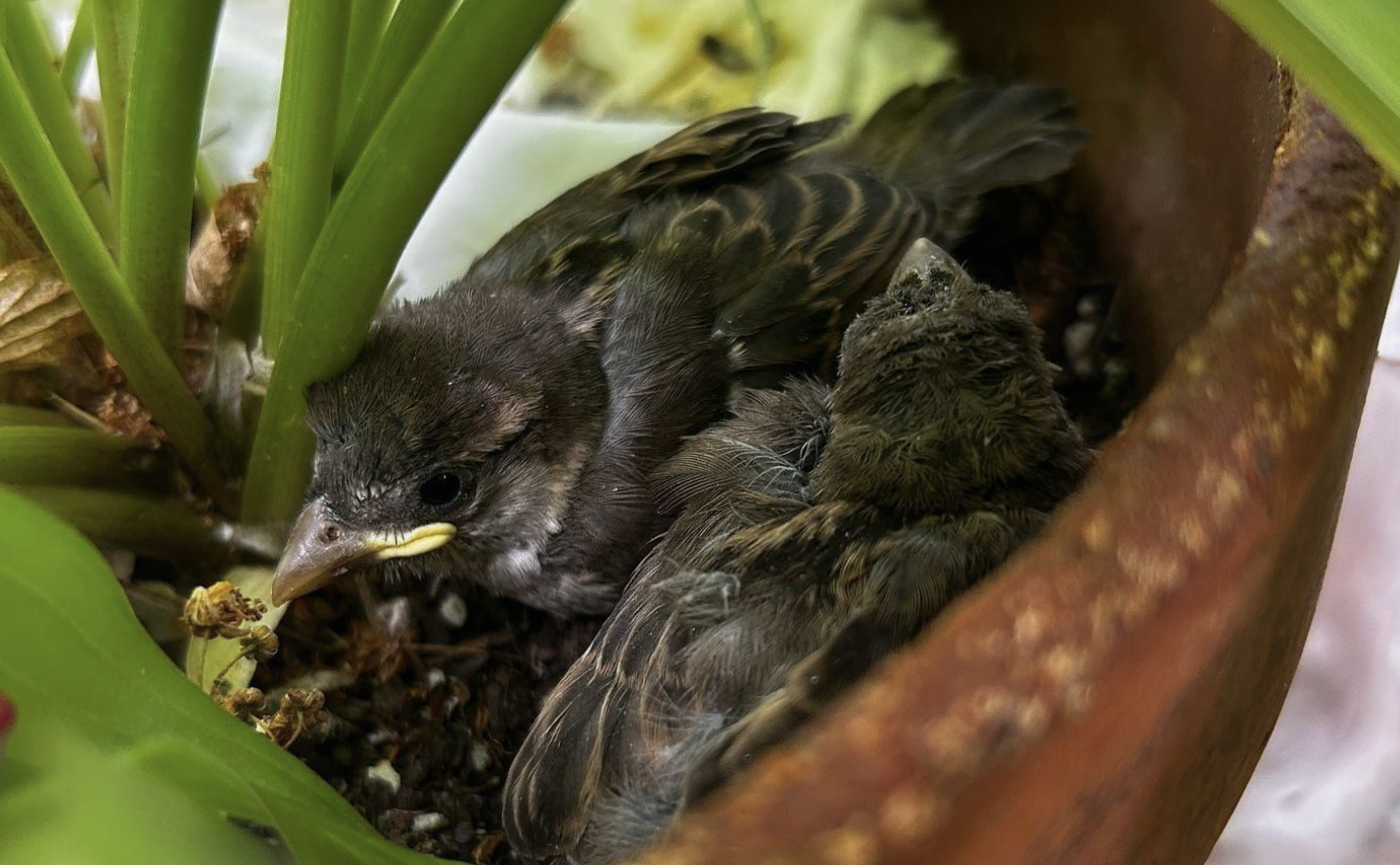
The world does not tend to wait for them, and doesn’t even pause as it might for other pieces of earthly life we must bear. A little fledgling, barely feathered and incapable of flight, that has fallen out of its nest and is stranded amongst the brick is not important.
What’s important is that dinner needs to be on the table for the kids in twenty minutes; what’s important is that relationship that’s on the rocks with no relief in sight; what’s important is that I need to get to work on time so that I can cover rent so that I can continue to be as self-sufficient as any grad student can be, but the train across the city is delayed; what’s important is that many people are dead because USAID was dismantled without a moment’s notice; what matters is that your church said nothing when it happened; what matters is that you’re headed to a new school tomorrow and the anxiety is eating your insides like acid and you’re terrified of eating lunch alone and your hair is stringy and you wish the dress fit better and looked more like you; what’s important is that you no longer recognize the country you thought you had grown up in; what’s important is that your father has had a stroke, and you don’t know if he will be able to speak again; what’s important is that you have always had to lift yourself up, and no one who has the power to help has never noticed enough to try; what matters is that you are alone, and you can’t imagine that life might ever change.
There is a baby bird sitting on my welcome mat when I come home from work. The bird is lucky, all things considered. The bar had hosted a graduation party that night, and rather than blinking blearily through a midnight haze after standing through eight hours of customers both kind and cantankerous and sweating profusely in a dish room full of billowing steam, the only tiring part of the night has been pouring an unholy number of diet cokes for the Class of 2026 and keeping my eye on the wine-drunk mother stealing the giant bowl of party chips.
All that to say, it’s been an easy shift and I’m home early, and so I manage to notice the small bundle of feathers quivering above the “we’re glad you’re here” printed on the mat. I set aside the box of chips I pilfered from the party leftovers that escaped the grasp of the PTA, and scoop him up after facing down some indignant flapping. It is, in fact, a myth that birds will abandon their baby if you do. My roommate is quite taken aback when I ring the doorbell with a bird in my hand—my keys are deep in my backpack, and I don’t want to drop the little fellow—and she is downright indignant herself when I bring him inside. He is very small, and I cannot find any sign of a nest.
My roommate is starting a brand new, hard-won job in the morning. She does not have time to decide what to do with a baby bird. I myself need to leave early in the morning to meet my father, someone I miss desperately, far outside the city for breakfast where he is visiting for a conference. My attempts at rescuing baby birds in the past have rarely gone well, though they have been numerous, and I am not optimistic.
But I do as my brief research stint bids and look amongst my landlord’s small plot of garden outside their beautiful townhouse and our hidden “english basement” below for a suitable place to give him the best chance at surviving the night and reuniting with mother bird in the morning. There is a planter with a small hosta plant elevated several feet off the ground, far above the rats of D.C. and the odd cat passing through. I tuck him in with some tissues, hiding him amongst the leaves, and look up at the silent canopy of the maple tree stretching far above me. It is silent, devoid of any parental bird noises, and very dark. My phone dings with a headline, something about our President’s slush fund to reward his political friends. I have to go inside—to follow up on the email I forgot to send, make sure the electricity bill is paid by midnight, have some dinner before bed, see if there is anything I can do to ease my roommate’s mounting anxiety about tomorrow. There are far too many important things to worry about.
My landlord’s garden is one of my favorite parts of living in our little Hobbit Hole. He has a great love of greenery, and the result is that I can spot the townhouse from all the way down the block and am greeted by a forest of planters, garden statues, and fragrant fauna when I make it home. The lush, verdant abundance of leaves springing out from bushes, the plentitude of potted ferns, the spider plants cascading down from an empty stone fountain, and a Japanese maple stretching lowly above it all almost makes up for the swarms of mosquitoes it inevitably summons in the late summer.
But today I am grateful, both because it has provided a temporary sanctuary for a lost baby bird, and because it reminds me of the understory—the life of a forest far below the canopy and just above the ground level that provides nourishment, shelter, and a nursery for the up-and-coming growth of the woodland. It also just so happens to be the name of the conference I spent three days attending just a couple of weeks ago. Both are rather extraordinary things to find in the heart of Washington, D.C.
Actually, they were rather insistent that the Understory was in fact not a conference, but a festival. The Understory Festival. It was not, as the name might suggest, a gathering of Park Rangers or enthusiastic environmentalists, though I suspect both could have been in attendance. It is actually a bit difficult to define, even after spending all weekend at its many events and listening to a plethora of welcome speeches, which reflects both the wide and varied nature of the kinds of people it attracted, and its own intentional uncertainty. I will use its creators’ own words to lieu of my own:
We find ourselves living in a time between times—when inherited frameworks are collapsing, trust in one another and in our institutions is eroding, and power, untethered from humility, too often turns predatory.…The Understory is not a conference but a people—a founding moment for a rising world of writers, artists, weavers, and civic builders to gather around a shared question: How might we rehumanize our common life and renew trust—between persons, and within the institutions that exist and those yet to be born?
I read between the lines—if you were grieving what society had lost in this last decade and beyond, if you were dismayed at the destruction that had been wrought in the last year and a half, and particularly if you were a Christian lamenting how this could have happened in an American Church you thought you understood, and if you were wondering where we could possibly go from here, this was the place for you. The existential weight of our times is an ache that I have struggled to learn to carry gracefully for years now, and so I could not sign up fast enough when registration opened in February. I was worn out in February. Come the last few days of May, I was entirely and utterly exhausted.
The year had been hard, though I don’t want to pretend that it was unique. If you are leaving a home that loves you, the first year out is hard for everybody. The first year spent across the country from childhood friends who remember what you wore in second grade is hard for everybody. Finding a real job, paying real rent, and buying real groceries on your own for the first time is hard for everybody. I was fortunate enough to not have to truly face most of those circumstances until I turned 24, but the fact remains that these turning points are hard for everybody, and they’re even more difficult when you have to learn how to do them all at the same time.
When I came to the Understory, I was coming off my first year of grad school and perhaps the hardest year of my life up to that point. I had discovered in the late July of 2025 that I needed to move from Chicago to Washington D.C. in less than a month for a program that I had applied to because it excited me, because I needed a doorway to D.C., and because I didn’t know what else to do. I couldn’t find a job to cover student expenses that fit my interests—blame it on the market, blame it on slashed government programs, blame it on my insufficient resume—and turned to the service industry instead. I had never worked in hospitality in my life, and I must have submitted over thirty applications before I got an interview based on a manager’s whim and an overly enthusiastic cover letter. I was working nearly thirty hours a week at one point, coming home at all hours and wondering how in the world I was going to make it to my 8:30am class in the morning. Personal losses at home were made all the more devastating by distance.
The role that I had intended to take on in this city—of representing Christ in a community often filled with polarized assumptions, a demand to hate the left or right, and a blatant embrace of power over principle—gave me purpose, but it did not give me comfort. It did not give me peace. Obligation settled thickly across my shoulders every place I entered into and left no time or money or space for easy laughter, real rest, or trusted friendship. I was here, having the kinds of conversations I had come to D.C. for, taking the little steps towards making a difference, and yet all I could think about was that I hadn’t seen my hometown in almost five months. These turning points of life are indeed hard for everybody, and I have wished many times this year that knowing such a truth was enough to make it less hard for me.
When I leave early the next morning to meet my father, the first light is just peeking over the roofs across the street. The air is very cool and quiet, and so there is no missing it when the mother bird leaps out of the potted hosta plant with a furious flutter at my interruption. I exclaim quietly with joy, not wanting to scare her more than I already have, and peek in amongst the hosta leaves. The baby bird has made it through the night, nestled perfectly against the pot’s lip, and he has been found.
The creators and curators of the Understory were right in insisting that it was more of a festival than a conference, and choosing the Washington National Cathedral as the space to host it only added to the sense. Musical performances linked each welcome speech and long-winded lecture together, and jazz filled the air during the meet-and-greet reception. A brilliant show of lights and vibrant projections molded themselves both to the architecture they were cast upon and to the intangible artistry of a live string accompaniment.
We were seated—over a thousand of us—together in the nave where the light show made the columns holding up such a cavernous hall look like redwoods, rushing upwards and into the heavens filled with stone and stars. At one point, the artist brought a thunderstorm into the cathedral. A live artist intertwined his own style with a traditional Chinese calligraphy over the course of three days, his creation unfolding before us near the grand entrance. A bookstore sold its wares, tucked away in a corner of masterful masonry and stained glass.
The names of the public speakers, teachers, civic leaders, and artists were just as varied as their performances. Jon Guerra performed a few times, and though I had never heard him in person I have known his name for many years as I wrestled with American Christianity alongside the lyrics of “Citizens,” released in 2020. David Brooks spoke on rebuilding and elitism, always cognizant of how intellectuals and people in power have left the working class behind. A breakout session titled “Widening the Canon,” led by several Black classical school teachers, sought to honor the traditional literature that authors of all backgrounds admired and intertwined into their more modern works while creating space for masterpieces that were once shunned because of the color of their creators’ skin, trying to create a new kind of accessibility. Oskar Eustis, who was pivotal in bringing about the very first production of Hamilton, was seeking stories of grief both civic and personal and shared his own: he told us of how Lin-Manuel Miranda sent him the first draft of “It’s Quiet Uptown” just two days after Eustis’ sixteen-year-old son committed suicide. He and his wife sat in rehearsals day after day, grieving their lost child alongside an audience that wept for Hamilton’s. Dr. Anika Prather lamented the nature of stories left unfinished in the lives and transformations of MLK, Malcolm X, and Abraham Lincoln. Leaders of Minneapolis churches reflected on the lessons learned from ICE’s incursion on the city, and what it meant to stand with your neighbor when they need you the most. Francis Collins, whose name I recognized from the Human Genome Project, treated us to a poignant performance on guitar of “If Not Now, Tell Me When.”
I could go on, but I think the list paints enough of a picture and if I tried to fully describe all that took place this piece would be far longer than it already is. It was a meeting of art, politics, religion, identity, culture, and everything else that has divided us with particular vitriol in the past decade or so. It was a rousing call to community, a place of peace to be around people who were grieving the same sorts of things even if we didn’t all agree on how to fix them. It was sometimes a bit too undefined, similar sentiments repeated again and again in different speeches that blurred together into one. Sometimes there were too many trailing words strung together, aesthetically beautiful, perhaps, but beating around the bush so insistently that the real intended meaning was lost in all the circling. Many of us were not entirely certain what we were doing there at the start, but we were all beyond grateful to be invited.
What stood out most from those three days was this: Imagination will be what brings us beyond the world’s dividing lines and categorized solutions, imagination built on and guided by Christian Humanism and its philosophical sisters that can manage to find answers unconfined by the present moment’s definition of who is an enemy, and who is our savior. People of all walks of faith and of no faith at all were present and welcome. The Understory reveled in uncertainty, a jarring encounter in the environment of sharp lines and dictating labels that D.C. is known for. It took its time, and it did not hurry.
When I open my front door the next day, the birds are putting up a massive clamor. I am a bit concerned but mostly just confused, particularly because a great deal of their uproar seems targeted at me. A mother-looking bird is perched on a branch, eyeing me angrily. And then I look down: lo and behold, another baby bird is sitting as still as a stone a few feet in front of me. The clamor only grows when I pick him up as stealthily as I can and deposit him in the planter next to his brother. They instantly huddle together as if they had been waiting desperately to finally be reunited. I check through the garden pretty thoroughly after that, looking for any more lost fledglings. I find what I’m almost certain is their third sibling, dead on the stone of the alleyway around the corner just a few feet away from the little enclave outside my door where I found the other two. The same bird returns to the scene of my abducting, looking for her missing offspring with frantic desperation. I patiently wait for her to realize that he is no longer there, and that he has gone to their new home. After a few recurring bouts of amnesia, she seems to catch on and I watch her flutter back and forth with food in her beak for a good long while.
The halls of the National Cathedral feel hallowed and old, though not because of their actual age. Its construction took several decades, eighty-three years to be exact. 1907 to 1990 is quite a time to come into being, encompassing some of the greatest modern calamities in not just our nation, but those of the entire world. As I traversed the massive cathedral for various events, I was struck by the recurrence of Abraham Lincoln, his words carved into the wall and his likeness left in sculptured stone in postures of speaking, praying, and entreating. His face is kind, worn, and—I think—heavy with a deep sadness. Lincoln will always be my favorite president in spite of his flaws—and in some ways, because of them. There are many facets of his character that are worthy of study, but for now I will just reflect on this: though Lincoln did not support slavery even at the beginning of his time in office, he did not necessarily believe in equal rights as an innate part of what it means to be human. But what he did do was something we so rarely see these days—he changed his mind, and he realized that he was wrong when doing anything rather than admit fault would have been far easier for the war-weary President. Perhaps he would have lived longer if he had done otherwise.
Lincoln developed a close friendship with Frederick Douglass over the years, slowly opening his eyes to the great and furious injustice America had done to her own people. He presided over a calamity that we have watched, in many ways, end other countries and entire futures for generations to come. And when it was over, he imagined a different future for the now United States of America. He had the friends and fortitude to imagine something greater than what his modern day would have accepted as possible. And, as I was reminded this weekend by Dr. Prather, he is a tragedy.
Abraham Lincoln was in the process of becoming, weary as he was at the end, and he knew that America could be different than it had been. A pathetic, spiteful man with a bullet ended that dream, and we are in many ways still living with the consequences of that lost future. And yet, even with that loss there is still magnificent hope. Who could have imagined, in the darkest depths of the Civil War, that we would survive to see a new kind of society? Even with all its tragic imperfections, broken promises, and grief-stricken injustices, who could have imagined that we might still be here, striving away to bring about good in face of the evil of our day? There were many—Dr. Prather offered up MLK, Malcolm X, and Abraham Lincoln, to name a few—and we cannot pretend that the darkness of their times was any less menacing than it is in ours. Therefore, let us go on.
Three days later, the baby birds have vanished. I stare dumbly at the empty planter, continuing to poke through the dirt just in case I had somehow missed them. There is no sign of a struggle, no sign of movement, no sign of the mother. They’re just gone. I feel stupid for having been so pleased with the results of my bird-rescuing only the day before. I feel foolish for feeling so sad that they are gone. I turn once more to my online sleuthing for some solace, but all I find is uncertainty. There are plenty of predators that can snatch fledglings without leaving so much as a feather behind. Mother birds sometimes move them away if they feel that the nesting location is unsafe. Perhaps they were further along in their development than I thought, and perhaps they had learned to fly. I will never really know. A pair of raucous bluejays wheel through the canopy overhead, and I glare up at the infamous nest-robbers. I shouldn’t feel so despondent. They were just baby birds.
One more story from this strange and wonderful festival, and then I will leave you in peace. The second night of the Understory, Sea Dog Theater presented an excerpt of their adaption of Viktor Frankl’s Man’s Search for Meaning, blending Frankl’s account of surviving the Holocaust with the anecdotes and reflections of the writer and actor Christopher J. Domig. The Austrian-American told his tale of moving back to Austria as an adult after being gone since childhood, returning to a place that used to be so familiar and so beloved, but now no longer felt like home. As he grapples with the ensuing isolation, his three-year-old son is suddenly afflicted by a mysterious illness, bleeding incessantly without cause and spending his young years in and out of specialists’ offices that provide no answers. He told this story of a parent’s helplessness and grief alongside Viktor Frankl’s account of when, as he huddled sick and starving amongst the other prisoners of the barracks, he was called upon to offer words of hope. The lights have gone out, and he begins to speak:
God knows, I was not in the mood to give psychological explanations or to preach any sermons—to offer my comrades a kind of medical care of their souls. I was cold and hungry, irritable and tired, but I had to make the effort and use this unique opportunity. Encouragement was now more necessary than ever….Then I spoke of the many opportunities of giving life a meaning. I told my comrades…that human life, under any circumstances, never ceases to have a meaning, and that this infinite meaning of life includes suffering and dying, privation and death. I asked the poor creatures who listened to me attentively in the darkness of the hut to face up to the seriousness of our position. They must not lose hope but should keep their courage in the certainty that the hopelessness of our struggle did not detract from its dignity and its meaning. I said that someone looks down on each of us in difficult hours—a friend, a wife, somebody alive or dead, or a God—and he would not expect us to disappoint him. He would hope to find us suffering proudly—not miserably—knowing how to die.
I am not learning how to die, and I would not venture to compare sufferings with anyone, much less a prisoner of genocide, but I do think this is a time in which people are tempted to give up hope. Democracy—which Winston Churchill once remarked was the worst form of government, except of course for all the other ones—seems to be stumbling all across the land. The U.S. is abandoning the ideals that, although it faltered in truly fulfilling them, it once strived for as a core part of what it meant to be an American: a revelry in attention, indecency, and betrayal have become the star-spangled currency of power.
War blossoms along borders in places once thought to be at peace, and age-old feuds have fallen once more into bloody disasters. The global humanitarian infrastructure has been dismantled just when the world seemed to need it the most. Technology is outpacing our ability to understand, much less control, its true implications. The online world has spawned a rage economy in which a few media companies, politicians, and so-called influencers profit from feeding a festering hatred that has real world consequences far beyond the comment section and election cycle. Society is happy to wield whatever weapon—cancel culture or a corrupted government without integrity—that best secures their interests above and before all others. We are angry, we are lonely, and many of us are grieving the kind of world we thought we would be stepping into as we reached adulthood.
And yet, we go on—we must. Viktor Frankl has a startling word for the temptation of hopelessness, for the pull to give up on a world that you wished was different. “We had to learn ourselves and, furthermore, we had to teach the despairing men, that it did not really matter what we expected from life, but rather what life expected from us,” he writes. “We needed to stop asking about the meaning of life, and instead to think of ourselves as those who were being questioned by life—daily and hourly. Our answer must consist, not in talk and meditation, but in right action and in right conduct.”
When the world is dark, will we add to the smog? When our leaders turn their back on integrity, will we follow in their footsteps? When someone looks down on each of us, will they find us suffering proudly and well? In my own wandering and rage and grief I had forgotten one of the most crucial lessons of growing up: though the world is outside of my control, how I live within that world is a choice that I make. My spirit is a choice. It cannot be decided by the doings—right or wrong—of others. Our goodwill, our resilience and charity and courage, cannot be true if it is only present when our world is comfortable.
As a young adult you are told to expect so much from these years, but what do these years expect from us in turn? Things are not as they should be, the lights are going out—therefore, let us go on. Let us make those small decisions that seem unimportant and treat them as if they really matter, because really, they do. How you choose to vote matters; how you respond to your infuriating coworker matters; how you treat your barista and bartender and waiter matters; how you preach on a stage matters; how you care for the neighbor who speaks a different language matters; how you clean and laugh and chat on the porch matters; how you speak to your mom and dad matters; how you wake up in the morning matters. It matters when you choose to look your friend in the eye to listen—really listen—rather than humming along and scrolling through on your phone, and it matters just as much when it’s your enemy. And such mattering should not paralyze but rather inspire us to live with renewed creativity, imagining how things might be different and loving what is good as well as we can. The Understory—both in the festival and forest—is created by a million smaller acts that build up the ecosystem we live in, acts that we all take part in whether we are aware of it or not. But it is us—humans, not trees—that have a choice in what kind of world our acts will help build. The possibility of failure is not permission to fail to act nobly or to give up on trying.
The lyrics of Dan Nichols’ cover of “If Not Now, Tell Me When,” settle over me as I sit on the steps under the great canopies of oak and maple stretching out far above. Bugs buzz past, the wind shuffles through the shrubs and bushes and empty hosta plant pots, squirrels and birds and rodents of all sizes squawk and scamper through their respective pieces of the urban understory. People walk past on the sidewalk, snippets of conversation and phone calls drift upwards, quick hellos and quiet nods permeate the few feet between us. Maybe the baby birds never made it out of the nest, or maybe they learned to fly. Even if I am left with the same uncertainty and the same sadness, I decide that if I find another one, I will try again. It is important, I think, to keep trying again.
“I see sorrow and trouble in this land, Although there will be struggles, we’ll make the change we can, If not now, tell me when?
I may never see the promised land, And yet we’ll take the journey and walk it hand in hand, If not now, tell me when?
So we’ll work it ‘til it’s done, every daughter every son, Every soul that ever longed for something better, something brighter—
It will take a change of heart for this to mend, But miracles do happen every shining now and then, If not now, tell me when?
If not now, tell me when? If not now, tell me when?
We may never see this moment, or place and time again, If not now, If not now,
Tell me when?”
The Weekly Digest
Premier Thought Every Thursday.
All of our recent essays and podcasts, delivered to you. Free.
Free. Delivered Thursday mornings.