
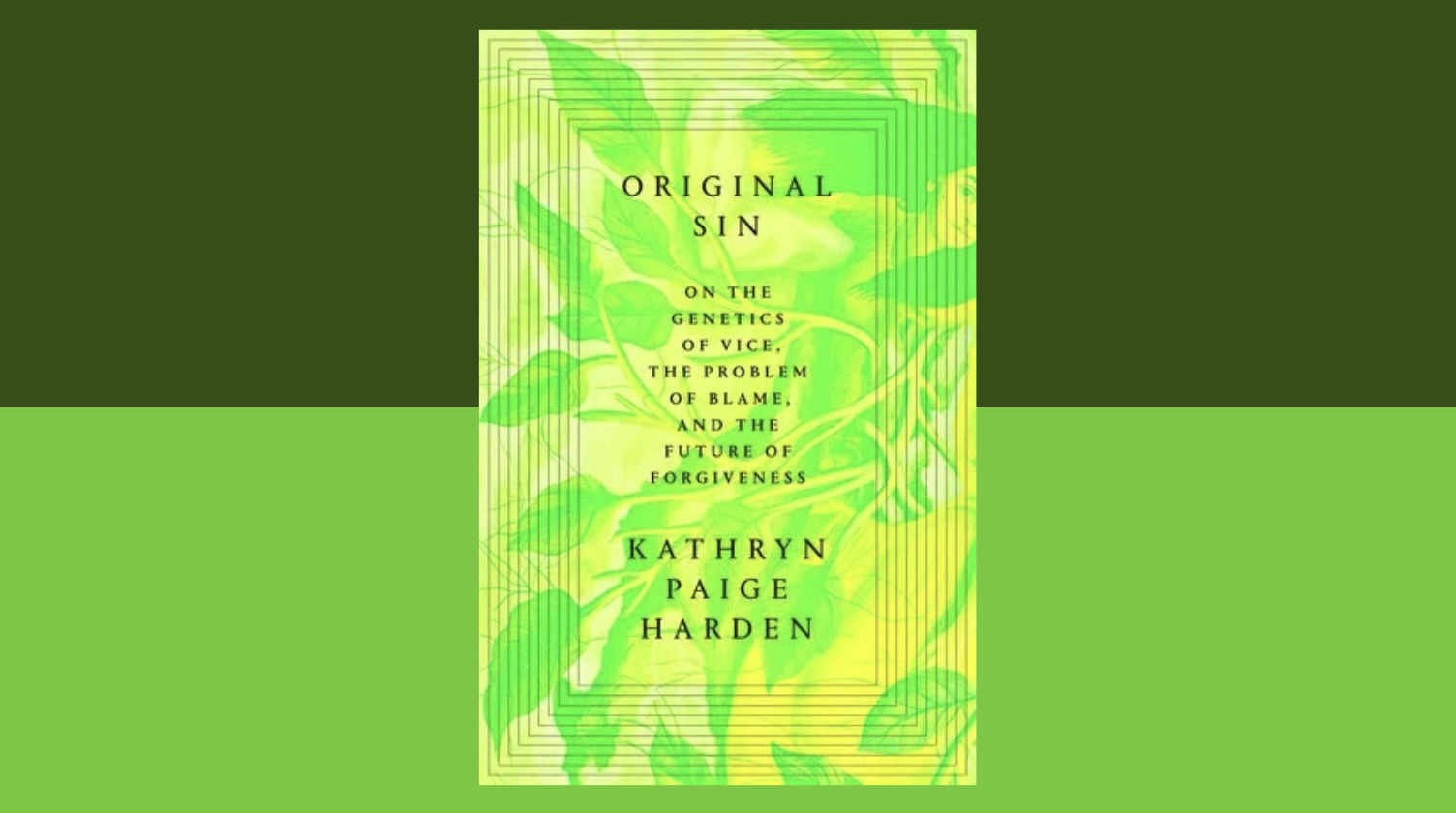
Kathryn Paige Harden. Original Sin: On the Genetics of Vice, the Problem of Blame, and the Future of Forgiveness. Random House, 2026. $30.00. 320 pp.
Somewhere deep inside each of us is a germ. Well, not a germ exactly. It’s more like a piece of code that entwines itself into every cell of our bodies. This piece of code determines how we live in the world. It determines how we make choices, whether we harm others, and whether we feel guilt or remorse when we do. Though it does not specify exactly how we may harm others, it most definitely predicts whether we will.
This code is genetic, not chosen. If you have it, your ability to freely choose to do good is severely limited—maybe rendered impossible. You cannot be called “free” if you have it, because what you choose is already determined by this tendency. Your will, you might say, is bound.
This account is not science fiction or religious. Instead, it is the main question that spurred Kathyrn Paige Harden to write her book Original Sin: On the Genetics of Vice, the Problem of Blame, and the Future of Forgiveness. Harden is a psychologist and behavioral geneticist who studies vice. She also studies twins. She is especially interested in those cases where twins, either one or both members of the sibling set, seem prone to vice.
Harden is comfortable to define vice as simple “badness,” and it ranges in her work from addiction to more serious issues, like murder and violence. Her work has arisen from a gap in the psychological literature surrounding why it is that some people do bad things. Religious reasons for this question have long predominated. The concept of sin was the pat answer to this question for a long time. But Harden is part of a school of behavioral geneticists who noticed patterns in family trees that seemed to connect certain people within families to certain negative behaviors. Upon genetic screening, behavioral geneticists have been able to identify differences both in people’s genomes, as well as chemical differences in their DNA that affect how their genomes work (their epigenomes). “We are interested,” Harden writes, “in how people’s genes connect with their environments to affect their thoughts, feelings, and actions in the world”.
All of this genetic research helps Harden to answer an important theological question: “Does what we inherit physically from our ancestors undermine our agency, and limit our freedom to choose right from wrong, as Augustine argued?” Bad behavior, it turns out, can be genetically influenced.
The questions that Harden has identified are some of the thorniest in Christian theology. When you add a layer of genetics, they get even juicer. If there is a “biological mechanism for badness,” is sin portioned out disproportionately? If some people have more of a predisposition toward vice, doesn’t “original sin” just reinforce inequity? Does confidence in someone’s moral responsibility shift if there is a biological determinant? And doesn’t the disproportionate parceling out of predisposition toward vice demand a lessening of blame toward those afflicted?
To our modern ears it seems that what is lucky cannot be moral and what is moral cannot be luck. But Harden’s thesis cuts against this assumption. Some of us, it seems, are damned even before birth.
Harden is correct that the question of inherited vice is a Christian one. But the doctrine of original sin does not map exactly onto the version of genetically inherited vice that she draws. For one, sin and vice are not identical concepts. Though this might seem pedantic, it matters quite a bit. Vice clearly refers to bad or immoral things that individuals do. Sin has a wider semantic range, referring to a knot in the will that makes a person unable to do the good they might desire. Instead of a simple choice (or predisposition) to do bad, a Christian doctrine of sin speaks about damage to the will. This damage precedes any possible action.
There is a fine distinction I liked to teach my students when I talked about this; to cut it short, what the Christian doctrine of sin affirms is that the brokenness in the will means that humans after the fall are unable not to sin. Christian traditions differ on how exactly the will is healed through the work of grace. But fallen humanity, after the fall, is “bound to sin,” with the double meaning of that phrase intended.
For the Christian, the concept of sin also extends far beyond vice. It includes social systems and false beliefs like prejudice. The Fall even implicates our ability to know the good. Such an expansive view of sin does not affirm total badness, as you hear caricatured from time to time. Rather, it can be a way to affirm the way all of us are implicated in our proclivity towards evil. You can affirm such a view without affirming a mythic Fall, though that is probably a story for another day.
A Christian doctrine of sin affirms that are all in this together, with our knowledge and our wills bound and limited—and yet, together, also offered the possibility of grace. It is a beautiful vision that ought to prevent one sinner from looking down too much on another. The cure is shared, just as is the disease. I find the Christian doctrine of sin very conducive to forging a collective vision of humankind and our debt to each other.
Suffice it to say, Harden doesn’t share this vision. Harden often reflects on the teachings of the “Bible church” that she grew up in—teachings she has now left behind. This church taught her that “virtue” is transcending the animal nature and vice is giving into its demands. But what if the animal nature predicts virtue, and what if its demands cannot be resisted? She asks questions like “Christians teach that you need to modify the soul to avoid the vices of the body—but what if you can instead modify the body? Does this change our view of what sin is?”
She wants to reconstruct our views of sin so that guilt does not apply—because how can someone be guilty of what they did necessarily? She opens her book with a story of taking LSD and reflecting on how drugs themselves seem to impede or force certain actions. It’s clear that she is pressing hard against the tradition she has received.
Though she has stumbled exactly onto the Christian question, unfortunately, Harden hasn’t given enough credit to the Christian answer. We have long needed a book on the moral question of guilt and accountability, as genetics casts new light on human susceptibility to sin. To succeed, however, a book would need a much more nuanced understanding of the Christian doctrine of sin. The good news is that there is room, and a need, for such a book.
The Weekly Digest
Premier Thought Every Thursday.
All of our recent essays and podcasts, delivered to you. Free.
Free. Delivered Thursday mornings.