
Satan hates it when you sing and pray. I doubt that he’s ever gotten over his not being like the Most High, which means he’s jealous whenever God is truly worshiped. You see, it’s difficult for a being that wants the adoration of all not to feel personally attacked when the glory he craves is ascribed to God rather than to him. The church’s worship reminds the devil that he’s still not like God, and it leads to the undoing of his kingdom. First and foremost, our songs are an adoration of the Holy Trinity, but that adoration is an assault on our adversary. If you want to give Satan a bad day, sing and pray—and if it’s Sunday, get to church!
Most people who walk into church are unaware that they’re stepping onto a battlefield. That wasn’t an option for Ukrainian priest Vitalii Kester. When the Ukraine War broke out in 2022, his church’s hallelujahs were accompanied by the noise of nearby artillery blasts. After celebrating the morning liturgy, Fr. Kester (who wore army pants beneath his vestments), would travel east to lead soldiers in worship on the battlefield. In an interview with The Washington Post, Kester said, “There are two wars going on here now. The fight for our land and the fight for the soul.”
The powers of hell are weakened by the worship of heaven, and we participate in this worship each Sunday as we journey up to Zion. This means that until Jesus returns, worship is a wartime activity, and on the line are souls and societies. I’m not talking about the “worship wars” waged in churches over styles of music (contemporary, traditional, etc.). I’m saying that the church’s worship is liturgical warfare against the demons who remain active in our world. Prayer and song are among the weapons of our warfare each Sunday, and they shape not only us but also the world around us. To be sure, heaven is not a place of conflict, but the worship of heaven relates to the conflicts of this present evil age. There is therefore a link not just between the worship of the church and heaven but also between our worship and a world that stands in need of deliverance.
The Practical Impact of Liturgical Warfare
It’s easy to talk about these things theoretically, but how does worship practically shape us for the battle and advance God’s work in the world? Put another way, what’s happening when we sing and pray? To understand why we worship, we need to know what’s actually happening during the heavenly ascent each Sunday. According to Scripture, our singing is didactic, doxological, confrontational, and creative; and our prayers uphold, effect, and mobilize.
Didactic
When I say that singing is didactic, I mean that worship songs should instruct us. We typically think of instruction as the job of the sermon, but you shouldn’t assume you’re being taught only when the pastor steps behind the pulpit. From childhood we use song as a vehicle for instruction (think of the ABCs or days of the week). This is because singing is a great tool for memorizing important facts. The church has always understood the value of songs and hymns for spiritual formation. The great proof of this is the fact that the apostles didn’t hesitate to quote hymns to make a theological point. John 1:1-18, Philippians 2:6-11, and Colossians 1:15-20 have long been understood as ancient hymns, or as having a kind of hymnic underpinning (See Matthew E. Gordley, New Testament Christological Hymns, 19). Hymns like these provided the raw material for the creeds and helped the Christian church maintain orthodoxy (See Paul L. Gavrilyuk, The Suffering of the Impassible God, 67). When we sing, we aren’t just addressing God but “one another in psalms and hymns and spiritual songs, singing and making melody to the Lord with your heart” (Eph 5:19). We sing for the glory of God and the benefit of the body.
One implication of the didactic function of singing is that we should pay close attention to the words in our songs. Musical worship isn’t about connecting with our feelings; it’s about the truth of God’s Word. Singing bad theology is a way of cementing heresy in our hearts. When I first planted the church I pastor, I oversaw writing the weekly bulletin and making sure it got printed in time for the Sunday service. The congregation had to suffer through my typos—some of which were more memorable than others. One Sunday the hymn “O for a Thousand Tongues to Sing” was missing the g on the word sing, so it was printed in the liturgy as “O for a Thousand Tongues to Sin”! Fortunately, the rest of the hymn was unscathed by my scribal error, but not all songs escape the negligence of their authors. Some songs may add concepts that are out of accord with Scripture, and others may say too little.
Doxological
Musical worship is also doxological, ascribing glory to God. This praise in turn has a transformative effect on the worshiper. Idolatry deforms, but right worship reforms and reshapes us into the image of the true God. This was the main point of G. K. Beale’s biblical theology of idolatry, We Become What We Worship. Beale surveyed the Bible’s teaching on worship, demonstrating that “what you revere, you resemble, either for ruin or for restoration” (G. K. Beale, We Become What We Worship, 11).
The key text establishing this is Psalm 115:8, which says of idols, “Those who make them become like them; so do all who trust in them.” In that passage, to become like an idol is to be spiritually mute, blind, deaf, and without feeling. We note again the personal stakes in this worship war. Idolatry—false worship—will make you numb to all spiritual reality. But when you worship God, according to Scripture, your spiritual senses are sharpened, and you become more capable of understanding and receiving divine truth. This clear sight and reception lead to our own “deification.”
As Paul wrote, “And we all, with unveiled face, beholding the glory of the Lord, are being transformed into the same image from one degree of glory to another. For this comes from the Lord who is the Spirit” (2 Cor 3:18). Since worship is meant to be doxological, our services must always have a clear Godward focus. We don’t gather to praise ourselves or our accomplishments. The worship of man will always lead to devastation rather than deification, since creatures cannot save themselves.
Confrontational
Third, singing in church is confrontational. Our music ascribes glory to God while simultaneously renouncing the world’s false promises of hope in self. Liturgist Jean-Jacques von Allmen says,
“Christian worship is the strongest denial that can be hurled in the face of the world’s claim to provide men with an effective justification of their life. There is no more emphatic protest against the pride and despair of the world than that implied in Christian worship.”
Think about how some of the songs you sing at church confront the false narratives and empty promises of the world. We’re tempted to think everything is riding on us, but we’re reminded of the futility of self-confidence in Luther’s hymn “A Mighty Fortress Is Our God” (just be sure to sing the whole thing!): “Did we in our own strength confide, our striving would be losing.” We’re distracted by wealth and the praises of others, but the hymn “Be Thou My Vision” reminds us, “Riches I heed not nor man’s empty praise, thou mine inheritance now and always.” We turn on the news only to see injustice followed by tragedy, and we’re tempted to despair. But we sing in defiance those words of the hymn “This Is My Father’s World”: “O let me ne’er forget, / that though the wrong seems oft so strong, God is the ruler yet. / This is my Father’s world, the battle is not done; / Jesus who died shall be satisfied, and earth and heav’n be one.” You can probably tell, we sing a lot of hymns where I pastor! Whether or not that’s the case in your church, the songs and prayers should confront the lies of this present age with the comforting truths found in God’s Word.
Creative
Finally, the songs of the church are creative. Here I’m not speaking of artistic ingenuity, but creative in the sense of world and culture shaping. Old Testament scholar Walter Brueggemann developed the thesis that Israel’s praise was a “world making” activity. What he meant by this was not that worship creates things ex nihilo like God does, but that our liturgies form our communities and the social worlds in which we live. The liturgy “sets a pattern of power and meaning upon social relations which reflects Yahweh’s sovereignty. A world of justice, mercy, peace, and compassion is created in the imaginative act of the liturgy.” Allmen said that worship shapes the taste not only of the church but also of the world outside the church. He makes the bold claim,
The cult [i.e., church’s worship] is formative of culture because it inspires political and social life. It is the point of reference for order and freedom, for justice and peace. It is so because it celebrates the true hierarchy of things, because it confesses the Lordship of Christ, and because it attests the miraculous grace that this Lordship of Christ does not absorb that which it controls, but is the foundation of its liberty, and regardful of it. Hence the possibility of diverse but coordinated vocations of care for the weak, of the discovery of the true rights of man, of human understanding and reconciliation. . . . Clearly the world does not know that in attacking the cult it is striking at the very thing that preserves and guarantees its life.
Why do we worship? In part, it’s because the heavenly ascent we participate in each week, full of praises and prayers, is a way of engaging in the spiritual battle that’s all around us. Make no mistake about it—worship is warfare. Not the kind of warfare that puts people in captivity, but the kind of warfare that sets them free. Souls and societies are on the line, and God calls each one of us to be armed with love and to join in the fight.
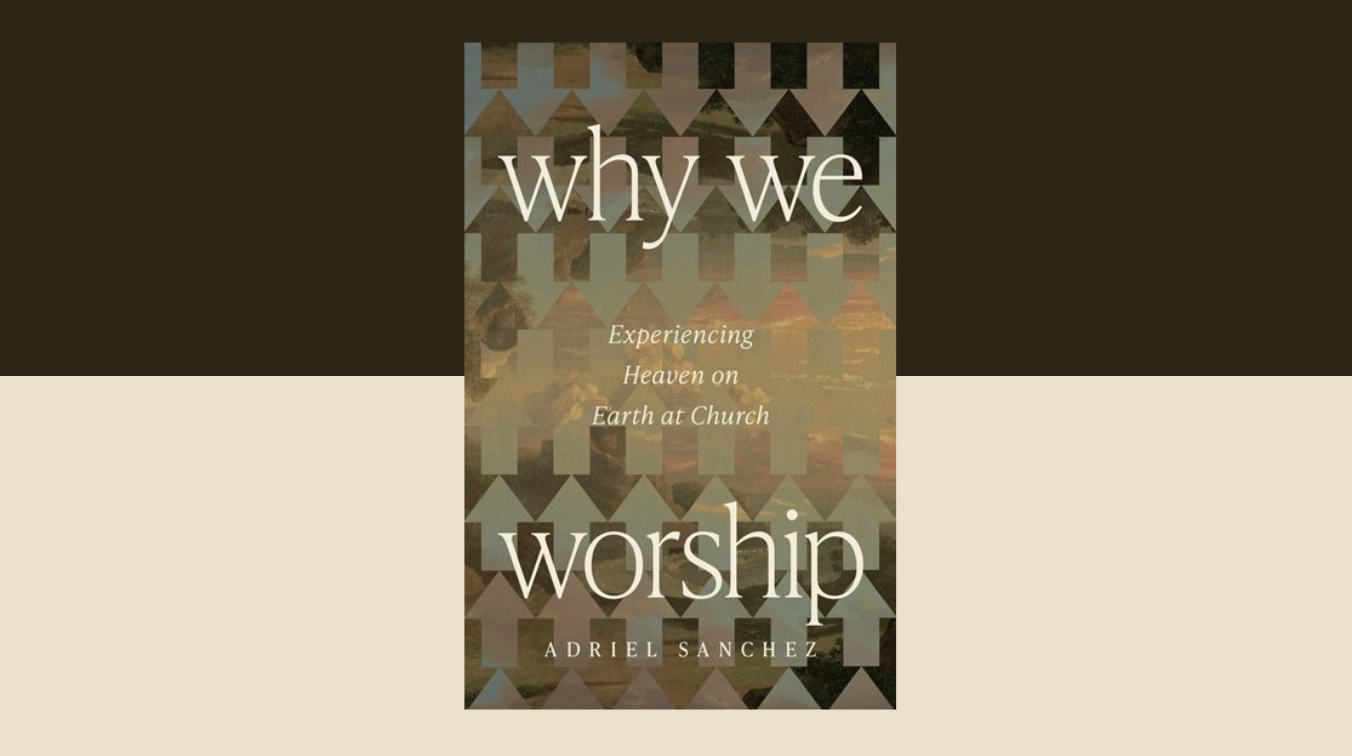
Adapted from Why We Worship by Adriel Sanchez. ©2026 by Adriel Avram Sanchez. Used by permission of InterVarsity Press. www.ivpress.com.
The Weekly Digest
Premier Thought Every Thursday.
All of our recent essays and podcasts, delivered to you. Free.
Free. Delivered Thursday mornings.