
Over the past few years, a number of prominent European women writers and activists who have been advocating for a different paradigm of thinking about women and gender than the one offered by secular modernity, have come to Christ. In each case, approximately the same formula transpired: the writer’s work led her to realize that contemporary norms vis-à-vis sexuality are failing women and are causing significant harm. The writer proposed a better way of treating women, then came to realize that what she was proposing was effectively a return to historic Judaeo-Christian sexual mores and the inextricably connected treasuring of women as women and men as men in a world that insists on treating both as interchangeable. Finally, upon investigating Christianity further, the writer came to identify with the faith and began attending church. In some cases, she then began writing more openly about the key role of Christianity in bringing about the gender revolution she has been advocating for all along.
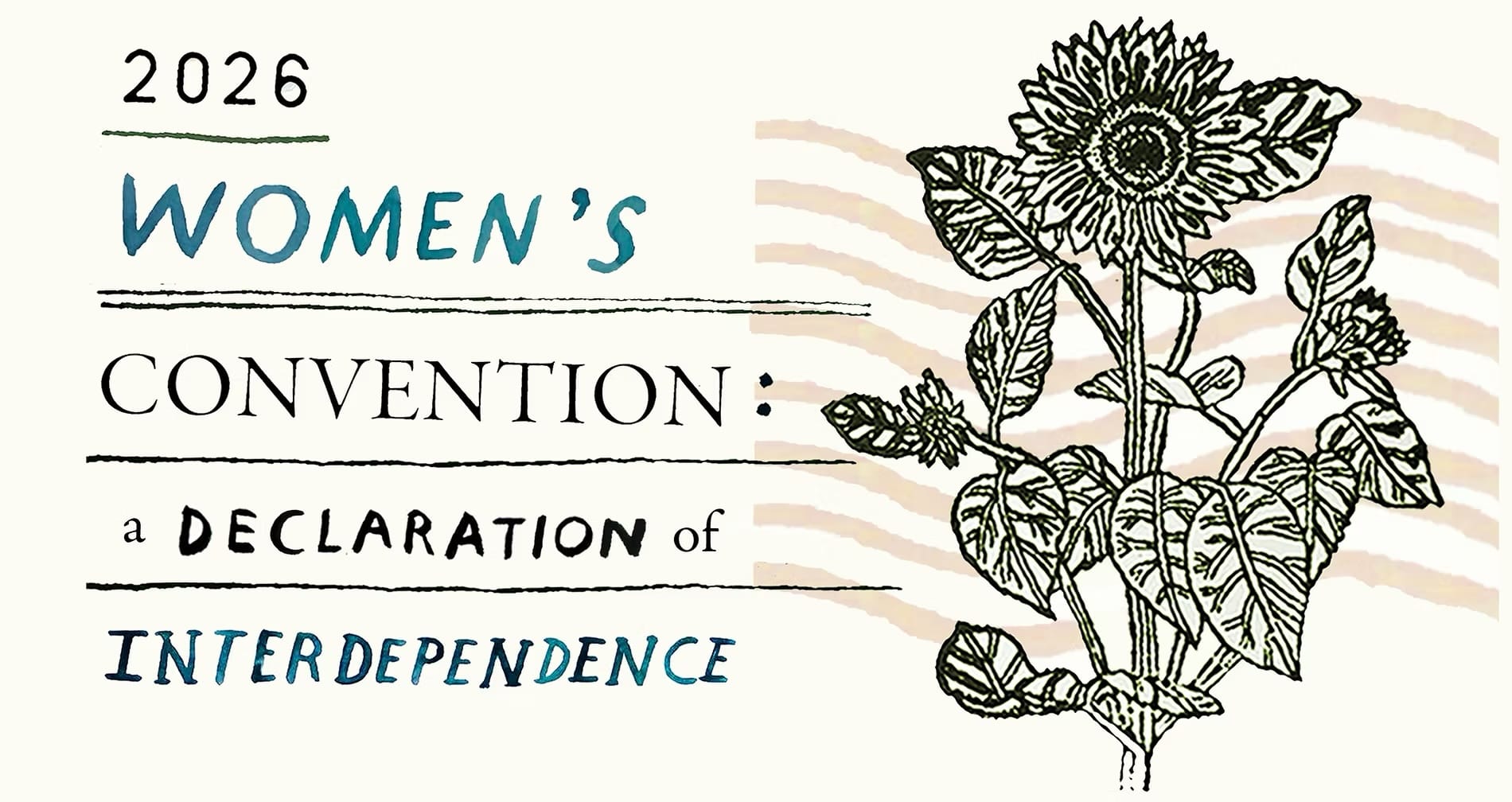
I had reason to think much about these women this past weekend, because I got to hear several of them speak at the Women’s Convention in Rochester, NY. Their ranks include (but are not limited to) Louise Perry, Mary Harrington, Nina Power, and Ayaan Hirsi Ali. Most of these women, furthermore, are part of the publication that set the foundation for this convention—Fairer Disputations.
Founded in early 2023, Fairer Disputations is the brainchild of legal scholar Erika Bachiochi, who also served as the convener of this weekend’s event. For the unfamiliar, FD is a journal and “an international community of scholars, public intellectuals, and journalists that aims to advance a sex-realist feminism.” Over the course of its three and a half years of publication and counting, it has built a remarkably diverse following of readers and writers (disclosure: I am a Featured Writer for the journal and was an invited speaker at the convention). Many readers and writers are Christians, and many are Americans, but the publication has from the outset been deliberately international and ecumenical, bringing together mostly women but also some men who have felt dissatisfied with the current mainstream discourse about women and gender.
I assumed before the convention that it would be, put simply, a conference of Fairer Disputations readers and writers. Imagine my surprise, therefore, when I met several enthusiastic attenders who were unfamiliar with the journal, but came to the convention because they heard about it—perhaps from a friend—and were attracted by the vision it offered.
Yes, as I had expected, the convention welcomed regular FD readers and writers. But it also brought together healthcare professionals from around the country, educators at all levels (from preschool through university), nonprofit workers, one British former politician, numerous journalists, and quite a few stay-at-home or work-from-home moms. Speaking of the latter, I've never seen so many babies at a conference. Some older kids were present as well, including my seven-year-old. I'm used to bringing one or more of my kids to professional events, but this was the first time that bringing my daughter along made me blend in rather than stand out.
In other words, the convention turned out to be something unique that reached beyond the journal’s readership. It showed a real possibility of scaling up intellectually honest and deep conversations about gender in our world, and the hunger for these conversations beyond merely the conservative Christian circles. At the same time, it seems that sometimes these conversations about gender are a true cultural apologetic for the Christian faith—as the examples of Perry, Ali, and others show. It is the realization that all people ever created are God’s image-bearers that makes it possible for us to treasure each woman and each man, several speakers emphasized.
Indeed, perhaps the key takeaway from the event for me was that while we need publications to begin and foster fruitful conversations, ideas can only fully take root and flourish in individual souls and lives through in-person conversations and relationships. To state the obvious, we as a society are very online, and that is the source of many evils—including pornography, which several speakers identified as the chief scourge of gender troubles in our age for both men and women.
This online world also facilitates and encourages our growing loneliness. We are surrounded by more words than ever on our screens, but these can never replace the conversation of friends who gather together with us. We reach for a machine to solve our problems when what we truly need is a person, noted long-time pediatric nurse, bioethicist, and activist Jennifer Lahl on the first morning of the convention.
I found myself thinking of Wendell Berry’s famous essay, “Why I am Not Going to Buy a Computer.” Everyone who has heard of this essay, which Berry originally wrote in 1987, knows the gist of it: Berry famously made a radical promise that he kept to the end of his days, just a couple of weeks ago. Yes, he never did buy a computer. But less frequently discussed, perhaps, is one crucial reason he made for his decision: his relationship with his wife, whom he described as his “best critic” for her work of not only typing up his writing on a 1956 typewriter but also commenting and improving his work with her comments along the way.
Berry described his relationship with his wife, Tanya, as “a literary cottage industry that works well and pleasantly” in this essay. This is the productive system of two persons working together that buying a computer—an intervening machine—would threaten, Berry worried in a clear example of refusing to reach for a machine to replace in-person interactions with a person beloved to him. The computer, in other words, is not the problem—but the removal of the need for conversations with a real person is. The result is invariably an erosion of relationships.
The possibility of technology to act as a wrecking-ball upon relationships of men and women, as well as of humans with each other more generally, has been a concern of the FD project since its inception. In her essay in March 2023, editor Serena Sigillito wrote: “Fairer Disputations is confronting a profoundly mistaken idea of what it means to be human, and we’re fighting for a better one. Our tagline, ‘Sex-Realist Feminism for the 21st Century,’ emphasizes both our embodiment and the technological age in which we live. You can’t be a human being without a body, and every body is either male or female.” Technology offers the illusion of shedding the body or the possibility of changing the body altogether—but these false promises will only destroy and disappoint and isolate. Too many Gen-Z girls especially feel nothing but despair over their bodies, their minds, their lives, NYT bestselling author Freya India reflected in her address. How could they not, given the messaging that bombards them daily on social media?
So what might a better way forward for women (and men) look like? That was the question of the weekend, and answers invariably came back to the need to foster joyful friendships in person, to build communities, and to reach out to the lonely and suffering around. What we need is a party, Helen Roy exhorted in the closing panel of the convention. This answer, of course, is also Christian at its core—our joy is not an abstract idea or feeling but is rooted in the confidence of God’s love for us, a confidence we get from the gospel. And to this love we can point others around, who are struggling with their worth and the worth of their bodies and minds, created male and female.
The Weekly Digest
Premier Thought Every Thursday.
All of our recent essays and podcasts, delivered to you. Free.
Free. Delivered Thursday mornings.