
The New Right is perhaps the most revolutionary force presently at work in American politics. Frustrated by the decadence of liberalism, many young men are turning to ideological combat and authoritarian politics for salvation. They hunger for new modes and orders. Understandable as their impatience is, though, it is no virtue.
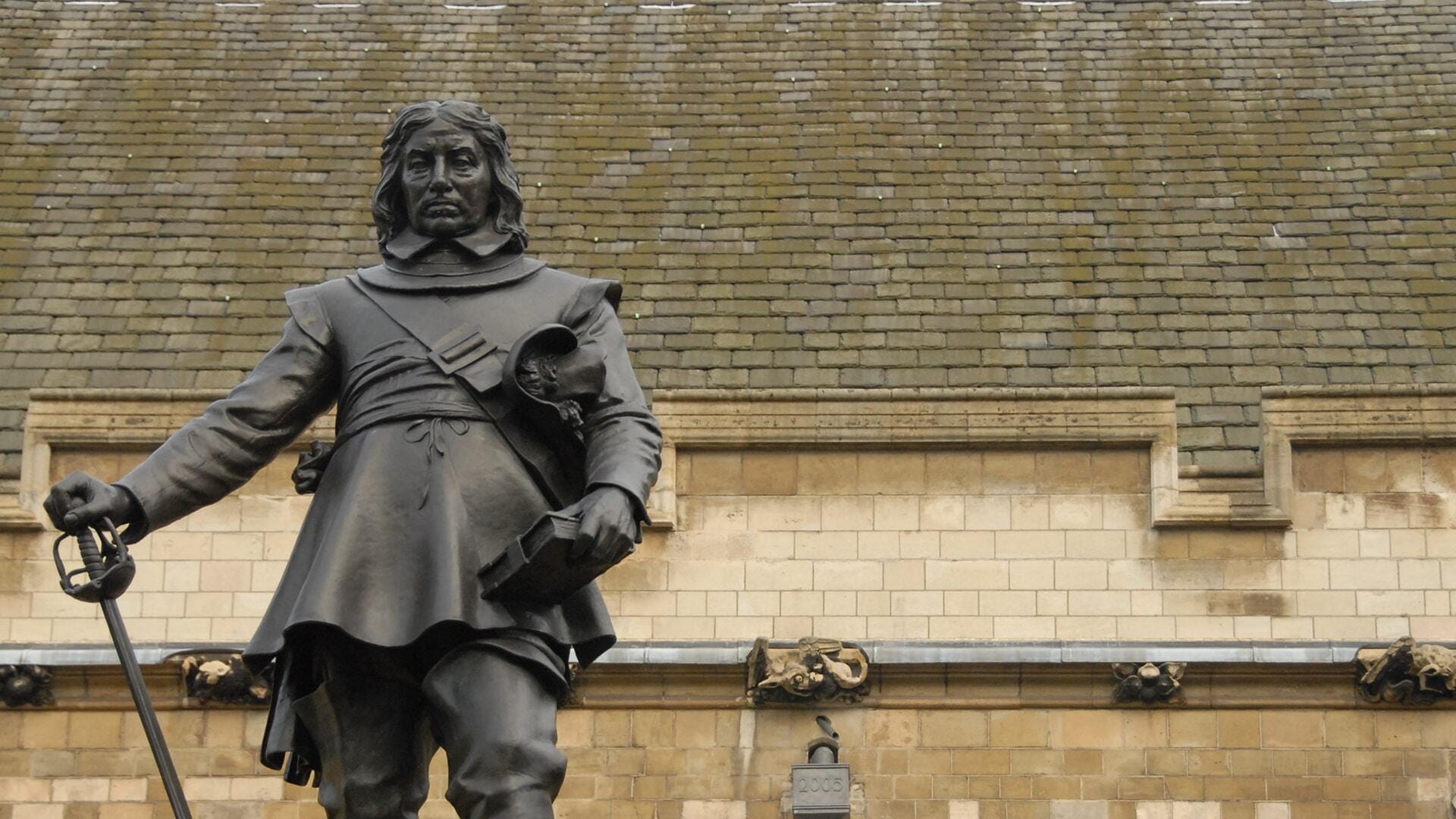
Timon Cline, one of the New Right’s more expressive Protestant advocates, recently published an essay defending this revolutionary fervor and the “spirit of iconoclasm” inspiring it. Contesting the claim that the New Right is a nihilistic force, he insists rather that the New Right “hates empty forms” and seeks a true spiritual substance. “What is ‘vulgarity’ when the whole world is vulgar?” he incisively asks. “What is ‘anarchy’ when the world is disordered?” To Cline, at least, the New Right has less to do with twentieth century fascism and more to do with the seventeenth century republicanism of Oliver Cromwell. His hope is that somehow this revolutionary energy can be channeled into a neo-Puritan republican project, reordering America as a Christian commonwealth fueled by intense belief.
In the end, however, that kind of revolutionary attitude cannot preserve the strength civilization needs in this hour of crisis. Lest we forget, Cromwell’s republican experiment lasted merely eleven years—and many of the Founders of the more enduring American Republic later considered him a paragon of tyranny. Neither the English Commonwealth nor any other revolutionary regime can provide a model for genuine renewal. What is more needful than new modes and orders is an unwavering devotion to the defense of the Permanent Things. A truly conservative disposition, rooted in common loves more than common hates, is the real source of energy the West needs to survive.
Unlike the modern ideologies it seeks to negate, conservatism above all values the moral beauty at the heart of Western civilization. Russell Kirk, the founder of modern American conservatism, borrowed the phrase “Permanent Things” from his friend T. S. Eliot to describe this beauty. “By ‘the Permanent Things,’” he wrote, Eliot “meant those elements in the human condition that give us our nature, without which we are as the beasts that perish. They work upon us all in the sense that both they and we are bound up in that continuity of belief and institution called the great mysterious incorporation of the human race.” The vast civilizational edifice built up over thousands of years—from works of great art and literature to free constitutions and institutions of liberal education—refracts and reflects the spiritual truths of biblical religion and Western philosophy that are so overpoweringly beautiful. Conservatives’ duty, then, is to redeem the times by cultivating and reviving that civilizational edifice, thereby preserving the moral and spiritual substance of the Permanent Things.
It is no doubt that the American conservative movement has fallen short of that high task. We must renew our efforts. But it is also the case that the New Right provides no serious alternative to conservatism. Its adherent’s failures are already apparent, at least so far as practical politics goes—it is difficult to identify anything they have conserved during their ten years, least of all the beautiful or the true. Donald Trump’s coalition may have won back the presidency, but his administration’s populism is already falling short of so many of his most earnest Christian supporter’s desires.
Just last week, the President signed an executive order further legalizing marijuana. His financial regulators have recently sided with the so-called “adult entertainment industry” against banks who would rather not do business with pornographers who exploit and abuse women. Trump’s appointees at the FDA have pushed to make it easier to access abortion pills, much to the consternation of pro-life groups. And whatever progress this administration has made securing the southern border has been utterly cheapened by Trump’s crackpot scheme to sell American citizenship to the highest bidder. Administration social media accounts may intone the slogans of Christian nationalists, but its actual policies have only further established the kind of permissive liberalism they claim to loathe.
If the New Right, or more specifically Christian nationalism, is so important to Trump’s coalition, why has it failed to lead us up into the land of virtue? In the past, Cline has looked to the cunning of Niccoló Machiavelli, and perhaps the insights of the Florentine may help explain.
In The Prince, Machiavelli described the unhappy case of Girolamo Savonarola, a Dominican friar who opposed the depravity of Renaissance Florence. Many consider him a proto-Reformer, and he initiated the infamous Bonfire of the Vanities in which many artistic masterpieces were burned and lost to civilization forever. Savonarola’s iconoclastic spirit would be imitated by the radicals of history, from Cline’s Cromwell to the French Jacobins.
But Machiavelli clearly did not believe Savonarola’s sectarian religious mania made Florence great again. Indeed, he wrote, Savonarola “was ruined in his new orders as soon as the multitude began not to believe in them.” His mysticism—or perhaps gnosticism—may have initially appealed to “those dissatisfied with prevailing outward forms,” but he had no way to force unbelievers to believe in his prophetic politics. Eventually, as is the case with so many revolutionaries, Savonarola’s movement collapsed in on itself and the friar was burned at the stake. His republic proved nothing but a failure for the Florentine people; it preserved neither their virtue nor their liberty.
The lesson for the New Right ought to be clear: iconoclasm is not enough. Some may want to harness the iconoclasts’ energy to bring about a new golden age, but they lack the overwhelming force to effectively channel it toward the Christian ends they have in mind. Cline himself seems to acknowledge this, arguing that the great crisis of our time is not material but spiritual, “the reduction of nationhood to forms lacking all substance.”
The problem, though, is that he proposes what is essentially a material solution to this spiritual problem: “Ultimately, iconoclasts want—need—is (sic) literally men of substance. They want strong men to lead them back to strong gods, gods that speak.” In other words, he hopes that a prince’s exercise of political power can reorient modernity’s discontents to a higher truth. If Savonarola failed to save Florence as an unarmed prophet, perhaps the prince Cline has in mind could become an armed prophet and save America.
The issue, of course, is that this agonistic vision of politics has little to do with the real substance of our national tradition. Our Founders read Machiavelli and learned much from him—but none more than the most Puritan among their number, John Adams. In a pivotal article, C. Bradley Thompson has argued that Adams credited the Florentine for restoring a consciousness of republicanism to the West, but that he went on to reject his constitutional vision. Much as the Massachusetts statesman admired Machiavelli’s realism about human nature, he also believed that a good constitution was a genuine safeguard for both virtue and liberty.
What, to Adams, was a good constitution? In his 1776 monumental essay, “Thoughts on Government,” he sought to define it in contradistinction with Thomas Paine’s radical, iconoclastic vision in Common Sense. Against those philosophes who sought to concentrate power in a political center, he defended constitutional institutions that put limits on power (such as bicameralism). But rather than considering these as modes and orders altogether new, Adams contended that the American Revolution was waged for a vision of free government that stretched back to time immemorial. The iconoclasts would not only throw out the decadence of the British Empire; their rage would undermine the very republican spirit that alone could secure genuine independence.
In this, and much else, Adams’s wisdom resembled that of his contemporary Edmund Burke. The Irishman was not the kind of prince for whom Cline or the iconoclasts long. But he is nonetheless the prophet we most need. His friend Samuel Johnson once remarked, “You could not stand five minutes with that man beneath a shed while it rained, but you must be convinced you had been standing with the greatest man you had ever yet seen.” That greatness, in no small measure, came from Burke’s intense perception of the spiritual realities undergirding society—the very thing the French Revolution imperiled in his time, and that the iconoclasm of the Left and Right imperils today.
Indeed, among Burke’s most prophetic insights was that concentrated power always destroys the very things society is constituted to protect. Earlier than any other critic, he saw that the democratic extremism of the Jacobins would transfigure into the military despotism Napoleon Bonaparte came to embody; he had no illusions about the iconoclasts’ search for order. The lust for power is profoundly anti-social no matter what slogans it deploys as justifications, Burke understood, because it was in fact irreligious.
At the back of every word Burke said or wrote is a great faith in the living God over and against human power. To that end, Burke argued in his Reflections on the Revolution in France that “All persons possessing any portion of power ought to be strongly and awfully impressed with an idea that they act in trust; and that they are to account for their conduct in that trust to the one great Master, Author and Founder of society.” Those who would overthrow society to seize power for themselves would undo the very thing that gives the state its divine sanction. The true task of the conservative statesman is to fight for the eternal truths around which civilization is built.
Beyond his unrelenting opposition to the French Revolution, this political theology also inspired Burke’s other great crusades against oppression. It is why he was so dogged in his prosecution of imperial abuses in India, for example. Burke’s distinctly Anglican and Protestant faith also galvanized his ardent support for Catholic emancipation. “I shall not think that the deprivation of some millions of people of all the rights of citizens, and all interest in the constitution, in and to which they were born, was conformable to the declared principles” of the British political tradition, he wrote to a fellow member of Parliament in 1792. Far from saving souls, Burke understood that sectarian domination, even by his fellow churchmen, corrupts politics and fuels factional resentment by excluding minorities from public deliberations and marring private conscience.
To be sure, though, Burke was no defender of the so-called “neutral public square.” In the Reflections and elsewhere he passionately defended the Anglican church establishment, even asserting it to be the cornerstone of Britain’s free constitution and a “profound and extensive wisdom.” In Burke’s view, establishment consecrates the state by ordering it to the “sublime principles” taught in revelation and enjoined by reason. He even held that, as he put it in one parliamentary speech, that Church and State are merely “different integral parts of the same whole” constituting a Christian commonwealth. As such, establishment was a bulwark and “barrier against fanaticism, infidelity, and atheism.” But not all who dissent are guilty of such sins; Burke was just as concerned with the religious bigotry behind the anti-Catholic Gordon Riots. All forms of religious factionalism or sectarianism were repugnant to Burke precisely because such iconoclasm undermines the eternal contract of society he loved.
Burkean toleration, then, is something more than liberalism. It is not indifferent to the truth, but rather embraces freedom as a duty arising from it. As the Spanish philosopher Jose Ortega y Gasset argued in his 1930 book The Revolt of the Masses, toleration of this sort is “the noblest cry that has ever resounded in this planet” because it is an expression of the Golden Rule taught to us by Our Lord. Religious liberty—and the Western tradition of freedom more broadly—demands citizens practice immense virtue. Much the same could be said of the American Founders’ contemporaneous commitment to free exercise; rather than lowering the stakes of political life, the First Amendment’s protections actually raise up our public discourse to the high goal of pursuing truth together and loving our neighbors.
For all his prophetic thunder, Burke believed himself to be a failure in his own life. He even requested to be buried in an unmarked grave, fearing that Jacobin invaders would desecrate his body. And yet, Burke’s soaring rhetoric inspired an entire generation of Britons to resist the seeming inevitability of Revolution. As Russell Kirk put it in The Conservative Mind, “He elevated political ‘expedience’ from its usual Machiavellian plane to the dignity of a virtue, Prudence.” A stunning passage from a 1795 letter Burke wrote to one of his political mentees illustrates exactly how this conservative disposition can be rallied against the gathering storm:
Novelty is not the only source of zeal. Why should not a Maccabeus and his brethren arise to assert the honour of the ancient law, and to defend the temple of their forefathers, with as ardent a spirit, as can inspire any innovator to destroy the monuments of the piety and the glory of antient ages? It is not a hazarded assertion, it is a great truth, that when once things are gone out of their ordinary course, it is by acts out of the ordinary course they can alone be re-established. Republican [eg revolutionary] spirit can only be combated by a spirit of the same nature: of the same nature, but informed with another principle and pointing to another end.
Burke would go on to describe this conservatism as the “true republican spirit”—a genuine devotion to the common good—contrasting with the false republicanism of the revolutionary forces. It is not iconoclasm, then, that could rescue England from the maw of revolution but conservatism. Burke’s doctrines captured Britain’s imagination and inspired her long struggle against both the Jacobin Republic and Bonapartist Empire. The Southern Agrarian scholar M.E. Bradford once wrote that the final victory at Waterloo “is proof to the proposition that men or nations of men can make their own fate—proof that it is possible to ‘turn the clock back’ or to ‘reverse a trend.’” That victory was only possible through Burke’s conservative spiritualism.
In other words, Burke was a successful prophet not because he sought to impose new modes and orders on a people, but rather because he sought out the innermost truths of the political forms he inherited. He rejected both the religious mania of Savonarola and the power politics of Machiavelli in favor of a truer republican spirit, one more firmly rooted in a genuine civilizational inheritance and the Christian faith that inspired it. Rather than trusting to the might of his own hand—or the might of strongmen he supposed were on his side—he trusted in the strength of the Lord. Insofar as the New Right sneers at the old pieties, at the very ideas and history that make Americans a people, they will never accomplish what Burke and his followers did. Iconoclasm is not an ideology for strong men or prudent men. In its zealotry, it can only ever set itself in opposition to the Permanent Things.
The Weekly Digest
Premier Thought Every Thursday.
All of our recent essays and podcasts, delivered to you. Free.
Free. Delivered Thursday mornings.