

Since their 2024 presidential election loss, Democrats have understandably engaged in considerable soul-searching. In their self-examination, they would do well to look both abroad and to their past. Democrats might profit from studying the ‘Blue Labour’ movement within the British Labour party, especially how it has diagnosed the latter party’s failures. It first emerged in 2009 as an alternative to the more centrist, globalist and business friendly mainstream New Labour. Never a large group, its supporters today number only a handful of Labour MPs in Parliament.
Blue Labour’s founder, Maurice Glasman, calls for his party to return to defending the economic interests of the working class and rejecting the neoliberal policies that have disproportionately benefited the wealthy. At the same time, Blue Labour advocates conservative positions on social and cultural issues, eschews centralized, top-down bureaucratic governance and celebrates localism. At its heart, it seeks to address the needs and concerns of the British working class by once again drawing upon the labor movement’s religious roots and cultural conservatism.
Glasman stresses that, historically, the labor movement’s “leadership and membership took the form of a broad-based Christian Movement, a distinctive blend of Catholic, Methodist and dissenting with a dose of High-Church Anglicanism. The Christian concepts of love, brotherhood, the dignity of labour, of community and solidarity, and even the Kingdom of God that sometimes peeked through, formed [its] fundamental language.” By the late twentieth century, however, the Labour party sadly became “compromised, lacking in vitality and severed from the roots of its renewal.” Glasman puts it poignantly: “The uncritical embrace of globalisation, the domination of finance capital combined with a pitiless progressive modernism left no place for workers in the movement they had created. It was a case study in alienation and dispossession.” Glasman argues that the “Christian inheritance of labour is a treasure of renewal…. a constitutive aspect of its inheritance but [one that] is rendered inaccessible if [instead] a revolutionary secularism prevails.”
Although the history of the Democratic party is obviously very different from that of its British cousin, it would benefit from recovering its first principles, including its religious heritage. Rather than cultivating a secularized, deracinated and cosmopolitan Left, Democrats should embrace and commend the religiosity and localism that have long characterized blue collar culture. Their failure to do so since the 1970s helps explain their declining portion of the blue-collar vote.
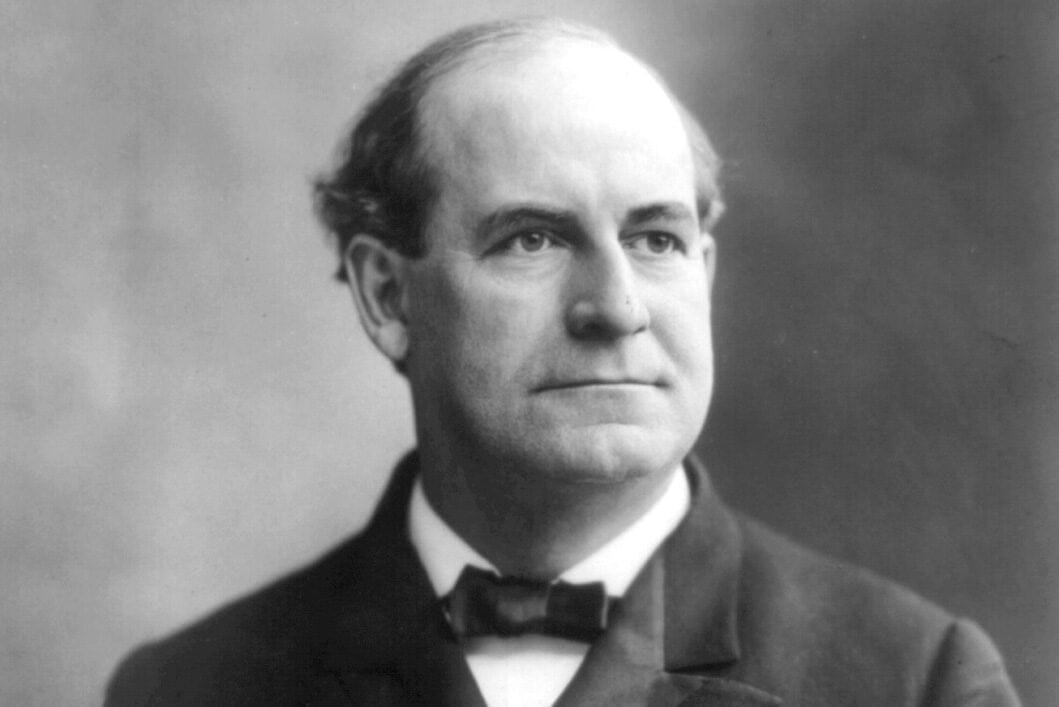
Two very different historical figures, a Protestant and a Catholic, illustrate how Democrats can build upon their religious heritage. The three-time presidential nominee, William Jennings Bryan (1860-1925), and New Deal supporter, Monsignor John A. Ryan (1869-1945) provide an illuminating insight into the Democratic party’s once successful appeal among blue-collar voters. Both sprang from rural Populist roots in the Great Plains, both understood the Democrats as the party of the common man, and both allowed their Christian faith to profoundly shape their politics.
While not a member of the People’s Party, Nebraska Congressman William Jennings Bryan became a tribune for the interests of rural labor when America was undergoing rapid industrialization and corporate consolidation. Catapulted suddenly to fame by his powerful oratory at the contentious 1896 Democratic nominating convention, Bryan never managed to win the White House but he enjoyed a wide and devoted following among the white rural working class.
Bryan argued that America’s dramatic economic growth after 1865 had chiefly benefited the Robber Barons whose giant corporations dominated the Gilded Age economy. In response, he called for the state to “counter the overweening power of banks and industrial corporations” and heavily tax the wealthy. He held that the Democrats should (in the words of biographer Michael Kazin) consistently “side with the common man and woman in their perpetual battle with the defenders of privilege, corruption, and big money.”
Like earlier nineteenth-century evangelicals who had championed the anti-slavery cause and temperance, Bryan understood that his faith had both a personal and a social dimension. Bryan came of age when the divisions over social reform among American Protestants were not as clear cut as they later became. Though Bryan never embraced the theological liberalism of Social Gospel leaders such as Washington Gladden and Walter Rauschenbusch, his thinking was clearly influenced by their approach. And he was happy to appear on the same platform with prominent Social Gospel clerics and academics at the Chautauqua Institute and similar venues. “Christ is not only a guide and friend in all the work a man undertakes,” Bryan declared to a 1912 church meeting, “but his name can be invoked for the correction of abuse and eradication of every evil, in private and public life.” Bryan often spoke of his politics as simply “applied Christianity,” a phrase he may have borrowed from Gladden’s 1886 book by that title.
Bryan refused to grant millionaires a pass simply because of their church attendance. Referring to the Baptist head of Standard Oil, Bryan declared that “it is not necessary that all Christian people shall sanction the Rockefeller method of making money merely because Rockefeller prays.” Never a deep thinker, Bryan usually side-stepped complex theological questions that divided evangelicals. Instead, his approach was thoroughly pragmatic. As he explained: “If it be true, as I believe it is, that morality is dependent upon religion, then religion is not only the most practical thing in the world, but the first essential.”
After winning the presidency in 1912, Woodrow Wilson appointed Bryan Secretary of State. Bryan’s opposition to U.S. entry into the European war strained his relationship with Wilson and he resigned from the administration in 1915. Thereafter, Bryan focused more narrowly on religious matters, especially opposing the teaching of biological evolution in public schools. Contrary to the common caricature of Bryan, his opposition to Darwinism often focused on the dangers of social Darwinism’s scientific-sounding argument used to support cutthroat competition and laissez-faire economics. Bryan feared, in Kazin’s words, “a society run by Darwinists [that] could justify a law barring the feebleminded and poor from having babies and could engage in endless wars of conquest.” In 1925, his naive defense of a literal six-day creationism at the infamous Scopes ‘Monkey trial’ made him the object of widespread ridicule.
In his three presidential runs, Bryan drew little support beyond rural America and failed to appeal to ethnic working-class voters in northern urban areas. His very public evangelical Protestant convictions appear to have alienated Catholic, Eastern Orthodox and Jewish voters in the cities. But economic collapse, in the form of the Great Depression, helped unite working class voters at the ballot box across ethnic, sectional and denominational lines in support of FDR’s Democrats. Like the early British Labour party, the Democratic party managed to unite Protestants and Catholics.
Though never a candidate for elective public office, Monsignor John A. Ryan was one of the New Deal’s most prominent and articulate Catholic supporters. Unlike Bryan, Ryan was a genuine intellectual who developed a philosophical and theological case for an activist government committed to defending the interests of the poor and dispossessed. But like Bryan, Ryan was a son of the Prairies, born on a Minnesota farm that his parents had homesteaded. Personally acquainted with the grievances that fueled the agrarian revolt of the late 1800s, Ryan first encountered Populist economic thought as a precocious teen when he read and was inspired by Henry George’s Progress and Poverty (1879). Alarmed by rising inequality and widespread poverty in America, George proposed eliminating all taxes except for a ‘Single Tax’ on the value of land. Such a tax, George argued, would target land speculators and encourage owners to make productive use of their property. As a mature thinker, Ryan retained this commitment to the sort of humane, small-scale proprietary capitalism that George maintained would ensure an egalitarian social order.
Later, as a Catholic priest and theologian, Ryan’s thinking obviously drew from Catholic sources foreign to the evangelical Bryan. Chief among these were a natural rights philosophy grounded in the historic Catholic conception of natural law and the teaching of papal social encyclicals, chiefly Rerum Novarum (1891) and Quadragesimo Anno (1931). Ryan held that all human beings created in the image of God possessed a fundamental dignity. Moreover, as divine image-bearers, they all possessed basic rights that the state was obliged to protect. Like Bryan, Ryan’s faith was not limited to a blinkered personal pietism. Ryan insisted that Catholics were called to engage in faith-driven social reform. They should work to promote the common good, a concept central to Catholic social teaching, stretching back to medieval theologians.
Throughout his early writings, Ryan offered constructive criticism of the economic order from a distinctively Catholic perspective. In his doctoral dissertation, later published as A Living Wage: Its Ethical and Economic Aspects (1906), he made a persuasive case for minimum wage legislation. His Distributive Justice (1916) focused on the maldistribution of wealth in the United States and censured unregulated capitalism. Ryan was the chief author of the Bishops' Program of Social Reconstruction (1919) that put forth several reform proposals including social security, unemployment insurance, and a federal minimum wage, some of which would later be adopted in Roosevelt’s New Deal program.
Predictably, Ryan became an early and outspoken supporter of the New Deal, including serving on the Industrial Appeals Board of the National Recovery Administration (NRA). In a controversial move for a Catholic cleric, Ryan openly endorsed Roosevelt for reelection in 1936, admonishing Catholics not to be led astray by the demagogic radio priest and FDR critic, Charles Coughlin. Ryan defended his provocative radio address in support of Roosevelt as “a discussion of certain political events in the light of moral law” rather than as an expression of partisanship.
The Wagner Act (1935) and other New Deal measures promoted the unionization of the American labor force that Ryan had long urged. This helped union membership in the nation triple between 1930 and 1940. The percentage of unionized workers in the economy rose from just under 13% in 1934 to over 34% in less than a decade. Strengthening the voice of trade unions and boosting their membership rolls deepened a sense of class solidarity. It furthered what Glasman refers to as “the elevation of covenantal institutions,” essential for durable and secure societies.
Moreover, Ryan always adhered closely to Catholic ethical teaching, including discouraging contraceptive use and supporting other measures to promote stable family life. As historians have noted (not always with approval), many of the New Deal’s social policies reflected traditional conservative ideas about gender roles and the family. The so-called New Deal ‘Maternalists’ (including Secretary of Labor Frances Perkins, Katharine Lenroot, and Mary Anderson, to name a few) endeavored to make the male ‘family wage’ the cornerstone of New Deal policy. The original Social Security Act (1935) and subsequent related legislation assumed and served to promote a conventional arrangement of husbands serving as the chief breadwinner, and women staying at home with young children, if possible. Such legislation was implicitly designed to discourage divorce and having children out of wedlock. In short, many New Deal policies envisioned a welfare state that protected conservative social ideals.
Both Bryan and Ryan understood that state intervention could protect the economic interests of working-class Americans while it nourished the kind of social conservatism blue-collar folks valued. This combination has been a central feature of authentic populism, which contrasts sharply with the fraudulent populisms in circulation today. Globalization and neoliberal policies have produced a market society that, as Glasman observes, gradually “disintegrates as its only bonds are self-interest and contract.” He terms this “the liquidation of solidarity” – something leading Democrats have promoted, though not always intentionally, for decades. By building on these and other historical examples, Democrats can engage in a revitalizing ressourcement to help them reconnect with working-class Americans.
The Weekly Digest
Premier Thought Every Thursday.
All of our recent essays and podcasts, delivered to you. Free.
Free. Delivered Thursday mornings.

